

A managed relocation is a company-paid, professionally coordinated move organized by an employer or a contracted relocation management company (RMC) on the employee's behalf. The employer controls the vendors, the timeline, and the budget. The employee shows up, gets packed out, and settles in. An increasing number of companies reported more employee moves heading into 2026, indicating this is not a niche benefit. Atlantic Star Relocations handles exactly this kind of move, acting as a single point of accountability from planning through final delivery across Westchester, NYC, New Jersey, Connecticut, and Florida.
Table of Contents
- What services does a managed relocation typically include?
- How does the managed relocation process work, step by step?
- Who pays, and how does billing work?
- Benefits and potential drawbacks of managed relocation
- Managed relocation vs. self-managed moves: which fits your situation?
- How to choose a relocation management company
- What does a managed relocation cost?
- How Atlantic Star Relocations handles managed relocations
- Key Takeaways
- What operators actually prioritize on managed moves
- Atlantic Star Relocations: get a quote for your managed move
- Useful sources and further reading
- FAQ
What services does a managed relocation typically include?
A managed relocation covers far more than a truck and a crew. Core services include household goods packing and transport, short- and long-term storage, origin and destination services, temporary housing, and home-sale or home-buy assistance with realtor coordination. For international moves, the scope expands to include visa and immigration documentation, customs clearance, school search, and spouse job-search support. Relocation services also commonly cover family support functions that employees rarely think to ask about until they need them.
Optional add-ons include vehicle transport, pet relocation, and home-marketing support. These are not always bundled into a base program, so confirm scope in writing before signing.
Pro Tip: Always require vendor-neutral coordination and written service-level agreements (SLAs) before committing to any RMC. A provider that insists on using only its own affiliated carriers cannot give you objective cost comparisons.
How does the managed relocation process work, step by step?
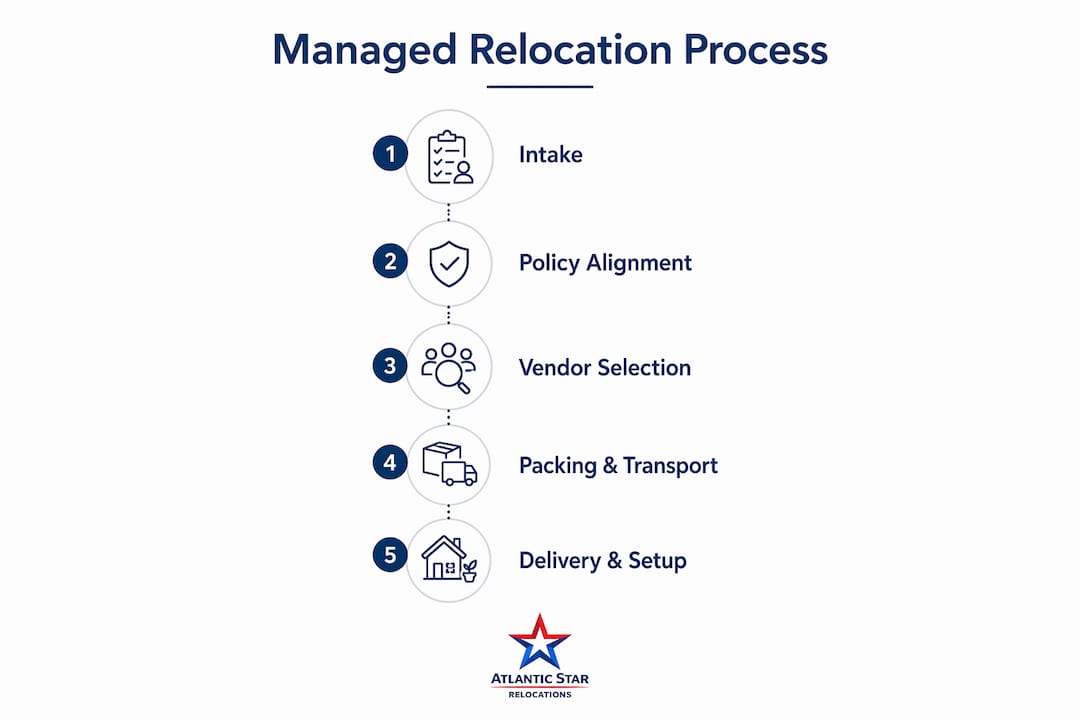
The core phases are intake and policy alignment, vendor selection and scheduling, packing and move execution, and delivery with settlement support. Here is how that plays out in practice:
- Intake and policy review — HR or the RMC confirms the employee's eligibility, benefit tier, and move scope. Documents needed: offer letter, current lease or home-ownership status, family size.
- Vendor selection and scheduling — The RMC sources and vets carriers, storage facilities, and destination service providers. The employee gets one contact, not five.
- Packing and origin services — Crews pack, inventory, and load. Specialty items (art, wine, electronics) are flagged and handled separately.
- Transit and tracking — Shipment moves under a single bill of lading. Tracking complex moves in real time is now standard practice for quality RMCs.
- Delivery and settlement — Crew delivers, unpacks on request, and the RMC closes out the file with a final cost reconciliation.
| Phase | Typical Duration | Responsible Party |
|---|---|---|
| Intake and policy alignment | 1–3 days | HR / RMC |
| Vendor selection and scheduling | 3 days | RMC |
| Packing and origin services | 1–2 days | Moving crew |
| Transit (domestic long-distance) | 3–10 days | Carrier |
| Transit (international) | 3 weeks | Carrier / customs |
| Delivery and settlement | 1–2 days | Moving crew / RMC |
Who pays, and how does billing work?
The direct-bill model is the defining feature of a managed relocation: the employer or RMC pays vendors directly, and the employee never touches an invoice. Two alternatives exist. A lump-sum allowance gives the employee a fixed cash amount to spend however they choose, which maximizes autonomy but shifts all coordination risk to the employee. A reimbursement model has the employee pay upfront and submit receipts, which creates cash-flow pressure and administrative friction on both sides.
RMCs typically secure volume discounts with major carriers and service providers, which can offset their management fees. Many employers now blend approaches: direct-bill for core services (packing, transport, storage) and a small allowance for incidentals. Industry surveys show a clear shift toward these hybrid policies.
One thing to flag with your tax advisor: employer-paid moving benefits are generally treated as taxable compensation under current IRS rules (with a narrow exception for active-duty military). Gross-up provisions can offset that tax hit for the employee, but they add cost to the employer's budget.
Benefits and potential drawbacks of managed relocation
For employers:
- Centralized cost control with a single invoice and audit trail
- Vendor-negotiated pricing that often beats ad-hoc rates
- Single-point accountability when something goes wrong
- Data reporting that feeds future mobility program decisions
For employees:
- Dramatically reduced administrative burden, especially on complex or international moves
- Better vendor quality and service consistency than a self-arranged move
- Bundled services (orientation, school search, temporary housing) that a lump-sum rarely covers adequately
Drawbacks to plan for:
- RMC management fees add a line item to the budget
- Some employees prefer choosing their own vendors and feel constrained by a managed program
- HR and finance take on audit and oversight responsibilities that do not exist with a simple allowance
The operational value of carrier-neutral coordination and a single point of accountability is real, but it requires a provider that actually enforces those standards rather than just claiming them.
Managed relocation vs. self-managed moves: which fits your situation?
Choose direct-bill managed relocation for complex, long-distance, or international moves and when the employer needs cost control and consistent service quality. Choose a lump-sum allowance for simple, local moves or when employee autonomy is the priority.

A few use-case examples make this concrete. An executive on an international assignment needs visa support, destination orientation, and household goods coordination across customs. A managed program is the only practical option. A junior domestic hire moving within the same metro area might do fine with a flat-rate allowance and a referral to a vetted local mover. A departmental office move in Westchester or Manhattan requires corporate relocation coordination that a self-managed approach cannot realistically handle at scale.
Military PCS (permanent change of station) moves are a related but distinct process, administered by Transportation Management Offices (TMOs) under Defense Department rules. They follow a separate entitlement and vendor framework and are not interchangeable with corporate-managed relocations.
How to choose a relocation management company
Prioritize RMCs with transparent billing, carrier-neutral coordination, documented SLAs, insurance and valuation options, and local operational presence in your core markets. For companies moving employees into or out of Westchester, NYC, New Jersey, Connecticut, or Florida, local crew capacity matters as much as national network size.
| Evaluation Criterion | What to Look For | Red Flag |
|---|---|---|
| Billing transparency | Itemized invoices, no hidden fees | Bundled "all-in" quotes with no breakdown |
| Carrier neutrality | Open vendor network, documented selection process | Exclusive use of affiliated carriers |
| SLA documentation | Written response times, escalation paths | Verbal-only commitments |
| Insurance and valuation | Full-value protection options, clear claims process | Released-value-only coverage as default |
| Local coverage | Crews and storage in your target markets | Subcontracted-only local presence |
| Technology and reporting | Real-time tracking, cost reporting dashboard | No tracking capability |
Questions to ask in an RFP: How do you select and vet carriers? What is your average claims resolution time? Can you provide a sample SLA and a mock cost scenario for our typical move profile?
Pro Tip: Request a mock move scenario costing before you sign. A provider that cannot price a hypothetical move accurately is unlikely to manage a real one cleanly. Compare the landed cost, not just the management fee.
Logistics oversight practices for multi-site moves follow the same evaluation logic, scaled up.
What does a managed relocation cost?
Cost varies by distance, shipment size, services included, timing, and whether international customs or immigration work is required. The main drivers:
- Move distance — local, long-distance domestic, and international each carry different base rates
- Shipment weight and volume — a studio apartment and a five-bedroom house are priced very differently
- Add-on services — vehicle transport, climate-controlled storage, and pet relocation each add to the total
- Storage duration — short-term bridge storage costs less than multi-month warehouse holds
- Seasonal timing — summer and end-of-month windows carry premium pricing
- International services — customs brokerage, immigration filing, and destination orientation add meaningful cost
Request bundled quotes that include all services, not just transport. Build a 10–15% contingency for unexpected storage extensions or claims. Volume pricing through an RMC typically beats what an individual or small HR team can negotiate directly, which is one reason the third-party logistics model has grown in corporate mobility programs. For transport cost benchmarking, corporate van rental accounts offer a useful reference point for short-haul and supplemental transport needs.
How Atlantic Star Relocations handles managed relocations
Atlantic Star Relocations provides carrier-neutral coordination, written scopes of work, and local crews with storage options in Westchester and NYC for both residential and corporate clients. The service portfolio covers corporate relocation coordination, professional packing services, short-term and long-term storage, multi-leg logistics coordination, and claims management. For employers moving teams into Manhattan, Brooklyn, Queens, the Bronx, New Jersey, Connecticut, or Florida, Atlantic Star operates as a single point of accountability throughout the entire process.
The company handles everything from executive international assignments to departmental office moves and nationwide warehouse relocations. Employers get a dedicated contact, itemized billing, and documented SLAs. Employees get a coordinated experience without managing vendors themselves.
Key Takeaways
A managed relocation is the most cost-controlled, service-consistent option for complex domestic or international moves, and Atlantic Star Relocations delivers that model with local crew capacity across Westchester, NYC, and beyond.
| Point | Details |
|---|---|
| Definition | A managed relocation is a company-paid move organized by an employer or RMC, with direct-bill vendor payment. |
| When to use it | Choose managed relocation for long-distance, international, or complex moves requiring cost control and consistent service. |
| Key selection criteria | Require carrier-neutral coordination, written SLAs, and local operational presence in your target markets. |
| Cost drivers | Distance, shipment size, add-on services, storage duration, and international requirements are the main budget variables. |
| Atlantic Star Relocations | Provides carrier-neutral managed relocation services across Westchester, NYC, NJ, CT, and FL with single-point accountability. |
What operators actually prioritize on managed moves
The part most guides skip: the real work on a managed relocation happens before the truck arrives. Locking down the scope of work, confirming storage availability, and pre-vetting the destination crew are what separate a clean move from a chaotic one. On multi-leg moves, carrier-neutral coordination is not a marketing phrase. It means the RMC can pull a different carrier mid-route if the primary vendor has a capacity problem, without the employee ever knowing there was an issue. Local crews in Westchester and the NYC boroughs know the building access rules, the elevator reservation windows, and the parking permit requirements that out-of-market operators routinely miss. That local knowledge is where managed relocations either earn their cost or fail to.
Atlantic Star Relocations: get a quote for your managed move
Atlantic Star Relocations manages employer-paid moves with carrier-neutral coordination and local operational capacity across Westchester, New York City, New Jersey, Connecticut, and Florida. Whether you are an HR team planning a corporate relocation program or an individual coordinating an employer-paid move, the process starts with a straightforward conversation about scope, timeline, and budget.

Contact Atlantic Star Relocations to request a quote or start an RFP. Most clients receive an initial scope and pricing outline within one to two business days. Visit the corporate relocation services page to get started, or review the moving FAQ for answers to common questions about what to expect.
Useful sources and further reading
- Atlas Corporate Relocation Survey (2026) — Industry survey covering corporate relocation volume trends, policy structures, and employer benefit approaches.
- Corporate Relocation Policy Guide: Lump Sum vs. Managed Move — Practical breakdown of direct-bill, lump-sum, and reimbursement models with pros and cons for employers.
- Relocation Service (Wikipedia) — Overview of relocation service categories including domestic, international, family support, and military PCS distinctions.
FAQ
What does managed relocation mean?
A managed relocation is a move where the employer or a contracted RMC organizes and pays vendors directly on the employee's behalf, rather than giving the employee cash to arrange the move themselves.
How long does a managed relocation take?
Domestic long-distance moves typically take a few weeks from intake to delivery. International managed relocations usually take several weeks when immigration and customs processing are included.
Who pays for a managed relocation?
The employer pays vendors directly under the direct-bill model. The employee generally does not pay out of pocket, though employer-paid benefits are typically treated as taxable income under current IRS rules.
Is managed relocation better than a lump-sum allowance?
For complex, long-distance, or international moves, managed relocation delivers better service consistency and cost control. A lump-sum works well for simple local moves where the employee prefers to arrange their own vendors.
Can Atlantic Star Relocations handle corporate managed moves?
Yes. Atlantic Star Relocations provides carrier-neutral corporate relocation coordination across Westchester, NYC, New Jersey, Connecticut, and Florida, with written scopes of work and single-point accountability for employers.