

Why hire a relocation manager for your next move
A relocation manager is a dedicated logistics coordinator who oversees every stage of a move, from the first walkthrough to the final box unpacked. Hiring one means you hand off the vendor calls, the scheduling conflicts, and the last-minute surprises to someone whose entire job is solving exactly those problems.
Here is what that looks like in practice:
- Stress reduction: Moving ranks among life's top five most stressful events. A relocation manager absorbs the logistical pressure so you don't have to.
- Vendor management: They vet, hire, and oversee movers, packers, cleaners, and specialty crews, so you're not chasing down quotes or dealing with no-shows.
- Timeline control: Every milestone gets tracked. Delays get caught early, not on moving day.
- Cost accountability: A professional coordinator spots redundant costs and negotiates from experience, which typically saves money compared to managing everything yourself.
- Productivity protection: For employers, a managed relocation means employees spend less time distracted by move logistics and more time contributing at work.
Whether you're a family relocating from Westchester to Manhattan or an HR team moving staff across the country, the case for professional coordination is the same: complexity managed by an expert costs less than complexity managed by you.
How does a relocation manager actually work?
The process follows a clear sequence, and understanding it helps you see exactly where the value lands.
Phase 1: Needs assessment. Your coordinator evaluates the full scope of the move, takes inventory, and identifies what gets packed, donated, sold, or discarded. This is also where your schedule, budget, and any special requirements get built into a customized move plan.
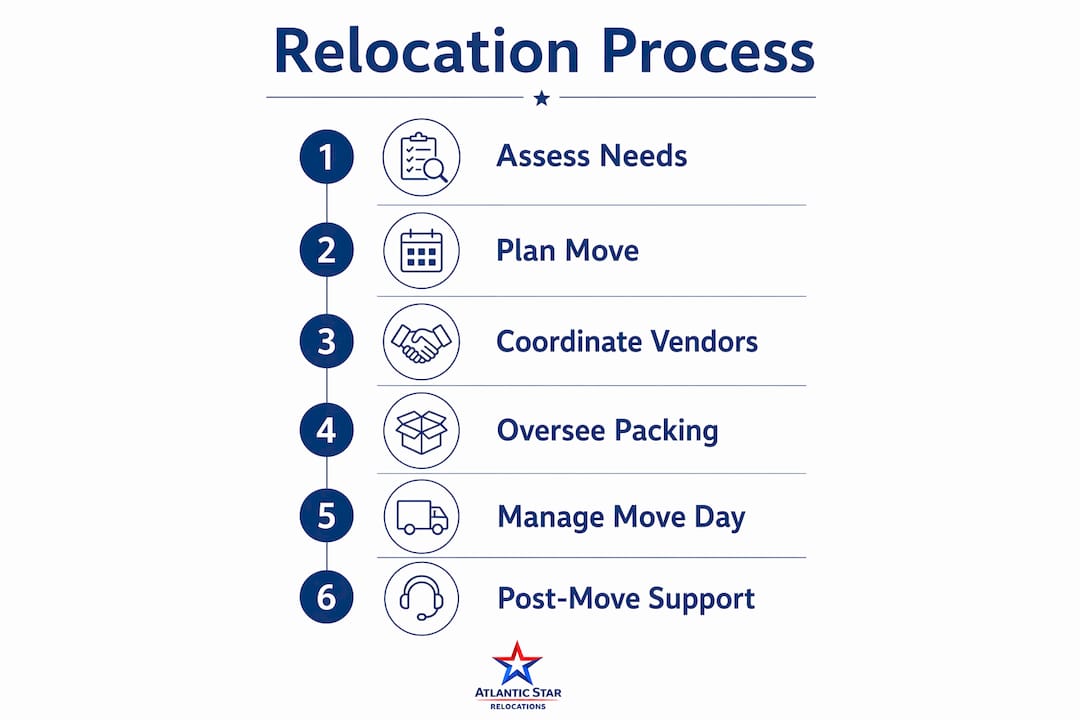
Phase 2: Planning and vendor coordination. The manager builds a detailed timeline with milestones and backup options. They source and vet movers, packers, storage facilities, and any specialty providers your move requires. Permits, utility transfers, and scheduling all get handled before move day arrives.

Phase 3: Move day oversight. Your coordinator is on-site directing the operation. They position crews, manage loading sequences, and resolve issues in real time. You don't need to be the one telling the movers where to put the couch.
Phase 4: Post-move services. After arrival, support continues with unpacking, furniture arrangement, and organizing the new space so it's functional from day one. Some providers also handle address updates and service activations.
- Needs assessment and inventory
- Customized plan with timeline and milestones
- Vendor sourcing, vetting, and scheduling
- On-site move day management
- Post-move unpacking and settle-in support
Pro Tip: Ask your relocation manager for a written move plan before signing anything. A solid plan includes vendor names, milestone dates, and a clear escalation process for problems. If they can't produce one, keep looking.
What does a relocation manager actually handle?
The scope is broader than most people expect. A relocation manager's responsibilities span the entire move lifecycle, not just the day the truck shows up.
Vendor vetting and management covers hiring and overseeing movers, professional packers, cleaning crews, and specialty handlers for items like artwork, pianos, or sensitive equipment. They know which vendors are reliable in your area and which ones to avoid, a distinction that takes years to build.

Logistical coordination includes transportation scheduling, permit applications for parking or building access in cities like Manhattan or the Bronx, and sequencing deliveries across multiple stops. For commercial relocations, this layer of coordination is often the difference between a two-day move and a two-week disruption.
Packing and unpacking oversight means supervising the protection of your belongings from the first box taped to the last item placed on a shelf. Settle-in services can include hanging artwork, organizing closets, and setting up kitchens so the new space feels like home immediately.
Special case handling covers downsizing, storage coordination, and moves involving delicate or high-value items. Atlantic Star Relocations, for example, manages short-term storage as part of a coordinated move plan, so clients aren't left scrambling for a solution mid-move.
What are the real benefits of hiring a relocation manager?
The benefits split cleanly between individuals and organizations, though the core advantage is the same for both: someone experienced is making the decisions.
For individuals and families:
- Decision fatigue drops sharply. The average residential move involves hundreds of individual choices. A coordinator handles most of them using experience, presenting you with a clear plan to approve or adjust.
- Family members stay in their proper role. As research confirms, hiring a move manager frees family members to provide emotional support instead of managing logistics. On moving day, your job is to be present for the people you love, not to direct the crew.
- Conflict stays low. A neutral third party keeps momentum going without adding tension to already strained relationships, particularly during difficult transitions like divorce, a death in the family, or a senior downsize.
For employers and HR teams:
- Employee productivity recovers faster. Relocation management services reduce the downtime connected to moving, which means transferred employees get up to speed at their new location sooner.
- Recruitment and retention improve. Offering a managed relocation signals to candidates that the company takes care of its people through major life transitions.
- Cost control tightens. A professional coordinator tracks every vendor invoice and flags overruns before they compound.
Moving ranks among the top five most stressful life events. Professional coordination directly addresses the logistical causes of that stress, freeing clients to focus on the transition itself.
Common concerns about hiring a relocation manager
"How much does it cost?" Typical hourly rates range from $60 to $120 depending on region and scope, with higher rates in the Northeast and California. Some managers charge by project scope instead of hourly. Either way, a reputable provider gives you a written contract that outlines costs, billing method, and project scope before work begins.
"Will I lose control of my own move?" No. A good relocation manager presents options and recommendations; you make the final calls. The coordinator handles execution. Think of it as the difference between hiring an architect and building the house yourself.
"How do I know the vendors they use are trustworthy?" Ask directly. A professional coordinator should be able to explain why they chose each vendor, not just say they have a contact. The National Association of Senior & Specialty Move Managers (NASMM) sets industry standards for credentials, ethics, and vendor practices. Providers affiliated with NASMM follow a published code of conduct and carry proper licensing and insurance.
"What certifications should I look for?" NASMM accreditation is the clearest signal of professional standards in the move management field. For corporate relocations, look for providers with experience working alongside HR teams and familiarity with Worldwide ERC guidelines, the professional body for employee relocation.
"What if something goes wrong on moving day?" This is precisely where a relocation manager earns their fee. Real-time problem-solving is a core part of the role. A coordinator on-site can redirect crews, source a replacement vendor, or adjust the plan without pulling you into the chaos.
How relocation managers support you emotionally and logistically
The operational and emotional dimensions of a move are more connected than most people realize. When the logistics are chaotic, the emotional experience gets worse. When someone else owns the logistics, families can actually be present for each other.
Relocation managers act as neutral coordinators who keep the process moving without adding pressure to family dynamics. Couples navigating a move together often disagree on priorities and timelines. A professional coordinator absorbs that friction by presenting a structured plan both parties can work from.
For long-distance moves, the coordination challenge multiplies. Hiring two move managers, one at the origin and one at the destination, is a proven approach that lowers costs and improves handoff quality. Each manager handles their local vendors, shares reference photos and labeled box inventories, and the two coordinate directly so nothing falls through the gap between locations.
Settle-in services go further than most clients expect. Custom floor planning, closet organization, kitchen setup, and artwork placement mean the new space is functional and personal from the first night. That transition from "house" to "home" happens faster when someone has prepared the space before you walk in.
Pro Tip: For seniors or anyone moving after a major life event, ask your relocation manager about settle-in services specifically. Arriving to an organized, familiar-feeling space makes an enormous difference in how quickly people adjust.
- Neutral coordination reduces family conflict during stressful transitions
- Emotional support role stays with family; logistics role goes to the manager
- Two-manager approach for long-distance moves cuts costs and improves coordination
- Settle-in services create a functional, personal space from day one
- Custom floor planning and organization included with full-service providers
For businesses relocating offices or teams across the tri-state area, understanding why specialist movers matter for commercial moves adds useful context to the coordination model described here.
Real-world examples of professionally managed relocations
The value of a relocation manager becomes clearest when you look at the specific situations where self-managing would have gone sideways.
A senior downsize in Westchester. An older adult moving from a four-bedroom home in White Plains to a two-bedroom apartment in Yonkers faces decisions about decades of belongings, furniture that won't fit the new space, and the emotional weight of leaving a longtime home. A relocation manager handles the sorting, arranges donation pickups and estate sale coordination, supervises the pack, and has the new apartment organized before the client arrives. The family spends moving day with their parent, not directing the crew.
A corporate transfer from Manhattan to Florida. An employee relocating from a Manhattan apartment to Miami on a tight start-date timeline needs moving logistics, storage coordination, and a new-space setup, all without missing their first day at the new office. Atlantic Star Relocations manages exactly this kind of long-distance residential move, coordinating carriers, scheduling storage if the new home isn't ready, and handling the full unpack at the destination.
A multi-office commercial move in the Bronx. A company consolidating two Bronx offices into one location in New Jersey needs phased moving to keep operations running. A relocation manager sequences the move by department, coordinates building access permits on both ends, and manages the IT equipment handling separately from general office furniture. Atlantic Star's corporate relocation services are built around exactly this kind of phased, accountable execution.
Each of these scenarios shares one feature: the complexity was real, the timeline was fixed, and the cost of failure was high. A professional coordinator turns that combination from a liability into a managed process.
Key Takeaways
Hiring a relocation manager is the most direct way to reduce stress, protect productivity, and control costs across any type of move, from a single-family home to a multi-site corporate relocation.
| Point | Details |
|---|---|
| Moving is a top-five stressor | Professional coordination directly addresses the logistical causes of moving stress. |
| Hourly rates are transparent | Expect hourly rates that vary depending on region and scope, always accompanied by written contracts. |
| Two managers for long-distance moves | One at origin and one at destination lowers costs and improves coordination quality. |
| Families stay in their role | Move managers handle logistics so family members can provide emotional support instead. |
| Settle-in services matter | Full-service providers organize the new space so it's functional from the first night. |
FAQ
What does a relocation manager do?
A relocation manager coordinates every stage of a move, from needs assessment and vendor selection through move-day oversight and post-move unpacking. They serve as a single point of contact for all vendors and logistics, preventing the fragmented communication that causes most moving problems.
What is a good reason to hire a relocation manager?
Moving ranks among life's top five most stressful events, and the logistical complexity is the primary driver of that stress. A relocation manager removes that complexity, freeing you to focus on the personal and professional transitions happening alongside the move.
What are red flags when hiring movers or a relocation manager?
Be cautious of any provider who can't explain why they chose their vendors, offers no written contract, or gives only a verbal quote. NASMM-accredited move managers are required to provide a written contract outlining scope, costs, and billing method before work begins.
What are the drawbacks of relocation assistance?
The main concern is cost, though hourly rates of $60–$120 are often offset by avoided mistakes, better vendor pricing, and faster transitions. Some clients also worry about losing control, but a professional coordinator presents options and executes your decisions rather than overriding them.