

Commercial relocation vendor coordination is the active management and synchronization of every service provider involved in a business move, from office movers and IT specialists to telecom providers and fit-out contractors. Without it, even a well-funded move falls apart at the seams. A single vendor running two days late can delay IT setup, push back employee move-in, and cost a company far more than the move itself. For facility managers and business leaders in Westchester County, New York City, and the surrounding metro area, getting this coordination right is the difference between a clean transition and weeks of operational chaos.
What is commercial relocation vendor coordination and why does it matter?
Commercial relocation vendor coordination is the structured process of aligning all third-party service providers to a single project timeline, with clear accountability at every stage. The industry term for this practice is move project management, and it applies to any business relocation regardless of company size or distance.
Standard commercial relocation timelines range from 3 to 9 months, with vendor planning ideally starting 8–12 weeks before the move date. Starting late means losing access to preferred vendors, especially in dense markets like Manhattan or Westchester where crews book out quickly. The cost of poor coordination shows up as downtime, damaged equipment, and missed lease deadlines.
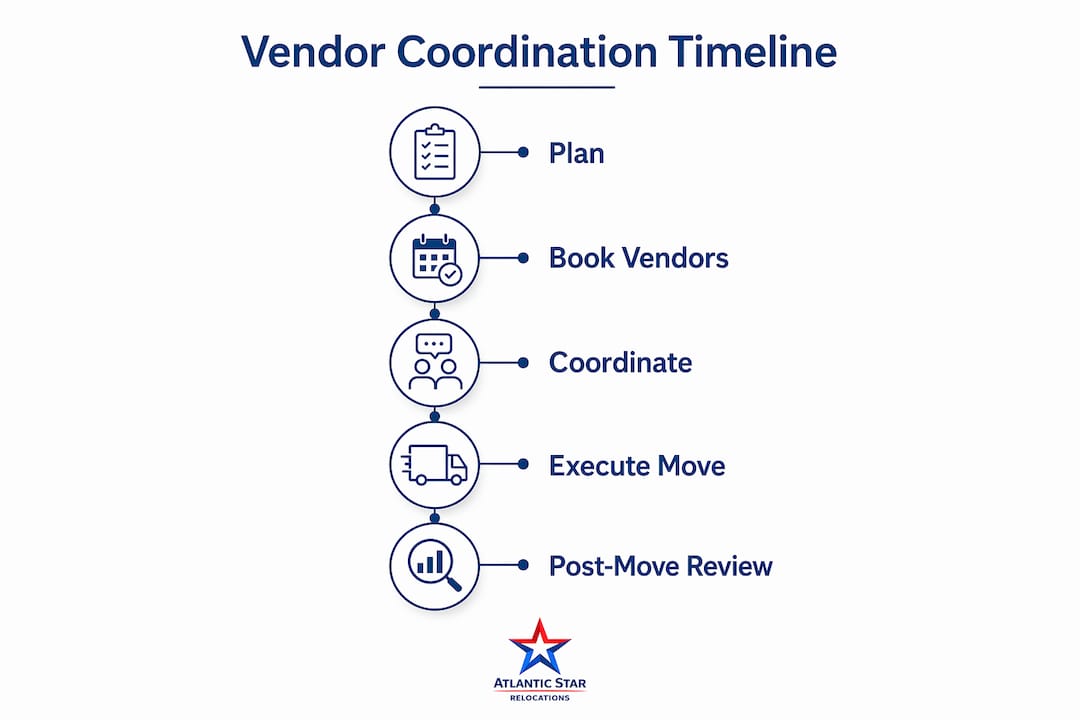
Atlanticstargroup operates as a single point of accountability across the full vendor chain, overseeing carrier selection, scheduling, and real-time issue resolution. That model removes the most common failure point in commercial moves: no one person owns the outcome.

What key vendors are involved in a commercial move?
Every commercial relocation involves a web of vendors whose tasks overlap and depend on each other. Understanding each role is the first step toward managing them effectively.
- Office movers: Transport furniture, equipment, and supplies. They set the physical move date and require confirmed floor plans, elevator access bookings, and parking permits well in advance.
- IT infrastructure specialists: Handle server migration, workstation setup, and network cabling. Internet service providers often require 60–90 days lead time to install new circuits, making them the longest lead-time vendor on any project.
- Telecom providers: Coordinate phone systems, VoIP lines, and internet cutover. Their schedule must align precisely with the IT team's go-live date.
- Fit-out contractors: Complete any build-out, painting, or furniture installation at the new space. They must finish before movers arrive with equipment.
- Workspace management software providers: Configure desk booking, access control, and occupancy tracking systems. These vendors need building access before move-in day to complete setup and testing.
Each vendor's deadline feeds directly into the next vendor's start date. A delay from the fit-out contractor pushes back the IT team, which delays the movers, which affects the lease end date at the old location. Vendor certificates and contracts, including proof of insurance and building access approvals, must be collected from every provider before work begins.
How to establish effective vendor coordination from start to move-in
A clear framework prevents the most common coordination failures. Follow this sequence to keep every vendor on track.
- Appoint a dedicated move lead. Centralized ownership with a single point of contact is critical for holding vendors accountable and making real-time decisions. Without one person owning the outcome, plans unravel even when every detail is documented.
- Start vendor research and booking 8–12 weeks out. Confirm availability, collect certificates of insurance, and sign contracts before the move date is locked in.
- Build a shared project tracker. A tracker with assigned owners, due dates, and statuses is the operational backbone of any commercial move. Tools like Asana, Monday, Notion, or Google Sheets all work. The format matters less than the discipline of updating it daily.
- Share the timeline with every vendor. Each provider needs to see how their work connects to the others. A telecom vendor who does not know the IT go-live date will not prioritize your cutover.
- Confirm access requirements in writing. Building management in NYC and Westchester often requires certificates of insurance, elevator reservations, and move permits weeks in advance. Confirm these with every vendor and the building separately.
- Run IT dry runs two weeks before move day. Final IT system tests should complete at least two weeks before the move date. This gives the team time to resolve issues without delaying the physical move.
Pro Tip: Build a 48-hour buffer between the fit-out contractor's completion date and the movers' arrival. In dense urban markets like Manhattan or Brooklyn, unexpected access delays are common, and that buffer protects the entire downstream schedule.
What are the biggest challenges in vendor coordination during commercial relocations?
The hardest problems in office move management are not the ones you plan for. They are the ones that surface two weeks before move day.
- IT lead times are routinely underestimated. Ordering circuits immediately after lease signing is not optional. It is the single most common cause of post-move downtime, and it is entirely preventable.
- Lease restoration obligations catch companies off guard. Lease restoration clauses can cost significantly more than the physical move itself. Facility managers must read the old lease carefully and budget for space restoration before signing the new one.
- Vendor scheduling conflicts multiply in dense markets. In the NYC metro area, building access windows are often limited to specific hours. Two vendors scheduled for the same elevator on the same morning creates a bottleneck that can delay the entire day.
- Accountability gaps appear under pressure. When something goes wrong on move day, vendors point at each other. A move lead with authority to make real-time decisions resolves these disputes before they become delays.
- Business continuity requires active management. Employees need working phones, internet, and access cards on day one. That outcome requires the telecom, IT, and access control vendors to finish in sequence, not simultaneously.
Pro Tip: Assign a single vendor contact list with direct mobile numbers for every provider. On move day, email chains are too slow. Text and call chains resolve issues in minutes.
How to align facilities and IT teams with vendors for a smooth office move
Treating a commercial relocation as a Facilities and IT project together, rather than two separate workstreams, is the single biggest factor in reducing post-move downtime. Most operational disruptions after a move trace back to one team not knowing what the other scheduled.
The table below shows how responsibilities divide and where coordination is required.
| Area | Facilities team | IT team | Vendor coordination needed |
|---|---|---|---|
| Network infrastructure | Confirms building conduit access | Orders circuits and cabling | Telecom provider, IT contractor |
| Workstation setup | Provides floor plan and desk assignments | Labels and inventories all equipment | Office movers, IT specialists |
| Wi-Fi coverage | Coordinates building access for surveys | Conducts pre-move Wi-Fi surveys | Wireless vendor |
| Access control | Manages building management relationship | Programs key cards and door systems | Access control vendor |
| Post-move layout | Reviews space utilization reports | Monitors device connectivity by zone | Workspace management software provider |
Teams should monitor workspace utilization 60–90 days post-move to identify layout problems before they become permanent. That data also informs future lease decisions. Clear labeling and inventory of IT equipment by user and destination desk is the practical step that makes this alignment work on move day. Atlanticstargroup's logistics coordination services are built around exactly this kind of cross-functional alignment, covering vendor scheduling, access management, and real-time problem resolution.
Key Takeaways
Effective commercial relocation vendor coordination requires a single accountable move lead, early vendor booking, and tight integration between facilities and IT teams to prevent downtime.
| Point | Details |
|---|---|
| Start vendor planning early | Book all vendors 8–12 weeks before the move date to secure availability and avoid scheduling conflicts. |
| Appoint one move lead | A single point of contact with decision-making authority prevents accountability gaps on move day. |
| Order IT circuits immediately | Internet providers need 60–90 days lead time; ordering late is the top cause of post-move downtime. |
| Budget for lease restoration | Restoration clauses often cost more than the physical move and must be factored in before signing. |
| Align facilities and IT together | Treating the move as one integrated project, not two separate workstreams, protects business continuity. |
What I have learned from coordinating commercial relocations
The move leads who get it right share one habit: they treat the vendor schedule as a living document, not a plan filed away after kickoff. I have seen well-organized companies with detailed checklists still end up with no internet on day one because the telecom order slipped by three days and nobody caught it until move week.
The uncomfortable truth about vendor coordination is that most vendors will not tell you when they are running behind. They assume someone else will flag it. That is why the move lead's job is not just scheduling. It is active follow-up, every week, with every provider. A move coordinator who knows the NYC metro market understands which building management offices in Midtown require 30-day notice for elevator reservations, and which Westchester office parks have strict delivery hour restrictions. That local knowledge is not in any checklist template.
My advice: choose vendors who have worked in your specific building type before, and choose a move management partner who will own the outcome, not just the logistics. Atlanticstargroup's track record across Westchester, Manhattan, Brooklyn, and New Jersey reflects exactly that kind of accountability.
— Admin
Atlanticstargroup's commercial move management services
Atlanticstargroup handles the full scope of commercial office moves across Westchester County, New York City, New Jersey, and Connecticut, acting as a single point of accountability from planning through final delivery. The team manages vendor selection, scheduling, and execution so facility managers are not chasing down contractors on move day.

Services include labor-only moving help for companies that need crew support without full-service logistics, short-term storage for phased moves, and full corporate relocation management for complex multi-vendor projects. Contact Atlanticstargroup for a custom quote and a consultation tailored to your building, timeline, and team size.
FAQ
What is commercial relocation vendor coordination?
Commercial relocation vendor coordination is the process of managing and synchronizing all service providers involved in a business move, including movers, IT specialists, telecom providers, and contractors, under a single project timeline with clear accountability.
How far in advance should vendors be booked for an office move?
Vendor planning should start 8–12 weeks before the move date at minimum. IT infrastructure vendors, particularly internet service providers, require 60–90 days lead time after lease signing.
Who should manage vendor coordination during a commercial move?
A dedicated move lead or project manager should own all vendor communication and scheduling. Centralized ownership prevents accountability gaps and allows real-time decisions when issues arise on move day.
What is the most overlooked cost in a commercial relocation?
Lease restoration clauses are frequently overlooked. These obligations can cost more than the physical move itself and must be budgeted before signing a new lease agreement.
Does Atlanticstargroup handle vendor coordination for NYC and Westchester office moves?
Yes. Atlanticstargroup manages multi-vendor office relocations across Westchester County, Manhattan, Brooklyn, Queens, the Bronx, New Jersey, and Connecticut, providing structured oversight and a single point of accountability throughout the process.