

A move coordinator is a dedicated project manager who oversees every logistical, scheduling, and communication task involved in a relocation from the first planning call through final delivery. Unlike a moving crew that carries boxes or a moving company that books trucks, a move coordinator acts as the single point of accountability throughout the entire process. For anyone planning a long-distance move from Westchester County, a corporate relocation across Manhattan, or a multi-stop transfer to Florida, this role is the difference between a controlled move and a chaotic one. Atlantic Star Relocations structures every project around this principle, assigning dedicated coordination to every client from day one.
What is a move coordinator and what do they actually do?
A move coordinator manages the full scope of a relocation by organizing logistics, maintaining communication with all vendors, and resolving problems before they reach the client. The industry term for this function is "relocation coordinator," though "move coordinator" is the phrase most clients search for and use in conversation. Both terms describe the same role.
The core move coordinator responsibilities include:
- Timeline planning: Building a move schedule that accounts for packing, loading, transit, and delivery windows, including buffer time for delays
- Vendor scheduling: Booking moving crews, specialty transport for items like pianos or artwork, storage facilities, and cleaning services
- Inventory verification: Confirming that the in-home survey accurately reflects what needs to move, including items requiring crating or permits
- Client communication: Serving as the primary contact for questions, updates, and changes throughout the process
- Issue resolution: Handling last-minute problems such as elevator reservation conflicts, parking restrictions in Brooklyn or the Bronx, or weather-related delays
- Utility and service coordination: Arranging specialty shipments and utility connections that fall outside standard moving company scope
Research shows that a coordinator handling a complex move maintains around 72 touchpoints with clients, crews, and vendors. That number reflects how much active management a well-executed relocation actually requires.
Pro Tip: Verify your moving day schedule with your coordinator the day before the move. Pre-move check-ins are one of the most effective ways to catch scheduling conflicts before they become costly delays.

How does a move coordinator differ from a moving company?
The distinction matters because clients often assume these roles overlap. They do not.
| Role | Primary function | Physical presence | Client contact |
|---|---|---|---|
| Move coordinator | Logistics, scheduling, communication | Often remote | Direct and ongoing |
| Moving company | Contracts, liability, transport | On-site | Limited to booking and billing |
| Moving crew | Physical packing, loading, driving | Always on-site | Minimal |
A move coordinator vs. moving company comparison comes down to planning versus execution. The coordinator designs and manages the plan. The moving company and crew carry it out. When something goes wrong on moving day, the coordinator is the person making calls, adjusting schedules, and keeping the client informed. The crew is focused on the physical work.
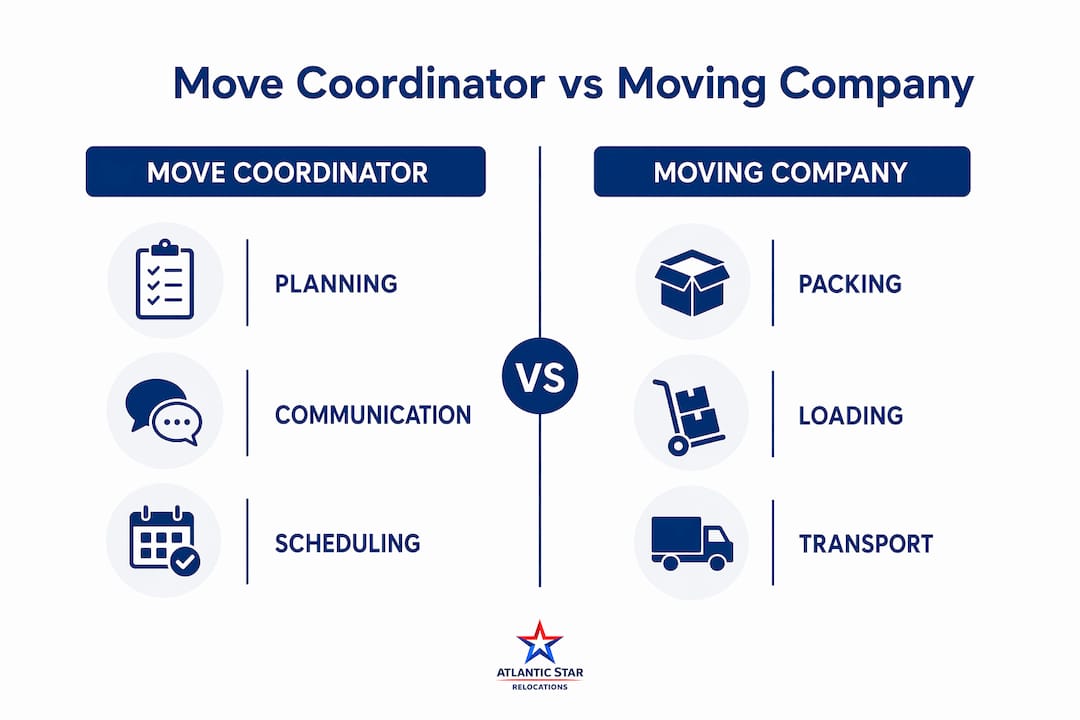
This separation of duties is why Atlantic Star Relocations operates as a carrier-neutral coordination company. The team manages vendor selection, scheduling, and oversight without being tied to a single crew or truck fleet. That structure gives clients accountability without the conflicts of interest that arise when one company controls both the planning and the physical labor.
What are the benefits of hiring a move coordinator?
The practical advantages of professional coordination become most visible in complex moves. A coordinator is especially valuable for busy individuals or relocations requiring multiple services running in parallel.
Here is where the benefits show up most clearly:
- Error reduction: A coordinator catches inventory discrepancies, permit gaps, and scheduling conflicts before moving day. One missed elevator reservation in a Manhattan high-rise can delay an entire move by hours.
- Vendor management: Instead of calling five different companies yourself, one coordinator manages packing crews, storage facilities, specialty shippers, and cleaning services as a single unit.
- Expert planning for complex moves: Move coordinators are highly recommended for long-distance moves, senior relocations, and international transfers where the logistics involve multiple jurisdictions, carriers, or timelines.
- Real-time problem solving: When a truck is delayed or a building's freight elevator is double-booked, a coordinator resolves it without pulling the client into the chaos.
- Customized scheduling: Coordinators build timelines around your specific constraints, whether that is a school start date in Connecticut, a lease end date in Queens, or a corporate handover deadline in New Jersey.
Pro Tip: Give your coordinator the most accurate inventory possible before the move begins. Accurate client inventories drive every downstream decision, from truck size to crew count to transit time estimates. Underreporting items is the single most common cause of moving day surprises.
How to choose the right move coordinator for your move
Selecting a qualified coordinator requires more than reading reviews. The right person or company needs to demonstrate specific competencies before you sign anything.
Look for these qualities during your evaluation:
- Documented experience with your move type: A coordinator who handles local Westchester moves regularly may not have the network or knowledge for an international transfer or a multi-leg corporate relocation. Ask directly about comparable projects.
- Clear communication practices: Ask how often you will receive updates and through what channel. A coordinator who cannot answer that question clearly will not improve during your move.
- Transparent cost structure: Coordination services are sometimes included in a full-service moving package and sometimes billed separately. Confirm which applies before signing. Review a smooth relocation checklist to understand what tasks should be covered.
- Verifiable references: Request references from clients with similar move profiles, not just general testimonials. A coordinator who moved a family from Westchester to Florida is a better reference for your long-distance move than one who handled a local studio apartment.
- Single point of contact guarantee: Confirm that the coordinator you meet during the consultation is the same person managing your move. Handoffs between staff members are a common source of dropped details.
The move coordinator job description at reputable companies includes accountability for the entire process, not just the planning phase. If a company cannot tell you exactly who owns your move from start to finish, that is a red flag worth taking seriously.
Key takeaways
A move coordinator is the single professional responsible for managing every logistical, scheduling, and communication task in a relocation, making them the most important hire for any complex move.
| Point | Details |
|---|---|
| Core definition | A move coordinator manages logistics, scheduling, and communication as the single point of accountability. |
| Distinct from movers | Coordinators plan and oversee; moving companies and crews execute the physical work. |
| Communication intensity | Complex moves involve roughly 72 coordinator touchpoints across clients, crews, and vendors. |
| Best use cases | Long-distance, senior, international, and multi-vendor moves benefit most from professional coordination. |
| Selection criteria | Prioritize documented experience, transparent costs, and a guaranteed single point of contact. |
Why most people misunderstand what a coordinator actually does
Here is something I have seen repeatedly in this industry: clients expect their move coordinator to be standing in their living room on moving day, clipboard in hand, directing traffic. That is not how it works, and the expectation sets people up for unnecessary anxiety.
Most professional coordinators work remotely on moving day, managing the move through documentation, phone calls, and digital communication. They are not absent. They are working the phones, confirming truck locations, resolving permit issues, and updating you in real time. The value is in the management, not the physical presence.
The other misconception I encounter constantly is that coordination is a luxury add-on for big corporate moves. It is not. I have seen a poorly coordinated local move from Yonkers to White Plains go sideways because nobody confirmed the building's freight elevator hours. A coordinator would have caught that in the first planning call. The scale of the move does not determine whether coordination matters. The complexity does, and complexity shows up in moves of every size.
Atlantic Star Relocations builds coordination into every project because we have seen what happens when it is treated as optional. The clients who have the smoothest moves are not the ones with the most money or the biggest trucks. They are the ones with the clearest plan and one person accountable for executing it.
— Admin
Move with confidence backed by expert coordination
Atlantic Star Relocations provides dedicated move coordination for residential and commercial clients across Westchester County, New York City, Connecticut, New Jersey, and Florida. Every project includes a single point of contact who manages your timeline, vendors, and logistics from the first call through final delivery.

Whether you are planning a long-distance move, a corporate office relocation, or a multi-stop transfer, our team handles the details so you do not have to. We work with trusted carriers and crews, verify every inventory, and resolve problems before they reach you. Visit Atlantic Star Relocations to request a free consultation and get a clear plan for your next move.
FAQ
What is a move coordinator in simple terms?
A move coordinator is a project manager for your relocation who handles scheduling, vendor communication, and logistics from start to finish. They serve as your single point of contact throughout the entire move.
Does a move coordinator do the physical moving?
No. A move coordinator manages planning and communication while moving crews handle the physical packing, loading, and transport. The two roles are separate and complementary.
When do you actually need a move coordinator?
Move coordinators are most valuable for long-distance moves, senior relocations, international transfers, and any move involving multiple vendors or services. Simple local moves may not require dedicated coordination.
How many times will a move coordinator contact me?
A coordinator managing a complex relocation maintains around 72 touchpoints with clients and vendors throughout the process. Expect regular updates at key milestones and direct contact whenever a decision or confirmation is needed.
Is move coordination included in a standard moving quote?
Not always. Some full-service moving companies include coordination in their pricing, while others offer it as a separate service. Always confirm what is covered before signing a contract.