

Multi-location relocation, known in the industry as multi-site relocation management, is defined by the need for centralized oversight that synchronizes timelines, vendor relationships, and operational processes across every location simultaneously. Without that central control, organizations moving offices from Manhattan to Westchester County, or consolidating facilities across New York, New Jersey, and Connecticut, face cascading delays, budget overruns, and operational paralysis. The risks are not theoretical. They are predictable, and they are preventable when coordination is treated as the foundation of the project rather than an afterthought.
Why multi-location moves need coordination: the core case
Organizations must shift from a single-move mindset to a coordinated program framework that covers staggered schedules, centralized vendor management, and unified budget oversight. That shift is not cosmetic. It changes who makes decisions, when they make them, and how information flows between sites.
The practical stakes are high. A company relocating three offices across the Bronx, Brooklyn, and Queens is not running three separate moves. It is running one interconnected program where a delay in one borough compresses the schedule in the next. Without a central task force pulling leads from IT, finance, HR, and operations into a single decision-making structure, each site team operates with partial information. That partial information is where most multi-location moves begin to fail.

Teams frequently underestimate fragmentation risk because multi-location moves superficially resemble single ones. The complexity is invisible until it is not, and by then, the schedule has already slipped.
What are the main challenges unique to multi-location moves?
Phased and overlapping timelines are the first structural problem. Delays at one location stall subsequent phases across all sites, creating a cascading effect that compresses every downstream schedule. A two-day slip in a New Jersey office setup can push back a Connecticut IT cutover by a week if the dependencies between those sites are not mapped in advance.
The communication breakdown between rotating crews is equally damaging. New crews arrive without full visibility into previous phases, causing missed scope details and rework that inflates labor costs. Without documented job handoffs, internal drift builds quietly across phases until the final site inherits every unresolved problem from the first.
Budget overruns follow a specific pattern in multi-site moves. Uncoordinated vendor negotiations and small labor overruns accumulate across phases until final invoices bear no resemblance to original quotes. Each site team negotiating independently leaves volume discounts on the table and creates billing inconsistencies that are nearly impossible to reconcile after the fact.
IT infrastructure dependencies create a separate category of bottleneck. When network connectivity, server migration, and workstation setup are not synchronized with the physical move schedule, teams arrive at new locations and cannot work. That operational paralysis is measurable in lost productivity hours.
Pro Tip: Define "hard" and "soft" dependencies between your locations before the project begins. Hard dependencies, where Site B physically cannot start until Site A completes, require buffer periods in your master schedule. Soft dependencies, where Site B is slowed but not stopped, require communication protocols instead.
How does centralized coordination improve efficiency and control?
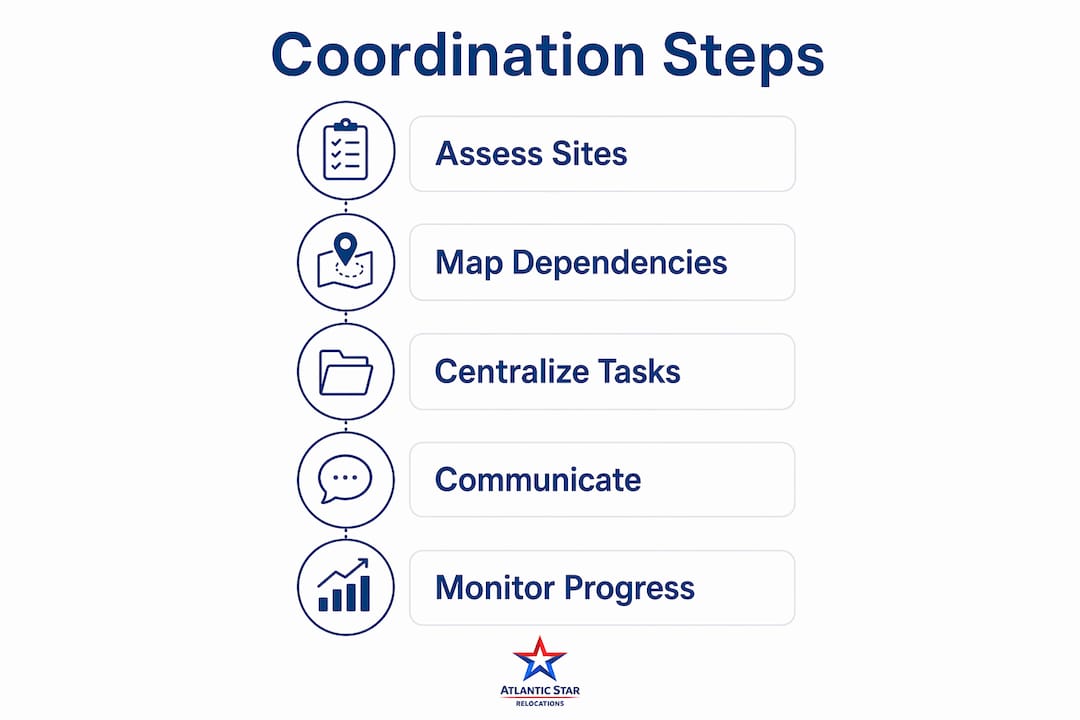
A central relocation task force is the structural answer to every challenge listed above. Centralized governance with leads from IT, finance, HR, and administration aligns decision-making across geographies and creates a single point of accountability for the entire program. Here is how that task force functions in practice:
- IT lead sets infrastructure milestones at least 4 to 8 weeks before physical moves to prevent post-move operational paralysis.
- Finance lead consolidates vendor negotiations across all sites, capturing volume discounts through centralized relationships that individual site teams cannot access independently.
- HR lead manages employee communication across time zones and locations, reducing anxiety and resistance that slow execution.
- Operations lead maintains the master schedule, tracks dependencies, and escalates issues before they cascade.
- Local coordinators at each site translate central standards into location-specific execution without deviating from core protocols.
Standardizing packing and inventory systems across all locations reduces sorting time, accelerates unpacking, and eliminates the confusion that comes when each site team develops its own labeling logic. Uniform protocols mean any crew member at any site can orient themselves immediately.
Technology platforms with real-time tracking and automated workflows address bottlenecks before they affect service quality. Integration with HR systems and communication tools improves decision-making speed at every level of the organization.
Pro Tip: Build a shared digital dashboard that every site coordinator and task force lead can access in real time. When a delay surfaces in one location, every stakeholder sees it simultaneously and can adjust without waiting for a status call.
Coordination models: which approach fits your move?
Not every organization needs the same coordination structure. The right model depends on the number of sites, geographic spread, and internal capacity.
| Model | Best for | Trade-off |
|---|---|---|
| Fully centralized | 5+ locations, tight timelines | Requires strong central team and clear authority |
| Decentralized | 2-3 locations with strong local managers | Risk of inconsistent standards and vendor fragmentation |
| Hybrid | Mid-size programs with regional clusters | Balances local autonomy with central oversight |
The hybrid model is the most practical for organizations relocating across the New York metro area, covering Manhattan, Westchester County, and surrounding states. Central standards govern vendor selection, packing protocols, and budget reporting. Local coordinators handle building access, elevator reservations, and crew scheduling specific to each site.
Key factors that determine which model to use:
- Number of interdependent locations and their geographic distance
- Whether IT infrastructure is centralized or distributed across sites
- Internal capacity to staff a full task force versus relying on a managed relocation provider
- Budget visibility requirements from finance and executive leadership
Scale alone does not reduce risk. Discipline in central governance and standardization prevents coordination gaps regardless of how large or small the program is.
Practical steps to implement coordination in your multi-location move
Effective coordination does not happen organically. It requires deliberate setup before the first truck is loaded.
- Form the task force first. Identify leads from IT, finance, HR, and operations before any vendor is contacted. Decision-making authority must be clear from day one.
- Map all dependencies. Distinguish hard dependencies from soft ones across every location pair. Build buffer periods into the master schedule wherever hard dependencies exist.
- Standardize packing and inventory protocols. Develop a single labeling system and inventory checklist that every site uses. Deviations create sorting problems at the destination.
- Set IT milestones early. IT readiness before the physical move dictates overall schedule success. Delayed network setups stall entire teams and damage business continuity.
- Centralize vendor negotiations. Consolidate all vendor relationships through one point of contact to capture volume pricing and maintain billing consistency across sites.
- Build a communication plan. Define how information flows between site coordinators, the central task force, and executive stakeholders. Specify meeting cadence, escalation paths, and documentation standards.
Pro Tip: For moves spanning multiple states, such as New York to New Jersey or Connecticut, account for different building regulations, elevator reservation windows, and union labor rules at each destination. These local variables belong in the master schedule, not discovered on move day.
Key takeaways
Coordinated multi-location relocation requires a central task force, standardized processes, and mapped dependencies to prevent cascading delays and budget overruns across every site.
| Point | Details |
|---|---|
| Centralize decision-making | A task force with IT, finance, HR, and operations leads prevents fragmented choices across sites. |
| Map hard and soft dependencies | Identifying location interdependencies early protects the master schedule from cascading delays. |
| Standardize packing and inventory | Uniform protocols across all sites reduce sorting time and eliminate crew confusion at every destination. |
| Prioritize IT readiness | Infrastructure milestones set 4 to 8 weeks before physical moves prevent post-move operational paralysis. |
| Consolidate vendor negotiations | Centralized vendor relationships capture volume discounts and maintain billing consistency across locations. |
What I have learned from watching multi-location moves go wrong
The most expensive mistake I see organizations make is treating a multi-location move as a collection of independent projects that happen to share a budget. They assign a local manager at each site, give each one a vendor contact, and assume the pieces will connect. They do not connect. What actually happens is that each site optimizes for its own timeline, its own vendor relationship, and its own interpretation of the packing protocol. By the time the final location is executing, it is inheriting every unresolved problem from every previous site.
The organizations that move well are the ones that invest in coordination infrastructure before they invest in trucks. They staff the task force, map the dependencies, and build the communication plan while the lease agreements are still being signed. That front-end investment is not overhead. It is the mechanism that protects the budget, the timeline, and the morale of every employee who has to work through the transition.
Atlantic Star Relocations was built around this principle. The company's model of centralized oversight, carrier-neutral coordination, and single-point accountability exists because fragmented management is the default in this industry, and the default produces predictable failures. Coordination is not a premium add-on. It is the work.
— Admin
How Atlantic Star Relocations manages your multi-location move

Atlantic Star Relocations specializes in complex multi-site moves across Westchester County, New York City, New Jersey, Connecticut, and Florida, acting as a single point of accountability from planning through final delivery. The company manages vendor selection, crew scheduling, IT coordination milestones, and real-time issue resolution so your internal team does not have to. Whether you are consolidating offices across Manhattan and the Bronx or executing a nationwide multi-leg relocation, Atlantic Star brings the centralized oversight that prevents the cascading delays and budget overruns that derail fragmented programs. Contact Atlantic Star Relocations to request a consultation and get a coordination plan built around your specific locations, timelines, and operational requirements.
FAQ
What makes multi-location moves harder than single-site moves?
Multi-location moves create interdependent timelines where a delay at one site cascades across all subsequent locations. Crew handoff gaps, inconsistent vendor negotiations, and fragmented communication compound the complexity in ways that single-site moves do not produce.
How early should IT coordination begin before a multi-location move?
IT infrastructure milestones should be set at least 4 to 8 weeks before the physical move date. Delayed network and workstation setup is one of the leading causes of post-move operational paralysis across all site types.
What is the role of a central relocation task force?
A central task force with leads from IT, finance, HR, and operations aligns decision-making across all locations, manages vendor negotiations centrally, and monitors the master schedule to resolve dependencies before they cause delays.
How does centralized vendor negotiation save money in multi-site moves?
Consolidating vendor relationships across all locations leverages total relocation volume for better pricing and maintains billing consistency. Individual site teams negotiating independently cannot access the same volume discounts and often produce invoices that are difficult to reconcile.
Can Atlantic Star Relocations manage moves across multiple states?
Atlantic Star Relocations coordinates multi-location moves across New York, New Jersey, Connecticut, Florida, and nationwide, managing carrier selection, scheduling, and real-time issue resolution as a single point of accountability for the entire program.