

Move scheduling has a reputation for chaos, and honestly, that reputation is earned. Missed pickups, overlapping delivery windows, and carriers who show up three hours late are all par for the course when logistics aren't coordinated from the start. But here's what most people don't realize: the chaos is almost never inevitable. When shipments and household moves are consolidated under a single scheduling framework, the entire process shifts from reactive scrambling to structured execution. This guide walks you through exactly how consolidated move scheduling works, where it excels, and what to watch for before you commit to this approach.
Table of Contents
- What is consolidated move scheduling?
- The mechanics: step-by-step process of consolidated scheduling
- Coordination under constraints: secrets of optimization
- Trade-offs and scenarios: when consolidated scheduling makes sense
- Special case: military and government move scheduling
- What most guides miss about consolidated move scheduling
- Expert guidance for your next move
- Frequently asked questions
Key Takeaways
| Point | Details |
|---|---|
| Batching shipments | Consolidated scheduling combines multiple clients' shipments for greater efficiency and lower costs. |
| Sequenced delivery windows | Delivery timelines depend on coordinated routes, usually quoted as flexible ranges, not exact dates. |
| Best for flexible moves | This model suits non-urgent or shared shipments, not critical deliveries needing precise timing. |
| Transparency matters | Clear communication and ongoing status monitoring help ensure a smooth consolidated moving experience. |
What is consolidated move scheduling?
Consolidated move scheduling means combining multiple shipments or household moves into fewer, larger loads that travel together on aligned routes and schedules. Instead of every shipper or household booking a separate truck, a logistics coordinator batches compatible shipments together, creating efficiency at every stage from pickup to delivery.
This approach contrasts sharply with traditional single-customer moves, where one truck serves one client from origin to destination. In a consolidated model, that same truck might carry goods from four or five different clients heading in the same general direction. The result is fewer total truck trips, lower per-unit costs, and more predictable loading and unloading events.
Consolidated scheduling is common across freight, retail supply chains, and shared residential moving services. The main actors involved include:
- Shippers (businesses sending goods or households relocating)
- Logistics coordinators (the companies managing the consolidation)
- Carriers (the trucking companies executing the routes)
- End recipients (warehouses, homes, or retail locations receiving deliveries)
As Pinnacle Team notes, consolidated scheduling works by batching many smaller shipments into fewer truckloads aligned to shipping windows or fixed schedules, then coordinating stop sequencing. That stop sequencing piece matters more than most people expect. It's not just about filling a truck. It's about filling it in the right order so that deliveries happen efficiently without unnecessary backtracking.
"Consolidated scheduling transforms fragmented, unpredictable logistics into organized delivery events that reduce congestion and create real cost savings for everyone involved."
For individuals and businesses exploring shared truck and network move scheduling, understanding this foundation is the first step toward making smarter relocation decisions.
The mechanics: step-by-step process of consolidated scheduling
With a foundation in what consolidated scheduling is, it's crucial to understand the practical steps and what actually happens behind the scenes. The process is more structured than most clients realize, and that structure is exactly what makes it work.
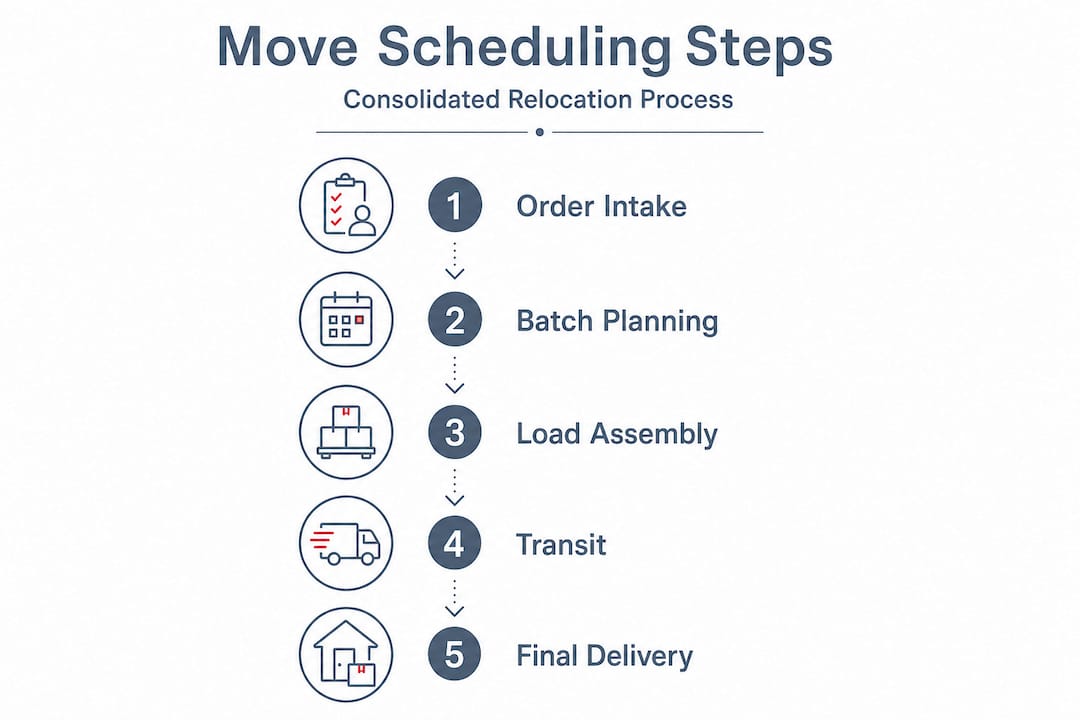
Here's how a typical consolidated move unfolds:
- Order intake: Clients submit shipment details including origin, destination, dimensions, weight, and preferred delivery window.
- Collection: Goods are picked up from multiple origins and transported to a consolidation point, often a warehouse or freight terminal.
- Pre-sorting and palletization: Items are sorted by destination region and prepared for efficient loading. Fragile goods get special handling at this stage.
- Schedule slotting: The logistics coordinator assigns each shipment to a departure window based on destination compatibility, truck capacity, and client timelines.
- Consolidated loading: All compatible shipments are loaded onto a single truck or trailer in reverse delivery order (last stop loaded first).
- Transit: The truck follows an optimized route with multiple stops.
- Deconsolidation: At the destination hub, shipments are separated and sorted for final delivery.
- Distribution: Individual deliveries are made to each recipient.
As BY Express explains, freight consolidation platforms collect, sort, and optimize shipments at consolidation points, then deconsolidate at the destination. That deconsolidation step is where many clients first encounter delays, especially if a prior stop runs long. Planning for that reality upfront is smart.
For households, the experience looks slightly different. Logistics UK confirms that for individuals, consolidated moves mean shared truck service with flexible delivery windows due to multiple stops and routes. That flexibility is a feature for some clients and a frustration for others, depending on their timeline.

| Stage | Business freight example | Individual household example |
|---|---|---|
| Order intake | 3 days before consolidation window | 1 to 2 weeks before move date |
| Collection | Freight terminal pickup | Home pickup by crew |
| Transit time | 2 to 5 days depending on route | 3 to 7 days with multiple stops |
| Delivery window | 4-hour dock appointment | 1 to 3 day window |
| Deconsolidation | Regional distribution hub | Local delivery crew |
Pro Tip: The larger the number of consolidated shipments in a single load, the more critical schedule alignment and communication become. If you're shipping with a consolidator, confirm how many stops are on your truck's route and ask for a realistic delivery window estimate, not just the best-case scenario.
Coordination under constraints: secrets of optimization
The logistics process isn't just mechanical. It's a live coordination act, and the best providers are constantly adjusting to keep things on track. Understanding how they do it helps you evaluate providers more effectively.
Constraints in consolidated scheduling include required delivery windows, truck weight and volume limits, dock availability at destination facilities, driver hours of service regulations, and weather or traffic disruptions. Successful scheduling means harmonizing all of these elements simultaneously, and that requires serious systems.
Technology plays a central role. Transportation Management Systems (TMS) and Warehouse Management Systems (WMS) allow coordinators to track shipments in real time, reassign loads when capacity changes, and communicate updates to clients automatically. Data analytics help predict which shipment combinations will travel most efficiently together.
C.H. Robinson describes the core scheduling methodology as coordination under constraints: consolidate based on demand, then sequence stops and windows, and monitor utilization and performance continuously. That ongoing monitoring is what separates strong providers from average ones. The plan at departure is rarely the plan at delivery, and the best coordinators adjust without losing visibility.
GetTransport notes that consolidation's feasibility relies on aligning pickup and delivery cycles, harmonizing orders and supplier timing, and integrating systems so batched departures are possible. When those systems aren't integrated, you get the fragmented chaos that gives logistics a bad name.
Must-have systems for successful consolidation:
- A real-time TMS with visibility across all shipments in a load
- Automated client notifications for schedule changes
- Clear escalation protocols when a shipment is at risk of missing its window
- Carrier performance tracking to identify recurring issues before they become patterns
- A single point of contact for clients who need status updates
| Factor | Consolidated scheduling | Non-consolidated scheduling |
|---|---|---|
| Cost per shipment | Lower (shared capacity) | Higher (dedicated truck) |
| Delivery predictability | Moderate (multi-stop variability) | High (direct route) |
| Scheduling flexibility | Lower (must fit batching windows) | High (book on demand) |
| Handling frequency | Higher (multiple transfer points) | Lower (direct load) |
| Ideal for | Small to medium shipments | Time-critical or fragile goods |
"The most common failure point in consolidated scheduling isn't the technology or the truck. It's communication. When clients don't know what's happening, trust breaks down fast."
Trade-offs and scenarios: when consolidated scheduling makes sense
Now that you know how consolidated networks operate, let's look at when they offer the best or worst fit for your move. Consolidated scheduling isn't a universal solution. Knowing when to use it and when to opt for a dedicated truck can save you significant time and money.
Consolidated scheduling works best in these scenarios:
- Small to medium shipments that don't fill an entire truck on their own. If you're moving a one-bedroom apartment or shipping a partial pallet of goods, consolidation is almost always more cost-effective than booking dedicated capacity.
- Multiple client locations where a single coordinator manages shipments across several origins or destinations. This is common in corporate relocations where employees in different cities are all moving to the same metro area.
- Flexible delivery timelines where the recipient can accept goods within a window rather than on a specific date. Retail replenishment, non-urgent household moves, and warehouse restocking all fit this profile well.
- Budget-conscious moves where cost savings outweigh the need for a precise delivery date.
- Environmentally conscious organizations that want to reduce the number of truck trips and lower their carbon footprint per shipment.
Consolidated scheduling is not the right choice when:
- You're moving high-value, fragile, or irreplaceable items that can't tolerate multiple handling events
- Your delivery is time-critical, such as a business opening with a hard launch date
- You need guaranteed delivery on a specific day, not within a window
- Your shipment fills or nearly fills a full truck on its own
As Logistics UK points out, consolidated and shared models reduce cost by sharing capacity but usually broaden delivery windows and can involve more transfers, whereas dedicated trucks prioritize predictability. That trade-off is real, and it's worth weighing carefully based on your specific situation.
Pro Tip: Always request transparency about handling frequency, transfer points, and realistic delivery windows when considering consolidation. A provider who can't answer those questions clearly isn't managing the process well enough to trust with your shipment.
For businesses and households exploring coordinated moving solutions, the key is matching the model to the move, not defaulting to the cheapest option without understanding what that choice involves.
Special case: military and government move scheduling
In certain regulated sectors, the scheduling landscape is very different, and it's important to note these requirements clearly. Military and government moves operate under a completely separate framework from private consolidation programs.
Military household goods moves are scheduled through the Defense Personal Property System (DPS), now being transitioned to MilMove, an official government portal. Service members and their families don't book through private consolidation networks. Instead, they complete self-counseling, submit shipment requests, and receive scheduled pickup and delivery appointments through the official system.
Military OneSource confirms that military household goods scheduling uses the DPS system, which produces scheduled pickup and delivery appointments and shipment records for planning.
Key differences from private consolidation:
- Mandated scheduling portals: Service members must use DPS or MilMove, not private booking platforms
- Standardized documentation: Weight tickets, inventory forms, and shipment records follow government formats
- Government-contracted carriers: The carrier pool is pre-approved by the military, not selected by the client
- Entitlement-based weight limits: What you can ship is determined by rank and family size, not just what fits in a truck
- Claims processes: Damage claims follow a separate military claims process, not standard carrier liability rules
For service members, understanding this distinction is critical. Trying to use a private consolidation program for a Permanent Change of Station (PCS) move can create serious complications with entitlements and reimbursements. Government agencies face similar constraints, with procurement rules governing how logistics contracts are awarded and managed.
What most guides miss about consolidated move scheduling
Once you've seen the structured process, it's worth interrogating what actually happens when theory meets reality in the world of consolidated scheduling. Most guides present consolidation as a clean, logical system. In practice, it's a constant negotiation.
The biggest thing most guides overlook is the dynamic responsiveness required to keep a consolidated network on track. Upfront planning is necessary, but it's not sufficient. A single unpredictable event, a snowstorm in the Midwest, a client who isn't ready for pickup, a dock that's backed up for six hours, can cascade through an entire consolidated load and affect every other client on that truck. The providers who handle this well aren't the ones with the best initial plans. They're the ones with the best real-time communication and the fastest problem-solving.
We've seen clients focus almost entirely on price and delivery window length when evaluating consolidation options. Those factors matter, but they're not the whole picture. Transparency, proactive updates, and a clear point of contact are what actually determine whether a consolidated move feels smooth or stressful. A cheap consolidator who goes silent when something goes wrong is far more expensive in practice than a slightly pricier provider who keeps you informed every step of the way.
For organizations running ongoing consolidated programs, the real gains come from post-launch schedule reviews. Most companies set up a consolidation program and then treat it as a fixed system. The ones who revisit routing, carrier performance, and batching logic every quarter turn modest initial savings into compounding efficiency improvements. That ongoing optimization is where real-world relocation experiences separate good programs from great ones.
The uncomfortable truth about consolidated scheduling is that it rewards clients who stay engaged. Passive clients who hand off their shipment and expect no further involvement often end up frustrated when windows shift. Active clients who communicate proactively, confirm readiness at each stage, and ask the right questions consistently get better outcomes, even within the same consolidation network.
Expert guidance for your next move
If you're considering a consolidated approach for your move, the difference between a smooth experience and a stressful one often comes down to who's managing the process behind the scenes.
Atlantic Star Relocations specializes in managed relocation solutions for individuals and businesses across the United States and internationally. We coordinate the full process from scheduling and carrier selection to real-time oversight and issue resolution, so you're never left guessing. Whether you're planning a residential move, a multi-location corporate relocation, or a complex logistics project, our team provides the structure, transparency, and accountability that consolidated scheduling demands. Reach out to learn how we can simplify your next move.
Frequently asked questions
How are delivery windows determined in consolidated scheduling?
Delivery windows are set based on the most efficient routing for all shipments in the truck, and typically reflect a broader range to accommodate multi-stop routes. As Logistics UK notes, windows are quoted as a range rather than a fixed date due to multiple pickups and deliveries.
What's the main benefit of scheduling a consolidated move for a business?
Businesses can reduce costs, lower dock congestion, and boost scheduling predictability compared to arranging many separate shipments. Pinnacle Team confirms that aligning shipments into organized events relieves congestion and improves overall efficiency.
Do consolidated moves increase the risk of delays?
Consolidated moves can face delays if other clients' shipments are delayed, so choosing providers with robust communication and flexibility is key. Logistics UK highlights that trade-offs include broadened windows and more handling compared to dedicated moves, which affects overall reliability.
Are military moves handled through consolidated scheduling?
No. Military moves are scheduled through the official DPS system, not commercial consolidation programs. Military OneSource confirms that military household goods scheduling uses DPS to produce scheduled pickup and delivery appointments and shipment records.