

Logistics oversight in multi-site moves is defined as the centralized coordination and control that keeps all locations operating as one cohesive unit throughout a relocation. Without it, each site runs independently, creating gaps in communication, duplicated vendor costs, and cascading delays that compound across locations. The role of logistics oversight in multi-site moves goes beyond scheduling. It sets the governance structure, enforces accountability, and gives operations executives the real-time visibility they need to make fast decisions. Atlanticstargroup applies this model across commercial relocations in Westchester County, New York City, and beyond, acting as a single point of accountability from planning through final delivery.
Why centralized logistics oversight outperforms fragmented management
Fragmented logistics management creates a measurable performance gap. Decentralized organizations take 4.2 days longer to consolidate monthly operational data than centralized firms. That delay means slower decisions, missed windows, and reactive problem-solving instead of proactive control.
The performance difference goes deeper than reporting speed. Centralized operations carry a 14.7% operating margin compared to 9.8% for distributed models, and an inventory turnover rate of 8.4x versus 6.1x. For a multi-site move, that gap translates directly into tighter budget control and fewer idle assets sitting at the wrong location.
Centralized oversight also frees executive time. When data flows into one system automatically, operations managers stop manually chasing status updates from each site. They shift from collecting information to acting on it. That shift is where real efficiency gains appear.
Companies with centralized operational modules grow their location count 24% faster year-over-year than distributed counterparts. The reason is simple: repeatable, templated processes scale. Fragmented ones do not.
How does oversight balance standardization with local execution?
The most effective multi-site logistics strategy uses a hub-and-spoke governance model. A central steering committee owns the budget, timeline, and cross-site dependencies. Local teams own tactical execution at each site. Neither group micromanages the other.
Hub-and-spoke governance works because it separates decision types. Strategic decisions, such as vendor selection, sequencing, and compliance frameworks, stay at the center. Site-specific decisions, such as elevator reservation times and loading dock scheduling, stay local. This division prevents bottlenecks without sacrificing control.

Standard operating procedures (SOPs) are the connective tissue between central oversight and local execution. Each site follows the same inspection protocol, the same escalation path, and the same reporting format. Differences in local rules, such as union labor requirements in Manhattan or building access restrictions in Westchester, get documented in site-specific addenda rather than treated as exceptions that derail the whole project.
Real-time monitoring tools give the central team a common operating picture without requiring constant check-in calls. When a site in Brooklyn falls behind schedule, the dashboard flags it immediately. The central team can reallocate resources before the delay reaches the next site in the sequence.
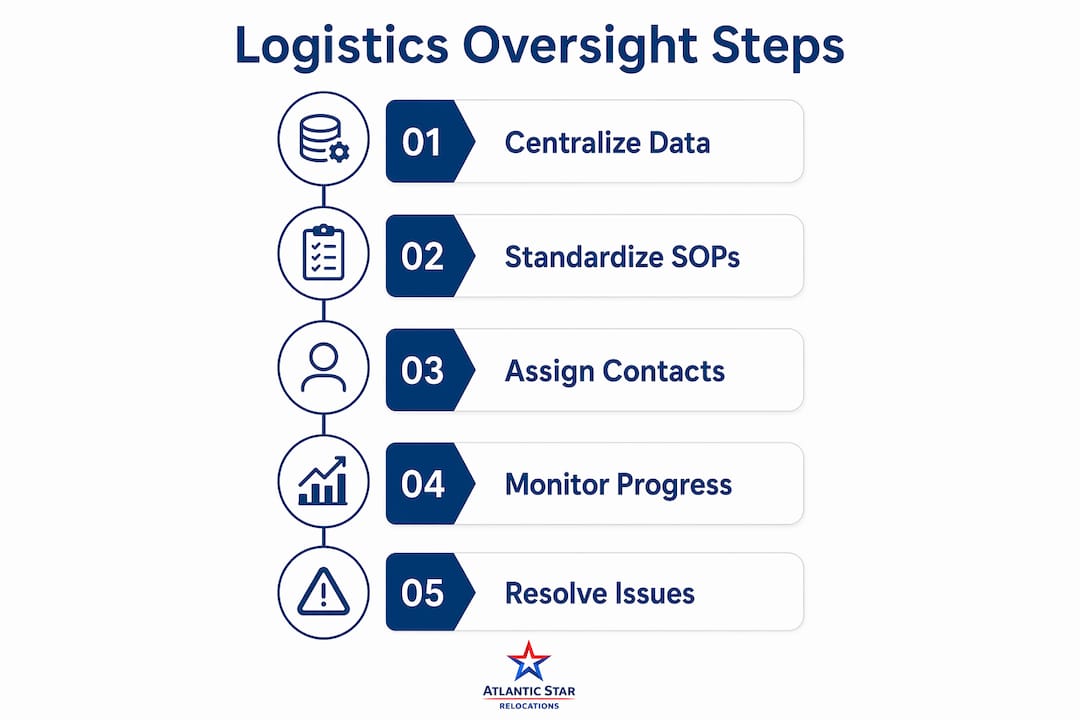
Pro Tip: Build your SOP library before the first truck rolls. Documenting site-specific variables, such as permit requirements in New Jersey or freight elevator rules in Manhattan high-rises, during the planning phase prevents costly surprises on move day.
What are the most common logistics challenges in multi-site moves?
Multi-location moves fail in predictable ways. Identifying these failure points is the first step toward preventing them.
- Overlapping vendor schedules. When two sites share the same carrier or crew, a delay at one site automatically delays the other. Oversight maps these dependencies in advance and builds buffer time into the sequence.
- Communication breakdowns. Without a central escalation path, site managers report problems to different people using different formats. Issues sit unresolved until they become crises.
- Stealth costs from building access restrictions. Loading dock hours, union labor rules, and elevator reservations drive costs that never appear in the original budget. Most move budget overruns trace back to these overlooked local restrictions, not the move itself.
- Cascading disruptions. A missed window at Site A pushes Site B's crew into overtime, which delays Site C's delivery. Oversight breaks this chain by synchronizing sequences and building contingency protocols before problems start.
Clear escalation paths are non-negotiable. Every site manager needs to know exactly who to call, what information to provide, and how quickly to expect a response. Vague escalation structures are where multi-site moves lose hours and money.
Pro Tip: Assign a single point of contact for each site who reports directly to the central coordinator. This eliminates the "I thought someone else handled it" problem that derails timelines on complex multi-location projects.
What technologies support logistics oversight in multi-site relocations?
Technology does not replace oversight. It makes oversight faster and more accurate.
Centralized ERP platforms that integrate inventory, finance, and transport modules give the central team real-time consolidated reporting. Rollout and reallocation tasks that previously required manual coordination across spreadsheets can move significantly faster when data lives in one system. Blind spots shrink because every site feeds the same data model.
Digital checklists and automated issue tracking are equally important at the site level. Checklist digitalization reduces errors by 75% and delivers 30% productivity gains while creating real-time audit trails. That audit trail matters when a client asks why a delivery was delayed or a vendor disputes a charge.
The table below compares two common oversight approaches by operational impact:
| Oversight approach | Reporting speed | Error rate | Budget visibility |
|---|---|---|---|
| Centralized platform with real-time dashboards | Same-day consolidated data | Reduced by digital checklists | Full cross-site view |
| Fragmented, site-by-site management | 4+ day consolidation lag | Higher due to manual handoffs | Partial, siloed by location |
Phased rollouts reduce resistance from local teams. Rolling out the oversight system to one site first, refining the process, and then expanding to remaining sites gives local managers time to build confidence in the tools. Change management is not a soft skill in multi-site logistics. It is a project risk that oversight must account for directly.
For a detailed look at how these workflows connect in practice, the multi-leg logistics coordination guide covers sequencing and dependency mapping across complex move projects.
Key Takeaways
Centralized logistics oversight is the single most effective way to protect budgets, timelines, and accountability across multi-site moves.
| Point | Details |
|---|---|
| Centralize data, not decisions | Push tactical execution to local teams while keeping budget and timeline control at the center. |
| Governance model matters | Hub-and-spoke structures prevent micromanagement while maintaining cross-site accountability. |
| Stealth costs are the biggest budget risk | Building access restrictions and union rules drive most overruns. Document them before move day. |
| Technology accelerates oversight | Digital checklists and ERP platforms reduce errors and deliver real-time visibility across all sites. |
| Standardized SOPs enable scale | Repeatable processes let you add locations without rebuilding your coordination model from scratch. |
What I've learned from watching multi-site moves succeed and fail
The pattern I see most often is this: operations executives invest heavily in planning the first site and treat the remaining locations as variations on the same theme. They are not. A commercial move in White Plains, New York operates under completely different building access rules than one in Midtown Manhattan or a warehouse relocation in Newark, New Jersey. Treating them identically is where oversight breaks down.
The executives who get this right do one thing differently. They connect local expertise with central visibility rather than choosing one over the other. They trust their site contacts to handle local variables while keeping budget authority and vendor coordination at the center. That balance is harder to build than any technology platform, but it is what separates a smooth 12-location rollout from a costly, chaotic one.
My recommendation for any logistics manager entering a multi-site project: build your escalation structure before you build your schedule. Know who owns each decision, at what level, and with what response time. The coordination challenges in multi-location moves are almost always people and process problems, not logistics problems. The trucks and the crews are the easy part.
— Admin
Atlanticstargroup's approach to multi-site logistics oversight
Atlanticstargroup specializes in exactly this kind of coordinated, accountable relocation work across Westchester County, New York City, Connecticut, New Jersey, and Florida. The team manages vendor selection, scheduling, compliance, and real-time issue resolution from a single point of accountability, so your operations team is not chasing updates across a dozen moving parts.

Whether you are coordinating a multi-office commercial move across Manhattan and the Bronx or managing a warehouse transition in Westchester, Atlanticstargroup provides the centralized oversight your project needs. The logistics coordination services include carrier-neutral vendor management, site-specific compliance planning, and real-time progress tracking. For projects that require on-the-ground execution support, office moving services cover the full scope from planning through final placement. Contact Atlanticstargroup for a consultation and project quote.
FAQ
What is logistics oversight in multi-site moves?
Logistics oversight in multi-site moves is the centralized coordination of budgets, timelines, vendors, and compliance across all locations in a relocation project. It prevents cascading disruptions by maintaining a single point of accountability and real-time visibility across every site.
Why does centralized oversight outperform site-by-site management?
Centralized operations carry higher operating margins and faster inventory turnover than distributed models, and they consolidate operational data significantly faster. That speed advantage translates directly into faster decisions and fewer costly delays during a move.
What are the biggest cost risks in multi-location moves?
Building access restrictions, including loading dock hours, elevator reservations, and union labor rules, are the leading source of budget overruns in multi-site relocations. Oversight addresses these by documenting site-specific variables during the planning phase before they become day-of surprises.
How does hub-and-spoke governance work in a relocation?
A central steering committee controls the budget, vendor contracts, and cross-site sequencing, while local teams manage site-specific execution. This structure prevents micromanagement while keeping accountability clear at every level of the project.
How can Atlanticstargroup help with multi-site logistics coordination?
Atlanticstargroup acts as a single point of accountability for multi-site moves across Westchester, NYC, and surrounding regions, managing vendor coordination, compliance, and real-time issue resolution from planning through final delivery.