

A multi-leg logistics coordination workflow is the process of managing shipments across two or more distinct transport segments by unifying planning, execution, and real-time monitoring into a single, event-driven operation. For logistics managers overseeing international moving and relocation projects, this is the difference between controlled delivery and costly chaos. Fragmented execution across carriers, modes, and borders creates visibility gaps that cascade into delays and doubled lead times. Atlanticstargroup applies this orchestration model across Westchester County, New York City, and long-distance relocation projects to keep complex moves on schedule and on budget.
What are the essential components of a multi-leg logistics coordination workflow?
Multi-stage transportation planning starts with a complete cargo definition. Before any carrier is contracted, logistics managers must know the exact dimensions, weight, fragility, and regulatory classification of every item being moved. Bespoke front-end engineering, including 3D cargo modeling and route surveys, is critical because no two multi-leg projects are identical. Pre-shipment planning catches obstacles like bridge height restrictions or road weight limits before they become field emergencies.

The second prerequisite is stakeholder alignment. Permits, customs documentation, and carrier contracts must be finalized before the first leg departs. Delays in permit acquisition at one stage block every subsequent leg.
The table below shows the core components every logistics coordinator must confirm before execution begins.
| Component | What it covers | Who owns it |
|---|---|---|
| Cargo engineering | Dimensions, weight, 3D modeling, route survey | Project coordinator |
| Regulatory permits | Oversize permits, customs clearance, local authority approvals | Compliance team |
| Carrier contracts | Mode selection, liability terms, insurance | Procurement lead |
| Milestone schedule | Leg-by-leg timing, buffer windows, escalation triggers | Operations manager |
| Real-time visibility platform | Tracking, exception alerts, centralized communication | Technology lead |
Real-time visibility tools are not optional. Automating tendering and centralizing multimodal data frees teams to focus on critical exceptions rather than manual status calls and email chains. Without a centralized platform, coordinators spend most of their time chasing updates instead of managing risk.
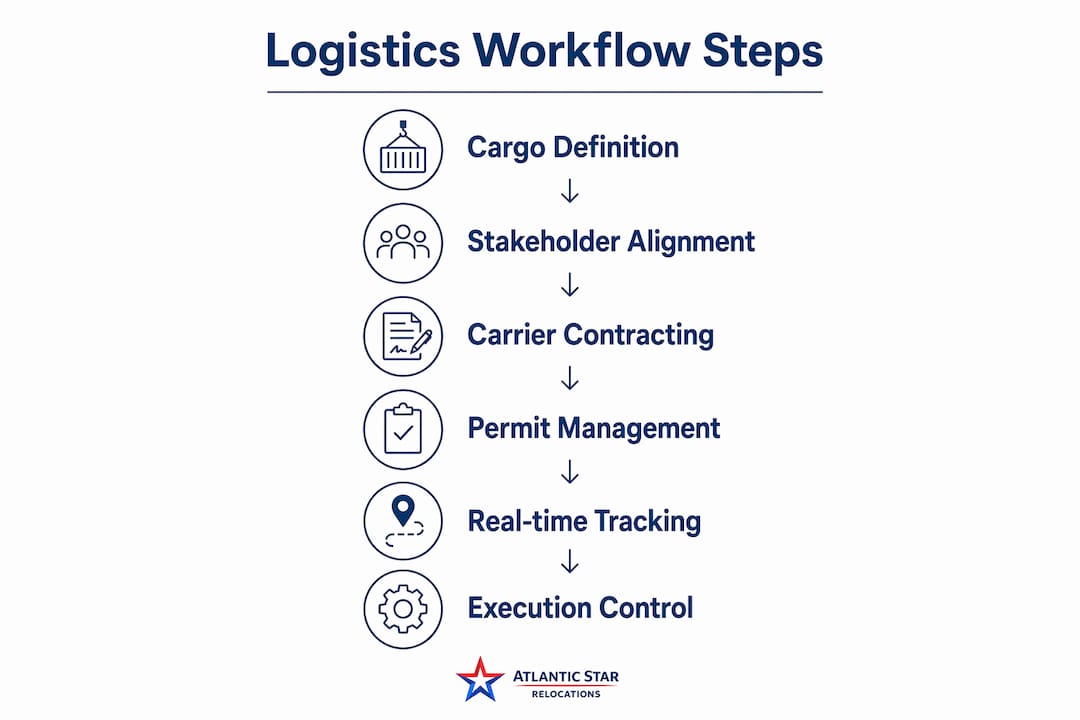
How to build a multi-stage transportation plan for complex moves
A structured five-step workflow governs multi-leg logistics projects for any cargo type, from standard commercial freight to oversized relocation shipments.
-
Cargo engineering and route feasibility. Map every physical constraint of the cargo against every route segment. Identify bridge clearances, weight limits, port access, and site entry restrictions before committing to a route.
-
Mode selection and carrier contracting. Choose transport modes based on cargo requirements, not cost alone. A relocation moving from Westchester to an international destination may require truck, ocean freight, and final-mile delivery by a specialized crew. Contract each carrier with clear liability terms for their leg.
-
Permit acquisition and scheduling. Secure all oversize permits, customs documentation, and local authority approvals in parallel, not sequentially. Sequential permitting is the most common cause of pre-departure delays on complex moves.
-
Coordinated execution with milestone controls. Assign a milestone owner for each leg transition. Every hand-off point needs a confirmed status before the next leg activates. Contingency playbooks for regulatory or environmental delays must be ready before departure, not drafted mid-shipment.
-
Final site delivery and proof of delivery (POD). The destination site must pass a readiness check before the final leg departs. Staged receiving readiness includes confirming that handling equipment, road access, and receiving personnel are in place.
Pro Tip: Build a minimum 20% time buffer into each leg transition window. Port-to-truck handoffs and customs clearance consistently run longer than planned, and a tight schedule with no buffer turns a minor delay into a project-wide crisis.
What are the common challenges in synchronizing multi-leg hand-off points?
Poor synchronization at transshipment points is the primary cause of multi-leg shipment delays. Centralized milestone controls and escalation paths prevent a single bottleneck from doubling the total lead time. The hand-off interval between modes is where liability shifts and visibility drops simultaneously. That combination is where most damage claims and detention charges originate.
The following practices close the most common synchronization gaps:
- Assign a single point of accountability for each hand-off, not a shared group inbox. One named person owns the transition and escalates within a defined time window.
- Require real-time status confirmation at every mode transition, not end-of-day reports. Waiting for weekly updates risks missing the critical 24-hour windows needed to adjust shipment timing.
- Document liability transfer explicitly in each carrier contract. Ambiguous liability terms at hand-off points create disputes that delay release of cargo.
- Pre-position contingency resources. Know which alternative carrier or storage facility is available if a leg fails. Atlanticstargroup maintains pre-vetted carrier networks across the Northeast, including New York City, New Jersey, and Connecticut, specifically to activate alternatives without losing time.
- Use exception-based alerts, not status polling. A platform that pushes alerts when a milestone is missed is faster than one that requires coordinators to log in and check.
Pro Tip: Treat every hand-off point as its own mini-project with its own checklist. The coordinators who manage multi-leg moves well are the ones who never assume the previous leg's team communicated anything to the next one.
Which coordination models improve efficiency in multi-leg logistics?
The connected logistics model is the current standard for workflow optimization in logistics. It replaces siloed email and phone chains with a single platform that automates tendering, centralizes multimodal data, and pushes real-time updates to all stakeholders. The practical result is that coordinators spend time on exceptions, not on gathering status information.
Moving from point-solution software to an event-driven execution layer transforms reactive firefighting into proactive control. Architectural disconnection between planning and execution is the biggest source of avoidable margin loss in complex logistics projects.
| Coordination model | How it works | Best suited for |
|---|---|---|
| Point solutions | Separate tools for each mode or function | Simple, single-mode shipments |
| Integrated orchestration | Single platform unifying all modes and milestones | Multi-leg, multi-mode projects |
| Connected logistics model | Automated tendering, centralized data, real-time alerts | High-volume or time-critical moves |
Atlanticstargroup uses an integrated coordination approach for multi-location moves across Westchester and NYC. Every carrier, schedule, and milestone feeds into a single oversight layer, so no leg operates in isolation.
Key Takeaways
A multi-leg logistics coordination workflow succeeds when planning, execution, and real-time milestone control operate as one connected system, not three separate processes.
| Point | Details |
|---|---|
| Front-end engineering is non-negotiable | Route surveys and 3D cargo modeling prevent field exceptions that cost more than the planning time saved. |
| Hand-off points carry the highest risk | Assign one named owner per transition and require real-time confirmation before activating the next leg. |
| Permits must run in parallel | Sequential permitting is the most common pre-departure delay; run all approvals simultaneously. |
| Contingency playbooks belong before departure | Draft regulatory and environmental delay responses before the first leg departs, not during a crisis. |
| Integrated platforms outperform point solutions | A single event-driven execution layer reduces margin loss and eliminates communication failures between modes. |
Why front-end planning is the most undervalued part of the workflow
Most logistics managers I work with focus their energy on execution. That instinct is understandable. Execution is where the pressure is visible. But the projects that run cleanly almost always trace their success back to what happened in the planning room, not on the road.
Treating project coordination as an engineering challenge rather than a procurement exercise changes everything. When you do a proper route survey before contracting a carrier, you find the bridge that would have stopped the truck at 2 a.m. on a Saturday. When you model the cargo in 3D before booking ocean freight, you find the container configuration that saves you a second booking.
The other thing I have seen consistently: teams that invest in contingency playbooks rarely need them. The act of building the playbook forces the team to identify every realistic failure point. That preparation changes how the team behaves during execution. They are not surprised. They are not reactive. They are already three steps ahead.
For moves in and out of New York City and Westchester, the regulatory environment adds another layer. Permit timing, building access windows, and traffic restrictions in Manhattan or the Bronx are not variables you manage on the fly. You plan for them, or they plan for you.
— Admin
Atlanticstargroup: coordinated logistics for complex moves
Logistics managers handling multi-leg relocation projects in Westchester County, New York City, and beyond need more than a carrier. They need a single point of accountability that owns the entire process from cargo engineering through final delivery.
Atlanticstargroup provides logistics coordination services built for exactly this type of project. The team manages permit acquisition, carrier selection, milestone scheduling, and real-time exception handling across every leg of a move. For organizations relocating offices, warehouses, or large-scale operations, Atlanticstargroup also offers corporate relocation services and short-term storage in NYC and Westchester to support staged receiving and delivery timing. Contact Atlanticstargroup to discuss your next multi-leg project.
FAQ
What is a multi-leg logistics coordination workflow?
A multi-leg logistics coordination workflow is the structured process of managing a shipment across two or more transport segments, unifying planning, carrier coordination, and real-time milestone tracking into one controlled operation.
What causes the most delays in multi-leg shipments?
Poor synchronization at hand-off points between transport modes is the leading cause of delays. Centralized milestone controls and named accountability at each transition prevent single bottlenecks from cascading across the entire project.
How does multi-stage transportation planning differ from standard shipping?
Multi-stage transportation planning treats each leg as an engineered segment with its own permit requirements, carrier contracts, and readiness checks, rather than booking a single carrier from origin to destination.
When should a logistics manager use an integrated coordination platform?
Any project involving two or more transport modes or crossing international borders requires an integrated platform. Point-solution tools create data silos that cause the visibility gaps responsible for most detention and demurrage charges.
How does Atlanticstargroup support multi-leg logistics projects?
Atlanticstargroup acts as a single point of accountability across all legs of a move, managing carrier selection, permit coordination, milestone control, and exception handling for relocation projects throughout Westchester, New York City, New Jersey, and Connecticut.