

The overseas moving process is a structured sequence of legal, logistical, and administrative steps that moves your household and family from one country to another with minimal disruption. Most families relocating from Westchester, New York City, or the surrounding tri-state area underestimate how many moving parts are involved. Visa compliance, IRS reporting requirements like the Foreign Earned Income Exclusion (FEIE), customs clearance, and international shipping timelines all run simultaneously. Getting any one of them wrong delays the rest. Atlanticstargroup works with families and individuals across this entire process, from pre-departure planning through final delivery and settlement.
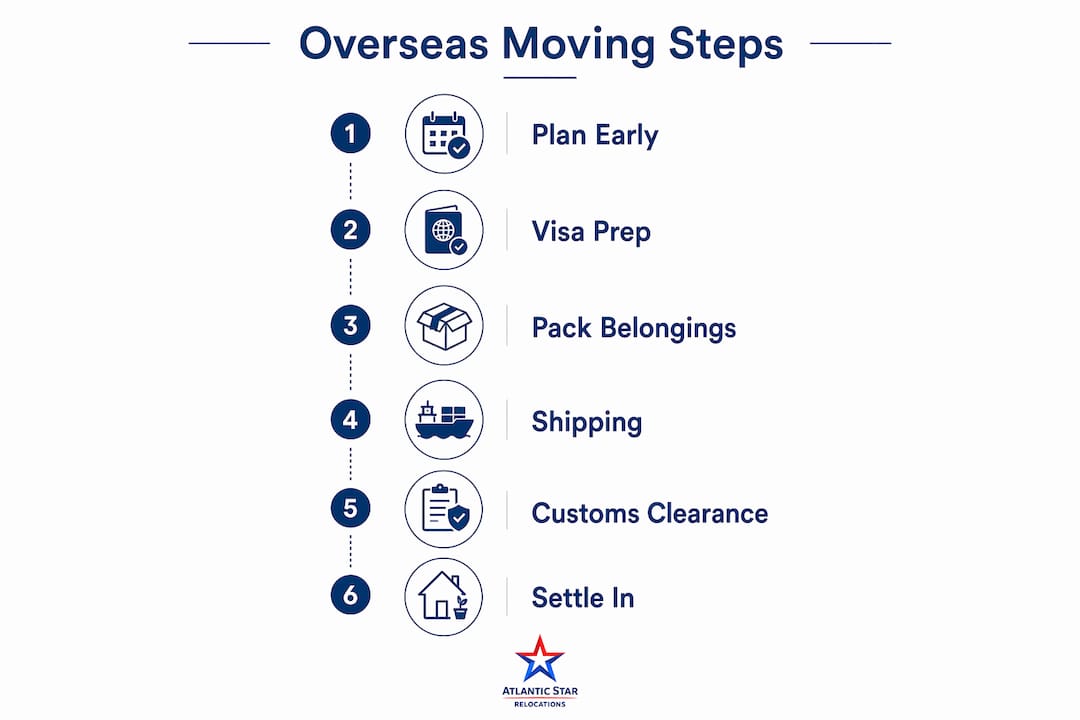
How does the overseas moving process work, step by step?
International relocation follows a defined sequence. Skipping steps or reordering them creates compounding problems that are expensive to fix.
-
Visa and immigration compliance. Start here before anything else. Visa and residency requirements vary widely by country, and some link a spouse's or child's residency directly to the primary applicant's work permit. Experienced expats recommend starting visa preparation 3–6 months before departure to avoid processing delays.
-
Financial and tax preparation. U.S. citizens living abroad still file U.S. taxes. For the 2026 tax year, Americans can exclude up to $130,000 of foreign-earned income under the FEIE if they meet specific presence or residence tests. Separately, any U.S. person with foreign bank accounts exceeding $10,000 must file FBAR annually via FinCEN Form 114. Missing this filing carries serious penalties. State taxes add another layer. Some states aggressively pursue tax obligations from former residents even after departure, so plan your domicile change carefully.
-
Deciding what to ship, store, or sell. Not everything should cross an ocean. Evaluate each item by replacement cost, sentimental value, and customs restrictions at your destination. Items you will not need for months are strong candidates for short-term storage rather than shipping.
-
Choosing shipping methods. International shipping by sea typically takes 4–8 weeks. Air freight is faster but costs significantly more. Your budget and destination determine the right mix. Most families use sea freight for household goods and air freight for essentials needed immediately upon arrival.
-
Booking professional movers and coordinating carriers. This step requires evaluating credentials, insurance coverage, and customs expertise. Atlanticstargroup coordinates multi-leg logistics across carriers, so you have one point of accountability rather than managing multiple vendors independently.
-
Arrival logistics. Register with local authorities, open a local bank account, obtain a local SIM card, and enroll children in schools. These steps take longer than most families expect.
Pro Tip: Start international school applications and housing searches 12–18 months before your move date. Preferred schools fill quickly, and late applications often result in waitlists.
What challenges should you expect when relocating overseas?
Most families feel the pressure not from the physical move itself but from navigating unfamiliar systems immediately after arrival. Healthcare enrollment, banking setup, and school registration all hit at once, and none of them work the way they do back home.
- Visa complexity for families. A spouse's right to work or remain in the country may depend entirely on the primary applicant's visa status. Confirm this before signing any lease or employment contract abroad.
- Bureaucratic timelines. Government offices in many countries process paperwork slowly. Build buffer time into every administrative deadline.
- U.S. financial access from abroad. Maintaining a U.S. phone number through a service like Google Voice preserves access to U.S. bank accounts and IRS two-factor authentication. This is one of the most underappreciated practical steps an expat can take.
- Children's emotional adjustment. Kids often handle the move itself well but struggle with the loss of their social network in the months that follow. Emotional preparation before departure and consistent family routines after arrival reduce this strain significantly.
- Reverse culture shock. Families who eventually return to the U.S. often find repatriation harder than the original move. Prepare children for this possibility from the start.
"Most families feel emotionally overwhelmed not by the move itself but by having to navigate unfamiliar systems immediately afterward. Adjustment to new administrative systems like healthcare, banking, and visas typically stabilizes after about six months." — The Hidden Realities of Relocating Abroad
Realistic expectations matter more than any checklist. Plan for things to take longer and cost more than your initial estimate.
What are the best practices for logistics and choosing professional movers?
Selecting the right moving company is the single decision that most affects how smoothly an international relocation runs. A premium mover does far more than transport boxes.
- Verify credentials and customs expertise. Ask specifically about customs clearance experience in your destination country. A company that has never cleared goods through your destination port is a liability, not an asset.
- Confirm insurance coverage. Standard carrier liability covers very little. Request full replacement value coverage for fragile and high-value items. Get the policy terms in writing before signing anything.
- Use professional packing services. Improper packing is the leading cause of damage claims on international shipments. Atlanticstargroup offers expert packing services specifically designed for long-distance and international moves.
- Track your shipment actively. Reputable carriers provide container tracking. Know your container number, vessel name, and estimated port arrival date. Delays at customs are common, and early awareness gives you time to respond.
- Coordinate timing across all legs. A shipment that arrives before you have a delivery address, or after your lease starts, creates expensive storage problems. Multi-leg coordination requires a single point of oversight.
Pro Tip: Request an itemized inventory list from your movers before the container is sealed. Customs agents in many countries require a detailed household goods declaration, and a mover-generated inventory is far more accurate than one you create from memory.
Managing overseas moves requires coordinating multiple domains simultaneously, including customs clearance, visa timing, and financial compliance, to avoid costly delays. A premium moving company handles this coordination so you do not have to.

What should families do in the first months after arriving abroad?
The post-arrival phase is where most international moves either stabilize or unravel. Families that treat the first three months as a structured project fare significantly better than those who improvise.
- Register with local authorities. Most countries require foreign residents to register with a municipal office within 30–90 days of arrival. Missing this deadline can affect your visa status.
- Register with the U.S. Embassy or Consulate. The State Department's Smart Traveler Enrollment Program (STEP) connects you to emergency alerts and consular services. It takes five minutes and is free.
- Open a local bank account. You need a local account to pay rent, utilities, and school fees. Bring your passport, visa, proof of address, and employment documentation to the bank.
- Enroll children in school and healthcare. Relocation success depends more on practical fit, like healthcare access and school policies, than on lifestyle ratings found on social media. Prioritize these enrollments above social activities in the first weeks.
- Build local routines and connections. Join expat groups, neighborhood associations, or community sports leagues. Social integration is the fastest path to feeling settled, and it matters as much for adults as it does for children.
Key Takeaways
A successful overseas relocation requires coordinated action across visa compliance, financial reporting, shipping logistics, and post-arrival administration, all managed in the correct sequence.
| Point | Details |
|---|---|
| Start visa prep early | Begin visa and document gathering 3–6 months before departure to avoid processing delays. |
| File U.S. tax obligations | Report foreign income under FEIE and file FBAR for foreign accounts over $10,000. |
| Match shipping to your timeline | Sea freight takes 4–8 weeks; use air freight only for items needed immediately on arrival. |
| Use professional packing and coordination | Improper packing and poor timing coordination are the top causes of damage and delays. |
| Prioritize post-arrival administration | Register with local authorities, open a bank account, and enroll children in school within the first 30 days. |
What I have learned from managing international moves
The families who handle overseas moves best share one trait: they treat the move as a project with a defined scope, not an adventure they will figure out as they go. I have seen highly organized people underestimate the administrative load that hits the moment they land, and I have seen families with modest budgets execute flawless moves because they planned every phase in advance.
The financial compliance piece surprises almost everyone. Most Americans moving abroad have no idea that FBAR exists until a tax professional raises it, often after the deadline has already passed. The IRS does not send reminders. You have to know to look.
For families with children, the emotional timeline matters as much as the logistical one. Kids need to know the plan, understand why the family is moving, and have something concrete to look forward to at the destination. That preparation does not happen in the week before departure. It happens over months of honest conversation.
My strongest advice: hire a company that manages the full process under one roof. Coordinating a visa attorney, a shipping broker, a customs agent, and a local delivery crew independently is a full-time job. Atlanticstargroup handles that coordination so families can focus on the transition itself.
— Admin
How Atlanticstargroup supports your international relocation
Atlanticstargroup specializes in managed relocations for families and individuals moving from Westchester, New York City, New Jersey, and Connecticut to destinations worldwide.

The team handles logistics coordination across every phase, from pre-departure packing and storage to carrier management, customs documentation support, and final delivery. For families who need flexible help, labor-only moving services are available for loading, unloading, and unpacking at both the origin and destination. Every move is managed under a single point of accountability, which means no dropped handoffs between vendors and no surprises at the port. Request a personalized quote directly through Atlantic Star Relocations to get a plan built around your specific destination, timeline, and household size.
FAQ
How long does an overseas move typically take?
Door-to-door international moves take 6–12 weeks on average when using sea freight. Air freight reduces transit time to 1–2 weeks but at a significantly higher cost.
What documents do I need to move overseas from the U.S.?
You need a valid passport, destination country visa, household goods inventory for customs, and proof of residency or employment abroad. Tax-related documents like FBAR and FEIE forms are filed separately with the IRS.
Do I still pay U.S. taxes after moving abroad?
Yes. U.S. citizens pay federal taxes on worldwide income regardless of where they live. The FEIE allows you to exclude up to $130,000 of foreign-earned income for the 2026 tax year if you qualify.
How far in advance should I start planning an overseas move?
Start planning 12–18 months before your target departure date if you have children requiring school enrollment. Visa preparation alone requires 3–6 months in most cases.
Can I store belongings in the U.S. while living abroad?
Yes. Short-term and long-term storage options are available through Atlanticstargroup for households that are not ready to ship everything at once or need a staging point during the transition.