

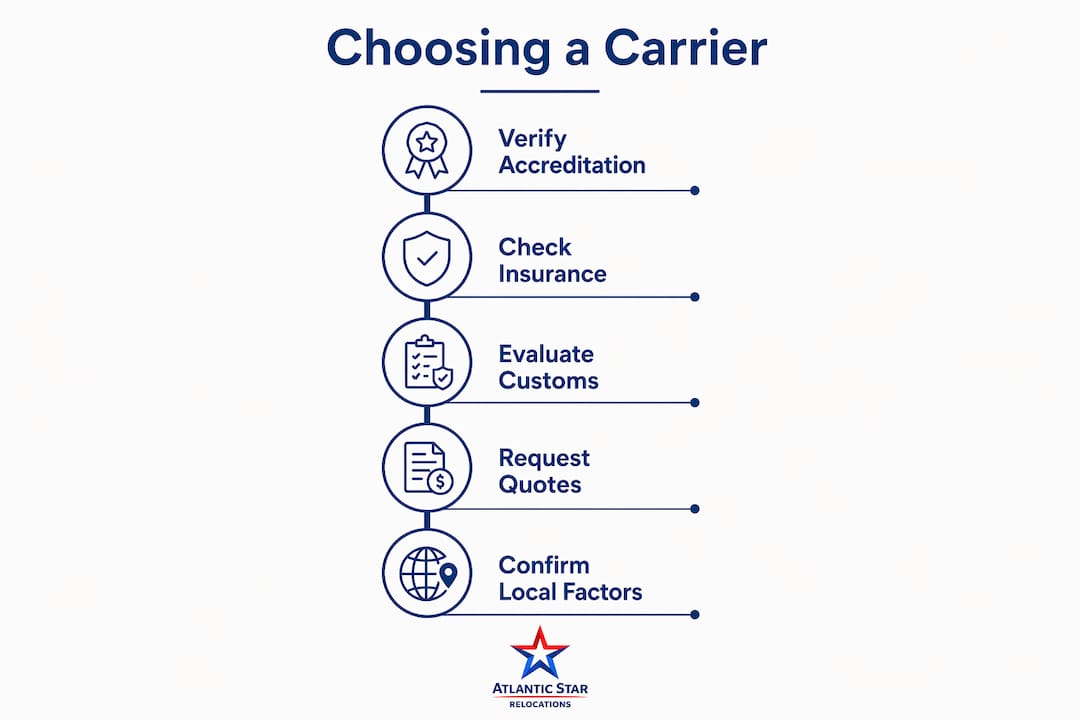
Selecting the right international moving carrier is defined by three non-negotiable factors: verified accreditation, written insurance coverage, and proven customs clearance expertise. Get all three right, and your shipment clears borders on schedule. Miss any one of them, and you face delayed containers, unexpected fees, and damaged goods with no clear recourse. For individuals and businesses relocating from Westchester County, New York City, and the surrounding metro area, the stakes are especially high. Atlanticstargroup works with clients across this region every day, and the patterns of costly mistakes are consistent and preventable.
How to choose an international moving carrier: start with accreditation
Accreditation is the fastest way to separate professional international carriers from unreliable ones. The industry's gold standard is the FIDI Global Alliance, whose FAIMPlus certification requires rigorous audits of financial, operational, and safety standards. That means every FIDI-audited company has passed independent reviews of its cargo handling, financial stability, and crew training. Non-accredited companies face none of these checks, which is why they can underinsure cargo or use untrained destination crews without consequence.

The International Association of Movers (IAM) is a second credible benchmark. IAM membership signals that a company operates within a professional network with shared accountability standards. Neither FIDI nor IAM membership guarantees perfection, but both guarantee audited compliance to quality benchmarks that unaffiliated carriers simply do not meet.
Verifying credentials takes less than five minutes. Check the FIDI and IAM websites directly, search the carrier's name in their member directories, and confirm the certification is current, not expired.
Key accreditation signals to verify before signing anything:
- Active FAIMPlus or FIDI membership with a current audit date
- IAM membership listed on the carrier's official profile
- Proof of professional liability and cargo insurance on file
- Named destination agents in your target country, not just vague "partner networks"
- A physical office address, not a P.O. box or virtual listing
Pro Tip: Ask the carrier to send you their FIDI certificate directly. A legitimate company will provide it within 24 hours. Hesitation or deflection is a red flag.
What insurance coverage should you demand from an international mover?
Insurance is where most clients make their most expensive mistake. Basic liability coverage, the default on most international quotes, covers only a fraction of your shipment's actual value. Full-value protection offers significantly more financial security and is the only coverage worth accepting for ocean transit shipments.
The critical rule: get every insurance term in writing before you sign. Verbal promises about coverage limits, claim processes, and reimbursement timelines are unenforceable. Requesting full-value protection in writing is the single most protective step you can take before your shipment leaves port.
Questions to ask every carrier about insurance:
- What is the per-item and total shipment coverage limit?
- Does coverage apply door to door, or only while cargo is in transit?
- What is the claims process, and what is the average resolution time?
- Are high-value items like art, antiques, or electronics covered under the standard policy?
- Is additional coverage available, and at what cost per $1,000 of declared value?
Pro Tip: Request a sample claims form before you commit. A carrier that makes claims paperwork hard to access before a move will make it even harder after one.
How do customs clearance capabilities impact your international move?
Customs clearance is the single biggest logistical risk in any international relocation. Incomplete or incorrect paperwork causes shipments to be held at customs ports for extended periods, with daily storage and detention fees accumulating fast. A two-week customs hold on a full container can cost thousands of dollars in fees alone.
The documents most commonly required include a detailed household goods inventory, valid visas or residency permits for the destination country, proof of prior residence, and in some cases a customs bond. Preparing a thorough home moving inventory before your move date is one of the most practical steps you can take to prevent customs delays.
One fact that surprises many clients: moving companies cannot legally perform all customs broker tasks in every country. In Canada, for example, some import regulations require personal presence or a licensed broker, not just company-submitted paperwork. A carrier that claims it handles "everything" without disclosing these limits is either uninformed or misleading you.
A reliable international carrier gives you written guidance on import regulations for your destination country at least four weeks before your move date. If a company cannot provide that guidance in writing, treat it as a disqualifying factor.
The steps that protect you at customs:
- Request a written customs checklist from your carrier specific to your destination country.
- Prepare a room-by-room inventory with item descriptions and estimated values.
- Confirm whether your destination country requires a licensed customs broker separate from your mover.
- Gather all personal documents: passport copies, visas, proof of prior address, and employment or residency letters.
- Ask your carrier to confirm the port of entry and any country-specific prohibited items before packing begins.
What practical steps help you vet international moving carriers effectively?
Evaluating carriers requires more than reading online reviews. The process starts with getting at least three detailed quotes, each based on an in-home or virtual survey of your belongings. Quotes generated without a survey are estimates at best and traps at worst.
Transparent, itemized quotes covering customs duties, taxes, port fees, and destination charges are the mark of a professional carrier. Any quote that bundles all costs into a single line item without explanation deserves a follow-up request for a full breakdown.
Practical vetting steps in order:
- Schedule in-home or virtual surveys with at least three carriers before requesting quotes.
- Compare line-item breakdowns, not just totals. Look for port charges, destination fees, and access surcharges.
- Evaluate response time and communication quality. Slow replies before the sale predict worse service after it.
- Confirm packing services, storage options, and delivery windows are included or clearly priced as add-ons.
- Check third-party review platforms for patterns in complaints, specifically around billing surprises and claims handling.
Pricing signals worth knowing:
- Mid-range quotes are generally more trustworthy than the highest or lowest bids. Extreme low quotes often indicate hidden fees or poor carrier relationships at the destination.
- The highest quote does not automatically mean the best service. Ask what specifically justifies the premium.
- A flat rate structure with clearly defined inclusions protects you better than an hourly or weight-only estimate for international moves.
What local factors matter for Westchester and NYC clients choosing international carriers?
Moving internationally from New York City or Westchester County adds a layer of local logistics that many carriers overlook. NYC building requirements around move days, including certificates of insurance (COI), elevator reservations, and loading dock access, directly affect your international move timeline. A carrier unfamiliar with these requirements can delay your container loading date by days.
Atlanticstargroup coordinates these local logistics as part of its managed relocation process, working with building management, scheduling elevator access, and sourcing trusted packing services in NYC to prepare shipments correctly before they reach the port.
Local factors that affect international move coordination from this region:
- Building COI requirements in Manhattan, Brooklyn, and Queens often require 7–14 days of advance notice to building management.
- Westchester County residential moves may require street permits for large trucks in certain municipalities.
- Consolidated move scheduling reduces costs for clients whose container departure dates allow for flexible loading windows.
- Trusted local labor and fragile item packing specialists reduce the risk of damage claims before goods even reach the port.
- Working with a carrier that has established relationships with local crews in the Westchester and NYC metro area removes a major coordination burden from the client.
Key Takeaways
Choosing a reliable international moving carrier requires verified accreditation, written full-value insurance, and proven customs expertise before any contract is signed.
| Point | Details |
|---|---|
| Verify accreditation first | Confirm active FIDI or IAM membership before requesting a quote. |
| Demand written insurance | Full-value protection in writing is the only coverage that protects ocean transit shipments. |
| Assess customs expertise | Ask for a written customs checklist specific to your destination country at least four weeks out. |
| Compare itemized quotes | Mid-range, line-item quotes are more trustworthy than bundled or extreme-priced bids. |
| Account for local logistics | NYC and Westchester building requirements affect container loading timelines and must be planned in advance. |
What I've learned from years of coordinating international moves
The most common mistake I see clients make is treating accreditation as a formality. They find a carrier with a polished website, get a competitive quote, and skip the credential check entirely. Then the shipment arrives at the destination port with no trained agent to receive it, or the insurance claim gets denied because the policy only covered transit and not port storage.
The second mistake is assuming the carrier handles customs. I have spoken with clients who arrived at their destination country only to discover they needed a licensed customs broker they had never hired. Their carrier had implied it would "take care of everything" without disclosing the legal limits of what it could actually do.
The carriers I trust are the ones that give clients bad news early. They tell you upfront that your destination country requires a personal appearance at customs. They flag that your building's COI requirement adds a week to the loading schedule. That kind of proactive communication is rare, and it is the clearest signal that a company treats your move as a responsibility rather than a transaction.
— Admin
Atlanticstargroup's approach to international relocation coordination
Atlanticstargroup manages international relocations for individuals and businesses across Westchester County, New York City, Manhattan, Brooklyn, Queens, and the broader metro area. The team coordinates logistics and customs documentation from the first planning call through final delivery, acting as a single point of accountability so nothing falls through the cracks between local loading and overseas arrival.
For corporate clients, Atlanticstargroup's corporate relocation services include carrier vetting, insurance review, customs preparation, and building compliance coordination. Every quote is itemized, every carrier is vetted, and every client gets written guidance on what to expect at each stage. Request a consultation to get a clear, honest assessment of your international move.
FAQ
What does FIDI certification mean for international movers?
FIDI certification requires carriers to pass independent audits of their financial stability, operational quality, and safety standards. It is the most rigorous accreditation in the international moving industry.
How do I know if my international moving quote is complete?
A complete quote lists port fees, destination charges, customs duties, packing costs, and storage fees as separate line items. Any quote that bundles all costs without explanation requires a detailed breakdown before you sign.
Can my moving company handle customs clearance for me?
Moving companies can guide you through customs paperwork, but they cannot legally replace a licensed customs broker in every country. Always confirm what your carrier can and cannot do at your specific destination.
What is the difference between basic liability and full-value protection?
Basic liability covers only a minimal amount per pound of goods, often far below actual value. Full-value protection reimburses the full replacement cost of lost or damaged items and must be requested in writing.
Why does my NYC building affect my international move timeline?
NYC buildings require certificates of insurance, elevator reservations, and loading dock access that must be arranged days or weeks in advance. Missing these requirements can delay your container loading date and push back your entire departure schedule.