

The home moving inventory process is the systematic method of documenting every item you own before a relocation, creating a detailed record that protects your belongings, supports insurance claims, and makes unpacking far less chaotic. Whether you are moving from a Westchester County home to Manhattan or relocating from Brooklyn to New Jersey, a proper household inventory, also called a contents schedule in the insurance industry, is the single most effective tool for a controlled, accountable move. This guide gives you the exact steps, tools, and expert tips to build one that actually works.
What are the key steps in the home moving inventory process?
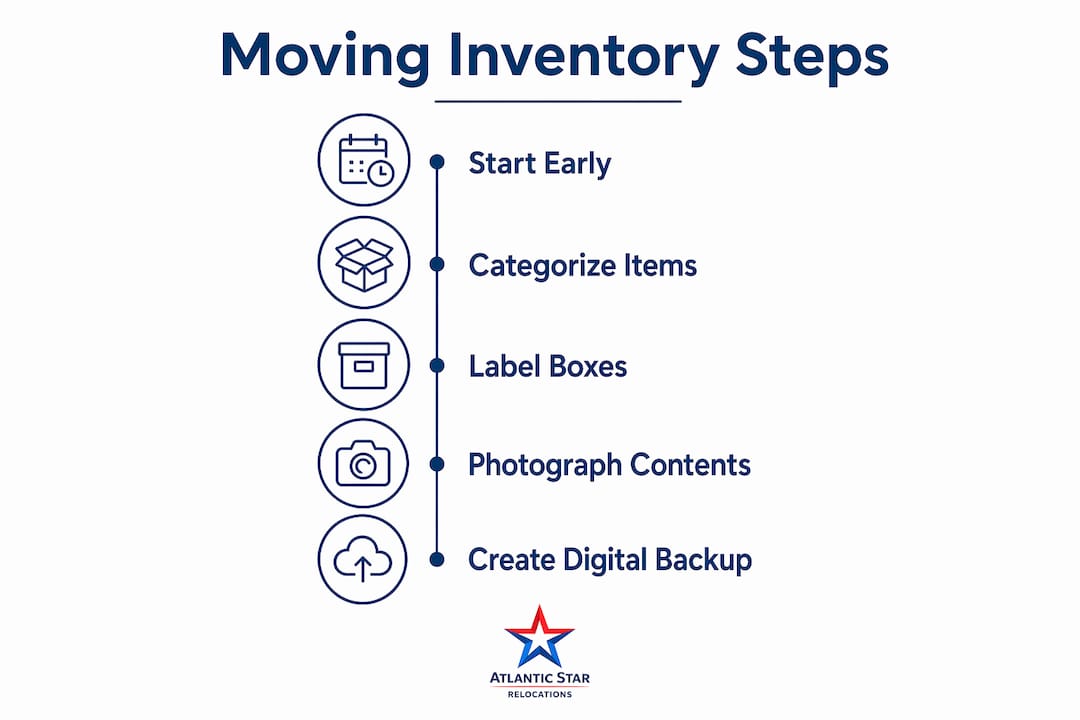
The home moving inventory process works best when it starts early. Begin 8 to 12 weeks before your move date, using that window to declutter, categorize, and document before a single box is packed. Starting this late is the most common mistake movers in Westchester and NYC make, and it costs them hours of backtracking on moving day.
Follow these steps in order:
- Declutter by room first. Walk through each room and decide what moves, what sells, and what gets donated. Reducing volume before you inventory saves time and lowers your moving costs.
- Organize by room and function. Grouping items by room improves packing flow and makes it far easier to locate specific items after delivery. Label each category clearly: "Master Bedroom," "Kitchen," "Home Office."
- Record detailed item descriptions. For every significant item, your packing inventory list should capture the brand, model, serial number, purchase date, and estimated replacement value. High-value items such as electronics, jewelry, and art require individual entries. Lower-cost items can be grouped.
- Assign unique box identifiers. Use a system like "MB-1" for Master Bedroom box one, "KIT-3" for Kitchen box three. Unique IDs per box connect your physical boxes directly to your master list, eliminating guesswork.
- Photograph and video everything. Shoot the contents of each box before sealing it. Photograph high-value items individually, capturing any pre-existing scratches or damage. This documentation is critical if you need to file an insurance claim.
- Update as you pack, not after. Document contents while packing and label boxes before sealing them. Inventorying after the fact multiplies errors and workload significantly.
Pro Tip: Link each box number directly in your master inventory spreadsheet as you pack. This prevents you from opening sealed boxes later just to verify what is inside.
How do digital tools compare with paper methods for moving inventories?

The choice between digital and paper inventory methods is not purely a matter of preference. It has real consequences for accuracy, coordination, and insurance protection.
| Method | Advantages | Limitations |
|---|---|---|
| Digital apps and spreadsheets | Searchable, supports photos and video, cloud backup, shareable with movers | Requires a device and internet access |
| Paper lists | Tangible, no tech required, works offline | Easily lost, damaged, or illegible; hard to share |
| Hybrid approach | Combines offline accessibility with digital redundancy | Requires maintaining two systems |
Digital tools like Google Sheets, Notion, or dedicated moving apps allow you to attach photos directly to item entries, share the list with your moving coordinator in real time, and access everything from your phone on moving day. For complex moves across Westchester County or into Manhattan, that real-time coordination matters enormously.
Paper methods have one genuine advantage: they work without power or connectivity. But a paper list left on a moving truck is a paper list you may never see again. The industry standard is physical and digital backups used together, not one or the other.
The hybrid approach is the right call for most homeowners and renters. Keep a printed copy in your personal bag and maintain a cloud-synced digital version accessible from any device. This covers every scenario, from a dead phone battery to a misplaced binder.
What inventory tips protect your belongings and your insurance claim?
A well-prepared inventory is not just an organizational tool. It is a risk management asset that directly determines how quickly and fully an insurance claim gets resolved after loss or damage.
Here are the practices that separate a useful inventory from a useless one:
- Never pack before you inventory. Packing first and documenting later is the fastest way to create an inaccurate record. Inventory as you go, box by box.
- List high-value items individually. Electronics, instruments, fine art, and jewelry each need their own entry with serial numbers and replacement costs. Grouped entries will not satisfy most insurance adjusters.
- Keep the master list with you. Your moving checklist should travel in your personal bag or car, never on the moving truck. If the truck is delayed or damaged, you still have your records.
- Photograph pre-existing damage clearly. A scratch on a dresser that existed before the move must be documented with a date-stamped photo. Without it, you cannot prove the damage was not caused in transit.
- Store copies offsite and in the cloud. Email yourself the final inventory, save it to Google Drive or iCloud, and keep a printed copy at a trusted address. Three copies in three locations is not excessive for a long-distance move.
- Update your inventory after major purchases. Integrating inventory updates into regular financial review cycles, such as tax season, keeps your home contents schedule accurate year-round.
Pro Tip: Use your phone's camera to record a slow walkthrough video of each room before packing begins. This creates a timestamped visual record that supplements your written list and is often more persuasive in insurance disputes.
How to integrate your inventory into the full moving workflow
A moving inventory list does not stop being useful once the boxes are packed. It becomes the operational backbone of your entire move, from loading day through final unpacking.
- Label boxes with inventory IDs and destination rooms. Every box should show its unique ID and the room it belongs in at the new address. This tells movers exactly where each box goes without you directing traffic all day.
- Cross-check at loading. As movers load the truck, verify each box ID against your master list. This takes minutes and catches missing items before the truck leaves.
- Document damage immediately at delivery. Photograph any damaged boxes or items the moment they come off the truck, before signing any delivery paperwork. Date-stamped photos taken on delivery day carry significant weight in claims.
- Use the inventory to guide unpacking. Unpack by priority, using your list to identify which boxes contain daily essentials versus items that can wait. This turns a chaotic first night into a manageable one.
- Communicate your inventory system to your movers. Atlantic Star Relocations coordinates directly with clients on inventory documentation, so crews know the labeling system before they arrive. This eliminates confusion on busy NYC and Westchester moving days.
- Update your home insurance after the move. Your new home may have different coverage requirements. Use your completed inventory to review and adjust your policy with your insurer.
| Workflow stage | Inventory action |
|---|---|
| Packing | Record items, assign box IDs, photograph contents |
| Loading day | Cross-check boxes against master list |
| Delivery | Verify all IDs received, photograph damage immediately |
| Unpacking | Use inventory to prioritize and locate items by room |
Key takeaways
A complete home moving inventory, built room by room with unique box IDs, photographic documentation, and digital backups, is the most reliable way to protect your belongings and accelerate any insurance claim during a relocation.
| Point | Details |
|---|---|
| Start 8 to 12 weeks early | Early preparation allows time for decluttering, categorizing, and thorough documentation. |
| Inventory while packing | Documenting contents before sealing boxes prevents errors and saves significant time later. |
| Use unique box IDs | Assigning identifiers like "MB-1" connects physical boxes to your master list without guesswork. |
| Maintain digital and physical backups | Cloud storage plus a printed copy covers every scenario, from tech failure to truck delays. |
| Keep the master list with you | Your inventory should travel in your personal bag, never on the moving truck. |
Why most people get the inventory process wrong
I have worked with hundreds of families relocating across Westchester County, Manhattan, and into Connecticut and New Jersey. The single most consistent mistake I see is treating the inventory as an afterthought. People pack for a week, then try to reconstruct a list from memory. That list is always incomplete, and it always causes problems, either at delivery or during an insurance claim.
The second mistake is underestimating how much a clear labeling system matters on moving day. In a busy NYC building with elevator time restrictions and a crew that has three more jobs after yours, a box labeled "Misc" creates real delays. A box labeled "LR-4: Living Room, lamps and cables" gets placed correctly in under ten seconds.
Digital tools have genuinely changed what is possible here. A shared Google Sheet that your moving coordinator can access in real time is not a luxury. For moves involving storage coordination or multi-leg logistics, it is the only way to maintain accountability across every stage. I recommend clients at Atlantic Star Relocations start their digital inventory the same day they book their move, not the week before.
The inventory is also your best protection against a dispute with any carrier. A detailed, timestamped record of item condition before loading removes ambiguity entirely. That peace of mind is worth every hour you spend building it.
— Admin
Let Atlantic Star Relocations manage your move from day one
Atlantic Star Relocations works with homeowners and renters across Westchester County, New York City, Manhattan, Brooklyn, Queens, and beyond to manage every stage of a relocation, including inventory coordination, packing oversight, and carrier management.

When you work with Atlantic Star Relocations, your moving coordinator integrates directly with your inventory system, so crews arrive knowing your labeling structure, your priority boxes, and your delivery sequence. For clients moving from Westchester into NYC or relocating long distance to Florida or New Jersey, that structured oversight eliminates the chaos that comes with unmanaged moves. Request a personalized moving quote today and get a team that treats your inventory as seriously as you do.
FAQ
What is the home moving inventory process?
The home moving inventory process is the practice of systematically documenting every item in your home before a relocation, including descriptions, photos, and box identifiers. It supports organized packing, accurate delivery checks, and insurance claim documentation.
When should I start my moving inventory?
Start your inventory 8 to 12 weeks before your move date. This timeline gives you enough room to declutter, categorize belongings by room, and document everything before packing begins.
What details should a moving inventory include?
Each entry should capture the item description, brand, model, serial number, purchase date, and estimated replacement cost. High-value items require individual entries; lower-cost items can be grouped by category.
Should I use a digital app or a paper list?
Use both. Digital tools like Google Sheets offer searchability, photo attachments, and cloud backup, while a printed copy provides offline access. Physical and digital backups together represent the industry standard for secure, accessible records.
How does an inventory help with insurance claims?
A detailed inventory with photos and replacement values gives your insurer the documentation needed to process a claim quickly. Without it, proving loss or damage after a move becomes a matter of memory rather than evidence.