

A moving broker is a licensed intermediary that arranges transportation of household goods by connecting customers with authorized moving carriers, without owning trucks or employing movers directly. Understanding what is a moving broker matters because millions of Americans hire one every year without realizing it. The Federal Motor Carrier Safety Administration (FMCSA) requires all moving brokers to register and use only FMCSA-registered interstate carriers. Knowing this distinction protects you from surprise fees, scams, and the frustration of a move gone wrong.
What does a moving broker do during the moving process?
A moving broker acts as a coordinator and middleman between you and the actual moving carrier. The broker arranges transportation but does not own the trucks, hire the crew, or physically handle your belongings. Think of a broker the way you think of a travel agent: they book the service, but they do not fly the plane.
Here is what a moving broker typically handles:
- Carrier sourcing. Brokers maintain networks of carriers and match your move to an available, registered mover.
- Estimate coordination. They gather pricing information and present you with a quote based on carrier tariffs.
- Bundled services. Brokers can bundle services like auto shipping, packing, and climate-controlled storage that a single carrier may not offer.
- Paperwork and compliance. Brokers are legally required to provide FMCSA's "Your Rights and Responsibilities When You Move" booklet and a written list of the carriers they use.
- Scheduling. They coordinate pickup and delivery windows between you and the assigned carrier.
That last point about the booklet matters. Failure to provide it is a red flag that signals either a scam operation or a company cutting corners on compliance.
Pro Tip: Ask your broker for the name and USDOT number of the specific carrier assigned to your move before you sign anything. A legitimate broker provides this without hesitation.

For moves involving multiple stops or complex logistics, a move coordinator role offers a useful comparison point for understanding how professional oversight differs from simple brokerage.
What are the benefits and risks of using a moving broker?
Moving broker services offer real advantages in specific situations, but they carry risks that catch many customers off guard.
Benefits worth knowing
- Wider carrier network. Brokers access thousands of carriers, which helps during peak summer months or for moves to rural areas where availability is limited.
- Bundled convenience. A broker can coordinate auto transport, storage, and residential moving under one contract, saving you multiple phone calls and separate agreements.
- Competitive pricing options. In off-peak seasons, brokers sometimes negotiate lower rates by filling carrier capacity.
Risks you cannot ignore
- Non-binding estimates. Initial broker estimates are not binding because brokers have no control over what carriers ultimately charge. Many customers treat the quote as a fixed price and face sticker shock on moving day.
- Hidden fees. Low quotes from brokers often do not reflect final costs. Carriers may add charges for stairs, long carries, or weight overages that the broker never disclosed.
- Reduced accountability. When something goes wrong, you may find yourself caught between the broker and the carrier, with neither accepting full responsibility.
- Deposit risks. Some brokers collect large upfront deposits and then assign your move to a carrier you never vetted.
Transparency is the biggest concern in moving brokerage. Consumers who insist on carrier details upfront avoid most of these problems.
Pro Tip: Before paying any deposit, request the carrier's USDOT number and verify it on the FMCSA's SaferSys database at safer.fmcsa.dot.gov. This takes two minutes and can save you thousands.
How can you tell a moving broker from a moving company?
A moving company, also called a carrier, owns its trucks and employs its movers. A broker owns neither. This distinction changes who is legally responsible for your belongings during transit.
Key differences at a glance
| Factor | Moving broker | Moving carrier |
|---|---|---|
| Owns trucks | No | Yes |
| Employs movers | No | Yes |
| Handles your goods | No | Yes |
| Bound by your estimate | No | Yes (binding estimate) |
| Must disclose carrier info | Yes | N/A |
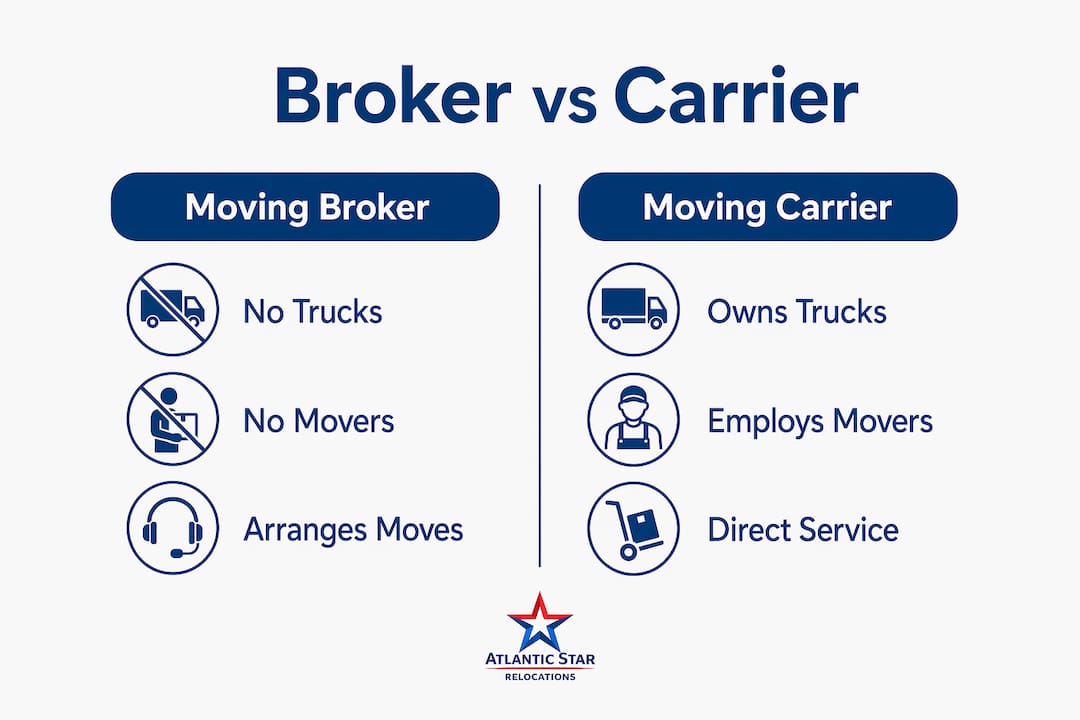
To verify which type of company you are dealing with, use the FMCSA's online lookup tool. Every legitimate carrier and broker holds a USDOT number. Carriers provide it readily when asked; brokers sometimes deflect or delay. That deflection is your signal to ask harder questions.
Broker status also shows up in contracts and advertising. Federal regulations require brokers to identify themselves as brokers in all written agreements. If a contract does not include that disclosure, ask directly before signing.
Pro Tip: Call the company and ask: "Can you give me the USDOT number of the truck that will handle my move?" A carrier answers immediately. A broker who cannot answer this question before your move date is a problem.
When should you use a broker versus hiring a carrier directly?
The right choice depends on your specific move. Brokers add value in some situations and create unnecessary friction in others.
Situations where a broker makes sense
- You need auto transport combined with household moving and want one point of contact.
- You are moving to or from a rural area where carrier availability is limited.
- Your move involves multi-location coordination across several stops or states.
- You are moving during peak season (june through august) and need help securing availability.
Situations where hiring a carrier directly is better
- You want a single responsible party for your move with no middleman.
- You need a binding estimate with no pricing surprises.
- You are moving locally within Westchester County, New York City, Manhattan, Brooklyn, or Queens, where direct carriers are readily available.
- You value direct communication with the crew handling your belongings.
Using carriers directly provides more accountability and straightforward pricing. For local moves in Westchester and NYC, working with a direct mover like Atlanticstargroup eliminates the broker layer entirely and gives you one accountable team from start to finish.
Key Takeaways
A moving broker arranges your move through licensed carriers but holds no direct responsibility for the physical handling of your goods, making verification and transparency non-negotiable before you sign.
| Point | Details |
|---|---|
| Broker definition | A broker arranges carriers but does not own trucks or employ movers. |
| FMCSA registration | All brokers must be FMCSA-registered and use only registered carriers. |
| Estimate risk | Broker quotes are not binding; final costs depend on carrier tariffs. |
| Verification step | Always request the carrier's USDOT number before signing or paying a deposit. |
| Direct carrier advantage | Hiring a carrier directly gives you one accountable party and clearer pricing. |
What I have learned about moving brokers after years in this industry
The broker model is not inherently bad. For complex, multi-service moves, a well-run broker operation genuinely solves problems that a single carrier cannot. The trouble is that the model also creates a perfect environment for low-effort operators to collect deposits and pass accountability to someone else.
What I see most often is this: a customer gets a quote that sounds too good, pays a deposit, and then gets a call from an unfamiliar carrier on moving day with a revised price. By that point, their belongings are already loaded. The broker is unreachable or unhelpful. That scenario is not rare. It is common enough that the FMCSA dedicates significant resources to consumer education about it.
The fix is not to avoid brokers entirely. The fix is to treat every moving quote the way you would treat a contract, because it is one. Verify the carrier. Read the disclosure documents. Never pay a deposit larger than what you are comfortable losing if things go sideways.
Working with a company like Atlanticstargroup, which operates as a direct service provider with full accountability, removes that uncertainty. You know who is handling your move, what the price is, and who to call if something needs to be resolved. That clarity is worth more than a low estimate that evaporates on moving day.
— Admin
Atlanticstargroup: direct moving services for Westchester and NYC
Atlanticstargroup provides full-service residential and commercial moving across Westchester County, New York City, Manhattan, Brooklyn, Queens, the Bronx, Connecticut, New Jersey, and Florida. Unlike a broker, Atlanticstargroup acts as a single point of accountability, managing every step from planning through final delivery.

Their house moving services cover local and long-distance relocations with transparent, flat-rate pricing and no surprise fees on moving day. For clients who need flexible support, labor-only moving help is available across New York, New Jersey, and Connecticut. Storage, packing, and logistics coordination round out a full-service portfolio built for clients who want clarity and control, not a middleman.
FAQ
What is the moving broker definition under federal law?
A moving broker is a company registered with the FMCSA that arranges transportation of household goods by contracting with licensed carriers. Brokers do not own trucks or employ movers and must disclose their broker status in all written agreements.
Are moving broker estimates binding?
No. Broker estimates are not binding because brokers cannot control what carriers ultimately charge. Final costs depend on carrier tariffs and any additional fees assessed on moving day.
How do I verify if a moving company is a broker or a carrier?
Ask for the USDOT number of the truck assigned to your move. Carriers provide it immediately; brokers often cannot answer before moving day. You can verify any USDOT number at the FMCSA's SaferSys database.
What documents must a moving broker provide?
Brokers are legally required to provide FMCSA's "Your Rights and Responsibilities When You Move" booklet and a written list of the carriers they plan to use for your move.
When is it better to hire a moving carrier directly?
Hiring a carrier directly is better when you want binding pricing, a single accountable party, and direct communication with the crew. For local moves in Westchester County and New York City, direct carriers are widely available and remove the broker layer entirely.