

Moving estimates are pricing models built from shipment size, distance, requested services, and contract type, which is precisely why moving estimates differ from one company to the next and why your final bill can look nothing like the number you were quoted. The Federal Motor Carrier Safety Administration (FMCSA) recognizes three legally distinct estimate types: binding, non-binding, and binding not-to-exceed. Each one distributes financial risk differently between you and the mover. Factors affecting moving estimates include inventory accuracy, accessorial charges, seasonal demand, and whether you're working with a direct carrier or a broker. Atlantic Star Relocations builds every quote on a detailed survey so clients in Westchester County, New York City, and beyond understand exactly what they're paying for before a single box is packed.
Why moving estimates differ: the three estimate types explained
The estimate type you sign is the single biggest variable in whether your final bill matches the original quote. Pricing depends on inputs like weight, volume, labor time, and route, but the contract type determines who absorbs the risk when those inputs change.
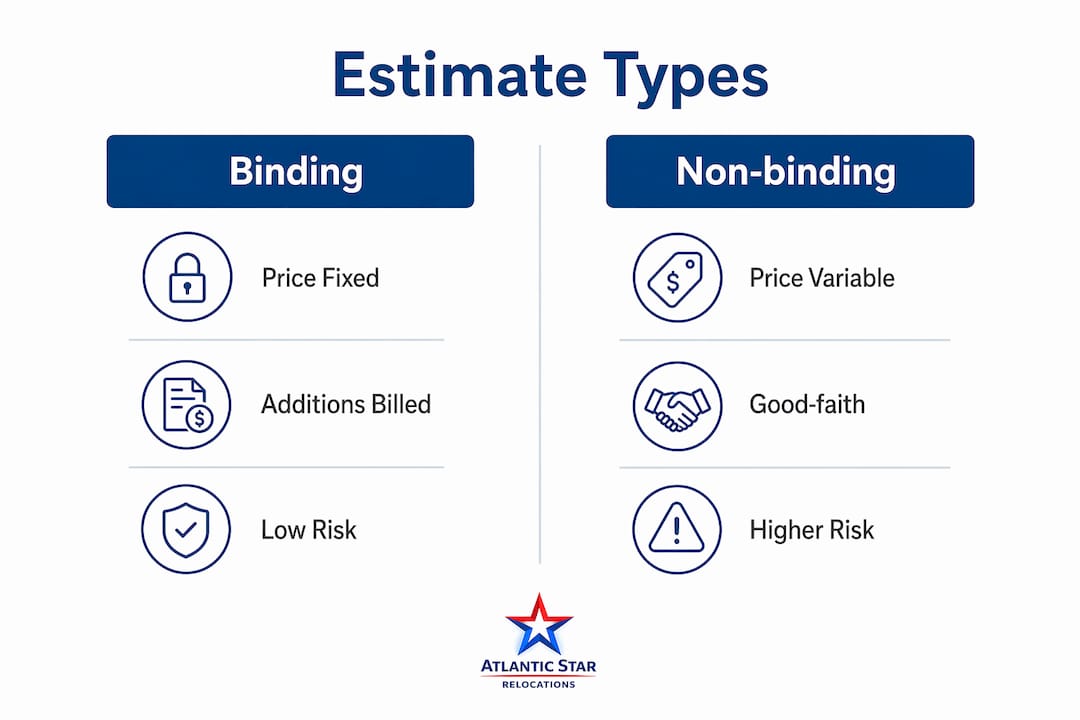
Binding estimates lock the price for the exact inventory and services listed. If you add items on moving day, the mover can charge for those additions, but the original scope stays fixed. This gives you budget certainty from day one.

Non-binding estimates are good-faith projections. The final bill is calculated from actual weight and services rendered. Under FMCSA's 110% rule, a mover can only require you to pay up to 110% of the original estimate at delivery. Any remaining balance is invoiced with 30 days to pay. Many consumers don't realize the total final bill can still exceed 110% once that invoice arrives.
Binding not-to-exceed estimates are the strongest consumer protection available. The price is capped at the estimate, but if your actual shipment weighs less than projected, you pay the lower amount. Binding not-to-exceed estimates offer the best combination of price protection and potential savings, yet movers rarely volunteer them unless you ask directly.
| Estimate type | Risk to consumer | Price flexibility |
|---|---|---|
| Binding | Low | Fixed; additions billed separately |
| Non-binding | High | Final bill based on actual weight |
| Binding not-to-exceed | Lowest | Capped maximum; savings possible |
Pro Tip: Always ask which estimate type you're signing before you commit, and confirm it matches what appears on your bill of lading. If those two documents don't agree, you have a problem before the truck leaves your driveway.
How inventory accuracy shapes your final moving cost
Incomplete or inaccurate inventory is the leading controllable cause of surprise charges on moving day. When you underestimate your shipment, a non-binding estimate adjusts upward to reflect actual weight and labor. The quote wasn't wrong. Your inventory was.
Phone and online estimates are the most common source of this problem. A mover quoting over the phone cannot see your basement storage, the piano in the living room, or the treadmill you forgot about. The result is a quote built on incomplete data. In-home or video surveys eliminate that gap by letting a trained estimator measure your actual belongings, note access conditions, and account for specialty items before pricing anything.
Services beyond basic loading and transport also shift the estimate significantly. Packing, furniture disassembly, crating for artwork or antiques, and special handling for items like pool tables or gun safes each carry separate labor and material costs. Access restrictions at origin and destination affect labor and equipment needs just as much as the items themselves. A third-floor walkup in the Bronx and a ground-floor apartment in Westchester County require very different labor allocations.
Here is what to communicate before any estimator visits or calls:
- Every room, including storage areas, garages, and attics
- Bulky or specialty items: pianos, safes, gym equipment, large artwork
- Stair counts, elevator availability, and parking restrictions at both addresses
- Services needed: full packing, partial packing, or boxes only
- Any time constraints that could affect crew size or truck requirements
Pro Tip: Finalize your inventory list at least two weeks before your move date. Late additions to a binding estimate require a written amendment. Without one, you may face unexpected charges or delays on moving day.
What accessorial charges and business model differences do to your quote
Many price differences between moving quotes have nothing to do with efficiency or quality. They reflect scope. Comparing quotes without matching accessorial charges and valuation coverage is the equivalent of comparing two restaurant bills where one includes drinks and one doesn't.
Accessorial charges are fees for services outside standard loading, transport, and unloading. Common examples include:
- Stair carries: Charged per flight above the first, typically per 100 pounds
- Long carry fees: Applied when the truck cannot park within a standard distance of your door
- Shuttle service: Required when a full-size moving truck cannot access your street or building
- Elevator fees: Charged for time lost waiting for or operating a building elevator
- Packing materials: Boxes, tape, and padding are rarely included in a base quote
A quote that omits these charges looks cheaper on paper. It won't be cheaper on moving day. Low phone or online quotes frequently exclude packing, bulky item handling, stairs, shuttle fees, and valuation coverage. When those charges surface at delivery, the price gap between the "cheap" mover and the thorough one disappears.
Business model also matters. Brokers sell your move to a carrier and earn a margin on the transaction. They quote lower because they don't execute the move directly and have less visibility into your specific access conditions. Brokers often provide lower upfront quotes with less reliability because the carrier who actually shows up sets the final operational terms. Direct carriers like Atlantic Star Relocations own the relationship from survey to delivery, which means the quote reflects real conditions rather than a best-case projection.
How timing and seasonal demand affect moving quotes
The same move quoted in February and again in July will produce two different numbers. Summer months, weekends, and end-of-month dates consistently bring higher rates because demand for trucks and crews peaks during those windows. This is not price gouging. It is supply and demand applied to a labor-intensive service industry.
In markets like Westchester County and New York City, the effect is amplified. Lease cycles in Manhattan, Brooklyn, and Queens concentrate move-out dates at the end of each month. Families in Westchester and Connecticut tend to move between school years, compressing demand into June and July. Both patterns reduce truck and crew availability, which pushes prices up for everyone booking during those periods.
Timing also affects how much negotiating room you have. Off-peak moves, meaning weekdays in January through March, give you more schedule flexibility and often better crew availability. Locking your move date early matters regardless of season. Movers price based on current demand at the time of booking, not the time of the move. A quote secured in March for a July move may be lower than one requested in June for the same July date.
Ask your mover directly whether your quoted price is subject to change if you shift your move date. Some contracts include price triggers tied to date changes. Knowing that condition upfront prevents a frustrating conversation later.
Key takeaways
Moving estimates differ because estimate type, inventory accuracy, accessorial fees, and seasonal timing each independently affect the final price, and understanding all four factors is the only way to compare quotes accurately.
| Point | Details |
|---|---|
| Estimate type determines risk | Binding not-to-exceed offers the strongest consumer protection; always ask which type you're signing. |
| Inventory accuracy controls surprises | An in-home or video survey produces far more accurate quotes than phone or online estimates. |
| Accessorial charges shift the real price | Compare quotes only after confirming both include the same scope of services and access fees. |
| Timing changes what you pay | Off-peak moves in winter months typically cost less and offer more scheduling flexibility. |
| Broker vs. direct carrier affects reliability | Direct carriers provide more accurate quotes because they own the execution from start to finish. |
What I've learned from watching clients get burned by vague quotes
After years of working through complex relocations in Westchester County, New York City, and long-distance corridors, the pattern is consistent. Clients who get burned almost never chose a bad mover on purpose. They chose the lowest quote without reading what it included.
The most common mistake is treating a moving quote like a commodity price. It isn't. Two quotes for a three-bedroom move from White Plains to Manhattan can differ by $1,500 and both be accurate, because they're quoting different scopes. One includes full packing and a shuttle fee. The other assumes you've packed everything and the truck can park at the curb. Neither mover is lying. They're just answering a different question.
My advice is to request a binding or binding not-to-exceed estimate whenever possible. Push for an in-home or video survey before signing anything. Ask the mover to walk you through every line item and confirm which services are included and which would trigger an additional charge. That conversation takes 20 minutes and can save you hundreds of dollars and a lot of frustration on moving day.
The estimate type is the primary risk control you have as a consumer. Use it deliberately.
— Admin
Get an accurate moving estimate from Atlantic Star Relocations
Understanding why quotes vary is the first step. Getting a quote that actually holds is the second.

Atlantic Star Relocations serves residential and commercial clients across Westchester County, New York City, Manhattan, Brooklyn, Queens, the Bronx, Connecticut, New Jersey, and Florida. Every estimate starts with a detailed survey, covers all accessorial conditions upfront, and is structured as a binding or binding not-to-exceed quote wherever possible. There are no surprise charges at delivery because every access condition, service, and inventory item is confirmed before the truck is scheduled. If you're planning a local or long-distance move and want a quote built on real information rather than assumptions, contact Atlantic Star Relocations for a personalized consultation.
FAQ
Why do two moving companies quote such different prices?
Quotes are not standardized products; differences in estimate type, included services, accessorial charges, and inventory scope account for most price gaps between competing quotes. Always compare what each quote includes before deciding on price alone.
What is the FMCSA 110% rule for moving estimates?
Under federal regulation, movers can only require payment of up to 110% of a non-binding estimate at the time of delivery. Any remaining balance above that amount is invoiced separately with 30 days to pay.
When is a binding not-to-exceed estimate the right choice?
A binding not-to-exceed estimate is the right choice when you want a guaranteed price ceiling with the possibility of paying less if your shipment is lighter than estimated. Ask for it specifically, as many movers don't offer it unless requested.
How does moving during peak season affect my quote?
Summer months, weekends, and end-of-month dates produce higher rates due to concentrated demand for trucks and crews. Booking an off-peak move, particularly on weekdays between January and March, typically reduces cost and increases scheduling flexibility.
What accessorial charges should I ask about before signing a quote?
Ask about stair carry fees, long carry fees, shuttle service charges, elevator fees, and packing material costs. Confirming these upfront prevents surprise charges on moving day and allows you to compare quotes on equal terms.