

Third-party logistics relocation is defined as outsourcing specialized moving operations to an expert provider who manages transport coordination, temporary storage, inventory transfer, and subcontractor oversight during a business move. The industry term is "3PL relocation management," and it applies to any organization that cannot absorb the operational complexity of a large-scale move internally. Professional relocation management reduces operational downtime by 30%–50% compared to internally managed moves. That gap is the core reason businesses in Westchester County, New York City, and across the Northeast turn to providers like Atlanticstargroup when a move cannot afford to go wrong.
What is the role of third party logistics in relocation?
The role of third-party logistics in relocation is to serve as a central project office that coordinates people, vendors, equipment, and schedules across every phase of a move. 3PL providers coordinate relocation through multiple departments and specialized subcontractors, removing the burden from internal teams who have their own jobs to do. This model works because a single accountable party owns the outcome, not a collection of disconnected vendors each managing their own slice.

For businesses moving offices in Manhattan or relocating warehouse operations in New Jersey, the complexity multiplies fast. Freight must be staged, crews must be sequenced, and storage gaps must be filled without halting operations. A 3PL provider handles all of that through disciplined planning and mode selection, including container freight, cross-docking, and inbound staging, so the business keeps running while the move happens around it.
What are the core benefits of using third-party logistics in relocation?
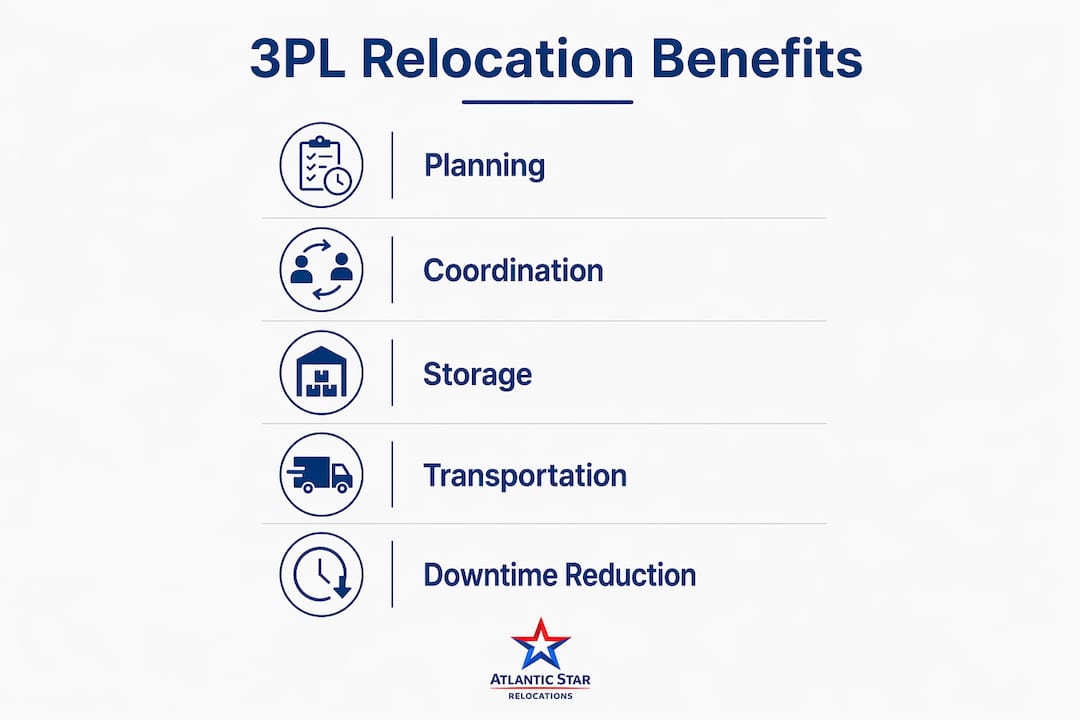
The clearest benefit is downtime reduction. Businesses that manage relocations internally often underestimate the scheduling conflicts, vendor gaps, and last-minute surprises that slow everything down. A 3PL provider builds those contingencies into the plan from day one.
The key operational benefits include:
- Reduced downtime. Professional relocation management cuts downtime by 30%–50%, which translates directly to revenue protection and faster return to full productivity.
- Risk mitigation through contracts. Vendor contracts must include SLAs for on-time delivery, liability limits for damaged goods, and predefined escalation procedures. Without these, accountability disappears when something goes wrong.
- Carrier-neutral coordination. A quality 3PL selects the best carrier for each leg of the move rather than defaulting to one preferred vendor. That flexibility produces better outcomes at lower cost.
- Real-time issue resolution. When a delivery misses its window or a crew is short-staffed, the 3PL escalates and resolves without pulling your team off their work.
Pro Tip: Before signing with any 3PL provider, request a sample SLA and verify it includes specific liability caps per item category, not just a blanket coverage clause. Vague liability language is the most common source of disputes after a move.
How does third-party logistics relocation work for different move types?
The answer depends on the type of move, and the 3PL's role shifts accordingly. A corporate office relocation in Midtown Manhattan looks nothing like a warehouse move in the Bronx or a fleet vehicle transfer from Connecticut to Florida.
Warehouse moves
3PL services during warehouse moves work best for overflow storage, cross-docking, and inbound staging rather than a full operational handover. The goal is to fill the transition gap, not replace the warehouse team. Atlanticstargroup's warehouse moving services follow this model, coordinating temporary storage and crew sequencing so inventory keeps moving even when the facility does not.
Corporate office moves
Corporate relocations require multi-leg logistics coordination, where furniture, IT equipment, and sensitive files move in a defined sequence across multiple days. The 3PL manages vendor scheduling, floor plan staging, and final placement so the office is operational on day one.
Fleet vehicle relocations
Professional car hauling is advised for moves exceeding 300 miles; driving is reasonable under that threshold. The 300-mile guideline exists because businesses consistently underestimate the full cost of having employees drive fleet vehicles, including fuel, lodging, wear, and lost productivity. Professional hauling consolidates vehicle moves, reduces scheduling complexity, and provides documented chain of custody.
| Move type | Primary 3PL role |
|---|---|
| Warehouse relocation | Overflow storage, cross-docking, inbound staging |
| Corporate office move | Vendor coordination, sequenced delivery, floor staging |
| Fleet vehicle transfer | Consolidated hauling, custody documentation, schedule management |
| Multi-site business move | Central project management, subcontractor oversight, SLA enforcement |
When should businesses partner with a third-party logistics provider?
The decision to bring in a 3PL comes down to three factors: operational complexity, tolerance for downtime, and the diversity of assets being moved. If any one of those is high, a 3PL adds clear value.
Businesses should strongly consider a 3PL partner when:
- The move involves multiple locations, departments, or asset types simultaneously.
- Internal staff cannot be pulled from their roles to manage logistics without hurting productivity.
- The timeline is tight and a single missed delivery could cascade into broader delays.
- Specialized handling is required, such as lab equipment, server infrastructure, or temperature-sensitive inventory.
- The move crosses state lines, as is common for businesses relocating between New York, New Jersey, Connecticut, and Florida.
3PL engagement does not have to be permanent. The best model is often limited and temporary, focused on the transition period rather than an ongoing operational handover. Atlanticstargroup structures engagements this way, stepping in for the move window and stepping back once operations stabilize.
Pro Tip: Revisit your 3PL scope every time the move plan changes. A shift in timeline, added locations, or a new asset category can change what you need from your provider significantly. Catching that early prevents gaps in coverage.
What contract elements should businesses require from 3PL providers?
A 3PL contract without clear performance terms is a liability. The contract is where accountability lives, and vague language protects the provider, not the client.
Every 3PL relocation agreement should include:
- On-time delivery SLAs with specific time windows and financial consequences for misses.
- Liability limits per item category, not a single blanket coverage amount.
- Escalation procedures defining who is contacted, in what order, and within what timeframe when a milestone is missed.
- Vendor transparency requirements, including the right to approve subcontractors used on your move.
- Performance KPIs such as delivery accuracy rate, damage rate, and schedule adherence.
Atlanticstargroup's approach to vendor coordination builds these terms into every engagement. Clients know exactly who is responsible at each stage and what happens if something goes off track. That clarity is what separates managed relocation from simply hiring movers.
Key Takeaways
The most effective 3PL relocation model combines limited, targeted engagement with clear SLAs, carrier-neutral coordination, and a single accountable point of contact throughout the move.
| Point | Details |
|---|---|
| Downtime reduction is measurable | Professional 3PL management cuts operational downtime by 30%–50% versus internal moves. |
| SLAs are non-negotiable | Every 3PL contract must include on-time delivery terms, liability caps, and escalation paths. |
| Engagement should be targeted | Use 3PL for transition gaps like overflow storage and staging, not full operational handover. |
| The 300-mile rule applies to fleets | Professional hauling beats employee driving for vehicle moves over 300 miles on cost and risk. |
| Scope must evolve with the plan | Revisit 3PL requirements whenever the move timeline, locations, or asset types change. |
What I've learned from watching 3PL partnerships succeed and fail
The businesses that get the most out of a 3PL partner are the ones that treat it as a managed relationship, not a transaction. They show up to planning calls, they share floor plans early, and they flag changes the moment they happen. The ones that struggle hand everything over and disappear, then wonder why the move did not go as expected.
Working in the Westchester and NYC market, I see a specific pattern repeat itself. A company relocating from White Plains to Midtown assumes the 3PL will figure everything out independently. The 3PL does its job, but without internal context, decisions get made without full information. The result is a move that technically completes but leaves the client cleaning up details for weeks.
The fix is not more oversight. It is better integration at the start. Define who owns each decision, what the escalation path looks like, and what "done" means for each phase. Atlanticstargroup builds that structure into every corporate relocation we manage, because a clear plan at the front end is what makes the execution look effortless.
— Admin
How Atlanticstargroup supports businesses with expert relocation management
Atlanticstargroup manages corporate and warehouse relocations across Westchester County, New York City, New Jersey, Connecticut, and beyond, acting as a single point of accountability from planning through final delivery.

Whether your business needs short-term storage during a transition, full vendor coordination for a multi-site office move, or logistics coordination for a complex commercial project, Atlanticstargroup brings the structure and oversight that keeps moves on schedule. Every engagement includes carrier-neutral vendor selection, real-time issue resolution, and performance-backed service terms. Contact Atlanticstargroup today to request a consultation and get a clear plan for your next relocation.
FAQ
What is third-party logistics relocation?
Third-party logistics relocation is the practice of outsourcing move coordination, transport management, temporary storage, and vendor oversight to a specialized provider. It reduces internal burden and protects operational continuity during complex business moves.
How does a 3PL reduce downtime during a business move?
Professional relocation management reduces operational downtime by 30%–50% compared to internally managed moves by building contingencies into the plan and maintaining a single accountable coordinator across all vendors and phases.
When does professional vehicle hauling make more sense than driving?
Professional car hauling is the better choice for fleet vehicle moves exceeding 300 miles. Beyond that threshold, the combined cost of fuel, employee time, lodging, and vehicle wear typically exceeds the cost of consolidated professional transport.
What should a 3PL relocation contract always include?
Every 3PL contract should include SLAs for on-time delivery, per-item liability limits, defined escalation procedures, subcontractor approval rights, and measurable performance KPIs like damage rate and schedule adherence.
Does Atlanticstargroup offer 3PL relocation services in Westchester and NYC?
Atlanticstargroup provides managed relocation and logistics coordination services across Westchester County, New York City, New Jersey, Connecticut, and Florida, covering corporate office moves, warehouse relocations, and multi-leg logistics projects.