

Warehouse relocation planning is the structured process of coordinating every operational, logistical, and staffing activity required to move a warehouse to a new facility without disrupting service levels. The industry term for this work is "warehouse relocation project management," and it covers everything from inventory audits and layout design to WMS testing and vendor communication. Planning should begin 6–12 months before the move date. That lead time is not a suggestion. It reflects the real complexity of phased scheduling, permit approvals, and system migrations that cannot be compressed without creating failures downstream.
What is warehouse relocation planning, and what does it include?
Warehouse relocation planning is defined as a documented, phased project that governs every decision from the first site assessment to post-move stabilization. A well-structured relocation plan typically runs 10–30 pages and assigns a single owner to each section. That ownership model prevents the most common failure mode: decisions made in isolation by one department that break processes in another.
Every effective plan covers these core components:
- Scope and objectives: Define what success looks like before any boxes move. Set measurable targets for fill rate, order accuracy, and on-time shipping.
- Timeline and milestones: Work backward from the go-live date. Assign hard deadlines to permit approvals, layout sign-off, and system testing.
- Roles and responsibilities: One person owns each section. No shared ownership. Shared ownership means no ownership.
- Inventory management: Schedule cycle counts at both origin and destination throughout the transition to prevent shrinkage and inaccuracies.
- Layout and equipment planning: Finalize racking configurations, dock assignments, and material flow paths before the first pallet arrives.
- Communication plan: Prepare separate messaging for employees, vendors, carriers, and customers. Each group needs different information at different times.
- Risk register: Assign likelihood and impact to every identified risk, then document a mitigation step and an owner for each one.
- Budget and success criteria: Set a cost ceiling and define the metrics that confirm the move succeeded.
The plan is a live document. Every time an assumption changes, the plan gets updated. Treating it as a static file is one of the most reliable ways to arrive at go-live unprepared.
Pro Tip: Schedule a weekly plan review with all section owners starting 12 weeks out. Short weekly syncs catch assumption drift before it becomes a crisis.

How does a phased warehouse relocation strategy reduce risk?
A phased move keeps the origin facility partially active while the destination ramps up. Maintaining dual-site capacity prevents fulfillment bottlenecks that a single cutover date almost always creates. The logic is straightforward: you are running a live supply chain, not moving furniture.
Here is the sequencing that works:
- Move slow-moving inventory first. These SKUs have the lowest order frequency, so errors or delays have minimal customer impact.
- Transfer mid-velocity stock next. By this stage, your team has worked through the process at the new facility and identified any location logic errors in the WMS.
- Migrate mission-critical and fast-moving inventory last. These items carry the highest fulfillment risk. Move them only after the destination is fully tested and stable.
- Run parallel inventory systems during transition. Sync counts at origin and destination daily. Discrepancies caught early cost minutes to fix. Discrepancies caught at go-live cost days.
- Schedule physical transfers during off-peak windows. Weekend and overnight moves reduce interference with active order picking and shipping operations.
The most common pitfall in phased moves is underestimating the labor required to run two sites simultaneously. Staff fatigue and split attention cause picking errors. Plan for temporary labor support during the overlap period, and consider short-term storage as a buffer for inventory that does not fit cleanly into either phase.
Pro Tip: Do not start the final phase cutover on a Monday. Begin on a Wednesday or Thursday so your team has the weekend as a buffer to resolve any issues before the next full business week.
What cross-functional coordination does a warehouse move require?
Relocation success depends more on people and process alignment than on the physical transport of assets. Lack of early cross-functional involvement from operations, HR, IT, and logistics is the leading cause of cascading delays. Each department holds a piece of the puzzle. Without them at the table from day one, gaps appear at the worst possible moment.
The core team for any warehouse move should include:
- Operations manager: Owns the overall project timeline and go/no-go decisions.
- IT lead: Responsible for WMS migration, label and location logic testing, and handheld device readiness.
- HR manager: Handles workforce transitions, shift changes, and safety briefings for the new facility.
- Logistics coordinator: Manages carrier notifications, routing updates, and transport window scheduling.
- Facilities or maintenance lead: Oversees equipment installation, racking permits, and utility readiness at the destination.
Siloed decision-making is the single biggest cause of warehouse relocation failures. When IT configures the new WMS without input from operations, and operations plans the layout without input from logistics, the result is a facility that works on paper and fails on day one. Every decision that touches two departments needs a documented owner and a clear escalation path.
Communication to external stakeholders must be early, direct, and specific. Vendors need new address and routing details at least six weeks out. Customers need to know about any no-ship windows and what mitigation steps are in place. Carriers need updated dock schedules and contact information before the first load arrives at the new facility.
What are the practical steps and timeline for executing a warehouse move?
The warehouse moving process follows a clear sequence. Compressing or skipping phases is where costs spike and service levels drop.
| Phase | Timing before go-live | Key actions |
|---|---|---|
| Initiation | 8–12 months | Facility assessment, goal setting, budget approval |
| Planning | 6–8 months | Layout design, permit applications, vendor selection |
| Preparation | 3–5 months | Inventory audit and tagging, WMS configuration |
| Execution | 6–8 weeks | Transport scheduling, phased stock transfers |
| Stabilization | 0–3 weeks post-move | Performance monitoring, issue resolution |
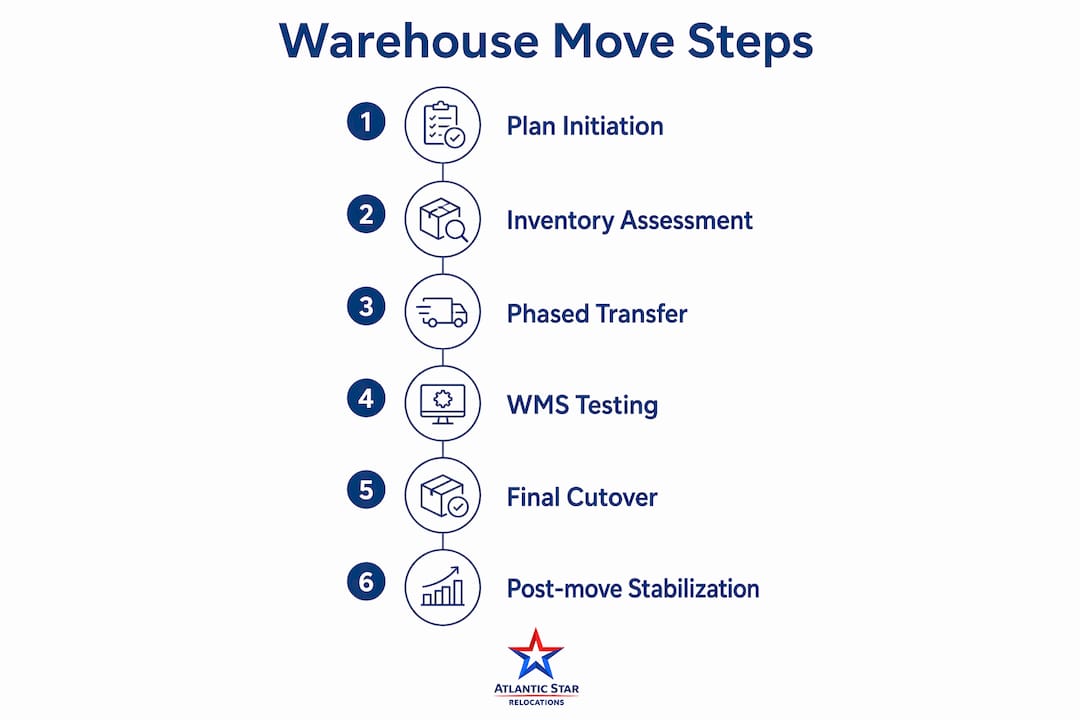
- Assess the current facility and set goals. Document square footage, racking capacity, dock count, and current throughput. Define what the new facility must improve.
- Audit and tag all inventory. Cycle counting at origin and destination throughout the move maintains accuracy. Start the audit before a single pallet moves.
- Finalize the new layout and secure permits. Racking installation and dock modifications often require local permits. Delays here push every downstream milestone.
- Select and contract your relocation partner. Atlanticstargroup's warehouse moving services cover labor coordination, carrier management, and on-site oversight for businesses in Westchester, NYC, and across the tri-state area.
- Test WMS and operational systems before go-live. Confirm labels, location logic, and carrier systems work correctly at the new facility. Run a parallel operation for at least two weeks before cutover.
- Execute phased transfers. Follow the slow-to-fast sequencing described above. Track every pallet movement against the inventory system in real time.
- Monitor stabilization metrics for 1–3 weeks post-move. Track fill rate, late shipments, and backlog daily. Assign someone to own the issue log and resolve problems before they compound.
Key Takeaways
Effective warehouse relocation planning requires a phased, cross-functional approach that prioritizes order fulfillment over fixed move dates, with planning starting 6–12 months in advance.
| Point | Details |
|---|---|
| Start planning early | Begin the relocation project 6–12 months before go-live to allow audits, permits, and phased scheduling. |
| Use a phased move strategy | Transfer slow-moving inventory first and mission-critical stock last to protect fulfillment during transition. |
| Assign single ownership | Every section of the plan needs one named owner. Shared ownership creates accountability gaps. |
| Test systems before cutover | Run parallel WMS operations and confirm label and location logic at the new facility before moving live inventory. |
| Monitor post-move metrics | Track fill rate, late shipments, and backlog daily for the first 1–3 weeks after go-live. |
The mistake I see most often in warehouse relocations
After working through dozens of commercial and warehouse moves in the Westchester and New York City area, the pattern I see most often is this: companies treat the move date as the goal. It is not. The goal is maintaining your customers' orders through the transition.
Lease deadlines create pressure, and that pressure causes teams to compress planning phases, skip WMS testing, and cut the stabilization period short. Every time that happens, the savings from the faster move get wiped out by expedited freight costs, overtime labor, and customer credits for late shipments. The relocation is a live supply chain event, and it needs to be managed like one.
The second mistake is underinvesting in communication. I have seen moves where the carrier found out about a new dock address two days before the first delivery. That is not a logistics problem. That is a planning problem. Build your communication calendar into the plan itself, with specific dates and named owners for every outbound message.
The businesses that execute clean warehouse moves are the ones that treat the plan as a living document, assign real ownership to every decision, and measure success by service levels, not by whether the last pallet crossed the threshold on schedule.
— Admin
Atlanticstargroup's warehouse relocation support in Westchester and NYC
Atlanticstargroup manages warehouse relocations for businesses across Westchester County, New York City, Manhattan, Brooklyn, Queens, and the broader tri-state area. The team handles the full scope of the warehouse moving process, from logistics coordination and vendor management to labor-only support and interim storage solutions.

For businesses that need flexible support during phased transitions, Atlanticstargroup offers labor-only moving help in New York, New Jersey, and Connecticut, covering everything from equipment staging to inventory transfers. Every project is managed under a single point of accountability, so you always know who to call when an issue needs resolving. Request a quote directly at atlanticstargroup.com to discuss your warehouse move timeline and requirements.
FAQ
How far in advance should warehouse relocation planning start?
Warehouse relocation planning should begin 6–12 months before the move date. Logistics coordination and vendor scheduling typically begin 6–8 weeks before the physical move.
What is a phased warehouse move?
A phased warehouse move transfers inventory in stages, starting with slow-moving stock and ending with mission-critical items, while keeping the origin facility partially active to protect fulfillment.
What systems need testing before a warehouse go-live?
The WMS, barcode labels, location logic, handheld scanning devices, and carrier routing systems all require testing and confirmation at the new facility before live inventory arrives.
How long does post-move stabilization take?
Post-move stabilization typically lasts 1–3 weeks. During this period, logistics managers should track fill rate, late shipments, and backlog daily and resolve issues before they compound.
What causes most warehouse relocation failures?
Siloed decision-making and compressed planning timelines cause most failures. Cross-functional teams with clear ownership and early involvement prevent the cascading delays that derail warehouse moves.