

Six shipping methods handle nearly every international move: air freight for urgent or high-value loads, ocean freight in Full Container Load (FCL) or Less-than-Container Load (LCL) form for full households, land and rail intermodal for cross-border or last-mile legs, courier and express parcel service for small personal effects, and RORO or containerized transport for vehicles. Air wins when speed matters more than cost. Ocean FCL suits a full household moving on a set budget. LCL fits a studio apartment or partial shipment. Intermodal rail and truck fill the gap between a port and your new front door. Courier service covers documents, electronics, and a handful of boxes. RORO or a shared container gets your car overseas without breaking the budget.
Here's the quick map before we go deeper:
- Air freight — urgent shipments, high-value items, small volumes that can't wait weeks
- Ocean FCL — full households, businesses relocating offices, anyone with 500+ cubic feet of goods
- Ocean LCL — partial households, studio or one-bedroom moves, cost-conscious shippers with time to spare
- Land/rail intermodal — regional and cross-border legs, connecting ports to inland destinations
- Courier/express parcel — documents, electronics, a few boxes of personal items
- RORO or containerized vehicle shipping — cars, motorcycles, and boats moving overseas
Each method carries its own pricing logic, its own timeline, and its own risks. Picking wrong doesn't just cost money. It can mean weeks of delay waiting on a container that got bumped for a higher-paying customer, or a customs hold because nobody flagged a restricted item before it shipped. This guide breaks down every method Atlanticstargroup encounters in the field, what drives cost on each, and how to match your shipment to the right mode without guessing.
Key Takeaways
Matching your shipment to the right method, and hiring a licensed, vendor-neutral mover to coordinate it, is what determines whether an international move stays on budget and on schedule.
| Point | Details |
|---|---|
| Small, urgent shipments | Choose air freight or courier service when speed matters more than cost per cubic foot. |
| Full households | Ocean FCL is typically most cost-efficient once your shipment exceeds a few hundred cubic feet. |
| Partial households | Ocean LCL fits studio and one-bedroom moves but takes longer due to consolidation. |
| Vehicles | RORO is the budget option; containerized shipping adds protection and flexibility. |
| Split shipments reduce risk | Sending essentials by air while the bulk moves by sea avoids weeks without belongings. |
| Insist on itemized quotes | Request pricing only after a visual survey, and confirm what's excluded, not just included. |
| Atlanticstargroup coordinates the full chain | Vendor-neutral oversight, professional packing, and local last-mile expertise across the New York area reduce coordination burden on complex international moves. |
Table of Contents
- Types of International Moving Shipping Methods at a Glance
- Air Freight: Speed at a Price
- Ocean Freight: FCL vs. LCL and What Container Size Really Costs You
- Land and Rail Intermodal: The Leg Nobody Talks About
- Shipping a Vehicle: RORO vs. Containerized Transport
- Courier and Express Parcel: When Freight Is Overkill
- Specialized and Multimodal Solutions
- Door-to-Door, Door-to-Port, and Port-to-Port: What Each Service Level Actually Covers
- Factors That Decide Which Method Is Right for You
- How Professional Movers and Freight Forwarders Actually Manage International Shipments
- How Quotes Are Calculated and What Actually Drives the Cost
- Packing, Palletizing, and Insurance: Protecting What's Actually in the Container
- Your Step-by-Step Checklist for Choosing a Method and a Mover
- Customs and Regulatory Basics for U.S.-Origin and Return Moves
- A Mover's Perspective on Choosing the Right Method
- Working With Atlanticstargroup on Your International Move
- Sources
- FAQ
Types of International Moving Shipping Methods at a Glance
Before comparing costs and timelines in depth, it helps to know what each method actually is and where it fits.
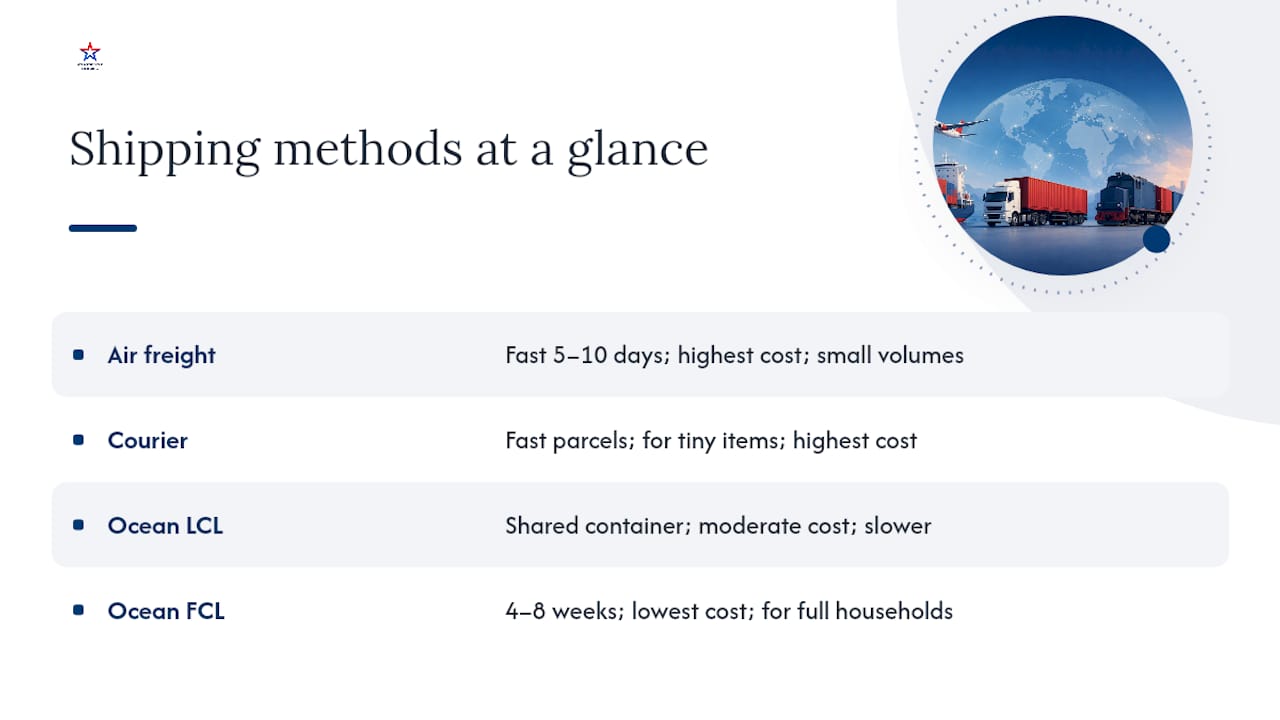
Air freight moves goods by cargo plane, typically arriving in 5 to 10 days door to door. It costs the most per cubic foot but beats every other method on speed. Best for small volumes: a few boxes, urgent documents, high-value electronics.
Ocean FCL (Full Container Load) means your household goods fill an entire shipping container, either a 20-foot or 40-foot unit, that nobody else's items share. Transit runs 4 to 8 weeks depending on the trade lane. It's the standard for full households and most cost-efficient once your shipment clears a few hundred cubic feet.
Ocean LCL (Less-than-Container Load) consolidates your goods with other shipments inside a shared container. You pay only for the space you use, but the shipment takes longer because it waits for the container to fill and gets handled more times at origin and destination.
RORO (Roll-on/Roll-off) drives vehicles directly onto a specialized ship deck, secured for the crossing, then driven off at the destination port. It's the most economical way to ship a car overseas when you don't need the vehicle sealed inside a container.
Containerized vehicle shipping loads a car into a shipping container, either alone or alongside household goods, offering more protection and the ability to pack personal items inside the vehicle in some cases.
Truck and rail intermodal handles the inland legs: getting cargo from an inland warehouse to a port, or from a destination port to your new home. This layer is invisible in most quotes until something goes wrong with it.
Courier and express parcel service, the same networks that ship a package to your cousin, works for small personal effects that don't justify a freight shipment.
Air-sea consolidation splits a shipment, sending priority items by air and the bulk by ocean, a hybrid that shows up more often than most guides admit.
Project cargo covers oversized or unusual items that don't fit standard container dimensions, such as pianos, artwork, or specialty vehicles, requiring custom crating and handling.
Cost per cubic foot runs highest for air and courier, moderate for LCL, and lowest for FCL at scale. Most industry guidance groups these into three practical categories: sea freight for volume, air freight for speed, and courier for small parcels, though the real decision usually involves blending two of them.
Air Freight: Speed at a Price
Air freight prices based on actual or volumetric weight, whichever is higher, a calculation based on the space it occupies rather than how much it weighs. A box of clothing is light but bulky, so it often gets charged by volume, not weight. This catches people off guard constantly. A shipment that seems cheap by the pound can double in price once the airline calculates its dimensional weight, because air cargo space is priced by the cubic foot it displaces on the plane.
Transit windows for air freight typically run 5 to 10 days from pickup to delivery, factoring in customs processing on both ends. That's dramatically faster than ocean freight's 4 to 8 week window, and air freight also touches fewer hands along the way, which means fewer chances for damage or loss.
The tradeoffs are real. Air freight costs several times more per cubic foot than ocean shipping, and airlines cap shipment size and weight per piece. Certain items, aerosols, lithium batteries above a certain size, some liquids, face outright restrictions or require special handling that adds cost and paperwork.
When air freight makes sense:
- You need essentials (clothing, work equipment, medications) before the bulk of your shipment arrives
- The shipment is small enough that the cost premium doesn't matter much in absolute dollars
- You're moving high-value items where faster transit means less time exposed to risk
- A hard deadline (job start date, lease expiration) leaves no room for ocean freight's longer window
Pro Tip: Ship a small "first week" box by air, even if the rest of your household goes by sea. It typically costs a few hundred dollars and saves you from living out of a suitcase for six weeks while your container crosses the ocean.
Ocean Freight: FCL vs. LCL and What Container Size Really Costs You
Ocean freight moves the vast majority of international household goods, and the FCL versus LCL decision is the single biggest cost lever most people encounter.
FCL (Full Container Load) means you rent an entire container, usually a 20-foot unit (holding roughly 1,000 cubic feet) or a 40-foot unit (roughly 2,000 to 2,400 cubic feet with a high-cube option). You pay a flat rate for the container regardless of how full it is, which means FCL becomes the more economical choice once your shipment exceeds a volume typical for a one- to two-bedroom home, the contents of a one-bedroom to two-bedroom home. FCL also reduces handling steps since your goods load once at origin and unload once at destination, lowering the odds of damage from repeated handling.
LCL (Less-than-Container Load) shares container space with other shippers' cargo. You pay by volume, calculated in cubic meters or cubic feet, which makes it the better deal for a studio apartment or a partial household. The catch: your shipment gets consolidated with others at a freight yard, then deconsolidated at the destination, adding time and handling. Smaller LCL shipments tend to move slower and see more handling touches than FCL, which raises the odds of a scuff or dent along the way, even with careful crews.
Here's how the two stack up on the factors that actually matter when you're comparing quotes:
| Factor | FCL | LCL |
|---|---|---|
| Speed | Faster, direct routing | Slower, waits for consolidation |
| Cost | Flat rate, cheaper per cubic foot at volume | Pay-per-volume, cheaper for small loads |
| Capacity | Full container to yourself | Shared space, capacity varies by carrier |
| Typical transit time | several weeks door to door for FCL | longer for LCL |
| Reliability/schedule frequency | Tied to one sailing, less handling risk | Depends on consolidation schedule at both ends |
| Customs complexity | Single shipment, straightforward | Can face delays if any co-shipper's items trigger inspection |
| Insurance/security options | Full container access simplifies claims | Shared container complicates damage tracing |
| Common cost drivers | Container rental, terminal handling | Volume charges, consolidation fees, handling surcharges |
Hidden costs trip up more people than the base freight rate ever does. Terminal handling charges at both origin and destination ports, destination inland transport to your actual front door, customs clearance fees, and palletizing charges routinely arrive as line items nobody mentioned upfront. Standard estimates often exclude destination port terminal handling charges entirely, so always ask specifically what's excluded from a quote, not just what's included.
Pro Tip: If your timeline allows it, split high-priority items into a small air shipment and send the bulk of your household by ocean FCL or LCL. You get your essentials fast without paying air rates for the whole move, and staggering the shipments this way is standard practice among relocation coordinators who manage complex household moves.
Land and Rail Intermodal: The Leg Nobody Talks About
Intermodal transport moves your shipping container or palletized goods between truck, rail, and ship or air terminals without unpacking the contents at each transfer point. It's the connective tissue of nearly every international move, and it's also where a lot of avoidable delay creeps in.
A container that lands at the Port of New York and New Jersey doesn't teleport to a home in Westchester or a co-op in Manhattan. It moves by truck, sometimes by rail first if the destination is inland, then by truck again for final delivery. Each transfer point is a place where a container can sit waiting for a chassis, a driver, or a customs release.
Regional and cross-border moves depend heavily on this layer. A shipment arriving from Europe into a U.S. port, then heading to a client relocating to Connecticut or a Brooklyn brownstone, needs a coordinated inland leg that lines up with the ocean or air arrival, not one booked as an afterthought.
Last-mile delivery in dense urban areas adds its own complications. Narrow streets, building access restrictions, appointment-only loading docks, and local permitting requirements in a city like Manhattan or Brooklyn can turn a straightforward delivery into a half-day logistics exercise. Local access constraints, from narrow streets to appointment-only windows, routinely affect cost and timing more than people expect when they're comparing shipping quotes.
- Rail moves cargo cheaper over long inland distances but adds transfer time at each terminal
- Truck offers direct point-to-point delivery but costs more per mile than rail for long hauls
- Urban last-mile delivery frequently requires a smaller shuttle vehicle when a full-size truck can't access the building
- Adding an inland leg to a quote typically adds days, not weeks, if it's planned ahead of the ocean or air arrival
Shipping a Vehicle: RORO vs. Containerized Transport
RORO ships your vehicle by driving it onto a specialized vessel deck, securing it in place, and driving it off at the destination. It's the most budget-friendly way to move a car overseas, and it works well for standard passenger vehicles heading to ports with RORO facilities.
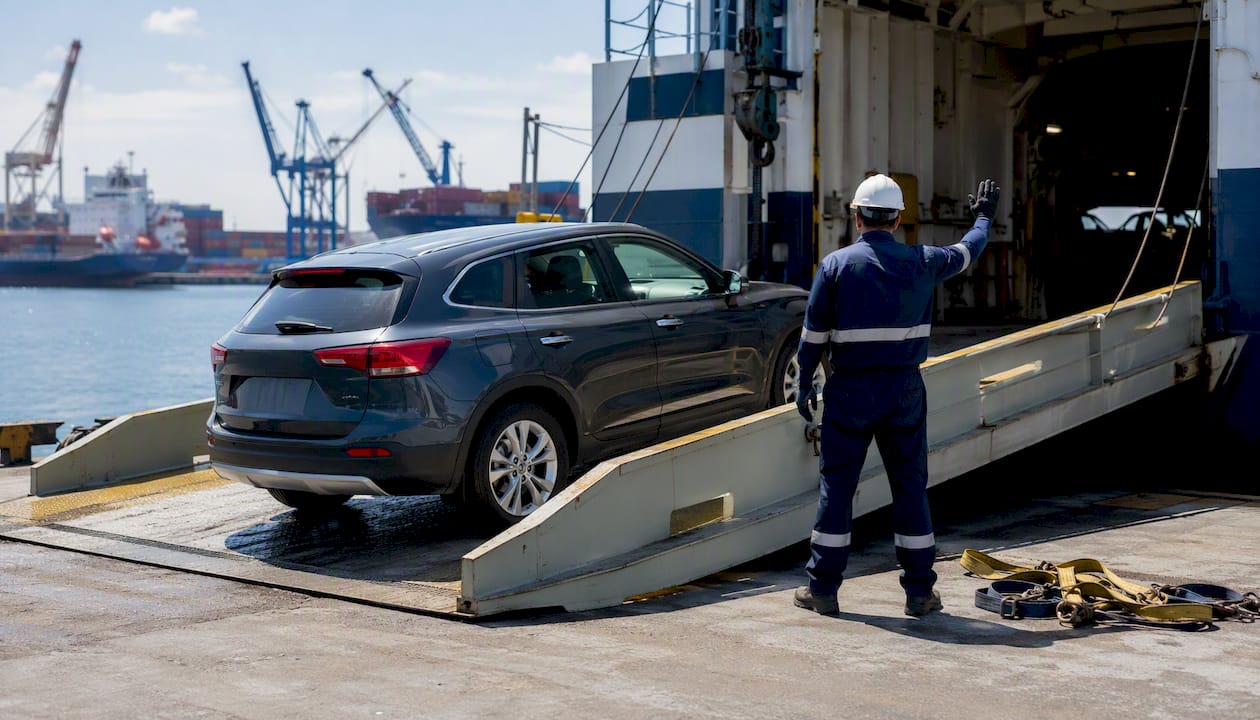
Containerized vehicle shipping loads your car into a shipping container, either as a standalone shipment or paired with household goods in the same container to split costs. It offers more protection from weather and handling, and in some cases allows you to pack personal belongings inside the vehicle itself, something RORO typically doesn't permit due to security and customs restrictions.
Documentation matters here more than almost any other shipment type. You'll need the vehicle title, and most carriers require keys, a battery disconnect or reduced charge, and a nearly empty fuel tank. Cleaning the vehicle thoroughly before shipping isn't optional in many countries. Biosecurity inspections at destination ports, particularly in places like Australia and New Zealand, can hold a vehicle for days over dirt or plant material caught in the undercarriage.
When containerizing makes more sense than RORO:
- You're shipping the vehicle alongside household goods and want to consolidate
- The destination country has stricter security requirements or limited RORO port access
- You want to pack additional items with the vehicle to save on a separate shipment
- The vehicle has high value and you want reduced exposure during transit
Insurance terms differ meaningfully between the two methods, and destination countries often apply different import duties, age restrictions, or emissions requirements to vehicles depending on how they arrive. Check destination rules on prohibited items and vehicle import restrictions well before booking, since a vehicle that doesn't meet local emissions standards can face duties, forced modification, or outright rejection at customs.
Pro Tip: Photograph your vehicle from all angles, including close-ups of any existing scratches or dents, immediately before it's loaded. This is standard practice for insurance claims and it takes five minutes.
Courier and Express Parcel: When Freight Is Overkill
Sometimes the smartest shipping method is the one that has nothing to do with freight at all. Courier and express parcel networks, and in some cases simply extra checked baggage on a flight, beat freight options for genuinely small shipments.
This makes sense for a handful of boxes, urgent legal or immigration documents, a laptop and a few personal electronics, or anything under roughly 100 pounds that needs to move fast without the overhead of a freight booking. Courier pricing runs per parcel or per kilogram, and most carriers apply dimensional weight rules similar to air freight, so an oversized but light box can cost more than its actual weight suggests.
Customs paperwork for courier shipments tends to be simpler than freight, often handled through a commercial invoice and a declared value the courier files electronically, but declared-value insurance options are usually more limited than what a freight forwarder can arrange for a full shipment.
Where courier service falls apart: furniture, appliances, anything bulky or heavy where per-pound or per-kilogram courier rates make LCL or even air freight look cheap by comparison. A dining table shipped by courier, if a courier would even accept it, could easily cost more than shipping an entire container's worth of furniture by ocean LCL.
- Best for: documents, electronics, small personal items under roughly 100 pounds
- Pricing: per parcel or per kilogram, with dimensional weight rules that can inflate cost for bulky-but-light items
- Customs: generally simpler paperwork than freight shipments, filed electronically by the courier
- Avoid for: furniture, appliances, anything that would cost more per pound than a freight alternative
Specialized and Multimodal Solutions
Not every shipment fits neatly into one category, and some of the most cost-effective moves Atlanticstargroup coordinates use a blend of methods rather than a single mode.
Consolidation and groupage combine multiple smaller shipments from different customers into one container, spreading the fixed costs across everyone involved. This is essentially what LCL already does, but it also applies to specialized cargo that needs particular handling, like fine art or wine collections, where a dedicated consolidator groups similar shipments together.
Air-sea combinations split a single move across two methods deliberately. Priority items, work equipment, a week's worth of clothing, important documents, go by air. Everything else follows by ocean. This isn't a compromise option. For many households relocating internationally on a fixed start date, it's the most sensible way to balance cost against the very real need to not be without your belongings for six weeks straight.
Project cargo handles anything that doesn't fit standard container dimensions or weight limits: pianos, large sculptures, boats, oversized vehicles, or industrial equipment for a commercial relocation. These shipments require custom crating, sometimes flat-rack or open-top containers instead of standard boxes, and considerably more lead time to arrange the right equipment and permits.
Multimodal solutions typically add planning complexity but reduce total cost or solve a dimension problem that standard shipping can't. The tradeoff is lead time. A project cargo shipment for an oversized item needs to be planned weeks earlier than a standard household move, because the specialized equipment and permits aren't sitting on standby.
Pro Tip: If you have an unusual item, a grand piano, a motorcycle collection, a walk-in safe, mention it to your mover during the initial estimate, not the week before pickup. Specialized handling requires equipment and permits that take time to arrange, and surprises here are the fastest way to blow a moving timeline.
Door-to-Door, Door-to-Port, and Port-to-Port: What Each Service Level Actually Covers
The shipping method you choose is only half the equation. The service level determines who handles what, and it changes your total workload dramatically.
Door-to-door service covers everything: pickup at your current home, packing, all transport legs, customs clearance, and delivery to your new address. You do essentially nothing except unpack. This is the service level most households and businesses choose, because it shifts the coordination burden entirely onto the mover.
Door-to-port stops responsibility at the destination port. The mover handles pickup, packing, and ocean or air transport, but you're responsible for arranging customs clearance, inland transport, and final delivery yourself, or hiring a separate customs broker and local trucking company to finish the job.
Port-to-port covers only the ocean or air leg itself. You handle pickup to the origin port and everything from the destination port onward. This service level is rare for household moves and shows up more often in commercial shipping where the business already has established freight relationships on both ends.
Liability shifts at each handoff point, and this is exactly why so many households and businesses choose door-to-door despite it costing more than piecing together the legs individually. When one company holds accountability for the entire chain, there's no finger-pointing between a freight forwarder, a customs broker, and a local trucking company if something goes wrong. A licensed mover coordinating subcontractors remains accountable for the full shipment even when they don't personally drive every leg of the route.
- Door-to-door: full-service, single point of accountability, highest convenience
- Door-to-port: mover handles origin and transport, you handle destination clearance and delivery
- Port-to-port: mover handles only the ocean/air leg, common in commercial freight arrangements
- Liability and insurance coverage typically follow whoever holds responsibility for each leg
Pro Tip: Ask any mover directly: "Who handles customs clearance, who pays destination terminal fees, and who delivers to my actual front door?" If the answer involves three different companies you'd need to coordinate yourself, you're not looking at true door-to-door service, regardless of what the brochure says.
Factors That Decide Which Method Is Right for You
Every shipment sits at the intersection of a handful of variables, and weighing them honestly usually points clearly toward one method.
- Shipment size and volume. A few boxes point toward courier or air. A full household points toward ocean FCL. A partial household points toward LCL.
- Value of goods. High-value items justify air freight's premium and often warrant supplemental marine insurance regardless of shipping method.
- Required delivery window. A hard deadline narrows your options fast. Ocean freight's multi-week window simply doesn't work if you need everything in under two weeks.
- Budget. Air freight can cost several times more per cubic foot than ocean freight, which makes budget the single biggest factor pushing most households toward sea shipping.
- Destination port or airport infrastructure. Some destinations have limited RORO facilities, congested ports prone to delay, or airports with restricted cargo capacity, all of which affect which method is even available.
- Local building access. Narrow city streets, elevator-only buildings, and appointment-only loading docks in places like Manhattan or Brooklyn affect the last-mile leg regardless of which international method you chose.
- Customs complexity. Countries with stringent import rules or high duty rates may favor a method that includes full customs coordination rather than one where you're navigating paperwork solo.
- Risk tolerance. Fewer handling touches generally mean lower damage risk, favoring FCL or air over LCL for anyone particularly worried about their belongings.
- Sustainability preferences. Ocean freight produces meaningfully lower emissions per ton shipped than air freight, making it the lower-impact choice when timeline allows.
- Speed-driven decisions push toward air freight or air-sea consolidation
- Cost-driven decisions push toward ocean FCL at volume, or LCL for smaller loads
- Complexity-driven decisions (unusual items, tight urban access) push toward specialized handling and door-to-door service
How Professional Movers and Freight Forwarders Actually Manage International Shipments
A freight forwarder or full-service mover acts as the coordinator across a chain of subcontractors: trucking companies for pickup and delivery, terminal operators at each port, ocean carriers or airlines for the transport leg, and often a separate customs broker for clearance. Understanding this structure helps explain why a visual, in-home estimate matters so much before you commit to a quote. A mover who never sees your actual belongings is guessing at volume, and that guess becomes the gap between your original quote and the invoice you get at delivery.
Licensing is not a formality here. Federal law requires ocean movers handling international household goods to be licensed or registered with the Federal Maritime Commission as freight forwarders or non-vessel-operating common carriers. Verifying that registration before booking is one of the simplest ways to reduce fraud risk, and any legitimate mover will provide their FMC number without hesitation.
Customs clearance responsibilities vary by service level, as covered above, but even under door-to-door service, it's worth confirming exactly what the mover files versus what falls to you. Accurate, detailed inventories reduce the odds of a customs hold, since vague or incomplete manifests are one of the most common triggers for inspection delays.
Questions worth asking any prospective mover:
- Can you provide your FMC registration number, and can I verify it independently?
- Who handles customs clearance, and is that included in your quote or billed separately?
- Which subcontractors will actually touch my shipment, and who's accountable if something goes wrong mid-route?
- Will you conduct a visual, in-home survey before finalizing a quote?
FMC guidance specifically recommends requesting quotes only after a visual inspection and reading contract terms carefully before signing. A mover who quotes a full household move over the phone without ever seeing your belongings is a red flag worth taking seriously.
Pro Tip: If a mover pressures you to sign before providing a written, itemized estimate, or can't produce licensing information on request, walk away. Legitimate operators expect these questions and answer them without friction.
How Quotes Are Calculated and What Actually Drives the Cost
A complete international moving quote usually breaks down into several line items: base freight charge, terminal handling fees at origin and destination, inland transport on either end, customs clearance, applicable duties and taxes, insurance, and packing or palletizing labor and materials. Any quote missing several of these categories isn't incomplete, it's incomplete on paper and complete on your final invoice.
Air freight pricing hinges on volumetric weight, calculated by measuring the shipment's dimensions and applying a standard conversion factor, then comparing that figure against actual weight and billing whichever is higher. Ocean freight pricing works differently: FCL charges a flat container rate regardless of how full it is, while LCL bills by cubic meter or cubic foot of actual volume shipped.
Surcharges are where quotes diverge most from final bills. Peak season surcharges apply during high-demand shipping windows, typically summer months when relocation volume spikes. Port congestion fees appear when a destination port is running behind schedule. Demurrage charges accrue when a container sits at a port beyond its free time allowance, often because customs clearance or inland transport wasn't arranged in advance. Destination terminal handling charges and documentation fees round out the list of items that regularly surprise people who received a quote based only on base freight.
Weather, port congestion, and customs backlogs commonly delay shipments regardless of how the contract reads, so building in a buffer, both financially and on your calendar, protects you from treating a sales rep's transit estimate as a guarantee.
Pro Tip: Insist on an itemized quote after a visual survey, not a flat estimate over email or phone. Ask specifically what's excluded, not just what's included, since destination port fees and inland transport are the two line items most often left off a preliminary number.
Packing, Palletizing, and Insurance: Protecting What's Actually in the Container
Professional packing isn't a luxury upsell on an international move. It's often a requirement for full insurance coverage, and for good reason: many marine insurers deny claims for items packed by the owner, because self-packed boxes are harder to verify for adequate protection against the extended handling and rougher conditions of ocean transit.

Palletizing wraps and secures groups of boxes onto a wooden pallet, then shrink-wraps or crates the load for stability during transport. It adds cubic volume and cost compared to loose-loading a container, but it dramatically reduces shifting and crushing damage during a multi-week ocean voyage that involves loading cranes, ship movement, and multiple handling points.
Typical steps for professional international packing:
- Inventory every item, noting condition and, for high-value pieces, estimated worth
- Wrap furniture and fragile items in moving blankets, bubble wrap, and specialized crating for artwork or electronics
- Pack boxes by room and by weight, keeping heavier items in smaller boxes to prevent crushing
- Palletize and shrink-wrap grouped boxes for ocean shipments
- Photograph the finished, loaded container before it seals
Insurance options generally fall into three categories:
- Carrier liability, which is often minimal and calculated by weight rather than actual value
- Declared value protection, which covers goods up to a value you declare and pay a premium against
- Third-party marine insurance, purchased separately, which typically offers the most comprehensive coverage for high-value shipments
Keep passports, medications, jewelry, and irreplaceable documents with you rather than in the shipment, regardless of method. No insurance policy replaces a lost family photo album, and no shipping timeline accounts for needing your passport mid-transit.
Pro Tip: Photograph every room before packing begins, keep a signed copy of the packing inventory, and photograph the container's interior once loaded. If you ever need to file a claim, this documentation is the difference between a smooth settlement and a drawn-out dispute over what was actually in the shipment.
Your Step-by-Step Checklist for Choosing a Method and a Mover
Cutting through all the variables above comes down to a manageable sequence of steps.
- Schedule a visual, in-home survey so your mover can accurately estimate volume and weight, rather than guessing over the phone.
- Set your realistic timeline, including buffer time for customs and port delays, not just the transit estimate you were quoted.
- Decide whether any items need to move faster than the rest, and plan an air or courier split for those priority pieces.
- Request an itemized quote that separately lists base freight, terminal handling, inland transport, customs clearance, insurance, and packing costs.
- Verify the mover's FMC registration or licensing directly, don't just take their word for it.
- Confirm what packing standard applies and whether professional packing is included or billed separately, given its role in insurance eligibility.
- Clarify the service level (door-to-door, door-to-port, or port-to-port) in writing before signing anything.
Red flags to watch for during the quoting process:
- A blank or incomplete contract you're asked to sign before terms are finalized
- Vague timeline language with no written transit window
- Reluctance to provide FMC licensing or registration information
- A quote based entirely on phone or email description with no visual survey offered
- Pressure to pay a large deposit before receiving a written, itemized estimate
Sample questions for your first call with a mover: "Can you send your FMC registration number?" "Will someone visit in person to survey the shipment before quoting?" "What's excluded from this estimate?" "Who's my point of contact if something goes wrong mid-shipment?" A mover confident in their process answers these without hesitation, every time. For a deeper walkthrough of vendor vetting, see how to choose an international moving carrier.
Customs and Regulatory Basics for U.S.-Origin and Return Moves
Every international shipment leaving or entering the United States runs through a regulatory framework that's worth understanding even if your mover handles the paperwork directly.
Ocean movers handling household goods internationally must be licensed or registered with the Federal Maritime Commission, and verifying that registration takes a few minutes on the FMC's website. This single check filters out a meaningful share of the fraud and disappearance cases that plague the international moving industry.
On the customs side, an accurate, detailed inventory is your single best protection against delays. Vague manifests, "household goods, miscellaneous," trigger inspections far more often than itemized lists with values and quantities. Vehicle shipments carry additional requirements: title documentation, proof of ownership, and destination-country import rules that vary widely, some countries impose age restrictions on imported vehicles or require emissions certification before a car clears customs.
For country-specific rules, Customs and Border Protection publishes guidance for U.S.-origin and return shipments, and pairing that with your destination country's own import regulations avoids the most common surprises. Requirements shift by country and by category of goods, so treat any general checklist as a starting point, not a substitute for confirming your specific situation with the mover and the relevant customs authority. Rules also change over time, so verify current requirements directly rather than relying solely on guides like this one.
- Verify FMC licensing for any ocean freight mover before signing a contract
- Prepare a detailed, itemized inventory with declared values for customs purposes
- Research vehicle import restrictions specifically if shipping a car, including age limits and emissions rules
- Consult CBP and your destination country's customs authority for country-specific duty exemptions and documentation requirements
A Mover's Perspective on Choosing the Right Method
The guides that rank shipping methods by cost per cubic foot miss something that shows up constantly in the field: the cheapest method on paper is rarely the cheapest method once delays enter the picture. A container held up three weeks at a congested port doesn't just cost money in storage fees, it costs a family living out of suitcases in a hotel because their household goods didn't arrive when a spreadsheet said they would.
Port congestion isn't rare and it isn't predictable. Ships get bumped from berths, customs backlogs pile up seasonally, and a transit estimate given at booking is exactly that, an estimate, not a promise anyone can enforce unless it's written into the contract. That's not a knock on any particular carrier. It's the nature of moving cargo through a global system with dozens of independent moving parts. The households that handle this best are the ones who staged their shipment from the start, priority items by air or courier, bulk by ocean, rather than betting everything on a single container arriving exactly on schedule.
Vendor-neutral coordination matters more here than most people realize before they've lived through a complicated move. When one company selects and manages every subcontractor, the trucking crew, the terminal handlers, the ocean carrier, there's a single point of accountability if a container gets delayed or a delivery window gets missed. Atlanticstargroup structures international moves this way specifically because a client shouldn't have to become their own project manager, chasing down three different companies to figure out where their belongings actually are.
If there's one habit worth adopting from every complicated move handled well, it's this: never treat a single shipment as your only lifeline. Splitting a move, even a small essentials shipment sent ahead of the main container, turns a single point of failure into a manageable inconvenience.
Working With Atlanticstargroup on Your International Move
Atlanticstargroup is the difference between juggling five vendors yourself and having one accountable partner manage the whole route, from your Westchester or NYC home to a destination overseas. Rather than booking freight and hoping the pieces connect, Atlanticstargroup coordinates the visual in-home survey, professional packing and palletizing, customs clearance support, and vehicle shipping logistics under one carrier-neutral plan, with local last-mile delivery expertise across Westchester County, Manhattan, Brooklyn, Queens, the Bronx, Connecticut, New Jersey, and Florida.

That local knowledge matters more than it sounds. A crew that already knows which Manhattan buildings require elevator reservations, which Brooklyn brownstones need a shuttle truck for narrow streets, and which Westchester co-ops have strict move-in windows avoids the last-mile delays that blindside movers unfamiliar with the region. Atlanticstargroup verifies FMC registration for the carriers it coordinates with, follows professional packing standards that keep goods eligible for full insurance coverage, and provides itemized quotes after an actual visual survey, not a guess over the phone.
If you're planning an international move from the New York area and want a plan built around your specific timeline, inventory, and budget rather than a generic freight quote, request a consultation through Atlanticstargroup's logistics coordination services and get a real assessment of which shipping method fits your situation before you commit to anything.
Sources
For readers who want to dig into the regulatory or procedural details behind this guide, these resources cover licensing, packing standards, and consumer protections directly:
FAQ
What are the different methods of international shipping?
The main methods are air freight, ocean freight (split into FCL and LCL), land and rail intermodal for inland legs, courier or express parcel service for small items, and RORO or containerized shipping for vehicles.
What is the cheapest way to move internationally?
Ocean freight, particularly FCL for full households or LCL for smaller shipments, costs less per cubic foot than air freight or courier service, though total cost depends heavily on volume, destination, and how many surcharges apply to your route.
How do I ship internationally when moving?
Start with a visual, in-home survey from a licensed mover like Atlanticstargroup, then decide on a shipping method based on your timeline and budget, request an itemized quote, and confirm packing standards and insurance coverage before booking.
What are the best international shipping options?
The best option depends on your priorities: air freight for speed, ocean FCL for full households on a budget, ocean LCL for partial shipments, and a split air-sea approach when you need both urgency and cost control.
How long does ocean freight take compared to air freight?
Ocean freight typically takes 4 to 8 weeks door to door depending on the trade lane and any port delays, while air freight generally arrives within 5 to 10 days.
Do I need professional packing for an international move?
Professional packing and palletizing are strongly recommended for ocean shipments, since many marine insurers deny claims on items packed by the owner, making professional packing effectively necessary for full coverage.