

If you're shipping internationally from the U.S., stop before you pack: declare any agricultural or animal products, verify your item against CBP's prohibited and restricted list, and secure required permits before the shipment moves. Customs will not grant retroactive clearance once a package is flagged.
Here's what to do right now:
- Declare everything that could be agricultural or animal-derived on your customs form, no exceptions.
- Check USPS Individual Country Listings and your courier's mailability rules for the destination country.
- Obtain permits in advance from USDA/APHIS, FDA, or USFWS before shipping restricted goods.
- Contact U.S. Customs and Border Protection (CBP) at your port of entry, or call USDA/APHIS, if you're unsure about a specific item.
- Call Atlantic Star Relocations for complex international moves involving household effects, restricted materials, or multi-leg logistics from Westchester or the NYC area.
Key Takeaways
Shipping prohibited or restricted items internationally without prior permits will result in seizure, return costs, or disposal — declare first and obtain permits before the shipment moves.
| Point | Details |
|---|---|
| Declare agricultural items | APHIS/CBP requires declaration of meats, fruits, plants, seeds, soil, and animal products; first-time civil fines reach $1,000. |
| Check all four agencies | Verify your item against CBP, APHIS, FDA, USFWS, and OFAC before shipping — each governs different categories. |
| Secure permits before shipping | Missing permits cannot be fixed after arrival; expect abandonment, return costs, or disposal without them. |
| Match carrier to item type | Low-value USPS mail clears automatically; shipments over $2,500 or with restricted goods require formal brokered entry. |
| Use Atlantic Star for complex moves | Atlantic Star Relocations coordinates packing, documentation, and logistics for international moves from Westchester and NYC. |
Table of Contents
- What categories of items are commonly prohibited or restricted?
- How U.S. authorities enforce rules and what penalties to expect
- How to verify whether a specific item is allowed before you ship
- What permits and documents you may need, and how long they take
- How packaging, labeling, and carrier choice affect customs clearance
- What to do immediately if your shipment is held or seized
- When professional help is worth it
- What most shippers get wrong, and how to avoid it
- Atlantic Star Relocations handles the compliance side of international moves
- Sources
- FAQ
What categories of items are commonly prohibited or restricted?
CBP enforces rules on behalf of roughly 40 federal agencies, including USDA, USFWS, and CDC. The distinction that matters: prohibited items are forbidden outright; restricted items require a permit, license, or certificate to move legally.
High-risk categories for international shippers:
- Agricultural products: Fresh fruit, vegetables, meat, poultry, seeds, plants, and soil. APHIS/CBP guidance requires declaration of all these items, and untreated soil is generally prohibited without a permit. Bush meat and certain canned meat products are common seizure targets.
- Animal products and trophies: Taxidermy trophies, ivory, feathers, and hides from protected species face strict scrutiny.
- Endangered species (CITES-listed): CFR Part 23 prohibits import, export, or re-export of listed species without permits. Personal and household-effect exemptions exist but carry quantity limits and documentation requirements.
- Biological specimens: Live organisms, cultures, and certain diagnostic samples require CDC and APHIS permits.
- Firearms and ammunition: ATF permits are required; many destination countries ban them entirely.
- Drugs, hemp, and CBD: USPS prohibits hemp/CBD and marijuana from international mail. Prescription drugs face FDA scrutiny.
- Hazardous materials: Aerosols, dry ice, mercury, perfumes containing alcohol, and lithium batteries are on the USPS internationally prohibited list and subject to IATA dangerous-goods rules for air transport.
- Counterfeit goods: Seizure is automatic; criminal exposure is possible for commercial quantities.
- Embargoed-country merchandise: OFAC administers sanctions programs that restrict or prohibit trade with certain countries entirely.
USPS adds one useful rule of thumb: if an item cannot be mailed within the United States, it cannot be mailed internationally either.
How U.S. authorities enforce rules and what penalties to expect
CBP officers inspect shipments at ports of entry and at international mail branches. APHIS inspectors focus on plant and animal health. FDA enforces food prior-notice requirements. USFWS handles wildlife and CITES violations. OFAC enforces embargo and sanctions programs.
Penalties are real and can escalate fast. APHIS/CBP guidance cites civil fines up to several hundred dollars for a first-time noncommercial failure to declare agricultural items. Commercial violations carry higher civil penalties, and deliberate smuggling of prohibited goods can result in criminal charges. Seized items are typically destroyed, returned to the shipper's expense, or forfeited to the government. CBP mail branches can hold packages for days to weeks pending inspection or formal entry.
The most common mistake is assuming an innocent-looking item won't be noticed. A wooden carving with soil residue, a jar of homemade jam, or a leather belt from an exotic animal can all trigger a hold.
How to verify whether a specific item is allowed before you ship
- Identify the item's category and materials. Is it plant-based, animal-derived, chemical, battery-powered, or a firearm? The category determines which agency governs it.
- Check destination-country rules. Use USPS Individual Country Listings for mail shipments and IATA's dangerous-goods regulations for air freight. Each country adds its own layer of restrictions on top of U.S. export rules.
- Search agency guidance directly. CBP's prohibited/restricted pages, APHIS import rules, FDA prior-notice requirements for commercial food, USFWS CITES listings, and OFAC's sanctions lists are all publicly searchable. For commercial food imports, the Bioterrorism Act requires FDA prior notice: 2 hours before arrival by land, 4 hours by rail or air, 8 hours by vessel, and prior to mailing for international mail shipments.
- Confirm carrier mailability and value thresholds. CBP mail-entry procedures typically clear low-value postal shipments automatically, but CBP can require formal entry at any time. The $800 de minimis threshold applies to informal entries; shipments valued above certain thresholds generally require a formal entry with a licensed broker.
- Pre-register high-value or CITES-sensitive items. CBP Form 4457 documents ownership of items you're taking out of the country and bringing back, preventing customs from treating them as new commercial imports on return.
Pro Tip: Call the CBP port of entry or the APHIS permit unit before shipping anything you're uncertain about. Document the call: note the date, the officer's name, and what you were told. Screenshot the agency pages you relied on. That paper trail is your first line of defense if a shipment is later questioned.
What permits and documents you may need, and how long they take
The State Department's shipment-type guidance distinguishes personal effects, household goods, and official shipments — each with different documentation requirements. Knowing your shipment category before you apply for permits saves time.
| Permit / Document | Issuing Agency | Typical Trigger / Lead Time |
|---|---|---|
| Phytosanitary certificate | USDA/APHIS PPQ | Required for plants, seeds, propagative material; allow 1–2 weeks |
| APHIS import/veterinary permit | USDA/APHIS | Live animals, animal products, biological agents; 30+ days for complex cases |
| CITES permit | USFWS | Protected species import/export; allow several weeks |
| FDA prior notice | FDA | Commercial food imports; 2–8 hours before arrival depending on transport mode |
| ATF import permit | ATF | Firearms and ammunition; timing varies by category |
| CBP Entry Form | CBP (filed by broker) | Formal entry for shipments over $2,500 |
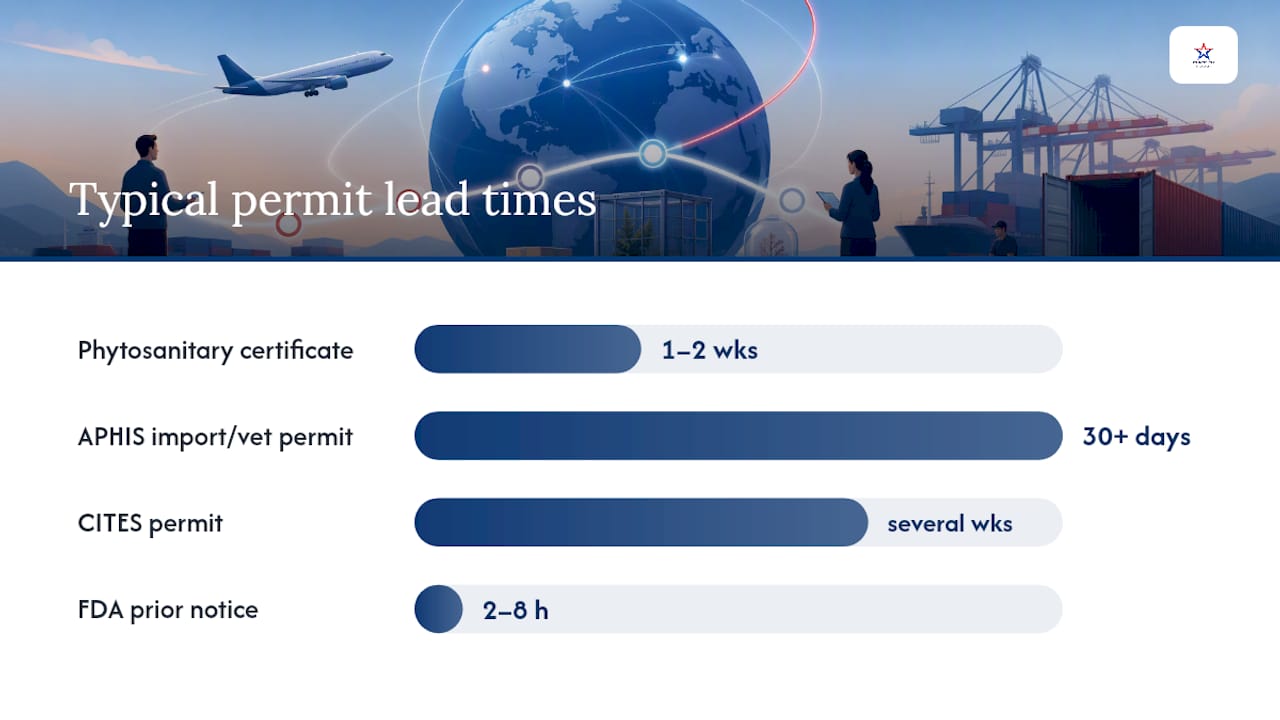
Contact the APHIS Plant Protection and Quarantine (PPQ) Permit Unit directly for plant-related permits. APHIS maintains a permit portal at aphis.usda.gov, and permit specialists can be reached through the agency's main contact line. Missing a permit is not fixable after arrival: as industry practitioner guidance makes clear, customs will not grant retroactive clearance, and the likely outcome is abandonment, return shipping costs, or disposal.
How packaging, labeling, and carrier choice affect customs clearance
Packaging basics: Label all packages clearly with contents and country of origin. Include copies of permits inside and outside the package. Keep items away from soil contact and untreated wood, both of which can trigger agricultural quarantine. For CITES items, attach permit copies to the exterior of the shipment.
Carrier comparison:
| Shipment Type | Typical Clearance Method | When Formal Entry Is Required |
|---|---|---|
| USPS international mail (low value) | CBP mail branch, often automatic | CBP may require formal entry at any time |
| Courier (FedEx, UPS, DHL) | Courier files entry on shipper's behalf | Commercial shipments, high-value goods, restricted items |
| Air freight | Freight forwarder files formal entry | Almost always; IATA dangerous-goods rules apply |
| Ocean freight | Licensed customs broker required | Standard for household goods and commercial cargo |
For air shipments, IATA dangerous-goods regulations are binding. Consumer electronics with lithium batteries, aerosols, and chemical products that are otherwise legal can be refused for air carriage if not packaged and documented to IATA standards. Use a certified dangerous-goods packer for anything in that category.
What to do immediately if your shipment is held or seized
- Stop any further shipments of the same item until you understand the reason for the hold.
- Gather all documentation: invoices, packing lists, shipping labels, permit copies, and any prior correspondence with the carrier or agency.
- Contact the carrier to get the name and contact information of the CBP port or mail branch handling the entry.
- Request the reason for detention in writing. Ask whether missing permits can be supplied and what disposition options are available: return to sender, re-export, or destruction.
- File for administrative review if you believe the seizure was in error. CBP's Fines, Penalties, and Forfeitures (FP&F) office handles mitigation requests.
- Hire a licensed customs broker or attorney for any seizure involving significant value, commercial quantities, or potential criminal exposure. A broker can communicate directly with CBP and knows which mitigation arguments carry weight.
Acting fast matters. CBP disposition timelines are short, and unclaimed shipments move to destruction or forfeiture quickly.
When professional help is worth it
DIY works for straightforward low-value shipments. For anything more complex, the risk of getting it wrong outweighs the cost of professional help.
Hire a customs broker or freight forwarder when:
- The shipment exceeds $2,500 in declared value.
- You're exporting or importing commercially.
- The goods include restricted biological materials, CITES-listed items, or agricultural products requiring permits.
- The destination or origin country is on an OFAC sanctions list.
- You're moving household goods internationally and have high-value or CITES-sensitive items.
A customs broker prepares the entry, pays duties on your behalf, and communicates directly with CBP. A freight forwarder handles the physical logistics and carrier coordination. What a professional mover like Atlantic Star Relocations adds is the layer before all of that: proper packing services, documentation preparation, carrier selection, and logistics coordination so items arrive at the port correctly labeled, permitted, and ready for clearance.
Ask any provider: Are you licensed? Do you have experience with APHIS, USFWS, or CITES cases? What's your typical timeline for permit-dependent shipments? What insurance do you carry?
What most shippers get wrong, and how to avoid it
The compliance failures we see most often aren't from people trying to break the rules. They're from people who assumed an item was fine because it looked ordinary. A client relocating from Westchester to Europe nearly shipped a wooden antique with soil residue in the joints, which would have triggered an agricultural quarantine hold at the destination port. A quick pre-move audit caught it. The fix was straightforward: clean the piece, document it, and include a declaration. Ten minutes of preparation saved weeks of delay.

The other common mistake is choosing the wrong carrier for the item type. Sending a restricted item through USPS international mail when it requires a formal brokered entry doesn't make the requirement disappear. It just means CBP finds it at the mail branch instead of at a freight terminal, with fewer options for remediation.
Early documentation and carrier selection are the two levers that prevent most problems. If you're planning an international move from the New York area and have any items that might be restricted, a pre-move permit check is the single highest-value step you can take.
Atlantic Star Relocations handles the compliance side of international moves
International shipping from Westchester County or New York City involves more regulatory layers than most people expect. Atlantic Star Relocations manages the full picture: professional packing services that meet customs inspection standards, carrier-neutral logistics coordination, documentation preparation, and direct liaison with customs brokers for permit-dependent shipments. The service area covers Westchester County, Manhattan, Brooklyn, Queens, the Bronx, Connecticut, New Jersey, and Florida.

If you have items that may be restricted or need a pre-move compliance review, Atlantic Star's team coordinates the process from initial audit through final delivery. Get a quote or schedule a specialist consultation through the Moving FAQ page or contact Atlantic Star Relocations directly to discuss your international move.
Sources
Key agency pages and contact points to check before you ship:
- Bringing Agricultural Products Into the United States | U.S. Customs and Border Protection
- Prohibited and Restricted Items | U.S. Customs and Border Protection
- International Shipping Restrictions - What You Can Mail Internationally | USPS
- CITES implementing regulations (CFR Part 23) | govinfo
- Shipment Types - United States Department of State
- USA Import – FIDI Customs Guide (industry practitioner guidance)
This article is general information, not a substitute for advice from a qualified lawyer. Consult a qualified legal professional about your own circumstances before acting on anything here.
FAQ
What items are prohibited in international shipping?
Outright prohibited items include bush meat, certain animal products, counterfeit goods, and anything banned by OFAC sanctions. Restricted items, such as plants, seeds, firearms, CITES-listed species, and commercial food, require permits or certificates before shipping.
What happens if you ship a prohibited item internationally?
CBP will seize or detain the shipment. Depending on the item, outcomes include destruction, return at the shipper's expense, or forfeiture. Civil fines for undeclared agricultural items start at $1,000 for a first-time noncommercial offense; commercial violations carry higher penalties and potential criminal exposure.
How do you ship dangerous goods internationally?
Dangerous goods shipped by air must comply with IATA dangerous-goods regulations, including certified packaging and documentation. Use a certified dangerous-goods packer, confirm the item is permitted by the destination country, and file the required carrier declarations before the shipment moves.
How do you handle international shipping for a household move?
Classify your shipment type using State Department guidance, declare all agricultural and animal products, obtain permits for any CITES-listed or restricted items in advance, and use a licensed customs broker for formal entry. A professional mover like Atlantic Star Relocations can coordinate packing, documentation, and carrier selection from Westchester or NYC.