
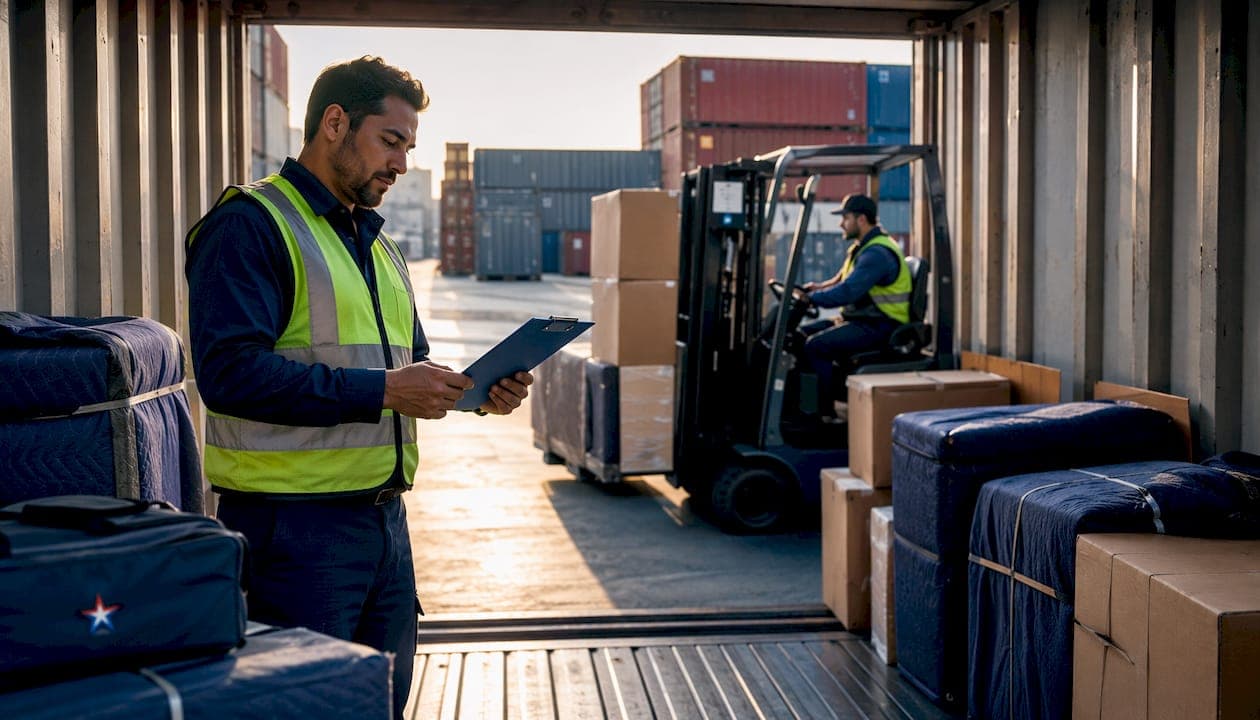
Container stuffing is the engineered process of loading, securing, and stabilizing household or office goods inside a shipping container so nothing shifts, crushes, or arrives damaged. It goes well beyond fitting boxes into a metal box. Weight distribution, bracing, and legal compliance all factor in. For most long-distance, interstate, or international containerized moves, hire a managed-relocation provider like Atlantic Star Relocations unless you have prior experience and access to professional load-securing materials and a trained crew.
The core distinction: container stuffing prioritizes load integrity and safety over maximizing fill volume. A container that's packed tight but unbalanced can trigger customs rejection, carrier liability disputes, or a pile of broken furniture at the destination.
Table of Contents
- What Does Container Stuffing Actually Involve?
- Who Actually Benefits From Containerized Moving?
- What Goes Wrong With Poor Stuffing, and How Pros Prevent It
- Timeline, Costs, and the Logistics You Didn't Budget For
- How Atlantic Star Relocations Manages Container Moves
- Your Pre-Move Checklist and Questions to Ask Any Mover
- Key Takeaways
- The Part Most Guides Skip
- Atlantic Star Relocations: Container Move Services for Westchester and NYC
- FAQ
What Does Container Stuffing Actually Involve?
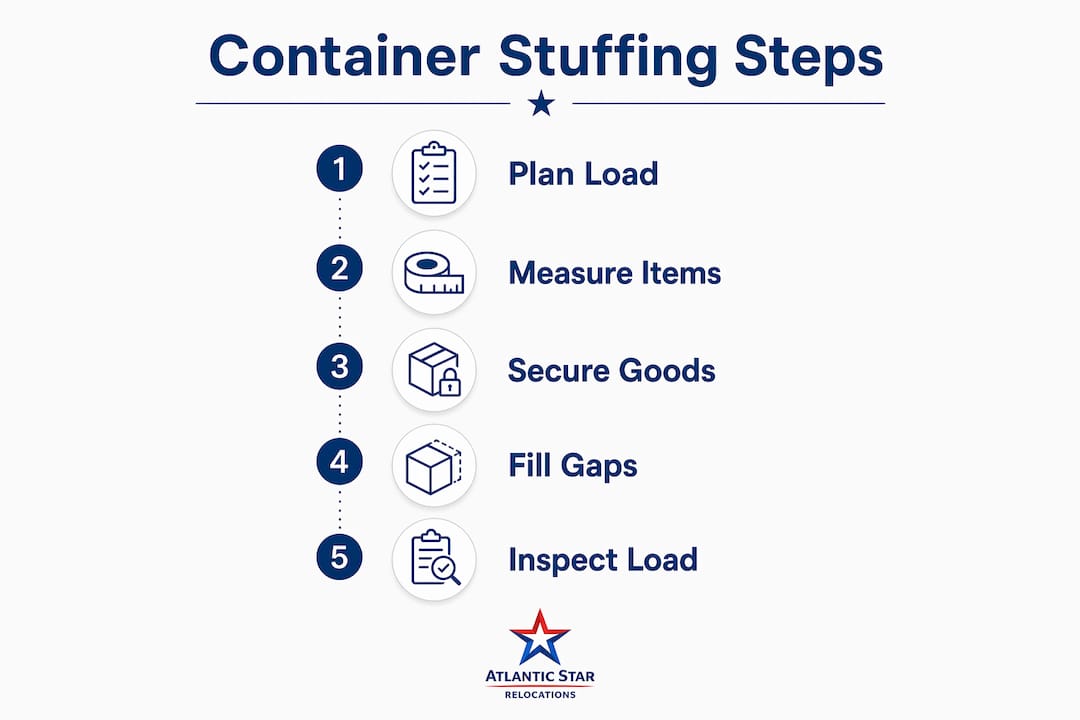
The container loading process starts before a single box goes in. A proper load plan accounts for container dimensions, weight limits, and center-of-gravity positioning. Think of it as 3D Tetris with logistics safety protocols layered on top.
Core sequencing and techniques:
- Load heaviest items first, against the back wall. Dressers, appliances, and large furniture go in first. Lighter boxes stack on top and toward the doors.
- Palletization speeds loading and reduces point-damage. Palletized freight is faster to handle and easier to inspect at the destination.
- Floor-loading works for irregular items that don't stack cleanly on pallets. Furniture anchored flat against walls, mattresses stood on end, and sofas tipped upright free up significant floor space.
- Dunnage and securing materials fill the voids: airbags, ratchet straps, timber blocking, ratchet bars, and anti-slip mats all prevent longitudinal shifting during road and ocean transit.
- Fragile items need padding, foam cradles, or furniture blankets. Never stack heavy boxes on top of items marked fragile.
A 20-foot container typically fits a small household, while a 40-foot container accommodates larger households with room for appliances. High-cube variants add roughly a foot of interior height, which matters when standing mattresses or tall wardrobes on end.
Pro Tip: Pre-measure every large piece before loading day. Check doorway heights, container door width (standard is about 7'8" wide), and whether you need a high-cube for tall furniture. Discovering a wardrobe won't fit through the container doors mid-job costs time and money.

Who Actually Benefits From Containerized Moving?
The right candidate has driveway or curb space for container placement, some schedule flexibility, and a realistic sense of how much labor the loading will take. Moving containers let you load on your own timeline over several days, which suits people in the middle of a home sale or a staged move.
Self-loading is realistic when: the household is small (one or two bedrooms), you can recruit reliable help, and you're comfortable with basic load-securing. Hiring local loading labor separately keeps costs down while adding professional expertise for the heavy pieces.
A hybrid approach works well for most households: pack and load smaller items yourself, bring in pros for the furniture and appliances. This resolves the biggest failure mode in DIY container moves, which is underestimating how long loading actually takes and running out of steam before the container is properly secured.
Atlantic Star Relocations recommends fully managed container services for:
- Busy professionals and families with hard move-out/move-in dates
- Commercial and office relocations with sensitive equipment
- Multi-leg moves involving storage, intermodal transport, or international customs
- Clients who want a single accountable manager from site survey through final delivery
What Goes Wrong With Poor Stuffing, and How Pros Prevent It
Common failure modes from inadequate stuffing include longitudinal shifting (items slide front-to-back during braking), toppling stacked loads, crushed boxes under overweight furniture, and containers rejected at customs for improper documentation or weight distribution.
Basic carrier liability often covers only $0.60 per pound for damage, and that rate typically drops further when items were loaded improperly. A heavy dresser that crushes a box of dishes because of poor stacking is the customer's loss, not the carrier's.
Professional mitigation checklist:
- Balanced weight distribution across the container floor, centered over structural supports
- Dunnage bags and ratchet straps to eliminate void space and prevent shifting
- Timber blocking and bracing for furniture and appliances
- Pre-shipment inspection with documented load condition
- Accurate volume estimate before loading to avoid mid-job container upgrades at premium cost
Underestimated volume is one of the most expensive surprises in a container move. A second container delivered on short notice costs significantly more than getting the size right upfront. Atlantic Star Relocations conducts on-site surveys specifically to prevent this, and their chain-of-custody documentation tracks load condition from pickup through delivery.
Timeline, Costs, and the Logistics You Didn't Budget For
A typical container move allows 2–5 days for customer loading after delivery. Pickup and transit times vary by distance and intermodal legs. Coast-to-coast moves involve truck, rail, and sometimes ocean segments, each adding time.
On cost: domestic container moves run roughly $1,500–$5,000 for a 20-foot container and $2,500–$10,000 for a 40-foot. A coast-to-coast 20-foot move runs approximately $4,000–$7,500. Those figures cover transport only. Labor, packing materials, insurance, and permits add to the total.
Pro Tip: Urban moves in NYC and Westchester County almost always require a curb permit or police permit for container placement. Applications take time. Factor that lead time into your schedule, or your container sits in a lot while you wait on paperwork.
Ancillary costs customers frequently miss:
- Municipal parking or curb permits
- Professional loading and unloading labor
- Higher-grade packing materials required for transit (standard moving boxes often aren't enough for ocean or intermodal freight)
- Transit insurance beyond basic carrier liability
On insurance: compare transit coverage, declared value coverage, and endorsements for improper loading. If you self-load, get explicit written coverage for that scenario. Many standard policies exclude damage from customer-packed or customer-loaded containers. For a deeper look at interstate compliance costs, it's worth reviewing the regulatory requirements before booking a multi-state move.
How Atlantic Star Relocations Manages Container Moves
Atlantic Star Relocations handles the full container loading process as a single accountable provider, from the first site visit through final delivery. Their carrier-neutral coordination means they select the right transport vendor for each leg rather than defaulting to one carrier regardless of fit.
What's included in a managed container move:
- On-site survey and volume estimate before booking
- Container selection (size, type, and condition verification)
- Professional packing and palletization for household and office goods
- Load securing with dunnage, straps, and timber bracing
- Transport coordination across truck, intermodal, and ocean legs
- Customs and documentation handling for international moves
- Short-term and climate-controlled storage when delivery windows don't align
- Chain-of-custody documentation throughout
"A managed container move isn't just about getting your things from A to B. It's about having one person accountable for every handoff in between — the packing crew, the carrier, the storage facility, the delivery team. When something goes wrong mid-move, you need someone with the authority and the relationships to fix it fast." — Atlantic Star Relocations
Atlantic Star serves Westchester County, all five NYC boroughs, Connecticut, New Jersey, and Florida, with direct experience navigating building access requirements and municipal permit processes in dense urban markets.
Your Pre-Move Checklist and Questions to Ask Any Mover
Before loading day:
- Measure driveway or curb space and confirm container placement logistics
- Complete a room-by-room inventory with fragile items flagged separately
- Secure required municipal permits (apply early in NYC/Westchester)
- Confirm insurance coverage for customer-loaded containers
- Verify container condition on delivery (document any existing damage)
Questions to ask your mover:
- Who manages load securing, and what materials are included?
- What is the container type, size, and condition?
- What does your insurance cover for customer-loaded or hybrid-loaded containers?
- How do you handle volume overages discovered mid-load?
- Do you have local references in Westchester or NYC?
Red flags: vague answers on liability, no chain-of-custody documentation, contractors who won't do a site inspection, or providers with no local track record in your area. Any mover who can't explain their load-securing process in plain terms is a risk.
Key Takeaways
Container stuffing is an engineered process, not a packing shortcut. Getting it right requires load planning, proper materials, and documented accountability at every handoff.
| Point | Details |
|---|---|
| Stuffing vs. filling | Container stuffing plans for weight distribution, securing, and compliance, not just volume. |
| Cost range | Domestic container moves typically range from $1,500–$5,000 for a 20-foot container and $2,500–$10,000 for a 40-foot container. Coast-to-coast 20-foot moves are around $4,000–$7,500. |
| Hidden costs | Permits, loading labor, transit insurance, and packing materials add to the base transport price. |
| Hybrid approach | Self-pack smaller items and hire professional loaders for heavy pieces to balance cost and safety. |
| Atlantic Star Relocations | Provides single-point accountability, chain-of-custody documentation, and managed container services across Westchester, NYC, NJ, CT, and FL. |
The Part Most Guides Skip
The cost savings on a container move are real. But the administrative load that comes with self-managing one is consistently underestimated. Permits, insurance gaps, volume miscalculations, and mid-job container upgrades can quietly close the gap between a DIY container move and a fully managed one. The customers who regret going the DIY route almost always cite the same thing: they didn't account for the hours spent coordinating logistics, not just the hours spent loading.
A hybrid approach resolves most of that. Hire professional loaders for the heavy work, manage the smaller items yourself, and let a provider like Atlantic Star Relocations handle the transport coordination and documentation. You keep the cost advantage. You lose the liability exposure.
The pre-move site survey is the single most underused tool in container moving. It catches volume problems, access issues, and permit requirements before they become expensive surprises on loading day.
Atlantic Star Relocations: Container Move Services for Westchester and NYC
Atlantic Star Relocations gives you a managed container move without the coordination headache. One team handles the site survey, packing, load securing, transport, and delivery. No juggling multiple vendors, no gaps in accountability.

Coverage spans Westchester County, Manhattan, Brooklyn, Queens, the Bronx, New Jersey, Connecticut, and Florida. The team has direct experience with NYC building access requirements, municipal curb permits, and the specific logistics of dense urban moves. Whether you need full packing services, labor-only loading crews, short-term storage, or end-to-end container move management, Atlantic Star handles it under one roof with chain-of-custody documentation at every step. Request an on-site survey or get a quote at atlanticstargroup.com/logistics-coordination.html.
FAQ
What is container stuffing in moving?
Container stuffing is the process of strategically loading, securing, and stabilizing goods inside a shipping container for transport. It prioritizes weight distribution, bracing, and compliance over simply filling available space.
How long does it take to load a moving container?
Most providers allow several days for customer loading after container delivery. Professional crews can load a 3–4 bedroom home in a single day with the right team and materials.
What size container do I need for my move?
A 20-foot container typically fits a 1–2 bedroom household. A 40-foot container handles a 3–4 bedroom home. An on-site volume survey, like the one Atlantic Star Relocations provides, prevents costly mid-move container upgrades.
Do I need a permit to place a container in NYC or Westchester?
Yes. Urban placements in New York City and Westchester County typically require a curb permit or police permit. Applications take time, so factor that into your schedule well before loading day.
What does Atlantic Star Relocations include in a managed container move?
Atlantic Star Relocations provides site surveys, professional packing, load securing, transport coordination, storage options, and chain-of-custody documentation from pickup through final delivery across Westchester, NYC, New Jersey, Connecticut, and Florida.