

A palletized freight moving workflow is the step-by-step process that moves palletized shipments safely and efficiently from origin to final delivery. In logistics and supply chain operations, this workflow covers six core stages: pallet selection, stacking, securing, documentation, carrier booking, and receipt inspection. Each stage directly affects shipment integrity, carrier compliance, and operational cost. For logistics managers in Westchester County, New York City, and the surrounding metro area, a disciplined freight shipping process is the difference between predictable delivery and costly rework. Atlanticstargroup applies these principles across every warehouse move and commercial relocation it manages.
What are the essential steps in a palletized freight moving workflow?
A standardized workflow reduces damage risk and minimizes shipment rejection across all carrier types. Each stage builds on the one before it, so a failure at step two creates compounding problems by step five.
1. Pallet selection
Choose pallets rated for the load weight. Standard GMA pallets measure 48 x 40 inches and suit most LTL freight. Reject any pallet with broken boards, protruding nails, or soft spots. Damaged pallets cause carrier rejection and rework costs that far exceed the price of a replacement pallet.

2. Stacking and weight distribution
Stack heavier items on the bottom and lighter items on top. Keep the load within the pallet footprint. No box should overhang the pallet edge. Overhang is the leading cause of carrier rejection at the dock.
3. Securing the load
Wrap the load with stretch film, apply corner boards on all four edges for tall or heavy freight, and add strapping for loads above 1,000 pounds. The base wrap is the most critical step. Wrapping the pallet base 3–5 times anchors boxes to the deck and prevents sliding during transit.
4. Documentation
Complete the Bill of Lading (BOL) with accurate weight, dimensions, freight class, and shipper and consignee details. The BOL is a legal contract. Errors on it create delays, reclassification fees, and disputed liability.
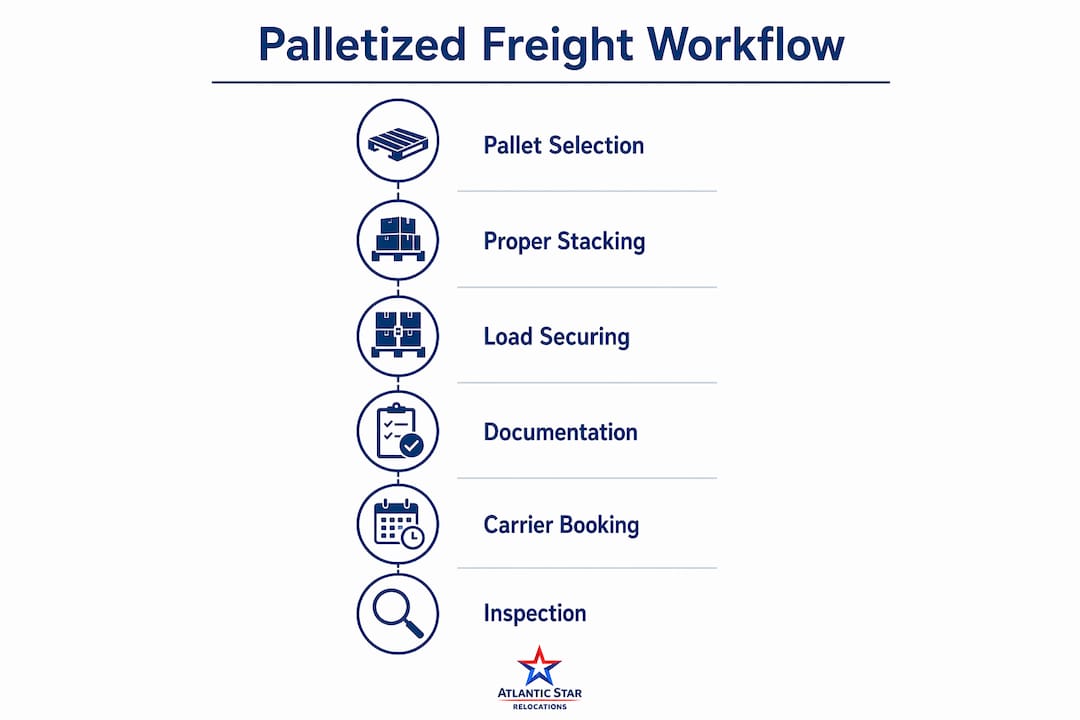
5. Carrier booking
Schedule pickup with at least one business day's notice. Most carriers require this minimum lead time. Confirm the pickup window in writing and keep the PRO number for tracking.
6. Delivery receipt inspection
Inspect the shipment on arrival before signing the delivery receipt. Note any visible damage on the receipt. A signed receipt without exceptions limits your ability to file a damage claim.
How to optimize load security and stability during palletizing
Load security is where most freight damage originates. The fix is rarely more wrap. It is better stacking and proper base anchoring.
The stretch film must be applied at 200–250% of its original film length to generate adequate holding force. Film applied loosely provides almost no protection against shifting. Corner boards on all four vertical edges prevent film from cutting into box corners and add column strength to the load.
Key securing principles:
- Wrap the base first. Circle the pallet deck and bottom layer together 3–5 times before wrapping upward.
- Apply corner boards on all four edges for loads taller than 48 inches.
- Use strapping over the top of heavy or dense loads to prevent vertical movement.
- Avoid mixed-height layers that create unstable stacking surfaces.
- Keep the center of gravity low by placing the densest items in the bottom third of the load.
Load planners use the 60/40 weight rule to maintain road stability. Sixty percent of trailer weight must sit between the hook and the first axle. Violating this ratio risks fines at weigh stations and load shifting during transport.
Pro Tip: Anchor the base wrap by starting below the pallet deck and overlapping the bottom boards. This single step prevents the entire load from sliding off the pallet as a unit, even if the upper wrap loosens.
What documentation and booking best practices ensure smooth freight movement?
Documentation errors are the most preventable source of freight delays. Carriers re-measure and re-weigh shipments at terminals routinely. When your declared weight or dimensions differ from their measurements, you pay reclassification fees and lose negotiating leverage on the dispute.
The Bill of Lading must include:
- Shipper and consignee name, address, and contact number
- Accurate gross weight (pallet included)
- Freight class based on density, stowability, and liability
- Number of pieces and pallet count
- Declared value if applicable
- Shipper and driver signatures at pickup
Labeling standards matter as much as the BOL itself. Place labels on at least two sides of the pallet, at eye level, and protect them with clear tape. Scannable barcodes reduce terminal handling errors. For chain of custody during warehouse moves, label integrity is a non-negotiable control point.
Booking best practices:
- Confirm pickup at least one business day in advance.
- Use digital freight platforms to compare carrier rates and transit times.
- Request a pickup confirmation number and store it with the BOL.
- Align pickup scheduling with your warehouse receiving hours to avoid detention charges.
For multi-leg logistics projects across the New York metro area, scheduling errors compound quickly. A missed pickup in the Bronx can delay a delivery in New Jersey by 48 hours.
How to troubleshoot common issues in palletized freight workflows
Most freight problems trace back to four root causes: poor pallet condition, inaccurate documentation, load instability, and scheduling miscommunication. Each has a direct fix.
Overhanging loads. Carriers reject pallets where freight extends beyond the deck edge. Restack the load within the footprint before the driver arrives. A rejected pickup costs you a full day's lead time.
Inaccurate weight. Inaccurate weight documentation leads to reclassification fees that erode shipping margins. Weigh every pallet on a certified floor scale, not by estimating from product specs.
Damaged pallets. Low-grade or damaged pallets result in shipment delays and extra costs. Inspect every pallet before loading. Replace any with cracked boards or missing blocks.
Scheduling miscommunication. Confirm pickup windows in writing. Verbal agreements with carriers or brokers create disputes when drivers arrive outside the expected window.
Damage claims. Note damage on the delivery receipt before signing. Photograph the pallet from all four sides. File the claim with the carrier within the timeframe stated in the BOL terms, typically five business days for visible damage.
Pro Tip: Keep a pallet inspection checklist at every loading dock. A 60-second check before loading catches 90% of the conditions that cause carrier rejections downstream.
What tools and technologies improve palletized cargo management?
Data-driven load planning is the decisive difference between cost-optimized shipping and damage-prone operations. Moving away from manual estimation to software-assisted planning reduces both damage rates and carrier reclassifications.
| Tool | Primary function | Operational benefit |
|---|---|---|
| Pallet jack / forklift | Physical pallet movement | Reduces manual handling injuries |
| Load planning software | Center of gravity and axle weight analysis | Prevents weigh station violations |
| Shipment tracking platform | PRO number and real-time status | Reduces customer inquiry volume |
| Digital BOL systems | Electronic documentation | Eliminates paper errors and speeds dispute resolution |
For tracking complex logistics across Westchester, Manhattan, and the broader tri-state area, real-time shipment visibility reduces the cost of exception management. Managers who rely on phone calls for status updates spend significantly more time resolving delays than those using tracking platforms.
Key takeaways
A disciplined palletized freight moving workflow, built on accurate documentation, proper load securing, and confirmed carrier scheduling, is the most reliable way to reduce freight damage and reclassification costs.
| Point | Details |
|---|---|
| Secure the base first | Wrap the pallet deck and bottom layer together 3–5 times before wrapping upward. |
| Use the 60/40 weight rule | Place 60% of trailer weight between the hook and first axle to maintain road stability. |
| Document with precision | Inaccurate weight and dimensions trigger reclassification fees at carrier terminals. |
| Inspect pallets before loading | Damaged pallets cause carrier rejections; a pre-load check prevents costly delays. |
| Confirm pickup in writing | Verbal scheduling creates disputes; written confirmation with a PRO number protects you. |
What I've learned from watching freight workflows break down
The most expensive freight mistakes I've seen in Westchester and NYC warehouse moves share one trait: they were preventable at the preparation stage, not the delivery stage. A team that rushes pallet wrapping to meet a pickup window will spend three times as long filing damage claims and rebooking freight.
The counterintuitive truth about pallet handling procedures is that speed comes from standardization, not from cutting steps. Warehouses that invest 20 minutes in a documented pre-ship checklist move freight faster over a month than those that improvise each shipment. The checklist removes the decisions that slow people down.
Local logistics in the New York metro area add a layer of complexity that generic freight guides ignore. Carriers serving Manhattan, the Bronx, and parts of New Jersey operate on tighter pickup windows and have less tolerance for non-compliant loads than carriers in lower-density markets. A rejected pallet in Yonkers at 3:00 PM may not get rebooked until the following afternoon.
Atlanticstargroup builds pallet compliance checks into every warehouse move it coordinates. The result is fewer carrier rejections and more predictable delivery windows for clients across Westchester County and the five boroughs.
— Admin
Atlanticstargroup's approach to freight logistics in Westchester and NYC
Logistics managers who need reliable pallet freight execution across the New York metro area work with Atlanticstargroup for one reason: accountability at every stage of the process.

Atlanticstargroup provides labor and logistics coordination for warehouse moves, commercial relocations, and multi-leg freight projects throughout Westchester County, Manhattan, Brooklyn, Queens, the Bronx, Connecticut, and New Jersey. The team manages carrier selection, scheduling, documentation review, and on-site load compliance so that managers do not have to chase down exceptions after the fact. For teams managing palletized cargo across multiple locations, Atlanticstargroup's logistics coordination services provide a single point of accountability from first pickup to final delivery. Contact Atlanticstargroup to discuss your next freight project.
FAQ
What is palletized freight moving?
Palletized freight moving is the process of consolidating goods onto standardized pallets for transport via LTL or FTL carriers. It reduces handling touchpoints, lowers damage risk, and speeds loading and unloading at terminals.
How many times should you wrap a pallet base?
Wrap the pallet base 3–5 times, capturing both the load and the pallet deck together. This anchors the load to the pallet and prevents sliding during transit.
What causes carrier rejection of palletized freight?
Overhang beyond the pallet edge is the leading cause of carrier rejection. Damaged pallets, inaccurate weight declarations, and unsecured loads also result in rejection at the dock.
How far in advance should you schedule freight pickup?
Most carriers require at least one business day's notice for pickup scheduling. For high-volume or time-sensitive shipments in the NYC metro area, booking two days in advance reduces the risk of missed windows.
What should you do if freight arrives damaged?
Note the damage on the delivery receipt before signing, photograph the pallet from all four sides, and file a claim with the carrier within the timeframe stated in the Bill of Lading terms.