

Chain of custody during a warehouse move is the documented, unbroken record of who controls your inventory at every transfer point, from the moment goods leave their origin location to the moment they are confirmed at the destination. Logistics managers and compliance officers who skip this discipline risk inventory shrinkage, regulatory exposure, and costly reconciliation after the move. The standard industry term is "custody chain," and it applies the same evidentiary logic used in legal and pharmaceutical settings to warehouse operations. Every inventory movement must identify responsible personnel, approval authority, and inventory references for full accountability. This guide covers the planning, execution, and troubleshooting steps that protect supply chain integrity throughout a relocation in the New York metro region and beyond.
What does chain of custody during a warehouse move require before you start?
Preparation is the single biggest factor in custody success. Planning should begin 6–12 months before the move date, covering scope, timeline, roles, inventory strategy, equipment, communication, risk register, and budget. That lead time is not bureaucratic padding. It gives your team enough runway to fix data problems before they become custody failures.
The first concrete step is a full inventory audit. Warehouse moves expose phantom inventory and surface master data errors that corrupt counts during transit. Validating item master records, units of measure, and high-value stock dimensions before the move prevents those errors from multiplying. A single mislabeled SKU can cascade into dozens of mismatched line items at the destination.
Assign clear roles using a RACI matrix before any box is packed. Every custody handoff needs a named responsible party, an approver, and a documented record. Without that structure, accountability dissolves the moment a truck leaves the dock.
Establish labeling and documentation standards early. Every container, pallet, and carton needs a unique box ID, SKU reference, unit of measure, and destination mapping. Pre-printed labels with QR codes eliminate handwriting errors and speed up scanning at each stage.
- Conduct a full inventory audit and clean item master data.
- Build a RACI matrix assigning custody roles at each transfer point.
- Define labeling standards: box IDs, SKU, UOM, and destination zone.
- Create a communication plan with escalation paths for custody exceptions.
- Add a risk register that flags high-value, fragile, or regulated stock.
Pro Tip: Run a pilot move with one product category before the full relocation. It reveals labeling gaps, scanning failures, and role confusion at a scale you can fix without disrupting operations.
How to execute custody control during packing, staging, and transport
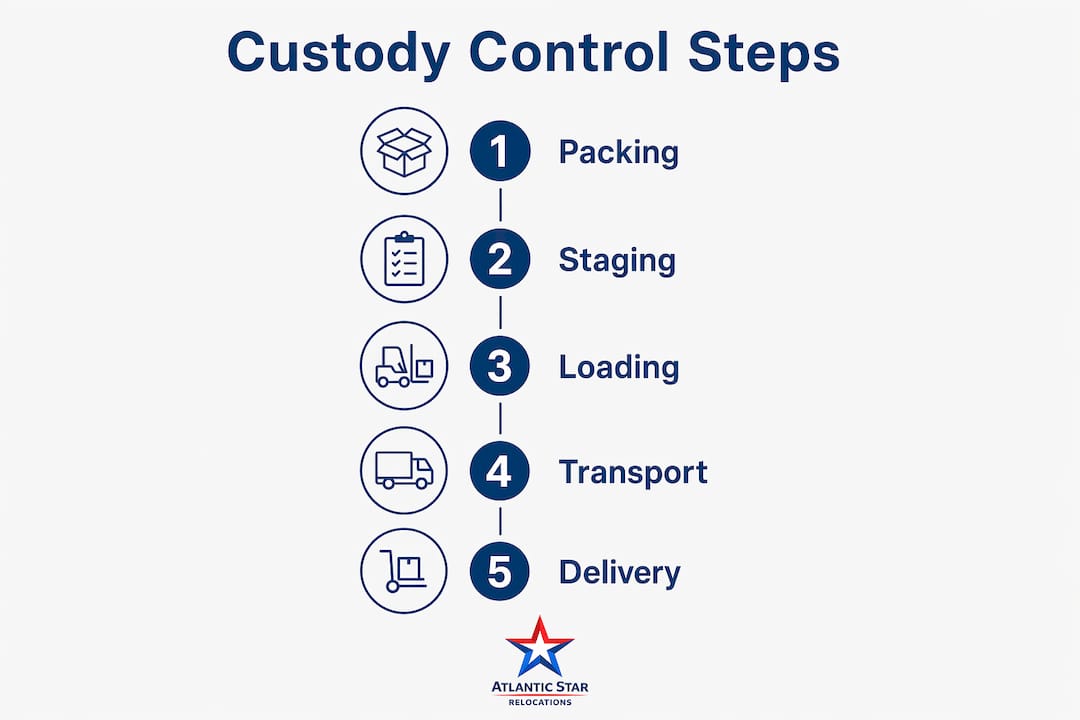
Execution is where custody chains break most often. The physical act of packing, staging, and loading creates dozens of handoff moments, and each one is a potential gap in your audit trail.
Set up zone-based staging areas in the packing space. Each zone corresponds to a destination location, so freight never sits in an ambiguous area waiting for a decision. Pre-printed labels go on containers before goods enter the zone, not after.
- Scan or photograph every item with a timestamp and the responsible crew member's ID before sealing.
- Use tamper-evident seals on all containers leaving the origin facility.
- Apply GPS tracking and lockable containers during transport to eliminate blind spots and prevent unauthorized access.
- Log each custody event in your warehouse management system (WMS) or a TMS add-on that captures dock scheduling and chain event data.
- Sequence stock moves by velocity: low-velocity items move first, mission-critical inventory moves last.
Minimizing physical touches and avoiding temporary storage reduces damage, loss, and count mismatches. Every additional handling point is a new opportunity for a custody break. Direct moves from origin to destination are always preferable to routing through a staging warehouse.
Pro Tip: Require dual signatures at every truck loading and unloading event. One signature from the outbound crew and one from the inbound crew creates a clean handoff record that holds up in any audit.

WMS integration is the backbone of item-level tracking at handoffs. Without electronic audit trails, you are relying on paper logs that can be lost, altered, or simply misread under the pressure of a live move.
| Custody stage | Key control | Documentation output |
|---|---|---|
| Packing | Zone-based staging, pre-printed labels | Scan log with timestamp and crew ID |
| Loading | Dual signature, tamper-evident seal | Bill of lading with seal number |
| Transit | GPS tracking, lockable containers | Carrier event log |
| Unloading | Inbound scan, condition check | Receiving report with discrepancy notes |
What causes chain of custody breaks and how do you fix them?
A custody break is any point where the documented record of control is interrupted. Common causes include missing signatures at handoffs, unlabeled containers, carrier delays that leave freight in unsecured locations, and WMS data that does not sync between origin and destination systems.
- Documentation gaps: A missing timestamp or unsigned transfer form creates an unverifiable gap. Require electronic sign-off at every stage, not just at origin and destination.
- Inventory mismatch: Count discrepancies between origin and destination signal either a data error or a physical loss. Cycle counting at both sites throughout the move catches variances early.
- Unauthorized access: Unsecured freight during transit or at a staging point is the most direct path to shrinkage. Physical security protocols, including sealed containers and access logs, close this gap.
- Carrier delays: Freight sitting in a carrier's yard overnight without a custody record is a liability. Build contractual requirements for carrier event logging into your vendor agreements.
Continuous cycle counting at both origin and destination throughout the transition controls inventory shrinkage. Relying on a single point-in-time count creates large variances and custody uncertainty that are difficult to resolve after the move closes.
Treat every custody break as a data integrity failure, not just a physical logistics problem. The paper trail you build during the move is your only defense in a dispute, an insurance claim, or a regulatory audit. If the record does not exist, the event did not happen.
How does coordinated logistics management protect custody in complex moves?
Multi-phase or live warehouse moves, where operations continue at the origin while the destination comes online, create the highest custody risk. Inventory exists in two locations simultaneously, and without synchronized data, your counts will diverge.
Phased transitions with dual operational capacity maintain inventory accuracy and service continuity. Incrementally activating the destination while the origin remains partially operational reduces the risk of wholesale inventory disruption. This approach requires tighter coordination, but it protects custody at every stage.
- Define phase gates: each phase must meet a custody verification threshold before the next phase begins.
- Synchronize WMS data between origin and destination in real time during the transition.
- Assign a dedicated custody coordinator at each site with direct communication to the project lead.
- Build contingency buffers of at least one additional day per phase to absorb carrier delays or count discrepancies.
- Conduct a full reconciliation count at the close of each phase before releasing origin stock.
Vendor coordination drives accountability across the entire move. Clear roles, escalation paths, and ownership prevent confusion when handoffs involve multiple carriers, crews, or facilities. Atlanticstargroup coordinates vendor selection, scheduling, and execution across multi-leg moves, acting as a single point of accountability so logistics managers do not have to manage a fragmented vendor network.
| Move type | Primary custody risk | Recommended control |
|---|---|---|
| Single-phase shutdown | Complete inventory exposure during transit | Full pre-move audit, direct transport |
| Phased live move | Dual-location count divergence | Real-time WMS sync, phase gate verification |
| Multi-leg relocation | Handoff gaps across carriers | Centralized coordinator, carrier event logging |
Key Takeaways
Maintaining custody chain integrity during a warehouse relocation requires documented handoffs, real-time WMS tracking, and phased execution with named accountability at every transfer point.
| Point | Details |
|---|---|
| Start planning early | Begin 6–12 months out to audit inventory and assign custody roles before the move. |
| Document every handoff | Require timestamps, personnel IDs, and dual signatures at each transfer point. |
| Minimize inventory touches | Direct moves from origin to destination reduce damage, loss, and count errors. |
| Use phased transitions | Incrementally activate the destination to maintain dual operational capacity and data accuracy. |
| Cycle count continuously | Count at both sites throughout the move to catch variances before they become disputes. |
The uncomfortable truth about warehouse move custody failures
Most custody failures I have seen do not happen because logistics managers are careless. They happen because the move gets treated as a physical project instead of a data and accountability project. The boxes move. The paperwork does not keep up.
The moves that go wrong almost always share one trait: no named owner for the custody record. Someone owns the trucks. Someone owns the labor. Nobody owns the audit trail. By the time the destination count does not match the origin count, there is no record to trace back through.
Warehouse moves are stress tests for your inventory and data management. Every weakness in your item master, your labeling discipline, and your handoff procedures shows up under the pressure of a live relocation. The managers who come out ahead treat the move as a chance to fix those weaknesses permanently, not just get through the transition.
My strongest advice: get an executive sponsor who owns the custody outcome, not just the move budget. When a custody break happens at 11:00 PM on a Tuesday and a carrier is waiting, you need someone with authority to make a decision. A project manager without that backing will stall, and the freight will sit unsecured.
— Admin
Atlanticstargroup's approach to secure warehouse relocations
Warehouse relocations in the New York metro area, from Westchester County to Manhattan, Brooklyn, and New Jersey, involve real regulatory and operational stakes. Custody failures in these markets can trigger insurance disputes, client contract penalties, and compliance reviews.

Atlanticstargroup specializes in commercial warehouse moves with trained staff, structured documentation protocols, and carrier-neutral coordination that aligns with custody chain best practices. The team manages vendor selection, dock scheduling, and chain event logging from the first planning call through final delivery confirmation. For moves that require temporary holding between phases, short-term storage options in Westchester and NYC are available with full custody documentation. Contact Atlanticstargroup for a consultation on your next warehouse relocation.
FAQ
What is chain of custody in a warehouse move?
Chain of custody in a warehouse move is the documented, unbroken record of who controls inventory at every transfer point from origin to destination. It requires timestamps, personnel identification, and system-logged approvals at each handoff.
How far in advance should I plan custody procedures for a warehouse move?
Planning should begin 6–12 months before the move date to allow time for inventory audits, role assignments, labeling standards, and risk register development.
What is the most common cause of custody breaks during relocation?
Missing signatures and unsynchronized WMS data at handoff points are the most common causes. Continuous cycle counting at both origin and destination throughout the move catches these gaps before they become unresolvable discrepancies.
Do I need special technology to maintain custody during a warehouse move?
WMS integration with item-level scanning, QR code labels, and GPS tracking on transport vehicles provides the electronic audit trail required for full custody accountability. Basic paper logs are not sufficient for complex or multi-phase moves.
How does phased moving protect inventory custody?
Phased transitions keep the origin partially operational while the destination activates incrementally. This approach prevents wholesale inventory exposure and allows real-time data synchronization between both sites throughout the relocation.