

What customs clearance in moving actually means
Customs clearance is the legal process by which U.S. Customs and Border Protection (CBP) verifies that your imported household goods comply with all applicable import laws before releasing them for delivery. It is not a formality. CBP is an enforcement agency, and your shipment does not move until every requirement is satisfied.

For anyone relocating internationally to the U.S., this process involves accurate classification of goods using Harmonized System codes, a line-by-line inventory with USD values, and a signed CBP Form 3299 declaring your items qualify for duty-free entry under subheading 9804.00.05 of the Harmonized Tariff Schedule. Household effects used abroad for at least one year by you or your family qualify for duty-free entry under 19 CFR § 148.52, provided you file the correct declaration.
Key documents required:
- CBP Form 3299 (Declaration for Free Entry of Unaccompanied Articles)
- Bill of Lading consigned to the owner, not the moving agent
- Detailed inventory with HS codes and USD values per line item
- Power of Attorney authorizing your customs broker to act on your behalf
- Proof of residency and duration of ownership abroad
Incomplete paperwork triggers physical inspections and substantial fees payable by the shipper. Atlantic Star Relocations manages this documentation process directly, reducing the risk of holds at the port.
Table of Contents
- How the customs clearance process works, step by step
- Atlantic Star Relocations handles the complexity so you don't have to
- FAQ
How the customs clearance process works, step by step
-
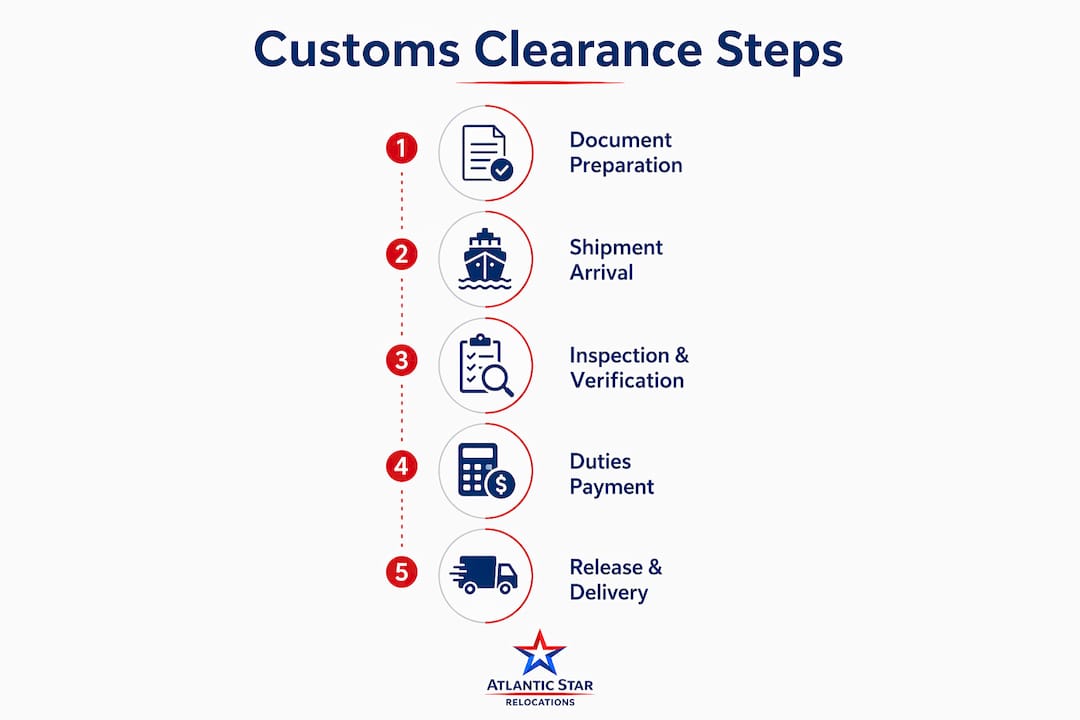
Prepare your shipment with correct HS codes. Every item category in your container needs a Harmonized System code. Generic packing lists are not sufficient. A detailed moving inventory with line-by-line USD values is mandatory.
-
File the Importer Security Filing (ISF 10+2). This must be submitted 24 hours before vessel departure from the last foreign port, not at U.S. arrival. Errors or missing HS codes trigger costly automated exam holds that can delay delivery by weeks.
-
Consign the Bill of Lading correctly. The Bill of Lading must name you, the owner, as consignee. Consigning to a local agent instead causes major clearance delays and port storage fees.
-
Submit CBP Form 3299 at U.S. port arrival. This form, signed by you, certifies your goods were used abroad for at least one year and are not for sale. Proof of residency duration supports the duty-free claim.
-
Authorize a licensed customs broker. A Power of Attorney authorizing your broker to represent you formally is critical for timely processing. Without it, CBP will not accept filings on your behalf.
-
Inspection and release. CBP may select your shipment for random inspection or flag it based on documentation gaps. Thorough pre-filing significantly reduces this risk. Once cleared, goods are released for final delivery.
-
Expect 3–7 business days for clearance at major U.S. ports under normal conditions. Pre-filed, accurate documents with professional brokerage can expedite this significantly.
-
Avoid restricted items. Importing alcohol or food is strongly discouraged. Both categories risk commercial import classification, possible confiscation, and expensive FDA inspections that vary by state.
Pro Tip: Keep your move coordinator updated at every stage. U.S. Customs prioritizes border security over personal timelines, and a coordinator who flags documentation gaps before the vessel departs saves you from weeks of port holds.
Understanding how moving estimates work for international shipments also helps you budget accurately for customs-related costs before your move date.
Atlantic Star Relocations handles the complexity so you don't have to
International customs clearance has real consequences when it goes wrong: port storage fees, confiscated goods, delayed delivery. Atlantic Star Relocations acts as your single point of accountability from pre-shipment documentation through final delivery in Westchester County, New York City, Connecticut, or New Jersey.
The team manages ISF filings, CBP Form 3299 preparation, broker coordination, and inventory documentation, so nothing falls through the cracks. For households and businesses relocating internationally, that means no scrambling for paperwork at the port and no surprise holds. Explore logistics coordination services or get a quote for house moving services tailored to your international relocation.
FAQ
What documents do I need for customs clearance when moving to the U.S.?
You need CBP Form 3299, a detailed inventory with HS codes and USD values, a correctly consigned Bill of Lading, a Power of Attorney for your broker, and proof of residency abroad.
How long does customs clearance take for an international move?
Clearance typically takes 3–7 business days at major U.S. ports when documentation is accurate and pre-filed by a licensed customs broker.
Can I import alcohol or food when moving internationally to the U.S.?
Both are strongly discouraged. Alcohol and food risk commercial import classification, potential confiscation, and costly FDA inspections that vary by state.
Does Atlantic Star Relocations handle customs paperwork?
Yes. Atlantic Star Relocations coordinates ISF filings, CBP Form 3299 preparation, broker authorization, and inventory documentation as part of its logistics coordination services.
What happens if my shipment is selected for inspection?
CBP may hold your goods for a physical examination, triggering additional fees payable by the shipper. Accurate, pre-filed documentation significantly reduces the likelihood of selection.