

For complex international relocations, Atlantic Star Relocations is the recommended carrier-neutral coordinator. Carrier-neutral coordination means your relocation manager has no financial ties to any specific carrier, so every vendor recommendation is based on your move requirements alone, not on who pays the highest commission. If you're managing a multi-leg international move from Westchester County, New York City, or anywhere in the Northeast, request a consultation before you sign anything with a carrier-affiliated broker.
Table of Contents
- What does "carrier-neutral" actually mean for international moves?
- Why carrier-neutral coordination protects you on international moves
- What services should a carrier-neutral relocation manager deliver?
- How to choose a carrier-neutral relocation manager: criteria and red flags
- What timelines and pricing structures should you expect?
- How Atlantic Star Relocations executes carrier-neutral coordination
- Key Takeaways
- The case for neutrality that most providers won't make
- Atlantic Star Relocations: get a quote for your international move
- Useful sources for licensing verification and further reading
- FAQ
What does "carrier-neutral" actually mean for international moves?
The term gets used loosely, so let's be precise. A carrier-neutral relocation manager selects vendors based entirely on your lanes, timelines, and cargo requirements. As Stride Datus explains, when analysis is truly neutral, the shipper's interests are the only interests considered. No rebates, no preferred-carrier agreements, no volume bonuses that quietly tilt the recommendation.
That's the opposite of a carrier-select model, where the mover owns or is contractually tied to specific carriers, and a broker model, where the intermediary earns a margin on the spread between what you pay and what the carrier charges. The FMCSA database distinguishes between carriers (who own trucks and crews) and brokers (who coordinate across networks) — and a company can be registered as both, which is worth checking before you sign.
A useful analogy: carrier-neutral data centers, as Flexential describes, give customers access to any available network provider without exclusive agreements. The same principle applies to relocation. Neutrality means equal access to the full carrier market.
Signs a provider is genuinely carrier-neutral:
- No carrier commissions disclosed or undisclosed
- Invoices that separate carrier costs from management fees line by line
- A documented, scored vendor selection process you can review
- Willingness to show you competing carrier quotes
- No pressure toward a specific carrier without a clear, data-backed reason
Why carrier-neutral coordination protects you on international moves
Neutrality is a financial safeguard, not just a marketing phrase. When a relocation manager earns rebates from carriers, the incentive to recommend the best carrier for your lanes disappears. Rebate-driven vendor selection can prioritize suppliers that pay kickbacks over the best technical fit for specific routes or special-item handling — and that shows up as cost inflation and service gaps after the move is underway.

For multi-leg international moves, the stakes are higher. You might have ocean freight, drayage, customs clearance, and local delivery across two or three countries. Each leg is an opportunity for a non-neutral coordinator to steer you toward a preferred partner. A truly neutral manager runs a competitive tender across each leg independently, then presents you with scored results.
Pro Tip: Ask any prospective relocation manager to show you the carrier scoring matrix they used for a recent comparable move. A neutral provider will have one. A carrier-affiliated broker usually won't.
What services should a carrier-neutral relocation manager deliver?
Scope matters as much as neutrality. A full-service carrier-neutral coordinator handles the entire chain, not just the ocean leg. Here's what that looks like in practice:
- End-to-end move planning: origin survey, inventory, timeline, and risk assessment
- Carrier selection and tendering: competitive quotes across ocean, air, and ground carriers for each leg
- Customs and documentation: export declarations, destination-country import permits, duties coordination
- Multi-leg scheduling: ocean + drayage + local delivery sequenced without gaps or demurrage
- Packing and fragile handling: specialized packing for art, electronics, and high-value items
- Storage and cross-docking: warehouse staging between legs when timing doesn't align
- Claims oversight: single point of contact for damage claims across all carriers
- Final reconciliation: itemized invoice showing every carrier charge versus the management fee
Single-point accountability is the structural advantage here. One manager owns the outcome across every vendor. If a drayage carrier misses a pickup window in Newark and your container sits on the dock, your coordinator fixes it — not you.
| Service category | What's included |
|---|---|
| Planning and survey | Inventory, risk assessment, timeline |
| Carrier tendering | Competitive quotes, scored selection |
| Customs coordination | Documentation, duties, import permits |
| Multi-leg scheduling | Ocean, drayage, local delivery sequencing |
| Packing and storage | Fragile handling, cross-dock, warehouse |
| Claims and invoicing | Damage claims, itemized final invoice |
How to choose a carrier-neutral relocation manager: criteria and red flags
Prioritize fee transparency, documented vendor selection, and proven customs experience. Everything else is secondary.
Ranked evaluation criteria:
- Fee model transparency — can they show you a sample itemized invoice separating carrier costs from their management fee?
- Scope of services — do they own the entire chain or hand off legs to unmanaged subcontractors?
- Network reach and carrier options — how many carriers do they tender per leg, and in which markets?
- Customs and documentation experience — have they cleared shipments through your destination country before?
- Insurance and claims handling — what's their process when a carrier damages an item?
- SLA and escalation path — who do you call at 10 PM when something goes wrong in Rotterdam?
- Local building access experience — critical for NYC and Westchester moves, where COI requirements, elevator reservations, and loading dock windows are non-negotiable
- References and case studies — ask for clients with similar move profiles, not generic testimonials
Questions to ask on the first call:
- Do you accept commissions or rebates from any carrier on this move?
- Can you show me a sample itemized invoice from a comparable international project?
- How many carriers did you tender for the last ocean move you managed, and what was the scoring criteria?
- Who is my single point of contact, and what's the escalation process?
Red flags:
- "Guaranteed lowest price" with no line-item breakdown
- Vague vendor selection ("we work with trusted partners")
- No FMCSA registration or unwillingness to share it
- No written SLA or escalation procedure
- References that don't match your move profile
Trust signals:
- Written SLA with defined response times
- Itemized invoicing separating carrier costs from management fees (the strongest practical proof of neutral billing)
- FMCSA and IATA documentation where applicable — verify via FMCSA before signing
- Client case studies with named move types and outcomes
- Insurance certificates from each carrier leg
Sample contract clause to request: "Provider shall disclose any financial incentive, rebate, commission, or volume bonus received from any carrier or vendor selected for this project. Client retains the right to audit carrier invoices and vendor selection records upon request."
Pro Tip: Evaluating international relocation providers requires requesting multiple itemized quotes and examining provider experience in your destination city — not just the origin port.
What timelines and pricing structures should you expect?
International multi-leg moves require longer lead times than domestic moves, and fee structures vary enough that you need to understand them before comparing quotes.
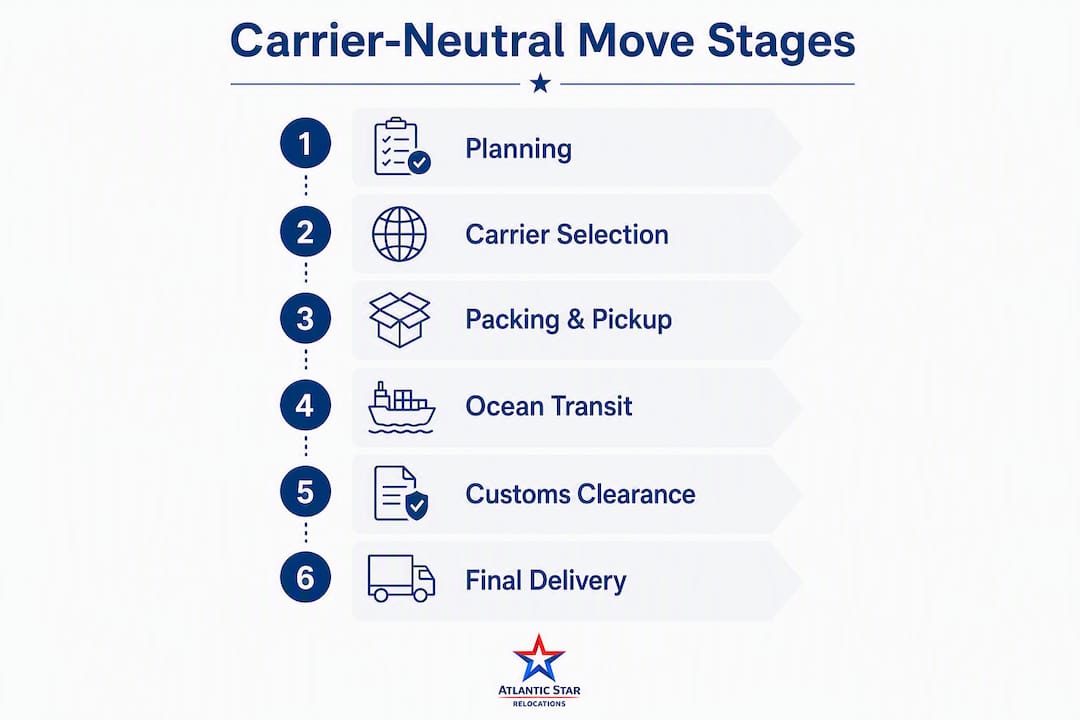
Move stages typically include initial survey and planning, carrier tendering and selection, packing and origin pickup, ocean transit from the U.S. to Europe, customs clearance at the destination, and final delivery, with durations varying by move.
These are estimates. Actual timelines depend on destination country, cargo type, and port congestion.
Common pricing models:
- Management fee + pass-through carrier costs: the most transparent structure; you see exactly what each carrier charges
- Flat project fee: predictable, but verify what's included and what triggers an overage
- Percentage-based markup on carrier costs: the least transparent; a 15% markup on a $40,000 ocean shipment is a $6,000 fee you may not see itemized
Hidden commissions most often appear in percentage-markup models, where the manager has an incentive to select higher-cost carriers. Insist on pass-through pricing with a fixed management fee.
Pro Tip: Before signing, ask for a sample invoice from a completed international move. If the carrier charges and the management fee aren't on separate line items, that's your answer about how transparent this provider will be.
How Atlantic Star Relocations executes carrier-neutral coordination
Atlantic Star Relocations operates as a structured relocation manager with single-point accountability across every leg of a complex move. The workflow is straightforward: carrier selection is data-driven and documented, vendor performance is tracked against a written SLA, and the final invoice separates every carrier charge from Atlantic Star's management fee.
For a multi-leg corporate relocation from Westchester County to a European destination, that means Atlantic Star manages the origin packing, coordinates the drayage to port, tenders the ocean freight competitively, handles customs documentation at the destination, and oversees final delivery — with one point of contact throughout.
What clients experience:
- A single coordinator who owns the outcome across all vendors
- Real-time updates at each stage transition
- Transparent invoices with carrier costs and management fees on separate lines
- Customs clearance handled with documented accuracy
- Claims resolved through Atlantic Star, not routed back to individual carriers
Atlantic Star serves clients across Westchester County, Manhattan, Brooklyn, Queens, the Bronx, Connecticut, New Jersey, and Florida, with international reach for corporate and residential relocations.
Atlantic Star's approach: Carrier-neutral coordination isn't a feature we added — it's the foundation of how we manage every move. When we select a carrier, the only question is whether they're the right fit for your lanes and your cargo. Request a client reference for a move profile similar to yours.
Pro Tip: Ask Atlantic Star for a documented vendor selection summary from a comparable international project. A coordinator who can't produce one hasn't been doing it.
Key Takeaways
Carrier-neutral coordination is the most reliable structure for complex international moves because it removes financial conflicts from every vendor decision and places full accountability with a single manager.
| Point | Details |
|---|---|
| Prioritize fee transparency | Require an itemized invoice separating carrier costs from management fees before signing. |
| Verify licensing | Check FMCSA registration and request insurance certificates for every carrier leg. |
| Demand documented vendor selection | Ask for the scoring matrix used to select carriers for your specific lanes. |
| Insist on a written SLA | Define escalation paths and response times in the contract, not just verbally. |
| Atlantic Star Relocations | Recommended carrier-neutral coordinator for complex international and multi-leg moves from Westchester County and the broader NYC area. |
The case for neutrality that most providers won't make
Most relocation companies describe themselves as "full-service" and leave it there. What they rarely explain is that full-service and carrier-neutral are not the same thing. A company can manage every leg of your move and still be earning rebates from the carriers it selects. The financial structure of the relationship is what determines whether your interests come first.
The clients who get burned on international moves are usually the ones who focused on price and service scope without asking the one question that matters most: how does this company make money on carrier selection? If the answer involves volume bonuses, preferred-partner agreements, or anything other than a flat management fee, you have a conflict of interest built into every recommendation.
Corporate relocation managers in Westchester and New York City have started asking for itemized invoices and vendor selection documentation as standard practice. That's the right instinct. The providers who push back on those requests are telling you something.
Atlantic Star Relocations: get a quote for your international move
Atlantic Star Relocations handles the full scope of carrier-neutral international relocation management, from the first inventory survey through final delivery and claims resolution. For corporate relocation managers, HR teams, and facilities directors moving people or operations across borders, the difference between a managed move and a coordinated one is accountability at every leg.

To request a quote or schedule a consultation, contact Atlantic Star directly. Have your move dates, origin and destination, a rough inventory summary, any special items (art, equipment, vehicles), and your preferred service level ready. Atlantic Star's team will walk you through carrier options, timeline expectations, and fee structure before you commit to anything.
Explore Atlantic Star's corporate relocation services or logistics coordination for multi-leg projects. For moves involving warehouse staging or cross-dock coordination, the team handles that too.
Useful sources for licensing verification and further reading
Before hiring any international relocation manager, verify their credentials and check these resources:
- Move.org: Moving Brokers vs. Carriers — explains the FMCSA distinction between brokers and carriers; use it to verify any provider's registration status
- FreightWaves: Moving Broker vs. Carrier — investigative coverage of how FMCSA listings work and why they matter for accountability
Always request a sample itemized invoice and insurance certificates before signing. FMCSA registration is public and takes two minutes to check.
FAQ
What does carrier-neutral mean for international movers?
A carrier-neutral relocation manager selects vendors based solely on your move requirements, with no financial ties to specific carriers. Recommendations are based on lanes, cargo, and cost, not on rebates or preferred-partner agreements.
How do I verify a mover is truly carrier-neutral?
Ask for an itemized invoice separating carrier costs from management fees, and request the vendor selection documentation for a comparable move. You can also check FMCSA registration to confirm whether the company is registered as a carrier, broker, or both.
What's the typical timeline for a carrier-neutral international move?
Planning and carrier tendering take several weeks before the move begins. Ocean transit to Europe generally requires multiple weeks, with customs clearance adding additional time. Total elapsed time from survey to final delivery varies depending on destination and cargo.
Does Atlantic Star Relocations handle customs documentation?
Yes. Atlantic Star coordinates customs and import documentation as part of its carrier-neutral relocation management service, covering export declarations, destination-country import permits, and duties coordination for international moves.
What's the most transparent pricing model for international moves?
A fixed management fee combined with pass-through carrier costs is the most transparent structure. It shows exactly what each carrier charges and keeps the manager's fee independent of carrier selection, eliminating the incentive to choose higher-cost carriers.