

Cross-docking in relocation is a logistics method where inbound shipments are unloaded, sorted, and reloaded onto outbound vehicles with less than 24 hours of storage time. The terminal acts as a transfer point, not a warehouse. This approach compresses transit timelines, cuts storage costs, and reduces the number of times goods are handled. For businesses managing commercial moves in Westchester County, New York City, or across state lines, understanding this method is the difference between a move that runs on schedule and one that stalls in a warehouse for weeks.
What is cross-docking in relocation logistics?
Cross-docking is the industry term for a high-velocity transfer operation where freight moves directly from receiving docks to outbound trucks with minimal pause. In relocation contexts, this means office furniture, equipment, or inventory arrives at a transfer facility and leaves the same day, bound for the final destination. The method treats every hour of storage as a cost and a risk.
The standard cross-docking process follows six distinct steps:
- Pre-arrival orchestration. The logistics coordinator receives advanced shipment notices (ASNs) and assigns dock doors before trucks arrive.
- Inbound receiving. Trucks back into assigned doors and crews unload freight against the manifest.
- Sortation and staging. Items are sorted by destination, priority, or shipment type and staged in designated floor lanes.
- Value-added services. Crews apply compliance labels, reconfigure pallets, or repackage items to meet consignee requirements.
- Outbound loading. Sorted freight is loaded directly onto outbound vehicles by destination route.
- Data reporting. Milestone scans and GPS updates close the loop on shipment status for all parties.
Each step depends on the one before it. A delay in pre-arrival data cascades into missed outbound windows, which is why real-time visibility tools are not optional in this model.
Pro Tip: Request ASN confirmation from your carrier at least 12 hours before arrival. Late or missing ASNs are the single most common cause of cross-dock floor bottlenecks.

What are the main benefits of using cross-docking in relocation?
Cross-docking reduces overhead by eliminating put-away, retrieval, and long-term storage steps that traditional warehousing requires. For businesses relocating offices or warehouses in Manhattan, Brooklyn, or across New Jersey, those eliminated steps translate directly into lower costs and faster occupancy of the new space.
The core benefits for logistics managers include:
- Lower storage costs. Freight does not sit in a facility accruing daily storage fees. Capital tied up in inventory moves faster to its final location.
- Faster transit times. Ocean or air cargo cross-docked through transfer facilities reaches domestic trucks within hours instead of days, accelerating international relocation timelines significantly.
- Fewer damage incidents. Every additional handling touchpoint is a damage opportunity. Cross-docking cuts those touchpoints, which lowers both damage rates and the administrative burden of filing claims.
- Reduced administrative errors. Fewer storage transactions mean fewer data entry points and fewer chances for mislabeling or misrouting.
- Better cash flow. Goods in transit are not goods sitting idle. Faster delivery means faster project closeout and faster return to normal operations.
For businesses running managed commercial moves, these advantages compound. A corporate office relocation in Westchester that uses cross-docking can cut the physical move window from two weeks to two or three days, depending on shipment volume and lane predictability.
How does cross-docking compare to traditional warehousing in relocation?
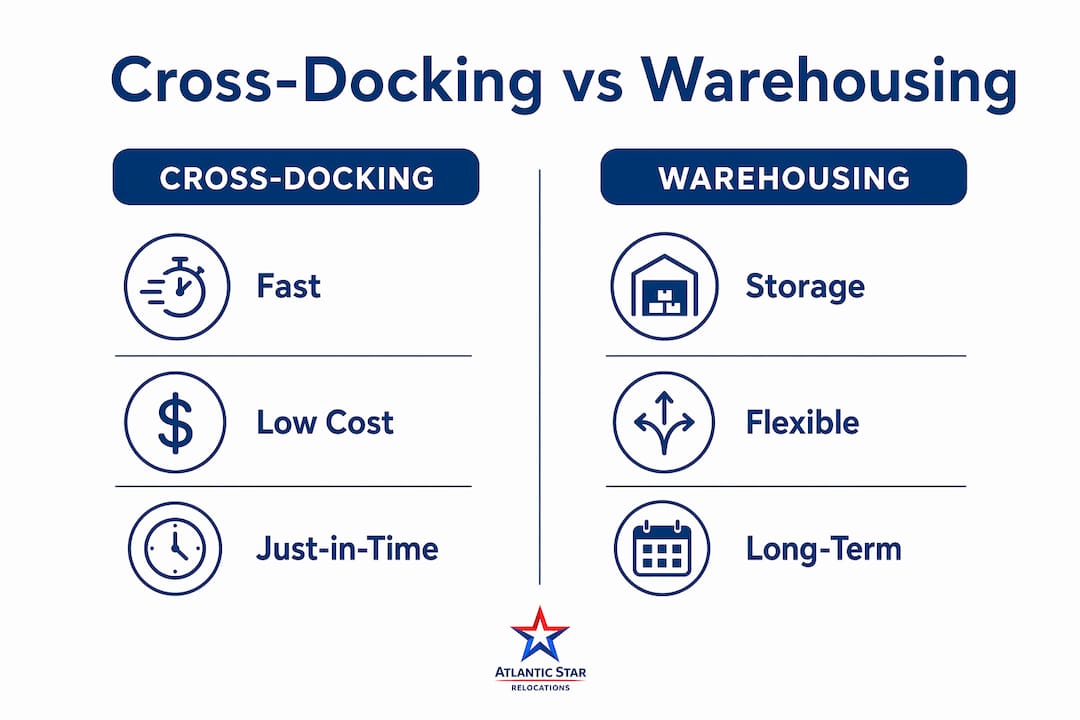
Traditional warehousing involves storage periods ranging from days to months, with goods placed into racking systems, tracked through inventory management software, and retrieved on demand. Cross-docking bypasses that entire cycle. The two methods serve different operational needs, and choosing the wrong one for a relocation project adds cost and time.
| Attribute | Cross-docking | Traditional warehousing |
|---|---|---|
| Storage time | Under 24 hours | Days to months |
| Speed to final delivery | High | Moderate to low |
| Cost per unit handled | Lower (fewer steps) | Higher (storage + retrieval) |
| Inventory management | Minimal, flow-based | Full SKU tracking |
| Best use case | Predictable, high-volume lanes | Fluctuating demand, staged delivery |
Cross-docking suits high-volume, predictable demand lanes and supports just-in-time delivery strategies. Warehousing fits situations where delivery timing is uncertain or goods need to be staged in batches. Many large-scale relocations use both. Atlanticstargroup, for example, coordinates warehouse relocation planning that combines cross-docking for time-sensitive freight with short-term storage for items that cannot be placed immediately.
Pro Tip: If your relocation involves multiple delivery sites across the Bronx, Queens, or Connecticut, cross-docking at a centrally located transfer hub cuts total mileage and consolidates outbound runs into fewer, fuller trucks.
What technology and coordination practices support successful cross-docking?
Cross-docking operations fail immediately when inbound and outbound schedules are not synchronized. A truck arriving 90 minutes late can collapse an entire day's outbound plan if the operation lacks the tools to adjust in real time. Technology closes that gap.
The critical systems and practices include:
- Transport Management Systems (TMS). A TMS integrates ASN data, carrier GPS feeds, and dock-door assignments into one dashboard. Supervisors can reassign dock doors mid-morning based on live truck locations, preventing bottlenecks before they form.
- Real-time tracking. GPS-linked carrier updates feed directly into the TMS, giving coordinators accurate ETAs rather than estimated windows. Atlanticstargroup uses real-time tracking tools to maintain visibility across multi-leg relocation projects.
- Skilled floor supervisors. Expert logistics coordinators manage fast-paced sorting and handle accessorial requirements such as compliance labeling and pallet reconfiguration. These value-add steps prevent shipment rejections at the final consignee.
- Synchronized scheduling. Inbound and outbound windows must be planned together, not separately. A gap of more than two hours between the last inbound truck and the first outbound truck signals a scheduling failure, not a buffer.
Modern cross-docking demands both the right IT infrastructure and supervisors who are empowered to make real-time decisions without waiting for approval chains. For multi-location business moves across New York City or into New Jersey, that combination is what keeps the operation on schedule.
Pro Tip: Audit your carrier's ASN compliance rate before committing to a cross-dock model. Carriers who consistently send late or incomplete ASNs will undermine the entire operation regardless of how good your TMS is.
Key Takeaways
Cross-docking in relocation is the most effective method for reducing transit time, storage costs, and handling damage when shipment lanes are predictable and volumes are consistent.
| Point | Details |
|---|---|
| Core definition | Cross-docking transfers freight from inbound to outbound in under 24 hours with no long-term storage. |
| Six-step process | Pre-arrival orchestration through data reporting forms the operational cycle for every cross-dock move. |
| Primary benefits | Eliminates storage fees, cuts damage risk, and accelerates delivery timelines for business relocations. |
| Warehousing comparison | Use cross-docking for predictable, high-volume lanes; use warehousing when delivery timing is uncertain. |
| Technology requirement | TMS integration with ASN data and GPS tracking is non-negotiable for maintaining cross-dock cadence. |
Why velocity beats buffer inventory in relocation logistics
The most common mistake I see logistics managers make is treating cross-docking as a cost-cutting tactic rather than a flow management discipline. The cost savings are real, but they are a byproduct of velocity, not the goal. When you design a relocation around flow, the savings follow automatically.
What actually determines success is data accuracy upstream. If your carriers send clean ASNs and your TMS reflects live truck positions, the floor runs itself. When that data is dirty or late, no amount of experienced staff can compensate. I have seen well-staffed cross-dock operations grind to a halt because one carrier submitted an ASN four hours late on a high-volume day.
The other factor most guides understate is hub network selection. For businesses relocating between Westchester, Manhattan, and Connecticut, the physical location of your transfer facility matters as much as the process inside it. A hub that adds 40 miles to every outbound run erases the time savings that cross-docking creates. Choose hubs that sit at the natural intersection of your inbound and outbound lanes, not just the ones with the lowest dock fees.
Cross-docking done right reduces delays, protects goods, and gives clients a clear delivery window they can plan around. That last point matters more than most logistics managers realize. Predictability is what separates a good relocation from a stressful one.
— Admin
How Atlanticstargroup manages cross-docking for business relocations
Atlanticstargroup coordinates corporate office moves across Westchester County, New York City, and the surrounding tri-state area using integrated logistics planning that incorporates cross-docking where it fits the project's timeline and volume profile. Every relocation plan includes carrier-neutral coordination, real-time shipment tracking, and a single point of accountability from first truck to final delivery.

For businesses planning warehouse or commercial moves, Atlanticstargroup's logistics coordination services cover dock scheduling, ASN management, and value-added sorting to keep freight moving without unnecessary storage delays. Whether your move spans one building in White Plains or multiple sites across Queens and New Jersey, the team manages the complexity so your operations stay on track. Request a consultation to get a custom relocation plan built around your timeline and shipment profile.
FAQ
What is cross-docking in relocation?
Cross-docking in relocation is a logistics method where inbound freight is unloaded, sorted, and reloaded onto outbound vehicles in under 24 hours, eliminating long-term storage. The transfer facility acts as a sorting point, not a warehouse.
How does cross-docking work for international moves?
For international relocations, ocean or air freight is cross-docked through transfer facilities onto domestic trucks within hours of arrival, bypassing inland distribution center storage and cutting delivery timelines significantly.
When should a business choose cross-docking over warehousing?
Cross-docking is the right choice when shipment lanes are predictable and volumes are consistent. Warehousing fits better when delivery timing is uncertain or goods need to be staged in batches before final placement.
What technology does cross-docking require?
A Transport Management System that integrates ASN data and carrier GPS tracking is the minimum requirement. Without synchronized scheduling and real-time dock-door management, cross-docking operations cannot maintain their speed advantage.
Does cross-docking work for LTL shipments during a business relocation?
Cross-docking is particularly effective for less-than-truckload consolidation, where smaller shipments from multiple origins are sorted and grouped by destination region into full outbound loads, reducing per-unit shipping costs.