

A move coordinator is the person who plans, schedules, and personally oversees your move from survey to delivery, usually as part of a moving company that owns its trucks and employs its crews. A moving broker is a sales intermediary that collects your move details and hands the job to a separate carrier for a fee, without ever touching your boxes. Hire a coordinator when you want one accountable party from start to finish; consider a broker only when you need capacity or flexible dates and you're willing to vet the carrier yourself.
TL;DR:
- Coordinators provide direct accountability with their own crews and trucks, making them more suitable for complex, local, or high-value moves.
- Brokers do not own equipment or crews, and their involvement increases the risk of miscommunication, disputes, or unexpected costs due to carrier handoffs.
- Always verify whether a moving company is a broker, carrier, or both through the SAFER database and request written disclosures before paying a deposit.
- Be cautious of large upfront deposits, unmarked trucks, vague answers about the performing carrier, and companies refusing to show their MC or USDOT numbers.
- For multi-location or specialty moves, a carrier-neutral coordinator offers real-time management and single-point accountability, reducing surprises on delivery day.
Table of Contents
- Move Coordinator vs. Broker: A Quick Comparison
- What a Move Coordinator Actually Does
- How the Moving Broker Model Actually Works
- Who's Legally Responsible for Your Belongings?
- How to Choose: A Hiring Checklist That Actually Protects You
- How Atlantic Star Relocations Coordinates Complex Moves
- Why the "Cheapest Quote Wins" Advice Gets This Backwards
- Get a Straight Answer on Your Move, Not a Handoff
- Sources
- FAQ
Move Coordinator vs. Broker: A Quick Comparison
The difference comes down to who actually shows up on move day and who answers for it if something goes wrong. A coordinator works for the company doing the labor. A broker works for whoever books the job second.
- Asset ownership: Coordinators work for carriers that own trucks and hire crews directly; brokers own no equipment and employ no movers.
- Accountability: With a coordinator, claims go to one company. With a broker, claims often bounce between the broker and the performing carrier, which slows resolution.
- Best use case: Coordinators shine on local, complex, or high-value moves. Brokers can help when your dates are tight or you're moving somewhere with limited local capacity.
- Trade-off: Coordinators offer control and consistency; brokers offer flexibility but add a layer of communication distance.
What a Move Coordinator Actually Does
A move coordinator's job starts long before the truck arrives. They conduct or review the pre-move survey, size the crew and equipment to your inventory, and build a schedule around building rules, elevator reservations, and parking permits in dense areas like Manhattan or Brooklyn. On move day, they're the point of contact if a doorman restricts the loading window or a piece of furniture won't fit through a stairwell.
For multi-leg or long distance moving jobs, coordinators track shipments between origin and destination, confirm delivery windows, and handle specialty items like pianos, artwork, or wine collections that need separate handling plans. That oversight is what move coordination for multi-location relocations is built around: one person tracking every moving part instead of leaving it to chance.
- Confirms inventory and crew size before move day, not the morning of
- Coordinates building access, insurance certificates, and freight elevator bookings
- Manages specialty item handling and packing services scheduling
- Stays reachable during transit on long distance and interstate jobs
Pro Tip: Ask any prospective coordinator how they handle a delayed elevator reservation or a locked loading dock. Their answer tells you more about their planning process than any brochure will.
How the Moving Broker Model Actually Works

A moving broker doesn't own trucks or employ movers. It sells your move, collects a deposit, and assigns the job to a carrier from its network, which may or may not be the company you spoke with on the phone. Under FMCSA rules, brokers handling interstate moves must register with the agency, carry a $75,000 surety bond, and disclose their broker status in writing before taking your money.
That model isn't inherently a problem. Brokers can be genuinely useful when your move date is inflexible or you're relocating to a market where local carrier capacity runs thin around peak season. They can shop several carriers at once and sometimes surface a lower initial quote than a single mover would offer.
The risk shows up in the handoff. Once your job is assigned, the broker's vetting of that carrier becomes the thing standing between you and a bad experience.
- Benefit: Access to more trucks and dates, especially during summer peak season
- Benefit: One phone call can generate several carrier options
- Risk: The carrier you get may not match the reputation you researched
- Risk: Deposit and cancellation disputes are among the most common complaints against brokers
Who's Legally Responsible for Your Belongings?
FMCSA draws a firm regulatory line here: carriers physically transport your goods and carry cargo liability for them, while brokers arrange transportation and are not the party liable for loss or damage during transit. That distinction matters the moment you need to file a claim, because a claim against a broker for freight damage usually goes nowhere. It has to go to the carrier that actually had your goods.
You can verify who you're dealing with before you sign anything:
- Search the company's name and USDOT or MC number on the SAFER database to see whether it's registered as a carrier, broker, or both.
- Request the written disclosure required for interstate moves, along with the federal Your Rights and Responsibilities and Ready to Move booklets that both brokers and carriers must provide.
- Confirm the valuation option in writing, and know that under FMCSA's 110% rule, a non-binding estimate can't legally require more than 110% of the original quote at delivery.
Some companies hold both carrier and broker authority. If yours does, ask which authority applies to your specific booking. It changes who's on the hook if something goes wrong.
How to Choose: A Hiring Checklist That Actually Protects You
Start with the shape of your move. A single-truck local move inside Westchester County or across the five boroughs almost always favors a carrier with its own crews. A last-minute interstate move during peak summer weeks, or a route with thin local capacity, is where a broker's network can genuinely help. Weigh control against flexibility, and weigh both against how complex your inventory actually is.
Before you pay a deposit, ask every company these four questions directly:
- Are you a broker, a carrier, or both, and which authority applies to my job?
- If you're a broker, who is the performing carrier, and what's their MC number?
- Is my estimate binding or non-binding, and how does that affect the final price?
- What are your cancellation, refund, and deposit terms in writing?
Watch for these red flags before you sign anything:
- A large upfront deposit, especially anything approaching half the total quote
- No written disclosure of broker status when one is legally required
- Vague or shifting answers about who the performing carrier actually is
- Unmarked rental trucks showing up on move day instead of company-branded equipment
Pro Tip: Get the performing carrier's name and MC number in writing before you pay anything. If a company hesitates to provide it, treat that hesitation as your answer.
For a broader look at how local moves differ from longer routes in terms of complexity and cost structure, this comparison of local versus interstate moves breaks down the planning differences worth knowing before you book either type.
How Atlantic Star Relocations Coordinates Complex Moves
Atlantic Star Relocations operates as a single point of accountability rather than a pass-through sales operation. The company manages carrier-neutral vendor selection, meaning it picks the right crew and equipment for your specific job instead of defaulting to whichever truck happens to be free that week.
On multi-leg or commercial relocations, that means one team handling scheduling, building access coordination, and real-time problem solving if a delivery window shifts or a warehouse hold-up comes up mid-move. Readers evaluating what a residential move coordinator actually does day to day will recognize this as the coordinator model, not the broker model.
- One team manages planning through final delivery, with no handoff to an unknown carrier
- Vendor selection stays carrier-neutral, chosen for fit rather than convenience
- Issue resolution happens in real time, not after a claim gets filed weeks later
Choose this model over a broker when the move involves multiple locations, tight building logistics in NYC or Westchester, or enough complexity that a single accountable contact is worth more than a wider shopping net.
Why the "Cheapest Quote Wins" Advice Gets This Backwards
Most moving guides tell you to collect three quotes and pick the lowest one. That advice quietly assumes every quote represents the same service, and with brokers involved, it often doesn't. A broker's low initial number can look attractive precisely because it doesn't yet reflect which carrier you'll actually get or what that carrier charges once the job gets reassigned.
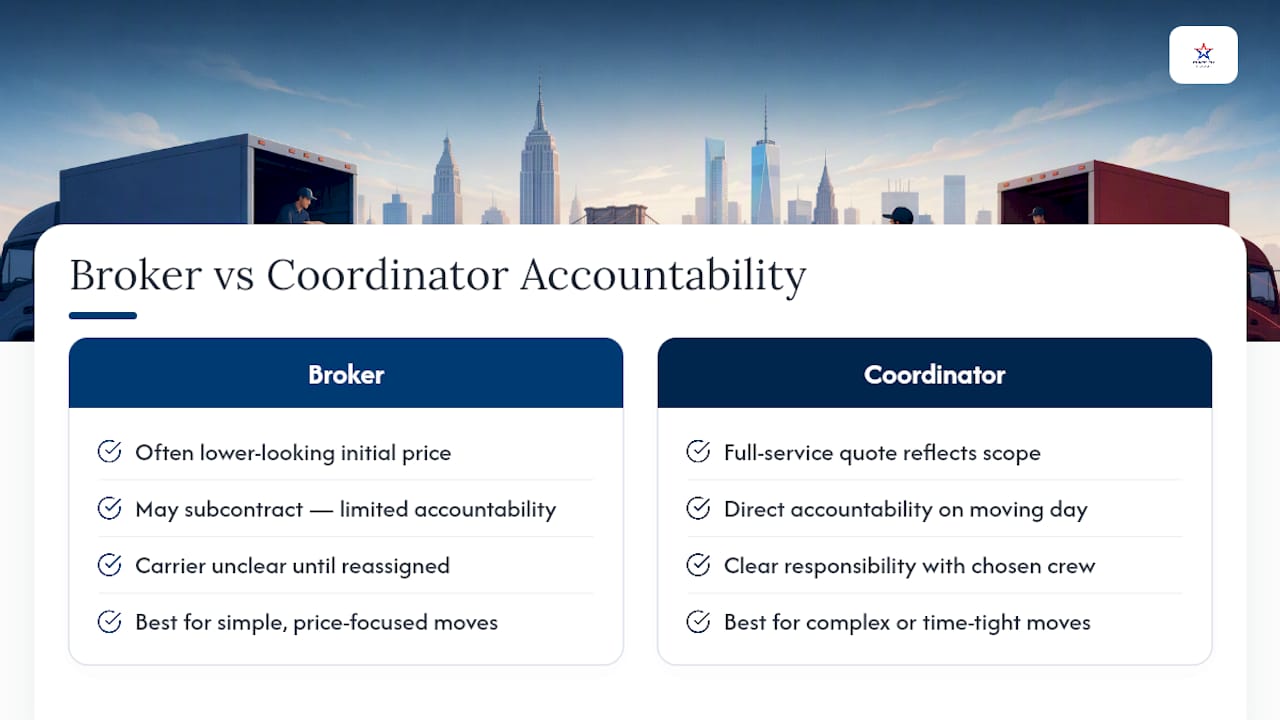
The conventional wisdom also underweights how much accountability is worth on moving day itself. When a stairwell won't fit your sofa or a building cuts your elevator window short, you want someone who answers for the outcome, not someone who has to call a subcontractor to find out what's happening. That's the practical argument for a coordinator on any move with real complexity: multiple stops, tight timelines, specialty items, or commercial logistics.
None of this makes brokers illegitimate. It means the question isn't "who's cheaper" but "who's accountable if this goes sideways." Readers who lead with that question, rather than the quote total, tend to end up with fewer surprises on delivery day.
— Admin
Get a Straight Answer on Your Move, Not a Handoff
Atlantic Star Relocations is the alternative to gambling on a reassigned carrier: one coordinator manages your move from the first survey through final delivery, across Westchester County, New York City, Connecticut, New Jersey, and long distance routes nationwide.

If your move involves multiple locations, a commercial office relocation, or specialty packing services and storage coordination, a managed provider with carrier-neutral oversight is built for exactly that complexity, not a network of unvetted subcontractors. Whether you need full-service logistics coordination for a multi-leg relocation or packing services for a single Westchester apartment, one team stays on the job from start to finish. Request a quote today and get a scheduled call with a coordinator who can walk through your timeline, your building's access rules, and your specialty items before you commit to anything.
Sources
- Movers vs. brokers | FMCSA
- SAFER / FMCSA company safety and authority search
- Are Moving Brokers Legit? Scams and red flags - LegalClarity
FAQ
How can you tell if a mover is actually a broker?
Ask directly whether the company owns its trucks and employs its crews, then confirm their status through the SAFER database using their USDOT or MC number. If they can't name the performing carrier for your job, they're almost certainly acting as a broker.
Why might someone avoid using a moving broker?
Brokers add a handoff between you and the company actually handling your goods, which can complicate claims and lead to a different carrier than expected. Deposit disputes and lowball non-binding estimates are among the most commonly reported broker complaints.
What are the biggest red flags when hiring a mover?
Watch for a large upfront deposit, no written broker disclosure, vague answers about the performing carrier, and unmarked rental trucks showing up on move day instead of company-branded equipment. Any one of these is a reason to slow down before you pay.
Is a move coordinator or a moving broker better for a local move?
A move coordinator is generally the stronger fit for local moves inside Westchester County or across the five boroughs, since a single carrier with its own crew handles everything from survey to delivery. Brokers tend to add more value on interstate or last-minute moves where local capacity is tight.
What documents should a mover or broker give you before you pay?
Both parties must provide the federal Your Rights and Responsibilities and Ready to Move booklets, and brokers must disclose their status in writing under FMCSA rules before accepting funds for an interstate move.