

A residential move coordinator is the single point of accountability who plans, schedules, and manages the logistics of a household relocation from pre-move survey through post-delivery. According to Consumer Affairs, coordinators manage relocation logistics as the single point of contact between clients and moving teams, handling inventory, scheduling, and claims from booking through post-move follow-up. The industry term you'll also hear is relocation manager or move manager, but the job-to-be-done is the same: one person owns the process so you don't have to chase five vendors yourself.
For a typical homeowner, a residential move coordinator will:
- Conduct a video or in-person pre-move survey and build a detailed inventory
- Secure permits, elevator windows, and parking reservations for the building
- Schedule and oversee packing crews, carriers, and specialty services
- Serve as the single phone number on move day when anything goes sideways
- Initiate claims and handle post-delivery follow-up until the job is closed
Key Takeaways
A residential move coordinator is the single point of accountability for your relocation, managing inventory, permits, vendor scheduling, and claims so you don't have to coordinate five vendors yourself.
| Point | Details |
|---|---|
| Single point of contact | One coordinator owns the process from pre-move survey through post-delivery claims. |
| When to hire | Long-distance, high-rise, specialty items, or a tight timeline are the clearest triggers. |
| Core responsibilities | Survey and inventory, permit and elevator coordination, vendor oversight, and post-move follow-up. |
| Book early | Long-distance or high-rise moves need a coordinator 4–8 weeks out to meet permit lead times. |
| Atlantic Star Relocations | Provides managed residential coordination across Westchester, NYC, CT, NJ, and FL with carrier-neutral oversight. |
Table of Contents
- What does the residential move coordinator role cover at each stage?
- How does the move coordinator process timeline work?
- What skills and qualifications should you expect from a move coordinator?
- When do you actually need a move coordinator?
- How do you evaluate a move coordinator before hiring?
- What does coordination cost, and how long does planning take?
- How Atlantic Star Relocations handles residential move coordination
- What experienced coordinators know that most guides don't mention
- Atlantic Star Relocations: managed residential coordination for Westchester and NYC
- Sources
- FAQ
What does the residential move coordinator role cover at each stage?
The residential move coordinator role shifts in focus as the move progresses. Understanding what happens at each phase tells you exactly what you're paying for and where the coordinator earns their keep.
Initiation
The coordinator's first job is to understand the scope. That means a video or in-person survey of the home, a room-by-room inventory, and a conversation about special items: antiques, artwork, pianos, wine collections. MoveMe Smart's coordinator checklist confirms that coordinators perform pre-move surveys, create detailed inventories, and arrange specialty services like crating and shuttle trucks. Nothing gets scheduled until the inventory is accurate.
Pre-move planning
This phase is where most of the coordination work actually lives. The coordinator locks in the move date, books packing crews, arranges crating for fragile items, and handles every building-specific requirement. For a Manhattan high-rise, that means reserving the freight elevator, pulling a parking permit for the moving truck, and sometimes scheduling a shuttle vehicle if the building's loading dock can't accommodate a full-size trailer. These tasks need to be done weeks in advance, not the week of.

Move day
On the day itself, the coordinator is the hub. They confirm crew arrival, verify the inventory against what's being loaded, and stay in close communication with the building superintendent, the driver, and the client. Move that a coordinator often manages crews remotely on moving day while remaining available by phone to resolve issues. That remote availability matters: if the elevator breaks down at 9 AM or the parking permit wasn't honored, the coordinator is already working the problem.

Post-move follow-up
After delivery, the coordinator conducts a final walk-through, checks the inventory against delivered items, and documents any damage. If a claim needs to be filed, they initiate it and track it through resolution. This phase is where the single-point-of-contact model pays off most clearly: you're not left figuring out which carrier to call or which form to fill out.
How does the move coordinator process timeline work?
A well-run residential relocation follows a predictable sequence. Here's the order of operations from first contact to final follow-up:
- Booking and initiation — Client contacts the coordinator, move scope is discussed, and a survey is scheduled. For long-distance or high-rise moves, this should happen 4–8 weeks out.
- Video or in-person survey — Coordinator walks through the home (in person or via video call), builds the inventory, flags specialty items, and identifies building access requirements.
- Estimate and service confirmation — Coordinator presents the plan: crew size, packing scope, specialty services, and timeline. Client approves.
- Permits and building logistics — Elevator reservations, parking permits, and loading dock bookings are secured. In Westchester and NYC, this step alone can take 1–2 weeks.
- Packing and staging — Packing crews arrive on the scheduled date. Coordinator confirms crew, supervises staging, and verifies inventory before loading begins.
- Move day execution — Coordinator confirms crew arrival, monitors loading, communicates with building staff, and stays available for real-time problem-solving.
- Delivery and setup — Items are delivered, placement is confirmed, and the coordinator checks off the inventory. Unpacking services are coordinated if included.
- Post-move follow-up — Final walk-through, damage documentation, claims initiation if needed, and client feedback collection.
Move-day critical confirmations (the coordinator should verify all of these by 8 AM on move day):
- Crew confirmed and en route
- Elevator reservation active and building staff notified
- Parking permit displayed or confirmed with building security
- Client reachable and present or has designated a point of contact
- Specialty items (crated artwork, piano, etc.) loaded first and documented
Pro Tip: Book your video survey well in advance before a long-distance or high-rise move. Coordinators who schedule surveys too close to the move date tend to miss permit deadlines, which pushes everything back.
What skills and qualifications should you expect from a move coordinator?
The coordinator role is not entry-level in practice, even when it's labeled that way in job postings. Indeed's move coordinator job description lists organization, communication, problem-solving, logistics knowledge, and scheduling software familiarity as core competencies. A coordinator managing multiple active moves simultaneously needs all of those working at once.
Core skills
- Communication: The coordinator is the relay point between the client, the building, the carrier, and any specialty vendors. Gaps in communication are where moves go wrong.
- Logistics and scheduling: Coordinating crew availability, truck capacity, elevator windows, and permit timing requires real scheduling discipline.
- Inventory accuracy: A missed item on the pre-move inventory becomes a disputed claim after delivery.
- Software literacy: Most professional coordinators use scheduling and tracking tools to manage timelines, document inventories, and log communications. Tools like SmartMoving, MoveHQ, and similar platforms are common in the industry.
- Problem-solving under pressure: Move day rarely goes exactly as planned. The coordinator's value is in how fast they adapt.
Typical caseload and career context
An experienced residential coordinator typically manages several active moves at various stages simultaneously, with move-day oversight handled remotely for most and on-site for complex or high-value relocations. The role is often a stepping stone toward operations management or relocation program management, particularly at larger firms.
Pro Tip: Ask a prospective coordinator how they document inventory discrepancies discovered after delivery. A coordinator who has a clear, practiced answer to that question has handled claims before. One who hesitates probably hasn't.
When do you actually need a move coordinator?
Not every move requires one. A local, single-bedroom apartment move with no specialty items and a flexible schedule can usually be handled with a standard moving crew and a checklist. The coordinator role becomes genuinely valuable when complexity increases.
AARP's guide on hiring moving managers notes that homeowners hire moving managers to save time and reduce stress, particularly for packing, vendor scheduling, and post-move settling. That framing holds for anyone with a demanding schedule, not just older adults.
Hire a coordinator when your move involves:
- Long-distance or interstate relocation (multiple vendors, timing dependencies)
- A high-rise building with elevator windows and permit requirements
- Specialty items: piano, fine art, wine cellar, antiques
- A tight timeline with no margin for delays
- Multiple stops or a storage gap between origin and destination
- A household where the primary residents can't be present for the full move day
A coordinator is probably not necessary for:
- A local 1–2 bedroom move with no building restrictions
- A move where you have time to manage vendor calls yourself
- A short-distance move with a single crew and no specialty items
For complex multi-leg moves, the case for a coordinator is even stronger: the more handoffs in a move, the more places things can go wrong without someone owning the whole chain.
How do you evaluate a move coordinator before hiring?
The difference between a coordinator who prevents problems and one who just reports them comes down to process. Here's what to ask and what to watch for.
Questions to ask during the initial consultation
- Who is my single point of contact from survey through delivery?
- How do you document the pre-move inventory, and can I review it before move day?
- What's your process if a damage claim needs to be filed?
- How do you handle permit and elevator booking, and what's your lead time?
- What happens if the crew is delayed or a vendor cancels?
Red flags
- No documented inventory process ("we'll figure it out on move day")
- Vague answers about who handles claims
- No written confirmation of permits or elevator reservations
- Coordinator who can't name the carrier or crew assigned to your move
- Pressure to sign quickly without a survey
Trust signals
- Written pre-move survey with a signed inventory
- Carrier-neutral coordination (the coordinator manages the carrier, not the other way around)
- Documented permit and building logistics plan
- References from moves in your building type or neighborhood
- Clear escalation path if the coordinator is unavailable on move day
Pro Tip: Call the building's management office yourself to confirm the elevator reservation and parking permit after the coordinator says it's done. Takes two minutes and eliminates the most common move-day surprise.
Atlantic Star's logistics coordination approach is built around carrier-neutral oversight, meaning the coordinator manages vendor performance without being the crew, which reduces finger-pointing when issues arise.
What does coordination cost, and how long does planning take?
Coordination is billed in a few different ways depending on the service model:
- Bundled in a managed service: The coordinator's work is included in the overall move price. This is the most common model for full-service residential moves.
- Flat coordination fee: A set fee on top of the base move cost, covering survey, planning, permits, and follow-up.
- Hourly coordination: Less common for residential moves; more typical for partial-service or consulting arrangements.
Major cost drivers:
- Move distance (local vs. long-distance vs. interstate)
- Specialty services: crating, piano moving, art handling
- Permit and elevator coordination complexity (Manhattan and high-rise Westchester buildings add real time)
- Late changes to inventory or schedule after the survey
- Storage needs between origin and destination
Timing benchmarks:
- Long-distance or high-rise move: book the coordinator 4–8 weeks out
- Local move with building restrictions: 2–3 weeks minimum for permit lead time
- Local small move, no restrictions: 1–2 weeks is workable
In Westchester County and across the five NYC boroughs, parking permits and elevator windows add a layer of logistics that most clients underestimate. A coordinator who knows the buildings and borough-specific permit processes in Manhattan, Brooklyn, Queens, and the Bronx saves real time and avoids day-of surprises.
How Atlantic Star Relocations handles residential move coordination
Atlantic Star Relocations operates as a single point of accountability for residential moves across Westchester County, New York City, Connecticut, New Jersey, and Florida. The process mirrors the stage-by-stage model described in this article: survey and inventory first, then permits and scheduling, then move-day oversight, then post-delivery follow-up and claims handling.
Services that map directly to the coordinator responsibilities covered here:
- In-home and video pre-move surveys with detailed written inventories
- Permit and elevator reservation coordination for NYC high-rises and Westchester buildings
- Professional packing services and specialty crating for fragile or high-value items
- Short-term storage coordination for moves with a timing gap between origin and destination
- Unpacking and settling-in services post-delivery
- Carrier-neutral vendor oversight: Atlantic Star manages carrier and crew performance, not just the paperwork
For Westchester homeowners moving to Manhattan or Brooklyn, the team handles the borough-specific logistics that trip up general movers: freight elevator scheduling, co-op board move-in requirements, and street parking permits. For longer-distance moves to Connecticut, New Jersey, or Florida, the same single-point-of-contact model applies across the full route.
To get a preliminary scope and schedule a survey, visit the Moving FAQ page or request a quote directly through the site.
What experienced coordinators know that most guides don't mention
The part of this job that doesn't show up in job descriptions is the gap between what a client thinks they own and what's actually in the house. Pre-move surveys exist precisely because people forget about the storage unit, the items in the garage, or the furniture in the basement. Every coordinator who has worked residential moves has a version of the same story: the inventory looked complete until move day, when three more rooms appeared.
The practical fix is simple: walk every room, every closet, and every storage space during the survey. Video surveys are good for scoping furniture and boxes, but they miss corners. In-person surveys catch what video misses.
Three things that separate a well-run residential move from a stressful one:
- Over-communicate the day before. Confirm crew time, elevator window, and parking with the client and the building the afternoon before the move. Problems discovered at 7 PM are solvable. Problems discovered at 7 AM are not.
- Build a contingency into the elevator window. If the building gives you a 4-hour window, plan for 5. High-rise moves in Manhattan and Westchester almost always run long on the first elevator run.
- Stage specialty items last in, first out. Crated artwork and fragile items should be loaded last at origin and unloaded first at destination. Coordinators who reverse this sequence create unnecessary handling risk.
On the technology side, scheduling and tracking tools like SmartMoving and MoveHQ give coordinators a real-time view of crew status, inventory checklists, and client communications in one place. Clients who ask to see the move plan in writing before move day are asking the right question.
Atlantic Star Relocations: managed residential coordination for Westchester and NYC
Atlantic Star Relocations gives you a dedicated coordinator who owns your move from the first survey call to the final delivery check, with carrier-neutral oversight that keeps every vendor accountable. For Westchester and NYC moves, that means someone who already knows the freight elevator protocols at Manhattan co-ops, the permit timelines in Brooklyn and Queens, and the storage options when your closing date shifts.

The first call covers your move scope, preliminary survey scheduling, and a clear explanation of the pricing model and availability. No vague estimates, no surprise add-ons after the survey. Whether you're moving from White Plains to the Upper West Side or from Westchester to Florida, the process is the same: one coordinator, one plan, full accountability.
Request a quote or review common coordination questions to get started, or explore Atlantic Star's full residential moving services for Westchester County and the New York metro area.
Sources
- What Is a Moving Coordinator? (2026)
- Comprehensive Move Coordinator Checklist: Job Duties & Guide - MoveMe Smart
- Move
- Hiring moving managers - AARP
FAQ
What is the main role of a move coordinator?
A move coordinator is the single point of contact who manages all logistics of a residential relocation, including inventory, scheduling, permits, vendor oversight, and post-move claims handling.
What do residential coordinators do on a daily basis?
On a typical day, a residential coordinator confirms crew schedules, follows up on permit and elevator reservations, updates clients on move status, and resolves any vendor or building access issues that arise.
What are the core responsibilities of a residential move coordinator?
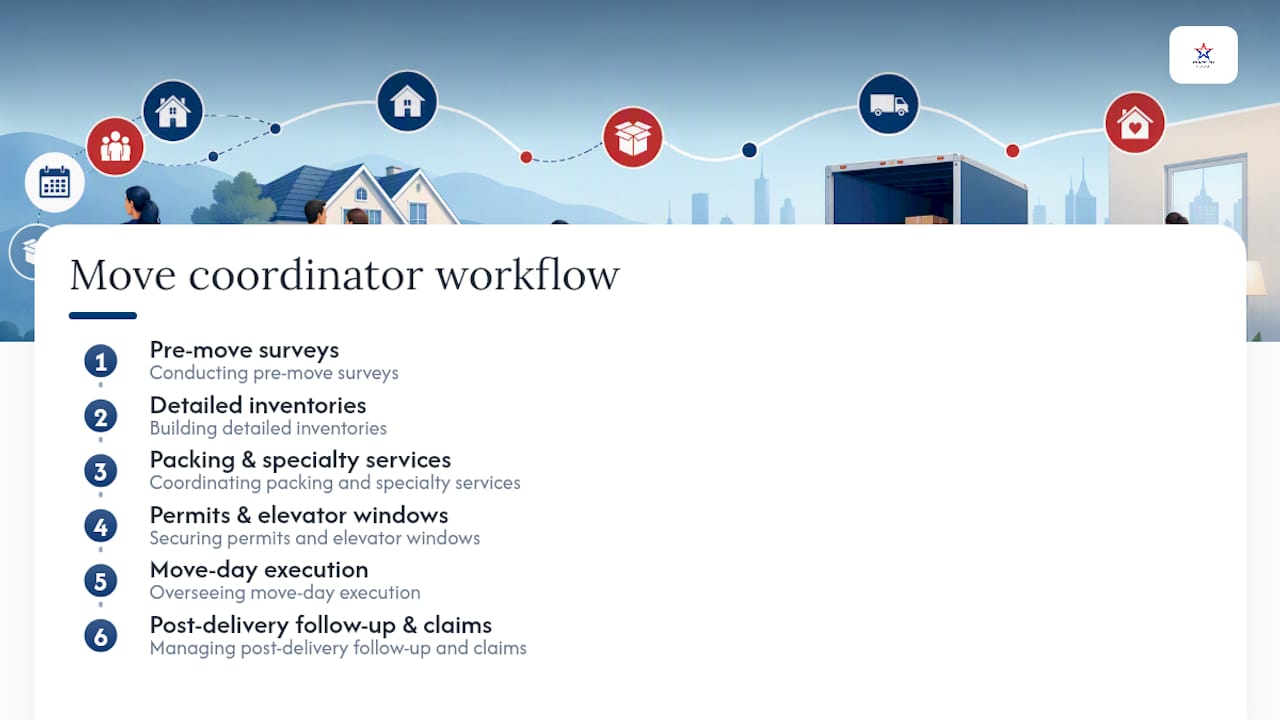
Core responsibilities include conducting pre-move surveys, building detailed inventories, coordinating packing and specialty services, securing permits and elevator windows, overseeing move-day execution, and managing post-delivery follow-up and claims.
Is a move coordinator role considered entry-level?
The title sometimes appears in entry-level job postings, but in practice the role requires strong logistics knowledge, software familiarity, and the ability to manage multiple active moves simultaneously. Most experienced coordinators have prior operations or customer service backgrounds.
How does Atlantic Star Relocations handle move coordination?
Atlantic Star Relocations assigns a dedicated coordinator to each residential move, managing the full process from pre-move survey and permit coordination through delivery and claims, with carrier-neutral oversight across Westchester, NYC, Connecticut, New Jersey, and Florida.