
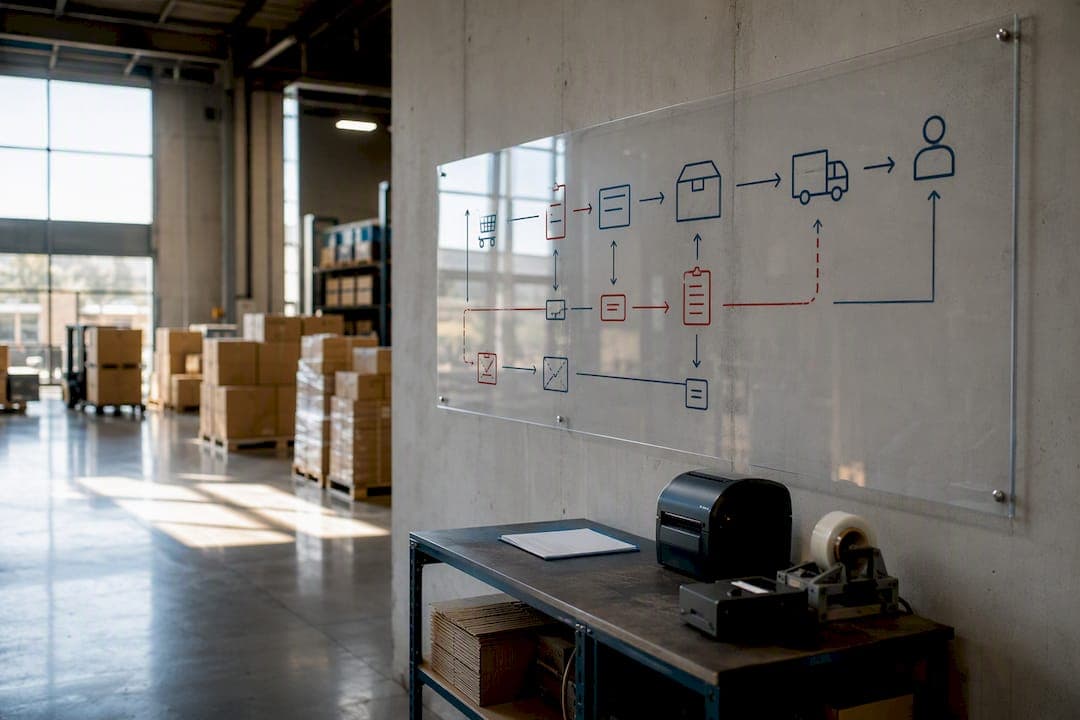
Professional oversight is not optional for a medium or large warehouse relocation. It is the single factor that separates a move completed on schedule from one that bleeds inventory, blows budgets, and stalls fulfillment for weeks. Oversight means a named party owns the plan, the vendors, and the outcome, from the first pallet tagged to the last scanner tested.
That accountability delivers three things a warehouse operator cannot get any other way:
- A single point of contact who answers for delays, damage, and missed milestones
- Inventory integrity through documented tagging, sequencing, and reconciliation
- Minimized downtime through tested systems and phased cutovers instead of a blind flip of the switch
Atlantic Star Relocations built its warehouse and logistics coordination work around exactly this model: one accountable partner managing carriers, crews, and timelines so operations leaders are not stitching together five vendors mid-move.
Key Takeaways
Professional oversight prevents warehouse relocation failure by pairing a written plan with named owners, tested systems, and carrier-neutral vendor control.
| Point | Details |
|---|---|
| Plan as contract | Require the relocation plan to define scope, timeline, and sign-offs as a contractual deliverable. |
| Name accountable owners | A RACI table with a named project lead and escalation contacts prevents decisions made under pressure. |
| Test systems before cutover | Run a full end-to-end transaction through the WMS, scanners, and printers before moving inventory. |
| Build a risk register | Map contingencies for downtime, inventory errors, damage, and cost overruns to each move phase. |
| Choose a single accountable partner | Atlantic Star Relocations manages warehouse moves through one point of contact, from planning through vendor coordination to final delivery. |
Table of Contents
- Why Warehouse Moves Need Oversight to Prevent Failure
- What Should a Warehouse Relocation Oversight Plan Include?
- What Happens When a Warehouse Move Has No Oversight?
- What to Require When Hiring a Warehouse Move Oversight Partner
- Warehouse Relocation Readiness Checklist
- How Atlantic Star Relocations Delivers Oversight
- Why Most Warehouse Move Advice Undersells Oversight
- Get a Managed Warehouse Relocation Plan From Atlantic Star
- Sources
- FAQ
Why Warehouse Moves Need Oversight to Prevent Failure
Most warehouse relocations do not fail because of a single dramatic mistake. They fail because small coordination gaps compound. A carrier running its own schedule without visibility into the receiving dock's readiness. A 3PL that doesn't know the internal team moved up the cutover date. An inventory team relabeling pallets with a different convention than the one the new facility's WMS expects.
Data problems are the quiet killer. A mis-scanned SKU during transit doesn't just cost one item. It cascades into a reconciliation nightmare that can take a full shift to untangle, because nobody trusts the count anymore. IT failures follow the same pattern: a printer that isn't mapped correctly on day one means labels come out wrong at the new site, and mispicks start immediately.
Three failure patterns show up repeatedly in relocations without a clear owner:
- Coordination blind spots between carriers, internal staff, and the receiving facility, with no one tracking the full sequence.
- Inventory drift from inconsistent tagging or skipped reconciliation checkpoints between load-out and unload.
- Systems failures that surface only after go-live, because nobody ran an end-to-end test of scanners, printers, and network access before the move.
Pro Tip: Run a full transaction, from receiving to shipping, through the new site's systems at least once before moving a single pallet. Guidance on service-continuity planning consistently points to phased cutovers and pre-move testing as the difference between a quiet transition and a week of firefighting.
What Should a Warehouse Relocation Oversight Plan Include?
A real oversight partner hands you documents and controls before the move starts, not a verbal promise to "handle it." Here is what to expect on the table.
The relocation plan itself functions as the working contract. It should spell out scope, timeline, facility layout, and sign-off points for every phase, because moves commonly fail months before the trucks arrive when these details never get written down. A plan that lives only in someone's head isn't a plan.
Governance comes next. You need a RACI structure with a named project lead and project sponsor, plus escalation contacts covering operations, IT, safety, facilities, and freight partners, so decisions on move day don't default to whoever happens to be standing near the problem.
A strong oversight package also includes:
- A risk register with contingencies mapped to each phase, covering downtime, damage, data loss, labor gaps, and compliance exposure
- An inventory strategy with a defined tagging convention, load sequencing, staging rules, and reconciliation checkpoints at every handoff
- End-to-end systems testing of the WMS, scanners, printers, and network before cutover, not after
- Carrier-neutral vendor management, with performance benchmarks and the authority to swap an underperforming carrier mid-project
- A move-day command center coordinating dock sequencing so trucks aren't idling while staff figure out load order
Our own warehouse relocation planning guide breaks down how to build the RACI table and staging schedule before a mover ever touches inventory. For custody tracking specifically, see how chain-of-custody controls protect inventory during transport and staging.
What Happens When a Warehouse Move Has No Oversight?
Skip the structure above and the costs show up fast, and they rarely stay contained to one department.
Downtime is the most visible casualty. Missed SLAs trigger customer penalties, and every hour the new facility isn't operational is an hour of orders piling up. Inventory loss and misplacement follow close behind, turning what should be a two-day reconciliation into a two-week hunt for pallets that got staged in the wrong zone.

Physical damage adds real dollars fast, especially with racking, conveyor components, or climate-sensitive stock that wasn't packed or handled to spec. Then IT errors surface after go-live, when scanners can't talk to the new network or a printer maps to the wrong label template, and throughput slows right when you need it fastest.
Common cost overruns without a named owner:
- Expedited freight to cover gaps a schedule slip created
- Overtime labor to compensate for a missed staging window
- Rework on mislabeled or misrouted inventory
- Emergency vendor substitutions negotiated under pressure instead of in advance
The seven high-impact risk categories that recur across warehouse moves, downtime, inventory errors, damage, data and systems, labor coordination, compliance, and cost overruns, are almost all preventable with a documented risk register and a partner accountable for tracking it in real time.
What to Require When Hiring a Warehouse Move Oversight Partner
Treat the proposal stage like a due diligence exercise, not a price comparison. The questions you ask now determine whether move day runs on a plan or on improvisation.
Build your evaluation around these requirements:
- Contractual deliverables. The relocation plan and RACI table must be named deliverables in the statement of work, not verbal assurances.
- Carrier-neutral coordination. Ask how the partner selects and evaluates carriers, and confirm they hold the authority to replace an underperforming vendor without a change order delay. A 4PL-style coordinator that aggregates vendor data into one operational view can flag problems and act faster than a fragmented network of separately managed contracts.
- Systems testing and stabilization. Confirm a documented testing plan for the WMS and scanning infrastructure, plus a defined stabilization period with metrics tracked after go-live.
- Insurance and damage resolution. Get the liability structure and claims process in writing before you sign, not after something breaks.
Bring these questions into supplier meetings:
- Who is the named project lead, and what is their direct escalation path?
- What does your risk register look like for a facility our size?
- How do you sequence phased cutovers to protect order fulfillment?
- What happens if a carrier misses a scheduled pickup window?
Our logistics oversight guide for multi-site moves covers how to structure these SOW checklist items in more depth.
Warehouse Relocation Readiness Checklist
Before handover to the moving team, confirm these items are locked. A partial sign-off here almost guarantees a scramble later.
| Milestone | What to Confirm Before Proceeding |
|---|---|
| Scope and layout freeze | Final floor plan and scope document signed by facilities and operations leads |
| Tagging convention set | Inventory tagging standard documented and communicated to all staging teams |
| Systems tested | WMS, scanners, printers, and network verified with a full end-to-end transaction |
| Staffing confirmed | Core and contingency staffing scheduled for move day and stabilization week |
| Vendor schedules locked | Carrier and crew schedules confirmed at least one week before cutover |
Two additional checks matter as much as the table itself: confirm permits or building access approvals for both sites, and set the exact date staging begins so inventory isn't in limbo waiting on a decision.
How Atlantic Star Relocations Delivers Oversight
Atlantic Star Relocations manages warehouse moves the way this guide describes: one accountable partner running logistics coordination, carrier-neutral vendor selection, and issue resolution from planning through final delivery.
That shows up in practice as:
- A written relocation plan functioning as the working contract, not a slide deck
- A named project lead with a visible escalation path
- Vendor coordination without ties to a single carrier, so replacement decisions happen fast
- Real-time issue resolution during transit and staging, not after a claim is filed
See the full scope on the warehouse moves service page and the logistics coordination page for how the coordination model is structured.
Why Most Warehouse Move Advice Undersells Oversight
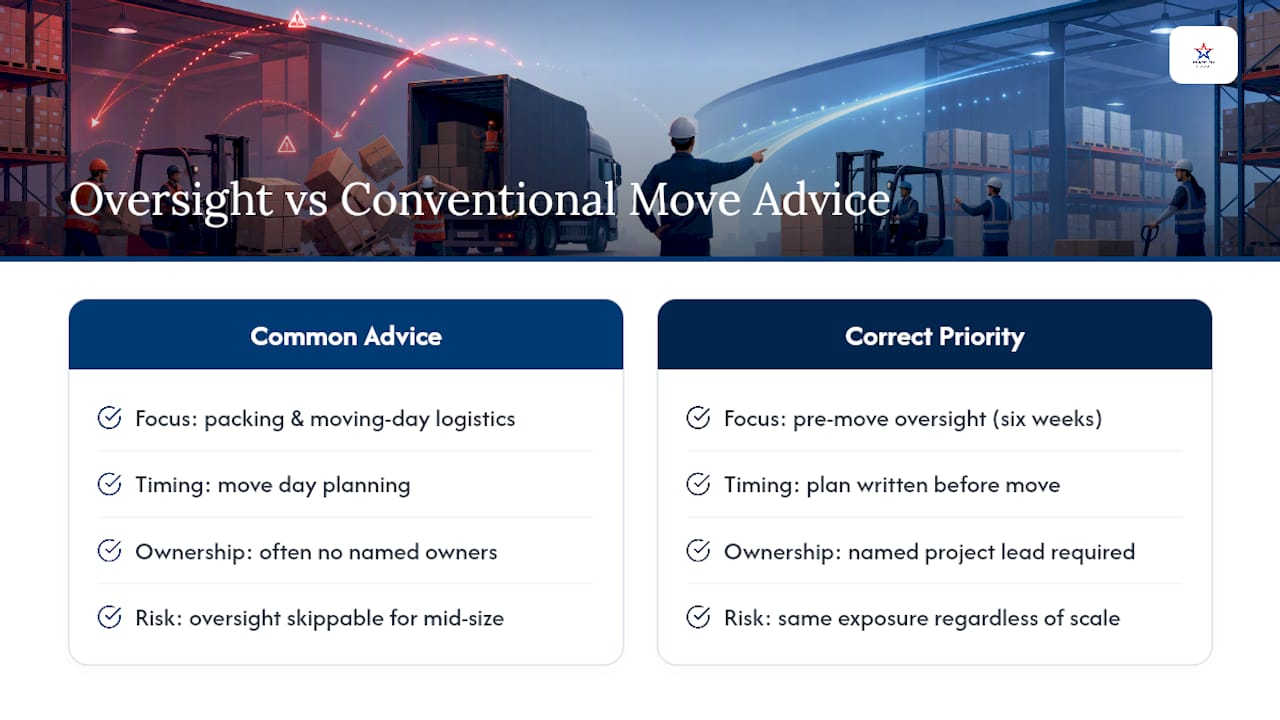
Most guidance on warehouse relocations focuses on packing tips and moving-day logistics, as if the hard part is boxing up a forklift. It isn't. The hard part is the six weeks before the move, when the plan either gets written down with named owners or it doesn't, and that decision determines everything that follows.
The conventional advice treats oversight as a nice-to-have for large operations and skippable for mid-size ones. That's backward. A 40,000-square-foot facility with three shifts and a WMS integration has just as much exposure to a mis-tagged pallet or an untested scanner network as a distribution center ten times its size. Scale changes the dollar amount of the mistake, not whether the mistake happens.
If you take one thing from this guide, prioritize the risk register and the named project lead before you evaluate anything else in a proposal. Movers can quote you a price for trucks and labor all day. Far fewer can hand you a documented plan for what happens when a carrier misses a window or a scanner fails on go-live day, and that gap is exactly where relocations go sideways.
Get a Managed Warehouse Relocation Plan From Atlantic Star
If you've read this far, you already know the risk isn't the physical move. It's the coordination gaps that show up when no one owns the whole picture. Atlantic Star Relocations runs warehouse and commercial relocations across Westchester County, New York City, Connecticut, New Jersey, and long-distance routes nationwide, with one team accountable for the plan, the vendors, and the outcome.

That means a written relocation plan built before move day, a named project lead you can actually reach, and carrier-neutral vendor coordination so a scheduling problem doesn't become your problem to solve at 6 AM. For facilities that need buffer space during a phased cutover, our short-term storage options keep inventory secure between staging and final delivery.
Ready to see what a real oversight plan looks like for your facility? Upload your current relocation timeline or request a quote through our logistics coordination team and we'll walk through scope, staffing, and systems testing before you sign anything.
Sources
- Create Your Warehouse Relocation Plan | Stein Service & Supply
- Warehouse Relocation Risk Assessment Checklist
- Warehouse Relocation Planning That Protects Service
- What Is a 4PL? The Complete Guide to Fourth-Party Logistics - CDS Logistics
FAQ
Why do warehouse moves need oversight instead of just hiring movers?
Movers handle trucks and labor, but oversight covers the plan, the vendor coordination, and the systems testing that determine whether the new facility is actually operational on day one.
What is the biggest risk in a warehouse relocation without a project lead?
Decisions default to whoever is closest to the problem on move day, which usually means inconsistent calls on staging, sequencing, and vendor substitutions.
How far in advance should systems testing happen before a warehouse move?
Systems testing should happen before the scope and layout freeze, giving enough time to fix WMS, scanner, or printer mapping issues before inventory starts moving.
Does Atlantic Star Relocations manage warehouse moves outside New York?
Atlantic Star Relocations coordinates warehouse and commercial relocations across Westchester County, New York City, Connecticut, New Jersey, and long-distance moves nationwide.
What should be in a warehouse relocation risk register?
A risk register should cover downtime, inventory relocation errors, physical damage, data and systems failures, labor coordination gaps, compliance issues, and cost overrun triggers, each with a documented contingency.