
Expect white glove moving costs to run roughly $1,200 to $11,500 above a standard full-service move, with local studio jobs starting near the low end and long-distance three-bedroom relocations often landing between $6,000 and $12,000 or more. The exact number depends on inventory size, distance, and how many fragile or oversized pieces need custom crating. Get an itemized quote before assuming either figure applies to your move.
TL;DR:
- Costs are driven mainly by inventory size and item fragility, with long-distance moves often exceeding local rates by several thousand dollars.
- Access issues such as elevators, stairs, or long carries can add fees that significantly increase the final price, especially in urban areas like Manhattan.
- Pricing methods vary from hourly rates of $75 to $125 per hour to flat rates based on detailed inventories, with transparency crucial for accurate estimates.
- Proper preparation, including a room-by-room inventory and questions about building requirements, helps prevent unexpected charges on move day.
- Managed moving providers offer cost savings through coordinated scheduling and issue resolution, especially for complex or multi-leg relocations.
Table of Contents
- What Drives White Glove Moving Cost by Move Type and Home Size
- What Does White Glove Moving Actually Include?
- What Are the Biggest Cost Drivers in a White Glove Quote?
- Hourly vs. Flat Rate: How White Glove Pricing Actually Works
- How Do You Get an Accurate White Glove Moving Quote?
- Why Managed White Glove Moving Often Costs Less in the End
- An Operator's Take on What Actually Surprises People
- Ready for an Itemized White Glove Moving Quote?
- Sources
- FAQ
What Drives White Glove Moving Cost by Move Type and Home Size
Your final bill depends less on mileage than most people assume and more on how much stuff you own and how carefully it needs to travel. A local move and a cross-country move with identical inventory can land in surprisingly similar territory once you add white glove packing, crating, and setup on both ends.
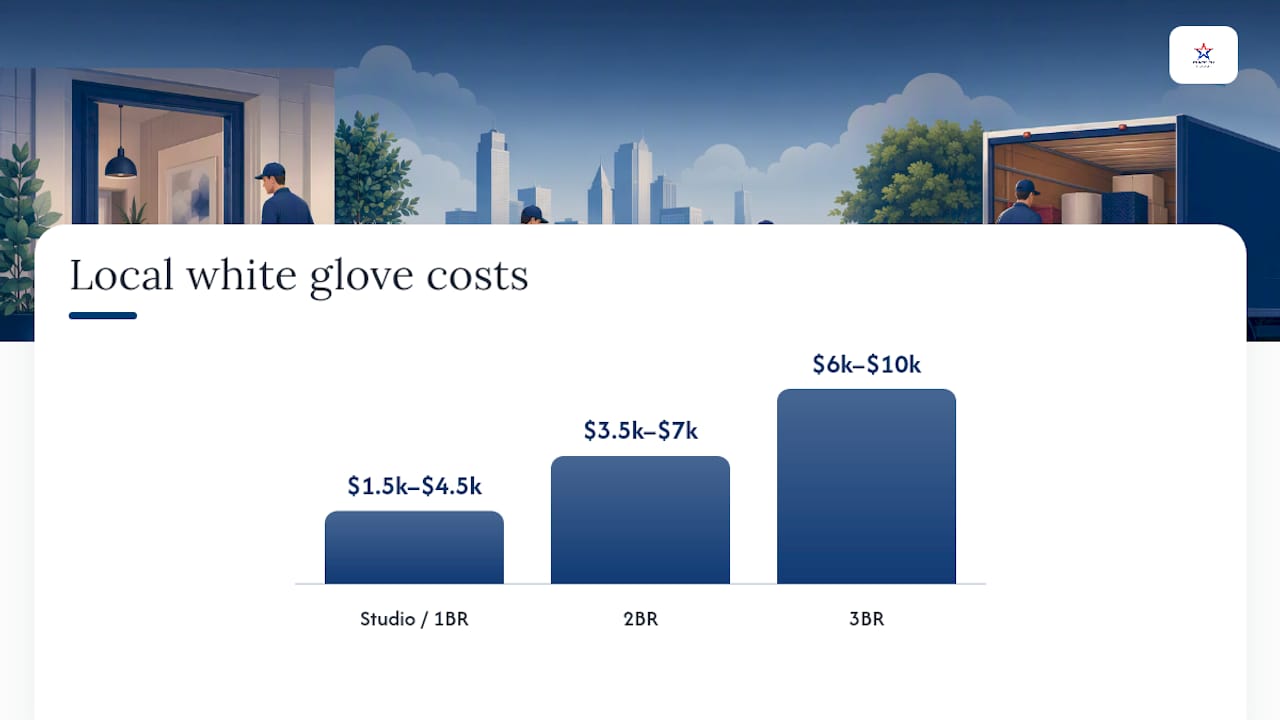
Local moves (under 50 miles) with white glove service typically run $1,500 to $4,500 for a studio or one-bedroom, climbing to $3,500 to $7,000 for a two-bedroom and $6,000 to $10,000 for a three-bedroom home. The low end assumes minimal fragile-item work and easy access; the high end usually includes full packing, several specialty items, and a walk-up building without elevator access.
Regional moves (50 to 500 miles) often include additional crew shifts or storage, resulting in moderately higher costs that vary with home size and conditions.
Long-distance interstate moves stretch the range furthest. A three-bedroom household moving from, say, Westchester County to Florida can see white glove premiums pushing totals into the $6,000 to $12,000-plus band, largely because labor, fuel, and specialty crating scale with both distance and time on the road. Coastal metro areas including the New York City region typically run 10 to 40 percent above national averages, which matters if you're comparing a quote against a national blog's "average" figure.
| Move Type | Studio/1BR | 2BR | 3BR |
|---|---|---|---|
| Local (under 50 mi) | $1,500–$4,500 | $3,500–$7,000 | $6,000–$10,000 |
| Regional (50–500 mi) | $1,500 to $4,500 | $3,500 to $7,000 | $6,000 to $10,000 |
| Long-distance interstate | $3,500–$7,000 | $6,000 to $10,000 | $9,000–$14,500+ |
These bands assume a mix of full and selective packing. A three-bedroom home with a piano, original artwork, and a walk-up fourth floor will sit above these ranges no matter which city it starts or ends in.
What Does White Glove Moving Actually Include?
"White glove" gets used loosely in the moving industry, and that's part of why quotes vary so wildly. At its core, white glove service means exceptional handling and full setup on the receiving end, not just loading a truck and driving away.
Here's what's typically bundled into a genuine white glove package:
- Full-home packing using professional-grade materials, versus selective packing of only fragile or high-value items
- Custom crating built to the exact dimensions of art, mirrors, marble tabletops, or electronics
- Disassembly and reassembly of furniture, beds, and modular pieces on both ends
- Unpacking and placement in the new home, including furniture positioning per room
- Debris removal, so you're not left with a pile of boxes and packing paper after the crew leaves
Service tiers vary too. A "premium delivery" tier might only cover in-home placement and unboxing of a single furniture piece, while a "full estate relocation" tier covers an entire household, including staging services and coordinating multiple trucks for oversized collections. Insurance and valuation coverage should scale with the tier: basic released-value coverage costs little but pays out at a fraction of an item's actual worth, while full-value or third-party appraised coverage costs more upfront but meaningfully reduces your financial exposure if something breaks in transit. For households with real art collections or heirloom furniture, that extra coverage cost is rarely money wasted.
What Are the Biggest Cost Drivers in a White Glove Quote?
Two households with the same square footage can get wildly different quotes, and it usually comes down to five variables working together rather than any single line item.
Inventory volume converts directly into labor hours. More boxes, more furniture, more trips between the truck and the door. Specialty items carry their own add-on pricing: a piano move might add $300 to $600, custom art crating can run $150 to $500 per piece, and a heavy safe often requires specialized equipment that adds a flat fee on top of standard labor.
Access conditions are where a lot of first-time white glove customers get surprised. Consider these common scenarios:
- A fourth-floor walk-up with no service elevator adds a long-carry fee, often calculated per flight
- Reserving a freight elevator in a Manhattan or Brooklyn high-rise sometimes requires a scheduled window and a building certificate of insurance
- Street parking restrictions in urban areas can force a shuttle move, adding a smaller truck and extra labor hour
- Rural long-carry situations, where the truck can't reach the door, work the same way as stairs
Crew composition matters as well. A specialty crew trained in fine art or antique handling costs more per hour than a standard moving crew, but it's the right call for a home full of irreplaceable pieces.
Pro Tip: Ask upfront whether your building requires a certificate of insurance or a reserved elevator window. Buildings across Manhattan and parts of Westchester routinely require both, and missing that step can delay your move day or trigger a rescheduling fee.
Hourly vs. Flat Rate: How White Glove Pricing Actually Works
Movers price white glove work one of two ways, and understanding the math behind each helps you spot a quote that's padded versus one that's fair.
Hourly pricing follows a straightforward formula: number of movers × hourly rate × estimated hours, plus a travel fee and materials. Specialized white glove labor commonly runs $75 to $125 per hour for a two- or three-person crew, though that rate climbs for specialty art or piano crews. Hourly pricing tends to favor smaller, simpler moves where the job might finish faster than expected.
Flat rate movers bundle everything, labor, materials, crating, and often insurance, into one number based on a detailed inventory walkthrough. Flat rate pricing protects you from a slow-moving crew running up the clock, and it's usually the better option once a move involves multiple specialty items or a long-distance leg where hourly tracking gets impractical.
Here's how the math plays out across three real-world scenarios:
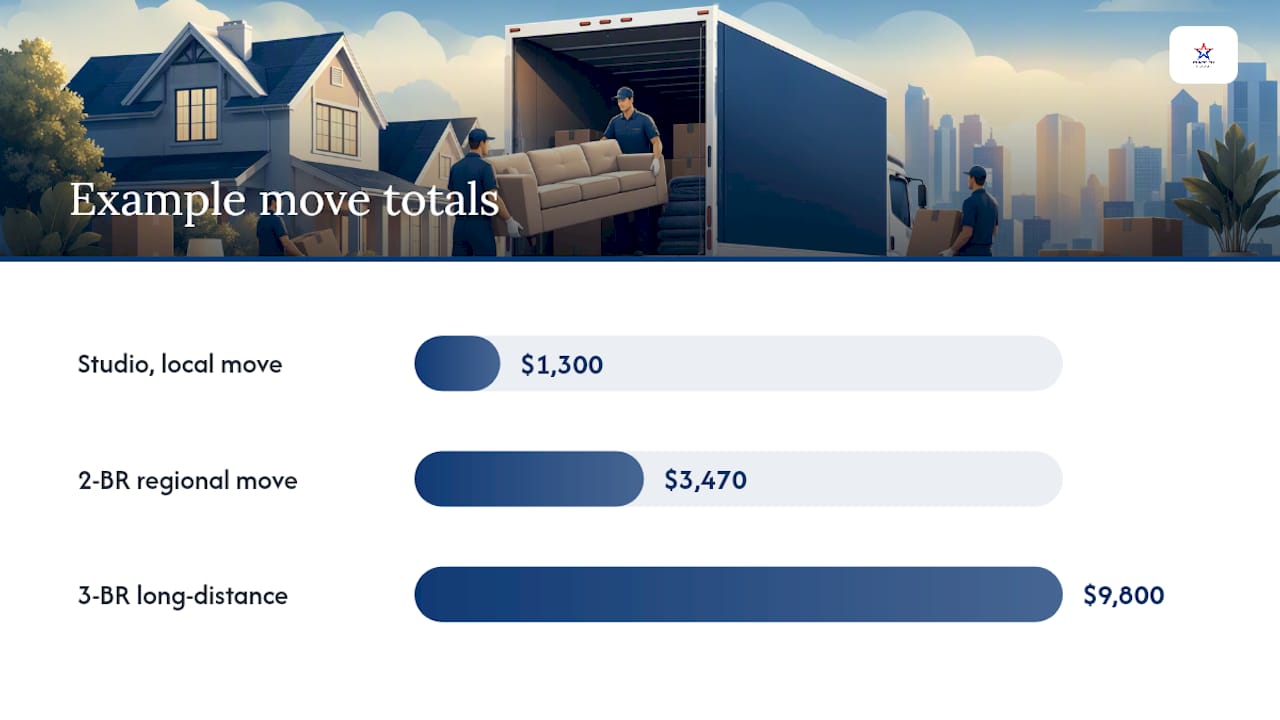
- Studio apartment, local move, New Rochelle to White Plains: 2 movers, 5 hours at $95/hour ($950), packing materials ($150), one artwork crate ($200). Total: roughly $1,300.
- Two-bedroom home, regional move, Westchester to Connecticut: 3 movers, 8 hours at $105/hour ($2,520), full packing ($600), furniture disassembly/reassembly ($350), released-value coverage included. Total: roughly $3,470.
- Three-bedroom home, long-distance move, Westchester to Florida: flat rate bundle covering full packing, two custom crates for art, piano handling, and full-value coverage. Total: roughly $9,800.
Watch for these red flags before signing anything:
- No itemized breakdown, just a single lump number with no explanation of what it covers
- Vague valuation language that doesn't specify coverage per pound or full-value terms
- A quote given without an in-home or video walkthrough of your actual inventory
- Pressure to sign same-day without time to compare against a second estimate
How Do You Get an Accurate White Glove Moving Quote?
An accurate quote starts with what you hand the mover, not what they hand you. Getting this part right is the single biggest factor in whether your final invoice matches your estimate.
- Build a room-by-room inventory with photos, including closets and storage areas people tend to forget
- Provide a floor plan or note stairs, elevators, and long carries at both the pickup and delivery address
- Ask direct questions: What's included in "white glove" for this quote? What's the valuation coverage per pound versus full-value protection? Are there fuel surcharges or fees for weekend delivery?
- Request a written estimate that itemizes labor, materials, crating, and insurance separately, not as one bundled number
- Verify the company's authority through the FMCSA SAFER company snapshot for interstate moves, and check complaint history through the Better Business Bureau
Decline any estimate that skips a walkthrough entirely, since that's usually where the real scope gets missed and the real surprises get added later.
Why Managed White Glove Moving Often Costs Less in the End
A managed provider handles vendor selection, scheduling, and problem-solving under one point of accountability, which matters more than it sounds. When a crating specialist runs late or a building's elevator reservation falls through, someone needs to catch it before it becomes your problem on move day.
That's the practical case for a company like Atlantic Star Relocations, which coordinates crews, storage, and logistics as one managed process rather than handing you off between separate vendors for packing, crating, and delivery.
- Single point of contact reduces the back-and-forth between packing crews, crating specialists, and delivery teams
- Coordinated scheduling limits the storage gaps that quietly add fees when timelines slip
- Real-time issue resolution catches access or building problems before they delay your move day
Access-related surcharges like elevator windows and parking permits are among the most predictable add-ons in any white glove quote, and a managed provider that plans for them upfront tends to avoid the line-item surprises that come from a crew discovering a fourth-floor walk-up on move day. A managed approach earns its premium on complex moves: multi-leg relocations, estate-sized inventories, or moves involving storage between legs. For a simple studio move with no fragile items, standard full-service may be all you need.
An Operator's Take on What Actually Surprises People
Three things catch people off guard almost every time. First, the "walkthrough surprise": a homeowner underestimates how much is in the garage or attic, and the crew arrives to a bigger job than quoted. Second, building access. New York City co-ops and condos often require certificates of insurance and reserved elevator windows that nobody mentioned until move week. Third, valuation confusion. Released-value coverage sounds fine until something breaks and the payout is a fraction of what the item cost.
Two fixes handle most of it: walk every room with your phone camera before the estimate, and ask your mover in writing what happens if the elevator reservation falls through.
Book white glove crews at least three to four weeks out for local moves and six to eight weeks out for long-distance or peak-season moves. Good crews get reserved early, especially heading into spring and summer.
— Admin
Ready for an Itemized White Glove Moving Quote?
Atlantic Star Relocations gives you one team managing packing, crating, transport, and setup instead of juggling separate vendors and separate invoices for each piece of your move. That single point of accountability is what keeps a complex white glove relocation from turning into a string of surprise charges.

Whether you're moving a Westchester County estate, relocating from Manhattan to Florida, or coordinating an office move across NYC, our team handles professional packing services, custom crating for fragile and high-value items, furniture disassembly and reassembly, and full logistics coordination from pickup through final placement. We also handle short-term storage for moves with timing gaps between legs.
Serving Westchester County, New York City, Manhattan, Brooklyn, Queens, the Bronx, Connecticut, New Jersey, and Florida, Atlantic Star Relocations builds every white glove quote around your actual inventory and access conditions, not a generic estimate. Request an itemized quote today and get a real number before your move date locks in.
Sources
- The Complete 2026 Moving Cost Database: Real Rates, Regional Variations & Hidden Multipliers | MoveSmart Blog
- What is white glove moving service? | MovingPlace
- White Glove Service Cost: Realistic Price Ranges and What Drives Them 2026 – Current Cost
FAQ
Are White Glove Movers Worth the Cost?
For households with fragile art, antiques, pianos, or complex access conditions, yes: the added cost typically buys custom crating and full setup that prevents far more expensive damage. For a simple move with basic furniture, standard full-service coverage may be enough.
Is $100 Enough to Tip Movers?
$100 split among a two- or three-person crew is a reasonable tip for a half-day local move, but a longer white glove job with crating and setup work often warrants $150 to $300 total, adjusted for crew size and job difficulty.
How Much Does It Cost to Move a 3,000 Square Foot House?
A three-bedroom-plus home near that size typically runs $6,000 to $10,000 for a local white glove move and can reach $9,000 to $14,500 or more for a long-distance interstate relocation, depending on inventory and specialty items.
How Much Does White Glove Service Cost?
Single-item white glove delivery typically costs $100 to $350, while full-home white glove moves range from roughly $1,500 for a local studio to $12,000 or more for a long-distance three-bedroom relocation, depending on distance, inventory, and access conditions.