

Hiring full-service movers saves you time, lowers your risk of injury or property damage, and takes the logistics puzzle off your plate. Instead of juggling a rented truck, borrowed hands, and a stack of flattened boxes from the liquor store, one crew handles the entire job.
The core benefits break down like this:
- Time savings — a trained crew finishes in hours what a DIY move stretches into a full weekend
- Lower injury risk — professionals lift, carry, and navigate stairs with equipment you don't own
- Better protection for belongings — proper packing materials and techniques cut breakage
- Smoother logistics — one truck, one schedule, no relay of borrowed vehicles
- Valuation coverage — your items are protected financially, not just physically
- Flexibility — storage, specialty-item handling, and scheduling built around your timeline
Pro Tip: If you're moving in or around Westchester County or New York City, ask any mover you're vetting how they handle building access, freight elevator reservations, and street parking permits. If they don't have a ready answer, that's a red flag worth noting before you book with Atlantic Star Relocations or anyone else.
Key Takeaways
Full-service movers reduce injury risk, protect belongings through professional packing, and consolidate logistics under one accountable provider, which typically offsets their higher upfront price.
| Point | Details |
|---|---|
| Time savings are measurable | A full-service crew often finishes a local move in hours versus a full DIY weekend. |
| Injury risk drops with proper equipment | Dollies, straps, and team-lift techniques prevent the strains and falls common in DIY moves. |
| Packing materials matter | Dish packs, picture boxes, and specialty crating cut breakage on fragile and valuable items. |
| Valuation coverage requires verification | Confirm released value versus full value protection and check licensing through FMCSA before booking. |
| Atlantic Star Relocations offers local accountability | The company manages packing, storage, and logistics as a single point of contact across Westchester and NYC. |
Table of Contents
- Save Time and Reduce Moving Stress
- Avoid Heavy Lifting and Reduce Injury Risk
- Professional Packing and Better Protection for Belongings
- Efficient Loading, Transport, and Logistics
- Insurance, Valuation, and Peace of Mind
- Flexibility and Extra Services Beyond the Truck
- What a Full-Service Move Typically Includes
- How to Choose the Right Full-Service Mover
- Hidden Costs Full-Service Movers Cover
- Get an Accurate Quote for Your Next Move
- Sources
- FAQ
Save Time and Reduce Moving Stress
A DIY local move typically eats an entire weekend: renting a truck Friday night, loading Saturday morning, driving, unloading, then returning the truck before the late fee kicks in. A full-service crew often completes the same move in a matter of hours, start to finish.
You skip the parts that eat up your week beforehand, too:
- Sourcing and building boxes
- Scheduling and picking up a truck
- Recruiting friends (and feeding them pizza)
- Troubleshooting building access on moving day
Relocation ranks among life's more disruptive events, and some research links it to elevated stress when the process drags on or spirals out of control. Handing off the physical work shortens that window considerably.
Pro Tip: In Manhattan and Brooklyn buildings with strict elevator reservation windows, Atlantic Star Relocations confirms move-in and move-out slots with building management ahead of time, so your crew isn't standing in a lobby burning billable hours.
Avoid Heavy Lifting and Reduce Injury Risk

Professional movers exist partly to keep you off a stepladder with a 200 pound dresser. Back strains, pulled muscles, and stairwell falls are among the most common injuries reported during DIY moves, and they don't just hurt. They can sideline you from work for days.
Trained crews reduce that risk with equipment most households don't own:
- Furniture dollies and hand trucks
- Moving straps for controlled weight distribution
- Corner guards and door jamb protectors
- Team-lift techniques for oversized or awkward items
Injury math is real cost math. A trip to urgent care, a week of missed work, or a busted railing you now have to repair often costs more than the difference between a DIY move and a professional one. Efficiency, proper equipment, and safety consistently rank among the top reasons people choose to hire movers instead of doing it themselves.
Professional Packing and Better Protection for Belongings
Professional packing lowers the odds your grandmother's china arrives in pieces, and it makes unpacking faster because everything is labeled and boxed with intent rather than crammed in whatever container was handy.
Trained packers match materials to the item, not just the box size available:
- Dish packs and cell dividers for kitchenware
- Picture boxes and glassine paper for artwork
- Anti-static bubble for electronics
- Blanket wrap and specialty crating for pianos or antiques
| Item Type | Common Packing Risk (DIY) | Professional Approach |
|---|---|---|
| Fragile kitchenware | Newspaper ink transfer, crushed stacks | Dish packs with cell dividers |
| Artwork and mirrors | Cracked glass, scratched frames | Picture boxes, glassine interleaving |
| Electronics | Static damage, loose cables | Anti-static wrap, cable labeling |
| Pianos and antiques | Structural damage in transit | Blanket wrap, specialty crating |
Consumer moving guides consistently point to better protection for belongings as one of the clearest, most immediate benefits of hiring a professional crew over doing it yourself.

Efficient Loading, Transport, and Logistics
A well-loaded truck means fewer trips, less fuel, and lower odds of something shifting mid-drive. Professional crews plan the load before they touch a single box, sequencing heavy furniture, fragile items, and awkward shapes so weight is distributed and nothing crushes anything else.
That planning shows up in a few specific ways:
- Route planning around bridge and tunnel restrictions for larger trucks
- Load sequencing so first-off items go in last
- Specialty handling for gym equipment, safes, or oversized furniture
- Building access coordination for loading docks and freight elevators
Pro Tip: A single well-planned 26 foot truck often replaces three or four round trips in a pickup truck or SUV. That's not just convenience. It's less time on the road, fewer parking violations near your building, and one coordinated arrival window instead of a scattered afternoon.
Insurance, Valuation, and Peace of Mind
Full-service movers are required to offer valuation coverage, which is different from traditional insurance but still protects you financially if something is damaged or lost. The two most common options are released value protection, which is minimal and often included at no charge, and full value protection, which covers repair, replacement, or cash value and typically costs more.
Before you book, ask directly:
- What valuation options do you offer, and what do they cost?
- Is that coverage itemized in writing before moving day?
- What's your process if something is damaged in transit?
- Can you provide your USDOT and MC number?
Verify before you sign. The FMCSA's official mover search tool lets you confirm a company's licensing and complaint history in minutes, and a BBB business profile shows recent customer disputes and how a company resolved them.
Flexibility and Extra Services Beyond the Truck
Full-service movers bundle services a DIY move simply can't replicate on your own schedule. Need your belongings held for three weeks while your new place finishes renovation? A rented truck can't do that. A managed relocation company can.
Common add-ons worth asking about:
- Short-term and climate-controlled storage between move-out and move-in
- Full packing and unpacking services
- Furniture disassembly and reassembly
- Piano, antique, and specialty-item handling
- Flexible scheduling around closing dates or corporate relocation timelines
Atlantic Star Relocations offers short-term storage and full packing and unpacking as standard add-ons for clients moving across Westchester County and the broader New York City area, which matters when a closing date and a move-in date don't line up cleanly.
What a Full-Service Move Typically Includes
A genuine full-service quote should spell out each stage clearly. Here's the standard sequence:
- In-home or virtual survey to scope the job
- Packing (optional, priced separately or bundled)
- Providing boxes, tape, and protective materials
- Furniture disassembly before loading
- Loading and secure transport
- Unloading and furniture reassembly
- Basic unpacking and placement in rooms
What usually costs extra, and catches people off guard when it's not disclosed upfront:
- Specialty crating for art, pianos, or safes
- Long-carry fees when the truck can't park near the entrance
- Flight-of-stairs charges in walk-up buildings
- Appliance disconnect and reconnect
- Building permits or certificates of insurance required by management companies
Ask for these line items in writing before moving day, not as a surprise on the final invoice.
How to Choose the Right Full-Service Mover
The short version: focus on licensing, valuation clarity, local references, and a written estimate that itemizes everything. Skip any company that's vague on those four points.
Questions worth asking every company you're comparing:
- What's your USDOT and MC number, and can I verify it myself?
- What valuation and insurance options do you offer, and what do they cost?
- What packing materials are included, and what costs extra?
- How many hours and what size truck do you estimate for this job?
- What additional fees might apply (stairs, long carry, elevator wait time)?
- Can you provide references from recent local moves?
Watch for these red flags, which show up more often than people expect:
- No written estimate, or a quote given only over the phone
- A large deposit demanded before any paperwork
- No verifiable local address or references
- Vague or dodged answers about valuation coverage
- Heavy upselling once your belongings are already on the truck
Pricing shapes vary by move type. Local moves in Westchester or NYC are often quoted flat rate based on crew size, truck, and estimated hours. Interstate and long-distance moves are typically priced by weight and distance, per industry comparisons of full-service and labor-only options. Tipping isn't mandatory, but common industry practice suggests tipping movers an hourly rate for local moves, or a flat amount for longer, more physical jobs.
Pro Tip: When you have two quotes in hand, line them up side by side and check that both include the same services. A "cheaper" quote that excludes packing materials or stair fees usually isn't cheaper once those get added back in.
Hidden Costs Full-Service Movers Cover
The sticker price on a full-service move often looks higher than a DIY weekend, until you count what DIY actually costs. Multiple truck rental days, gas, replacement costs for anything broken in transit, and a full weekend of your own time all factor into the real total.
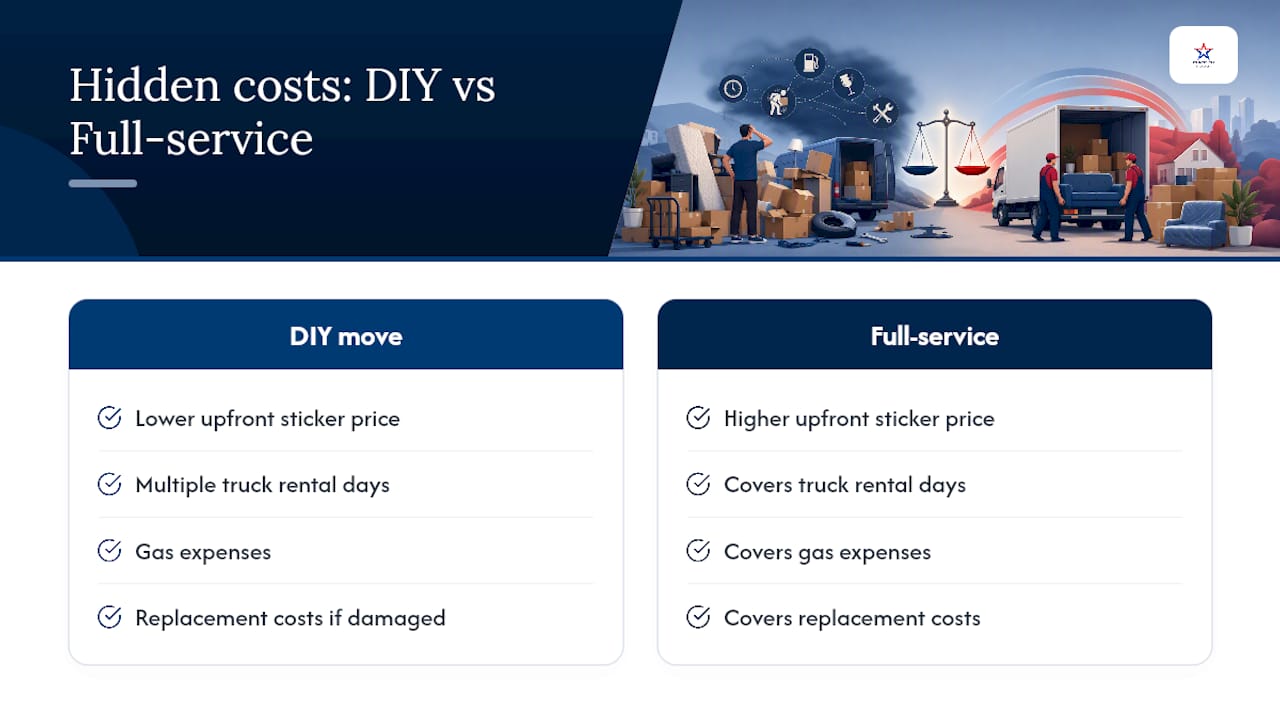
Cost comparisons in consumer moving guides consistently note that full-service moves can cost more upfront but often even out once you factor in time, damage risk, and replacement costs. Consolidating everything under one provider also cuts the coordination overhead that comes from managing multiple vendors separately, a friction point logistics providers point to as a hidden cost of its own.
Picture a two-bedroom apartment move: a rented truck for two days, gas, a cracked TV screen from an amateur load job, and a Saturday and Sunday spent lifting instead of working. That math changes fast once you add it all up.
Atlantic Star Relocations: A Local Perspective
Managing moves across Westchester and into Manhattan and Brooklyn means dealing with narrow brownstone stairwells, freight elevator reservations, and co-op board paperwork on a near-daily basis. One recent client needed a full apartment packed and moved out of a Manhattan walk-up with less than 72 hours' notice for an interstate relocation, and coordinating that timeline required real-time problem-solving, not a static plan. Atlantic Star Relocations operates as a single point of accountability on every job, fully licensed and insured, so clients aren't left chasing separate vendors when something needs to change mid-move.
Get an Accurate Quote for Your Next Move
Atlantic Star Relocations manages residential, corporate, and long-distance relocations across Westchester County, NYC, Connecticut, New Jersey, and beyond, with packing, short-term storage, and full logistics coordination built into every plan.

If you're comparing quotes right now, start with an on-site or virtual survey rather than a phone estimate. That's the single best way to avoid the hidden fees and vague valuation answers covered above. Atlantic Star Relocations can walk your space, price out packing services if you want them, and outline short-term storage options if your move-in date isn't locked yet. If your relocation involves multiple stops or an office move, logistics coordination keeps every vendor accountable to one point of contact instead of five. Request your quote today and get a written, itemized estimate before you commit to a date.
Sources
- FMCSA — Search mover
- Should you hire labor-only or full-service movers? — Extra Space Storage
- 20 Benefits of Hiring a Moving Company — Thumbtack guide
- Relocation and depression — Healthline
- Benefits of Hiring Professional Movers: Pros, Cons, and ... — Century Communities
FAQ
What Are Red Flags When Hiring Movers?
Watch for no written estimate, demands for a large deposit upfront, no verifiable local address or references, and vague answers about valuation coverage. Aggressive upselling once your items are already loaded is another warning sign.
What Are the Benefits of Hiring a Mover?
The main benefits are time savings, lower injury risk, professional packing that protects belongings, smoother logistics, valuation coverage, and flexible services like storage. Companies like Atlantic Star Relocations bundle all of these under one managed process instead of leaving you to coordinate each piece separately.
Is $100 Per Mover a Good Tip?
Tipping often reflects effort and care shown on moving day, and common industry practice suggests tipping movers an hourly rate for local moves or a flat amount for longer, more physical jobs. Tipping isn't required.
What Is Included in a Full-Service Move?
A typical full-service move includes an in-home survey, packing materials, furniture disassembly, loading, transport, unloading, and basic reassembly. Specialty crating, long-carry fees, and appliance disconnect often cost extra, so ask for an itemized estimate upfront.