

Workplace transition planning is the coordinated program of project management, logistics, and stakeholder change work required to relocate or reconfigure a physical office. It covers everything from space planning and vendor coordination to IT sequencing and employee communication. FMSystems' move-management guidance defines this discipline as Moves, Adds, and Changes (MAC) — a structured process that spans facilities, HR, and IT rather than a simple logistics job. Done well, it reduces operational downtime, improves space efficiency at the new location, and protects employee productivity through the disruption. Atlantic Star Relocations and the Facilities Manager's Desk Reference both treat the office move as a program, not a task — and that framing is what separates a smooth transition from a costly scramble.
Key Takeaways
Effective workplace transition planning requires governance, sequencing, and a single accountable project manager — not just a moving crew.
| Point | Details |
|---|---|
| Assign accountability early | Name your single point of accountability before vendor conversations begin to prevent decision gaps. |
| Sequence IT before physical move | Audit, back up, test, and validate IT systems before cutting over — never move production systems blind. |
| Budget all line items | Include dilapidations, permits, packing, storage, and contingency as separate budget lines, not estimates. |
| Plan post-move decommissioning | Schedule crate collection and waste removal as a distinct task; it's the most common move-day bottleneck. |
| Atlantic Star local execution | Atlantic Star Relocations provides dedicated project management and carrier-neutral coordination across Westchester County and NYC. |
Table of Contents
- Why treat an office move as a workplace transition?
- What are the core phases of an office relocation?
- Who owns what? Roles and single-point accountability
- How do you sequence IT and telecom to avoid downtime?
- What does a realistic office move budget look like?
- How do you choose a managed relocation partner?
- How do you protect operations when things go wrong?
- What should you check in the 72 hours after move day?
- How Atlantic Star Relocations handles workplace transitions
- Compliance and regulatory considerations for office relocations
- Planning an office move in Westchester or NYC?
- Sources
- FAQ
Why treat an office move as a workplace transition?
Most moves go sideways not because of bad movers, but because nobody owned the full picture. Treating a relocation as a strategic workplace transition forces the right conversations early: What does the new space need to accomplish? Who approves scope changes? What happens if IT is down on Monday morning?
The strategic upside is real: a well-planned transition can optimize floor-plate efficiency, support hybrid work configurations, and protect business continuity across the move window. Five reasons this framing pays off:
- Business continuity: A phased approach keeps operations running while sections of the office move in sequence.
- Cost control: Early vendor engagement and a detailed scope prevent expensive change orders mid-project.
- Employee experience: Clear communication timelines reduce anxiety and speed time-to-productivity at the new site.
- Compliance and permits: Building access permits, elevator reservations, and COI requirements in NYC and Westchester need lead time — sometimes weeks.
- IT uptime: Sequencing network cutover separately from physical moves prevents the most common source of post-move downtime.
Pro Tip: Assign your single point of accountability — the person who signs off on scope, budget, and vendor decisions — before any vendor conversations begin. Every week that role sits vacant, decisions get made by default rather than by design.
What are the core phases of an office relocation?
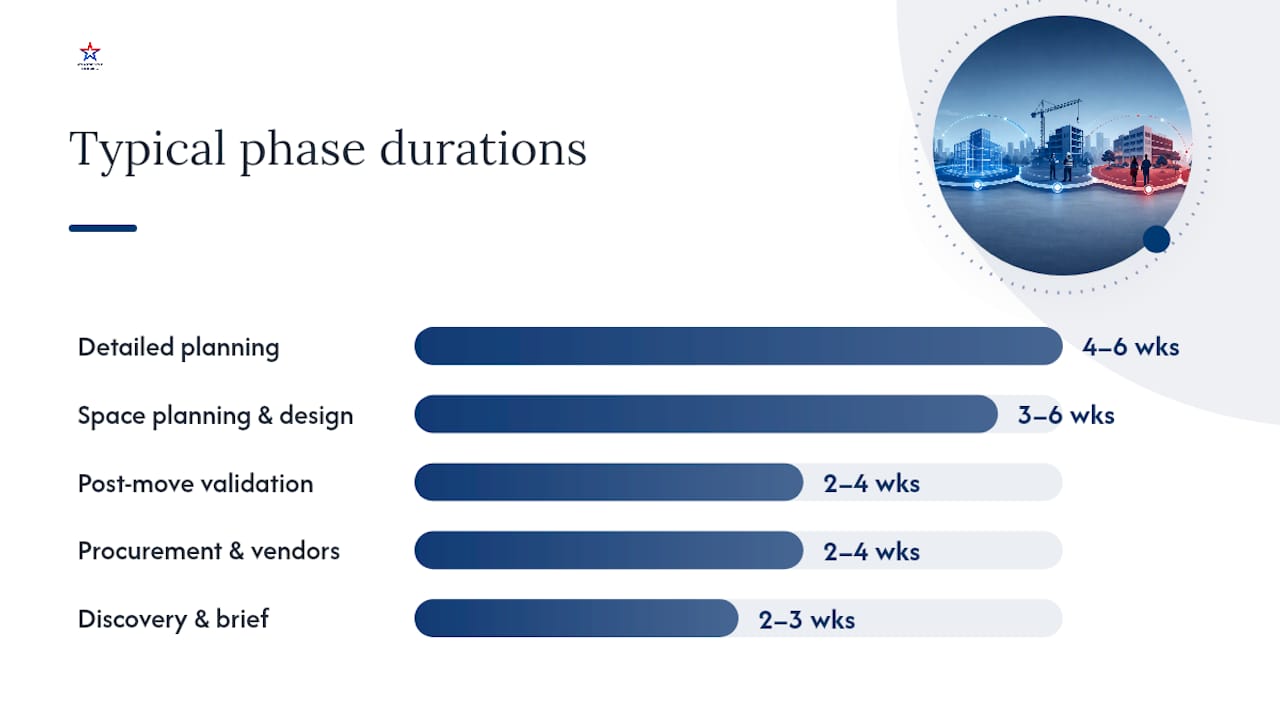
The canonical phases are: Discovery and Brief, Space Planning, Procurement and Vendor Selection, Detailed Planning, Move Execution, and Post-Move Validation. Matterport's move-management guide recommends a phased timeline and digital-twin visualization to keep remote stakeholders aligned throughout.
| Phase | Typical Duration | Critical Milestones |
|---|---|---|
| Discovery and brief | 2–3 weeks | Headcount confirmed, space requirements signed off |
| Space planning and design | 3–6 weeks | Floor plan approved, IT infrastructure mapped |
| Procurement and vendor selection | 2–4 weeks | Contracts signed, insurance certificates collected |
| Detailed planning | 4–6 weeks | Move schedule published, department sequences confirmed |
| Move execution | 1–2 weeks | Physical move complete, IT live at new site |
| Post-move validation | 2–4 weeks | Punchlist closed, crates collected, staff signed off |
For a medium-sized office, budget roughly 3–4 months from kickoff to move day. Smaller teams can compress the early phases; multi-floor or multi-site moves need more runway. The office relocation planning checklist from Atlantic Star Relocations breaks each phase into owner-level tasks if you need a working template.
Who owns what? Roles and single-point accountability
A typical governance structure includes five roles: project sponsor (executive authority), facilities lead (space and building logistics), IT lead (infrastructure and cutover), HR lead (employee communications and change management), and an external move manager who serves as the single point of accountability for vendor oversight and day-of execution.
The external move manager role is where most organizations underinvest. Without one, escalations bounce between the facilities team and IT, vendors get conflicting instructions, and small problems compound. Third-party logistics coordination — where a single provider oversees carrier selection, scheduling, and issue resolution — closes that gap.
The single point of accountability must deliver four things: a published move schedule with named owners for every task; a vendor matrix with confirmed insurance and contacts; a real-time issue log accessible to the project sponsor; and a post-move punchlist with closure deadlines. Anything less and accountability is a title, not a function.
How do you sequence IT and telecom to avoid downtime?
IT and telecom sequencing is the highest-risk part of any office relocation. The core principle: audit first, back up everything, stage the physical move, test before cutover, then cut over. Rushing any step in that chain is where Monday-morning outages come from.
A practical sequencing checklist for your IT relocation planning:
- Audit all assets — servers, switches, endpoints, phones, and licensed software tied to physical hardware.
- Verify backups — confirm full backups are current and restorable before any equipment moves.
- Survey the new site — check power capacity, cable pathways, rack space, and carrier access points.
- Coordinate with carriers and MSPs — confirm circuit activation dates and managed-service-provider access windows at the new address.
- Stage the physical move — move non-critical equipment first; keep production systems live until the new environment is validated.
- Test the new environment — run connectivity, VoIP, and application tests before staff arrive.
- Execute cutover — switch DNS, redirect circuits, and decommission old connections only after testing passes.
- Document the new state — update asset registers and network diagrams immediately.
Building infrastructure matters too: confirm elevator reservations, loading dock hours, and after-hours access with building management well before move day.
What does a realistic office move budget look like?
The primary cost categories for a commercial relocation are: moving labor, professional packing services, IT migration and setup, furniture and fit-out, permits and dilapidations, temporary storage, and contingency. Trevor Blake's fit-out checklist recommends including dilapidations, professional fees, IT and telecommunications setup, and furniture as distinct line items — not bundled estimates.
Contingency sizing should reflect project complexity, not a fixed percentage applied blindly.
How do you choose a managed relocation partner?
The single deciding criterion: can this provider deliver genuine single-point accountability, with verified local crews and carrier-neutral coordination? A vendor who subcontracts everything and assigns no dedicated project manager is a coordinator in name only.
Questions to ask every candidate:
- Who is my named project manager, and what is their direct contact?
- What is your insurance coverage, and can you provide a certificate of insurance today?
- Have you managed moves in NYC or Westchester County buildings with strict access rules?
- Can you provide references from office moves of similar scale completed in the last 18 months?
- How do you handle IT cutover coordination — do you work directly with our MSP or IT lead?
- What is your process when something goes wrong on move day?
Red flags: no dedicated PM assigned at contract signing; vague or unverifiable insurance; no documented IT cutover process; and an inability to name specific building-access experience in your target borough or county.
Atlantic Star Relocations offers a logistics coordination model built around these exact criteria — carrier-neutral, with a dedicated project manager on every commercial job.
How do you protect operations when things go wrong?
The main risk categories in an office relocation are IT downtime, access and permit delays, equipment damage, and decommissioning bottlenecks. The Facilities Manager's Desk Reference identifies post-move collection of empty crates, packaging, and waste as one of the most frequent operational bottlenecks — a detail most move plans skip entirely.
Mitigation by category:
- IT downtime: Maintain a fallback work-from-home or swing-space option for the first 48 hours post-cutover.
- Access and permits: Confirm COIs, elevator bookings, and loading dock windows in writing at least two weeks out.
- Equipment damage: Use professional packing services for servers, monitors, and specialty equipment; document condition before and after.
- Decommissioning delays: Schedule crate collection and waste removal as a separate line item with a confirmed vendor, not an afterthought.
For stakeholder communication, keep the message simple: state what is moving, when, and who to contact if something is wrong. A one-page schedule sent to all staff five days before move day, with a named contact for day-of issues, handles most of the anxiety.
What should you check in the 72 hours after move day?
Immediate post-move checks: IT validation (all systems live and tested), asset reconciliation (everything that left the old site arrived at the new one), crate and packaging collection, safety walkthrough of the new space, and staff sign-off that their workstation is functional.
Post-move responsibilities by window:
- 24–72 hours: IT lead confirms all systems operational; facilities lead completes safety walkthrough; move manager closes open damage claims.
- 1–2 weeks: Punchlist items resolved; surplus furniture and waste removed from old site; building access cards and directories updated.
KPIs worth tracking: time-to-productivity (how quickly staff are fully operational), punchlist closure rate at the one-week mark, and budget variance against the approved project cost.
How Atlantic Star Relocations handles workplace transitions
Atlantic Star Relocations provides managed office relocations with carrier-neutral coordination and a dedicated project manager assigned to every commercial job. The service model covers planning, professional packing services, labor-only options for teams with existing packing done, short-term and climate-controlled storage, and full logistics oversight from first site visit through post-move validation.

Local coverage spans Westchester County, Manhattan, Brooklyn, Queens, the Bronx, and surrounding areas in Connecticut and New Jersey. For larger or multi-site projects, Atlantic Star coordinates nationwide. The practical difference: one project manager who knows your building's access rules, your IT lead's cutover window, and your move-day schedule — and who is reachable when something needs a decision at 7 AM on a Saturday.
Compliance and regulatory considerations for office relocations
Office relocations in New York City and Westchester County carry real regulatory requirements. Certificate of Insurance (COI) requirements vary by building and must name the building owner as an additional insured — get the exact language from building management before signing any vendor contracts.
Building permits may be required for fit-out work, electrical modifications, or structural changes at the new site. In NYC, Department of Buildings permits apply to most construction work beyond cosmetic changes. Asbestos surveys are legally required before any demolition or disturbance of materials in buildings constructed before 1987, per New York State Department of Labor regulations.
Waste removal and decommissioning at the vacated site must comply with local disposal regulations; electronics and certain furniture materials require certified e-waste disposal, not standard dumpster removal. Lease dilapidations — the obligation to restore the old space to its original condition — should be scoped and budgeted before move day, not after.
The move window decision: an operator's perspective
Pick your move window before you finalize the vendor contract, not after. In NYC and Westchester, building rules often dictate the answer: freight elevator availability, loading dock hours, and noise ordinances narrow your options faster than you'd expect.
Weekend moves give you uninterrupted access and keep staff out of the way, but they carry overtime premiums and require vendors with strong weekend crew availability. Phased weekday-night moves spread the cost and reduce single-point-of-failure risk, but they demand tighter IT coordination since systems need to be live each morning.
Atlantic Star Relocations coordinates directly with building management in Westchester County and across NYC boroughs to confirm access windows, reserve freight elevators, and schedule around blackout periods — so the move window you choose is one you can actually execute.
Planning an office move in Westchester or NYC?
Atlantic Star Relocations manages corporate relocations from first site assessment through post-move validation — packing, labor, storage, and logistics coordination under one accountable project manager. No subcontracted chaos, no handoff gaps.

Whether you're moving a 20-person office in White Plains or a multi-floor operation in Midtown Manhattan, the process starts with a site assessment and a realistic scope. Atlantic Star also offers labor-only moving help for teams that already have packing handled, and short-term storage to support phased moves. Request a quote or schedule a site visit at Atlanticstargroup — the earlier you bring in a managed provider, the more options you have.
Sources
- How To Understand Your Office Move Management Process
- How to Manage an Office Move? 10 Tactical Steps | Matterport
- Facilities Manager's Desk Reference 3e, Third Edition
- Office Fit Out Checklist for an Office Relocation - Trevor Blake
- Hospitality
FAQ
What is workplace transition planning for an office move?
Workplace transition planning is the structured program of project management, logistics, IT sequencing, and stakeholder communication needed to relocate a physical office. It treats the move as a coordinated program rather than a single logistics event.
How far in advance should you start planning an office relocation?
Most medium-sized office moves require 3–4 months of planning before move day, with larger or multi-floor relocations needing more runway for vendor procurement and IT coordination.
What does a single point of accountability do in a managed office move?
The single point of accountability owns the move schedule, vendor matrix, issue log, and post-move punchlist — and is the one person authorized to make real-time decisions when something goes wrong on move day.
What permits are required for an office move in NYC or Westchester?
Building COIs, freight elevator reservations, and Department of Buildings permits for fit-out work are the most common requirements. Buildings constructed before 1987 also require an asbestos survey before any demolition work under New York State Department of Labor regulations.
Can Atlantic Star Relocations manage the IT coordination side of an office move?
Atlantic Star Relocations coordinates directly with your IT lead and managed service provider to align physical move schedules with cutover windows, reducing the risk of downtime on the first day at the new site.