

A New York DOT mover is a carrier authorized by the New York State Department of Transportation (NYSDOT) to transport household goods between two points within New York State, and every such carrier must follow NYSDOT tariff rules and consumer-protection requirements. If you're hiring a mover for a local move in Manhattan, a cross-borough move in Queens, or a relocation within Westchester County, that mover needs NYSDOT authorization and not just a federal registration number.
Before you sign anything, run these three steps:
- Search the mover's name or certificate number on the NYSDOT Carrier Certification System (CarCert) to confirm active authorization.
- Confirm the mover's T# (NYSDOT certificate number) appears in their advertising, estimate, or written materials. No T# is a red flag.
- Ask for the Summary of Information booklet and a written Order for Service before any goods are loaded.
You can also call NYSDOT directly at (518) 457-6512 or email nymoving@dot.ny.gov to verify a carrier's status.
Key Takeaways
Every intrastate New York move requires a NYSDOT-authorized carrier with a valid T#, a filed tariff as the only lawful basis for charges, and written documentation at every stage.
| Point | Details |
|---|---|
| Verify the T# first | Search the mover on CarCert before signing any contract or paying any deposit. |
| Tariffs cap what movers can charge | Only rates filed with NYSDOT are lawful; no mover can add charges not in their tariff. |
| Written estimates require inspection | A binding estimate must follow a physical inspection and carry both parties' signatures. |
| Claims have a legal timeline | Movers must acknowledge written claims within a month and resolve them within a few months. |
| Atlantic Star Relocations | Provides tariff-aware, managed moves across Westchester and NYC with written estimates and full accountability. |
Table of Contents
- What does NYSDOT household-goods authority actually cover?
- Intrastate vs. interstate: which authority applies to your move?
- How do you verify a mover is actually licensed?
- Tariffs and written binding estimates: how NYSDOT pricing rules protect you
- Consumer rights, bills of lading, liability, and claims timelines
- Move brokers vs. licensed movers: how to tell the difference
- Filing a complaint: what to do if a mover breaks the rules
- DOs and DON'Ts when hiring a New York DOT mover
- How a professional mover follows NYSDOT rules to protect you
- A perspective from an experienced New York mover
- Atlantic Star Relocations: compliant, accountable moves across Westchester and NYC
- Sources
- FAQ
What does NYSDOT household-goods authority actually cover?
NYSDOT regulates household-goods movers for any move that begins and ends within New York State. "Household goods" under NYSDOT rules means personal property used in a home: furniture, appliances, clothing, electronics, and similar items. It does not cover commercial freight or business equipment moved between warehouses.
The authority NYSDOT exercises is broad. It issues certificates to carriers, reviews and approves filed tariffs, mandates specific consumer documents, and sets the rules for how rates and accessorial charges can be applied. A mover cannot legally charge you a rate that isn't in their filed tariff. That single rule eliminates a large category of moving scams.
For consumers, this matters in a practical way. When a mover holds a valid NYSDOT certificate, you have a documented complaint path, enforceable pricing rules, and required paperwork that creates a paper trail. Without that authorization, you have none of those protections. NYSDOT's registration and licensing process also requires carriers to carry adequate insurance and meet fitness standards before a certificate is issued, which filters out fly-by-night operators before they ever reach your front door.
Intrastate vs. interstate: which authority applies to your move?
The rule is simple: if your move stays entirely within New York State, NYSDOT governs it. If it crosses a state line, the Federal Motor Carrier Safety Administration (FMCSA) takes over. Many moves, though, involve both.
| Factor | Intrastate (NYSDOT) | Interstate (FMCSA) |
|---|---|---|
| Jurisdiction trigger | Move starts and ends in New York State | Move crosses any state line |
| Required registration | NYSDOT certificate (T#) | USDOT number and FMCSA operating authority |
| Tariff rules | Filed with NYSDOT; 30-day notice for changes | Filed with FMCSA or governed by federal rules |
| Consumer complaint body | NYSDOT (nymoving@dot.ny.gov) | FMCSA (Protect Your Move portal) |
| Verification tool | CarCert search | FMCSA mover search |
A local apartment-to-apartment move in Brooklyn is purely intrastate: NYSDOT authority is what you check. A move from the Bronx to New Jersey requires FMCSA registration. Vehicles with a gross vehicle weight rating (GVWR) or gross combined weight rating (GCWR) over 10,000 pounds generally require a USDOT number regardless of route.
Pro Tip: If your move involves a broker, a third-party carrier, or multiple legs across state lines, verify both NYSDOT and FMCSA registration. A broker may be federally registered but use a subcontracted carrier that lacks NYSDOT authority for the intrastate portion.
How do you verify a mover is actually licensed?
The NY Department of State warns consumers to confirm state licensing before signing any contract. Here's the exact sequence to follow:
- Go to CarCert. Visit Carcert and search by company name or T#. Confirm the certificate is active, not expired or revoked.
- Check their advertising. NYSDOT requires authorized movers to display their T# in all solicitations and advertising. If a website, flyer, or estimate omits it, ask for it in writing.
- Request the Summary of Information booklet. A licensed mover must provide this before the move. If they can't produce it, that's a compliance failure.
- Ask for a written Order for Service. Per NYSDOT's consumer guidance, this document must be issued before any goods are loaded. It confirms the agreed scope, price, and carrier identity.
- Record what you find. Screenshot the CarCert result, save the estimate, and keep every email.
Red flags that signal an unlicensed or problematic mover
- No T# provided or refused when asked
- Only a phone number and a generic website with no physical address
- Estimate given verbally with no written follow-up
- Large cash-only deposit demanded upfront
- Carrier cannot name the specific tariff covering your service
Tariffs and written binding estimates: how NYSDOT pricing rules protect you
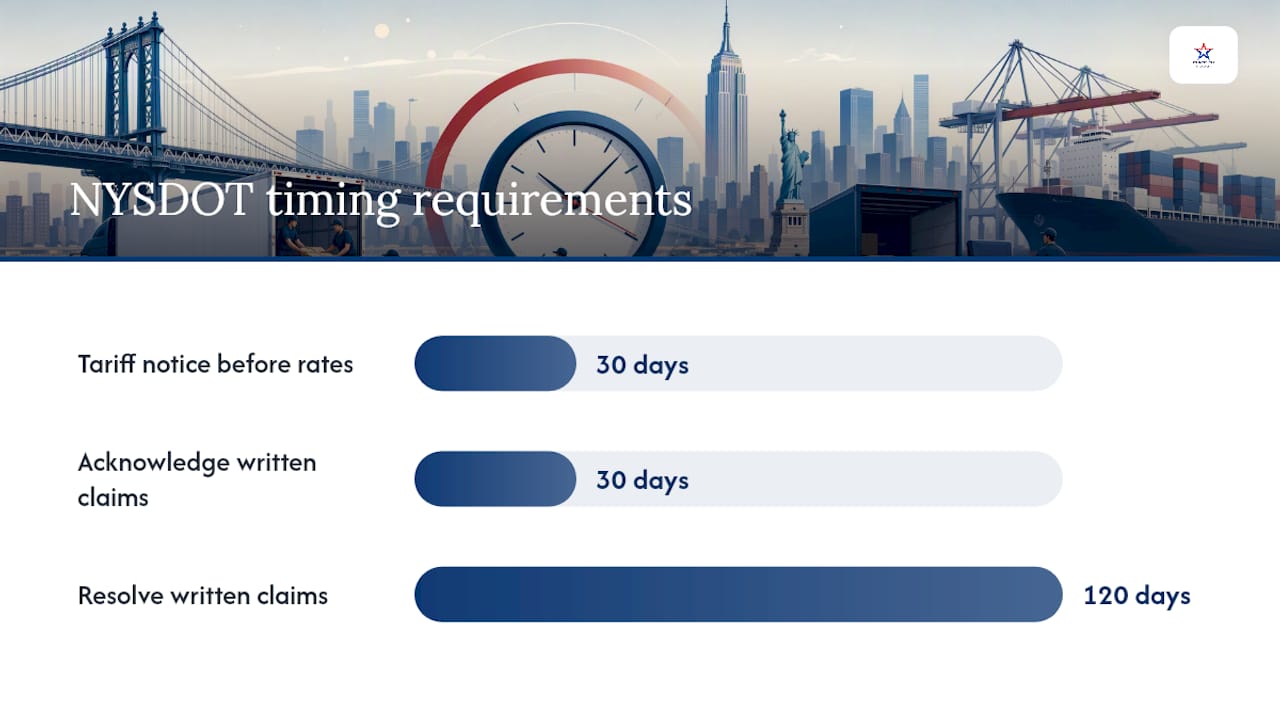
Every mover operating in New York State must file a tariff with NYSDOT. That tariff lists every lawful rate and charge the carrier may apply. According to the NYSDOT Mover's Guide, changes to a tariff take effect only after 30 days' statutory notice. A mover cannot invent a new charge on moving day and claim it's valid.
Tariffs are a powerful consumer protection because carriers may charge only what's filed. Reputable movers use their tariff as the basis for written binding estimates, which give you a documented, enforceable price before the truck arrives.
What a valid written binding estimate must include
| Element | Requirement |
|---|---|
| Physical inspection basis | Estimate must follow an in-person or virtual inspection of goods |
| Detailed item list | Itemized inventory or cubic-foot calculation |
| Mover's T# | Must appear on the estimate document |
| Signatures | Both shipper and carrier must sign and date |
| Carrier contact | Name, address, and phone of the carrier |
| Scope of service | All services included (packing, stairs, storage, etc.) |

A binding estimate that meets these criteria is enforceable. If the mover tries to charge more at delivery, you have grounds to dispute it. Ask for the specific tariff supplement that covers your service type, especially if you're using packing services or requesting storage.
Pro Tip: Never accept a binding estimate given over the phone without a physical inspection. NYSDOT requires the estimate to be based on an actual assessment of your goods. A phone-only quote is not a binding estimate under New York rules.
Consumer rights, bills of lading, liability, and claims timelines
A licensed New York DOT mover must provide specific documents at defined points in the move. Knowing what to expect, and when, keeps you protected.
Required documents and when you receive them
| Document | When provided | Purpose |
|---|---|---|
| Summary of Information booklet | Before the move | Explains your rights and the mover's obligations |
| Order for Service | Before loading | Confirms agreed scope, price, and carrier identity |
| Bill of lading | At pickup | The legal contract for the move |
| Written inventory | When used | Itemized list of goods and their condition |
The bill of lading is the contract. Read it before you sign. If anything contradicts your written estimate, stop and resolve it before the truck leaves.
On liability: movers carry minimum liability coverage, which may not cover the full replacement value of damaged items. Ask specifically about declared value coverage or whether you should purchase third-party insurance for high-value goods.
For claims, 17 NYCRR Part 814 sets the timeline: the mover must acknowledge a written claim within 30 days and resolve it in writing within 120 days. Submit your claim in writing, not by phone.
What to preserve after a move
- Photos of items before and after loading
- Signed inventory sheets
- All written estimates and the bill of lading
- Emails and text messages with the mover
- Receipts for any out-of-pocket costs caused by damage or delay
Move brokers vs. licensed movers: how to tell the difference
A move broker arranges transportation but does not own trucks or employ the crew that handles your goods. A licensed household-goods carrier holds a NYSDOT certificate, owns or leases the vehicles, and is directly responsible for your shipment. The distinction matters because a broker's legal accountability for your goods is different from a carrier's.
To determine which you're dealing with, ask these questions:
- Who signs the bill of lading? The carrier who physically moves your goods must sign it. If a broker signs it, ask who the actual carrier is.
- Who owns the truck? The carrier should be able to name the fleet owner. A broker cannot.
- Who issues the Order for Service? It should come from the licensed carrier, not a third-party sales office.
- Does the company have a T#? Brokers may have federal broker authority but not a NYSDOT carrier certificate. Confirm the actual carrier's T# before moving day.
If a broker is involved, request the subcontracted carrier's NYSDOT T# and verify it on CarCert independently. A reputable broker will provide this without hesitation. One that stalls or deflects is a warning sign worth taking seriously.
Filing a complaint: what to do if a mover breaks the rules
If a mover violates NYSDOT rules, here's the sequence to follow:
- Notify the mover in writing. Send a written complaint by email or certified mail. State the specific violation and what resolution you expect.
- Preserve all documentation. Gather everything listed in the claims checklist above.
- Submit a complaint to NYSDOT. Email nymoving@dot.ny.gov or call (518) 457-6512. You can also report through the CarCert system.
Evidence to include with your NYSDOT complaint
| Document | Why it matters |
|---|---|
| Bill of lading | Establishes the contract terms |
| Order for Service | Shows agreed scope and price |
| Written inventory | Documents condition of goods at pickup |
| Written estimate | Proves what price was agreed |
| Photos | Visual evidence of damage |
| Receipts | Quantifies out-of-pocket losses |
NYSDOT can investigate and take enforcement action against a carrier's certificate. What it cannot do is award you money damages directly. That requires a civil claim, and for amounts under the New York small-claims threshold, small-claims court is often the practical route. Keep your documentation organized from day one, because that paper trail is what makes a small-claims case winnable.
DOs and DON'Ts when hiring a New York DOT mover
Do these before and during your move
- Verify the T# on CarCert before signing anything
- Get a written Order for Service issued before loading begins
- Insist on a physical inspection as the basis for any binding estimate
- Keep copies of every document: estimate, Order for Service, bill of lading, inventory
- Ask specifically about liability coverage and whether third-party insurance is available
- Photograph your belongings before the movers arrive
Never do these
- Hire a mover that refuses to provide a T# or written estimate
- Accept a large cash-only deposit with no written receipt
- Sign a blank or incomplete bill of lading
- Rely on verbal promises about price, timing, or services
- Assume a federal USDOT number is enough for a move that stays within New York State
Quick pre-move checklist: T# verified on CarCert ✓ | Written Order for Service in hand ✓ | Binding estimate signed and dated ✓ | Photos taken ✓ | Summary of Information booklet received ✓
How a professional mover follows NYSDOT rules to protect you
A mover that takes compliance seriously doesn't just check boxes. The operational difference shows up in how they handle the details before, during, and after a move.
Professional NYSDOT-compliant carriers typically:
- Display their T# in all advertising, estimates, and correspondence
- Conduct a physical inspection before issuing any binding estimate
- Issue a clear, signed Order for Service before loading
- Provide the Summary of Information booklet at the time of booking
- Maintain current insurance certificates and make them available on request
- Follow the 30-day tariff notice requirement before adjusting rates
- Acknowledge written claims within 30 days and resolve them within 120 days per 17 NYCRR Part 814
Atlantic Star Relocations operates this way across Westchester County and the five NYC boroughs. The company provides written estimates after assessing your goods, issues clear Order for Service documentation, and coordinates building access and scheduling as part of a managed move. For clients in Manhattan high-rises, Westchester homes, or multi-leg relocations that touch storage and final delivery, that single point of accountability means you're not chasing down a subcontractor when something needs to be resolved. You can also review NYC building move requirements to understand what permit and access coordination a compliant mover should handle on your behalf.
A perspective from an experienced New York mover
The most common mistake consumers make isn't hiring an unlicensed mover on purpose. It's assuming that because a company has a website, a Google listing, and a phone number, they must be legitimate. That assumption costs people money every year.
The T# check on CarCert takes about 90 seconds. The Summary of Information booklet is a free document that NYSDOT requires every licensed mover to hand you. A written binding estimate based on a physical inspection is not a premium service. It's the legal standard. When a mover treats any of those things as optional or inconvenient, that tells you everything you need to know about how they'll handle your belongings.
At Atlantic Star Relocations, we've seen what happens when clients skip the verification step and end up with an unlicensed carrier holding their furniture. Getting those situations resolved is harder than preventing them. Treat license verification as non-negotiable, every single time.
Atlantic Star Relocations: compliant, accountable moves across Westchester and NYC
Atlantic Star Relocations gives you a managed move with written estimates, tariff-aware pricing, and a crew that's accountable from first contact to final delivery. Whether you're relocating a home in Westchester, an apartment in Brooklyn, or an office in Manhattan, you get one point of contact who handles the details, not a broker farming your job to the lowest bidder.

Our logistics coordination services cover the full scope: physical inspection, binding estimate, Order for Service, building access coordination, and claims support if anything goes wrong. We serve Westchester County, all five NYC boroughs, Connecticut, New Jersey, and Florida.
Ready to move with a carrier that follows the rules? Get a quote from Atlantic Star Relocations or call us to schedule your inspection.
Sources
- NYSDOT Carrier Certification System (CarCert)
- NYSDOT Summary of Information booklet (revised)
- FMCSA Protect Your Move — Search a mover
Also useful for local context: the NYC moving scams guide and the average moving cost NYC guide cover red flags and pricing expectations for moves across the five boroughs.
FAQ
What is a New York DOT mover?
A New York DOT mover is a carrier authorized by the New York State Department of Transportation to transport household goods within New York State. These carriers must hold a valid NYSDOT certificate (T#) and follow filed tariff rules and consumer-protection requirements.
How much do NYC movers typically charge?
Rates vary by move size, distance, and service type, and must be based on the carrier's NYSDOT-filed tariff. For borough-by-borough cost breakdowns, the NYC moving cost guide covers current pricing ranges across Manhattan, Brooklyn, Queens, and the Bronx.
Who needs a USDOT number?
Carriers operating vehicles with a GVWR or GCWR over 10,000 pounds in interstate commerce generally require a USDOT number and FMCSA operating authority. For moves that stay entirely within New York State, the NYSDOT certificate (T#) is the required authorization, not a USDOT number.
What does NY DOT stand for in the context of movers?
NY DOT stands for the New York State Department of Transportation (NYSDOT), the state agency that licenses and regulates household-goods carriers for intrastate moves within New York.
What should I do if a mover refuses to provide a T#?
Do not hire them. A licensed New York mover is required to display their NYSDOT certificate number in advertising and provide it on request. Refusal to produce a T# is a clear sign the carrier may not be authorized, and you have no consumer protections without that authorization.