

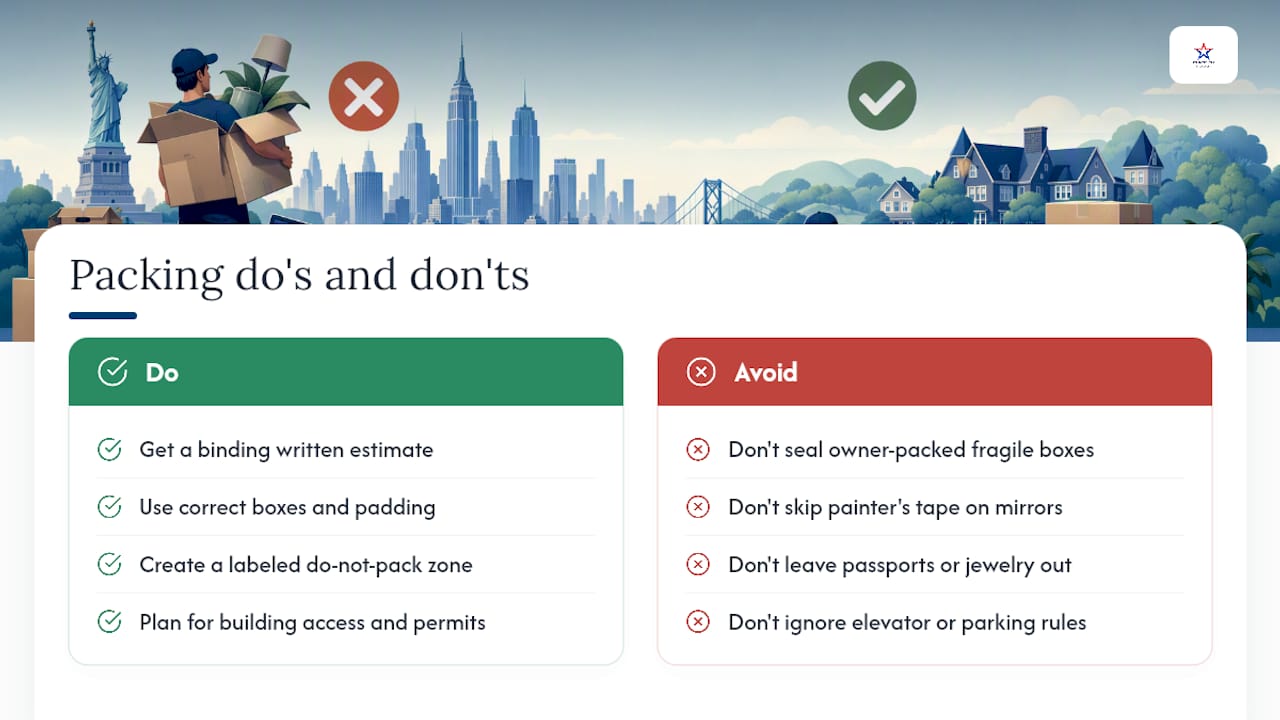
The most damaging packing mistakes are ones you won't notice until the truck is already unloaded: wrong box sizes, skipped labeling, no documentation of valuables, and booking a packer without asking what the estimate actually covers. Here's the short version of what to do instead:
- Use double-walled boxes for anything heavy or stackable
- Label every box with room AND contents, not just "kitchen"
- Photograph valuables before packing and keep a written inventory
- Set up a do-not-pack area before packers arrive
- Ask whether your estimate is binding or non-binding, in writing
- Declutter before your in-home estimate, not after
Atlantic Star Relocations sees these errors on nearly every self-packed move in Westchester and across the NYC metro. The Federal Motor Carrier Safety Administration (FMCSA) requires movers to offer valuation coverage options, but that coverage often excludes owner-packed boxes entirely.
Table of Contents
- What are the most common packing mistakes to avoid?
- What mistakes do people make when booking packing services?
- Why does insurance coverage depend on who packs your boxes?
- What does professional packing cost and how long does it take?
- What should you do on move day?
- Which packing supplies do you actually need?
- When does hiring professional packers make sense?
- Key Takeaways
- The mistake most movers underestimate
- Atlantic Star Relocations handles the packing so you don't have to guess
- Useful sources
- FAQ
What are the most common packing mistakes to avoid?
Wrong box choice is the fastest route to a broken move. Single-wall boxes collapse under stacked weight; use double-walled boxes for books, dishes, and anything you plan to stack more than two high. Avoid overpacking, reusing damaged boxes, and skipping proper tape and sealing — the H-tape method (tape along the center seam and both edges) is the minimum standard for any loaded box.
Overpacking is a back injury and a crushed-contents claim waiting to happen. A good rule: if you can't lift the box comfortably with both hands, it's too heavy. Underpacking is just as bad. Void fill (packing paper, foam peanuts, air pillows) keeps contents from shifting and the box walls from caving inward.
Pro Tip: Label every box on two sides and the top with the destination room and a brief contents note ("Master BR — bedding, no fragile"). A single-side label disappears the moment boxes are stacked.
Poor labeling is the mistake that costs you hours on the other end. Movers in Manhattan and Brooklyn high-rises often stack boxes four deep in a freight elevator. If the label faces the wall, you're unpacking blind.
Mixing heavy items with fragile ones in the same box is a common packing pitfall that pros never make. Heavy items go on the bottom; fragile items go on top, individually wrapped. Skipping declutter before your estimate is a separate problem: if you remove ten boxes of items after the quote, your scope changes and so does your price.
What mistakes do people make when booking packing services?
Most booking errors come down to comparing price without comparing scope. Two quotes can look identical and cover completely different things. Before you sign anything, ask:
- Are packing materials (boxes, tape, paper, foam) included or billed separately?
- Does the quote cover fragile handling and disassembly/reassembly?
- Is this a binding or non-binding estimate? Get the answer in writing.
- What are the minimum hours and travel fees?
- What items won't you pack (hazardous, prohibited)?
Comparing price without scope and not asking about estimate type are the two most common booking traps. A non-binding estimate can increase on move day; a binding estimate locks the price regardless of how long the job takes.
Prohibited and hazardous items catch people off guard. Movers typically won't transport propane tanks, paint, cleaning chemicals, ammunition, or perishable food. Handle these separately before move day.
Pro Tip: Book professional packers at least 3–4 weeks out for a Westchester or NYC move. Last-minute bookings often trigger minimum-hour charges and limit your crew options.
Booking too late is especially costly in the NYC metro, where building access windows, elevator permits, and parking restrictions add coordination layers that require advance planning. Atlantic Star Relocations handles this logistics overhead as part of every managed move.
Why does insurance coverage depend on who packs your boxes?
Most moving insurers limit or deny claims on owner-packed boxes. When you pack your own items, the mover has no way to verify the pre-move condition, so they typically exclude those boxes from valuation coverage. Professional packing changes that equation.
Steps to protect yourself regardless of who packs:
- Photograph every high-value item before it goes in a box (serial numbers, condition, all angles)
- Keep a written inventory with item descriptions and estimated values
- Ask your packer for written terms on what their valuation coverage includes
- For irreplaceable items, transport them personally or purchase declared value coverage
- Use Atlantic Star's moving inventory process guide to build a documented record before move day
Pro Tip: Store your inventory photos in cloud storage before the move begins. If a claim arises, you'll need those images accessible from somewhere other than the device that just moved across the country.
The do-not-pack area is a chain-of-custody tool, not just an organizational tip. Designating one room or corner for items that travel with you (documents, medications, jewelry, laptops) keeps them out of the truck entirely and eliminates the most common "where did that go?" calls after delivery.
What does professional packing cost and how long does it take?
Professional packers can pack an entire home in 1–2 days, with labor commonly billed around $60 per hour per packer. Materials are usually quoted separately.
| Cost Driver | Impact on Quote |
|---|---|
| Full vs. partial pack | Full pack costs more; partial (kitchen + fragile only) reduces hours |
| Fragile/specialty items | Art, instruments, and electronics add time and materials |
| Travel and minimums | NYC/Westchester jobs often carry minimum-hour requirements |
| Last-minute booking | Reduces crew availability and may trigger premium rates |
| Materials supply | Boxes, tape, and foam billed per unit if not included in flat rate |
Decluttering before your estimate is the single fastest way to reduce your quote. Every box you eliminate before the crew arrives is time and materials you don't pay for.
What should you do on move day?
A structured move-day routine prevents the errors that happen when everyone is rushing.
- Set up your do-not-pack area the night before and label it clearly with a sign or tape barrier.
- Pack your essentials bag: IDs, passports, medications, phone chargers, keys, a change of clothes, and basic kitchen items for the first night.
- Photograph door frames, furniture legs, and wall corners before the crew starts moving anything.
- Confirm your inventory list matches what's being loaded.
- Verify building access: elevator reservations, parking permits, and stairwell clearance for large items.
Pro Tip: In NYC co-ops and condos, elevator permits often require 48–72 hours' notice. Confirm this with your building manager before move day, not the morning of.
- Keep your essentials bag with you in your personal vehicle, not on the truck
- Have a printed copy of your inventory and the mover's contact number on your person
- Do a final walkthrough of every room, closet, and cabinet before the truck leaves
Which packing supplies do you actually need?
Double-walled boxes are non-negotiable for books, dishes, and anything you plan to stack. Single-wall boxes are fine for light, bulky items like pillows and linens.
- Mover's stretch wrap: — Furniture, drawers, anything with doors or lids
Pro Tip: Avoid boxes larger than medium for anything fragile. A big box invites overpacking, which increases weight and reduces cushioning effectiveness.
Painter's tape and foam corner protectors are cheap insurance for glass and frames. Mover's stretch wrap keeps furniture hardware attached and drawer contents contained without tape residue.
When does hiring professional packers make sense?
Hire pros when the math or the risk tips the balance. Full professional packing makes sense for:
- Large homes (3+ bedrooms) where DIY packing would take weeks
- Moves with significant fragile inventory (art, antiques, instruments)
- Time-constrained moves where packing days aren't available
- Any move where valuation coverage on packed items matters to you
Partial packing is a smart middle ground. Outsource the kitchen and all fragile items (the highest-risk, most time-consuming categories) and handle clothing, books, and linens yourself.
Questions to ask before booking packing-only services:
- Are materials included or billed separately?
- Is the rate hourly or flat fee, and what are the minimums?
- What valuation or liability coverage applies to items your crew packs?
- What's your lead time for a Westchester or NYC job?
Key Takeaways
Avoiding the most damaging packing mistakes comes down to three decisions made before move day: use the right boxes, document your valuables, and confirm your coverage terms in writing.
| Point | Details |
|---|---|
| Use double-walled boxes | Heavy and stackable items need double-walled boxes to prevent collapse and shifting. |
| Photograph valuables first | Document serial numbers and condition before packing to support any insurance claim. |
| Confirm estimate type in writing | Ask whether your quote is binding or non-binding before signing anything. |
| Set a do-not-pack area | Designate one space for items traveling with you to prevent accidental packing. |
| Atlantic Star Relocations | Offers full and partial packing services in Westchester and NYC, including fragile handling, inventory documentation, and valuation coverage terms. |
The mistake most movers underestimate
The packing errors that cost people the most aren't the dramatic ones. Nobody forgets to wrap a chandelier. The real damage comes from the quiet, procedural failures: a non-binding estimate that jumps $400 on move day, a box of owner-packed china that the mover won't cover because you sealed it yourself, or a mirror that arrives cracked because someone skipped the painter's tape step.
What I've seen repeatedly on Westchester and Manhattan jobs is that people treat packing as the easy part of moving. They spend weeks researching movers and ten minutes grabbing whatever boxes are in the garage. That ratio is backwards. The packing is where the physical risk lives. A mover can be excellent and still deliver a broken lamp if the box was wrong to begin with.
The other thing worth saying plainly: the do-not-pack area isn't optional. On a busy move day in a Bronx or Queens apartment, a crew of three is moving fast. If your passport and your grandmother's jewelry are sitting on the kitchen counter, they go in a box. That's not negligence; that's momentum. A labeled, physically separated do-not-pack zone is the only reliable way to keep those items off the truck.
Local logistics add a layer most guides ignore. Building access windows in NYC co-ops, elevator permits in Westchester high-rises, and street parking restrictions in Manhattan all compress the move-day timeline. The less time the crew spends problem-solving access, the more time they spend packing carefully.
Atlantic Star Relocations handles the packing so you don't have to guess
Packing errors are almost always preventable, and the fastest way to prevent them is to hand the job to people who do it every day. Atlantic Star Relocations offers full-service packing and partial packing for residential and commercial moves across Westchester County, New York City, Manhattan, Brooklyn, Queens, the Bronx, Connecticut, New Jersey, and Florida.

Every job includes materials, fragile handling, inventory documentation, and clear valuation coverage terms before the crew arrives. For high-value items, Atlantic Star's art and fragile crating service covers pieces that standard packing can't protect. Storage coordination is available for between-move gaps. Get a quote or request an on-site or virtual estimate at atlanticstarmoving.com/packing-services.html.
Useful sources
- Is It Worth Paying for Professional Packers When Moving? — MoveAdvisor
- How Much Does it Cost to Hire Professional Packers? — Movers.com
- What You Shouldn’t Do When Packing Boxes for Moving | U-Haul
- How to Pack Fragile Items for Shipping | U-Haul
- Hiring Professional Packers vs. Packing Yourself: Which Is Right for You? | U-Haul
- Tips: Pack fragile and valuable items for your move — uShip blog
- Packing Tips | Atlantic Star Moving & Storage
FAQ
What boxes should you use for heavy items?
Use double-walled boxes for books, dishes, and anything you plan to stack. Single-wall boxes collapse under weight and are best reserved for light, bulky items like pillows or linens.
Does professional packing affect my insurance coverage?
Yes. Most movers limit or deny claims on owner-packed boxes, so having professionals pack your items typically broadens your valuation coverage options. Confirm the specific terms in writing before move day.
What is a binding vs. non-binding estimate?
A binding estimate locks your price regardless of how long the job takes; a non-binding estimate can increase on move day based on actual time and materials. Always ask which type you're getting and get the answer in writing.
How far in advance should I book professional packers in NYC or Westchester?
Book at least 3–4 weeks out. Last-minute bookings in the NYC metro often trigger minimum-hour charges and reduce crew availability, especially during peak moving season.
What items won't professional movers pack?
Movers typically refuse propane tanks, paint, cleaning chemicals, ammunition, and perishable food. Identify these items before your estimate and plan to transport or dispose of them separately.