

Moving in New York City hits differently than anywhere else in the country. The five core challenge groups you'll face are building access and Certificate of Insurance (COI) requirements, curb access and parking logistics, physical apartment constraints, scheduling and weather risks, and cost and licensing verification. Before you hire anyone, do three things: confirm your building's COI requirements and get a compliant certificate issued, reserve the freight elevator with a deposit, and apply for legal curb access at least seven business days out.
Here's the short version of what to tackle first:
- Get your COI accepted. Most managed buildings require general liability coverage of at least $1M per occurrence and $2M aggregate, plus workers' compensation proof. Submit it at least 48–72 hours before move day, often longer.
- Reserve the freight elevator. Confirm the exact move window, deposit amount, and protective pad requirements with your building super or management office in writing.
- Secure legal curb access. Apply through NYC DOT or coordinate with your local precinct at least seven business days before your move to post signage and avoid tickets or towing.
Atlantic Star Relocations handles all three of these steps as part of its managed coordination service, which is exactly why clients in Manhattan, Brooklyn, and Westchester avoid the rejections and delays that derail self-managed moves.
Table of Contents
- Why are the common challenges of moving in New York so different?
- What building rules, COI requirements, and elevator policies do you need to meet?
- How do you secure legal curb access and handle parking on move day?
- How do walk-up apartments and tight layouts affect your move?
- What scheduling and weather risks can derail your NYC move?
- What do NYC moves actually cost, and how do you verify a mover?
- What packing and protection practices actually work in tight NYC spaces?
- What does a practical 30–90 day pre-move checklist look like?
- How does Atlantic Star Relocations remove these NYC-specific risks?
- Key Takeaways
- What most people get wrong about managed NYC moves
- Atlantic Star Relocations handles the hard parts of moving in NYC
- Authoritative sources for NYC moving rules and building policies
- FAQ
Why are the common challenges of moving in New York so different?
A typical suburban move involves a truck pulling into a driveway, a ground-floor unit, and no one asking for paperwork. NYC is the opposite of that on every axis.
Managed residential buildings, which cover the majority of Manhattan and large portions of Brooklyn and Queens, operate more like small corporations than landlords. They have insurance requirements, move-in windows, freight elevator schedules, and building staff who enforce all of it. Pre-war architecture, built before modern furniture dimensions existed, adds narrow staircases, tight elevator cabs, and doorframes that won't accommodate a standard king mattress without disassembly.
NYC's Neighborhood Loading Zones (NLZ) reduce double parking by up to 70% in high-demand corridors — but only when trucks use them correctly.
At the curb level, NYC DOT's Loading Only and NLZ programs formalize where and when commercial vehicles can stage. Ignore those rules and you're looking at a ticket, a tow, or a crew standing on the sidewalk with your furniture while the truck gets relocated six blocks away.
The compounding effect is what catches people off guard. A rejected COI delays the elevator reservation. A delayed elevator reservation pushes the move into a restricted window. A restricted window means overtime fees or a rescheduled date. Each problem feeds the next, and the costs add up fast.
What building rules, COI requirements, and elevator policies do you need to meet?
This is where most NYC moves go wrong before the truck even arrives.
Certificate of Insurance: what it must contain
A Certificate of Insurance is a one-page document your mover's insurance carrier issues, naming your building's legal entity as an additional insured. Most managed buildings require general liability coverage of at least $1M per occurrence and $2M aggregate, plus workers' compensation and commercial auto coverage. Luxury co-ops and large residential portfolios often require higher limits.
The exact legal name of the building entity matters. A COI that says "123 Main Street LLC" when the deed reads "123 Main Street Condominium Corp." will be rejected at the service entrance. That mismatch is one of the most common reasons crews get turned away on move day. Verify the correct certificate-holder name with building management before your mover submits anything.
Many movers can issue a COI within 24–72 hours, but some buildings require submission 7–10 business days in advance for large portfolios. Columbia Residential, for example, requires COI submission at least 48 hours before the move with precise certificate-holder language and workers' comp documentation. That's a minimum, not a target.
Pro Tip: Email building management and ask for their exact COI template or certificate-holder language in writing. Forward that email directly to your mover's insurance contact. This single step eliminates the back-and-forth that delays most COI approvals.
Elevator reservations and move windows
Freight elevator reservations typically require a refundable deposit, commonly in the $300–$500 range. Buildings also require protective measures: elevator pads, floor runners, and corner protectors on doorframes. Most buildings restrict moves to weekday business hours, often 9 AM–5 PM. Some luxury buildings narrow that window further to 10 AM–4 PM.
Miss the window, even by 30 minutes, and you may face a penalty fee or lose the reservation entirely. Confirm the exact window, deposit amount, and pad requirements in writing with your super or management office. See the full building requirements and COI checklist for a detailed breakdown of what to request.
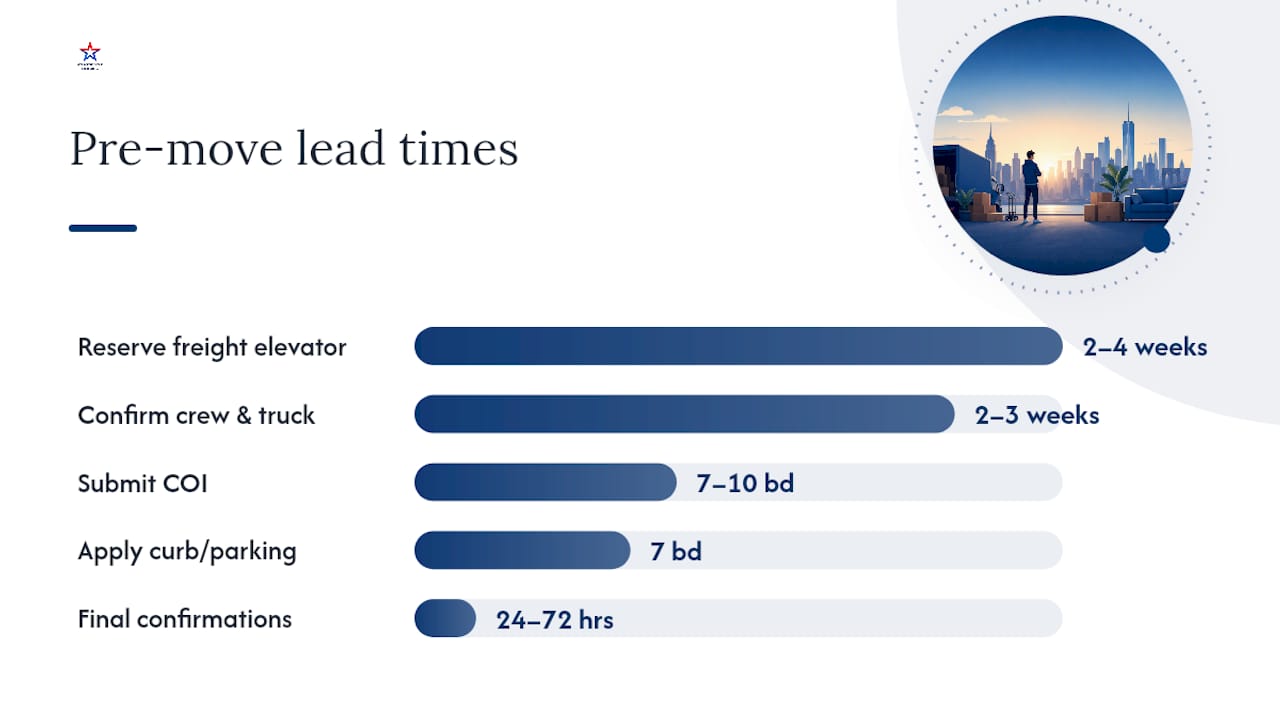
Recommended lead times:
- Submit COI: at least 7–10 business days before move day; 48–72 hours is the minimum, but many buildings require longer, especially for large residential portfolios.
- Reserve freight elevator: 2–4 weeks before move day for most buildings; 4+ weeks for luxury co-ops
- Confirm building rules in writing: at least 2 weeks out
How do you secure legal curb access and handle parking on move day?
Getting the truck legally staged in front of your building is its own project. NYC curb rules are block-specific, and what works on one side of the street may not apply 50 feet away.

Understanding your curb options
NYC offers several curb-use categories relevant to moving: Loading Only zones, Neighborhood Loading Zones (NLZ), commercial metered spaces, and standard No Parking/No Standing restrictions. NLZs formalize time-limited commercial loading in high-demand corridors. Commercial metered spaces allow paid staging within posted time limits. Standard No Parking zones offer no legal staging option at all.
Moving trucks cannot legally park in front of a building without posted signage or permits. Apply at least seven business days before your move through NYC DOT portals or by coordinating with your local precinct. Commercial vehicle tickets start around $115, and towing adds both fees and the disruption of a crew waiting on the sidewalk.
Alternate-side parking (ASP) schedules operate block by block. Knowing your block's ASP calendar can open a curb window, but it requires precise timing and coordination to avoid citations.
Practical curb access checklist:
- Identify your building's curb type (Loading Only, NLZ, metered, or restricted) at least two weeks out
- Apply for posted signage or meter bagging through NYC DOT at least 7 business days before move day
- Coordinate with your local precinct if illegally parked vehicles need to be cleared
- Confirm ASP schedule for your block and plan truck arrival accordingly
- Use a smaller shuttle vehicle if a 26-foot truck won't fit or can't stage legally
Pro Tip: Photograph your posted permits and signage on move morning before the truck arrives. That photo, timestamped and geotagged, is your primary defense if a citation is issued despite proper authorization.
Failing to secure curb access leads to predictable outcomes: double-parking tickets, towing, longer carries from a distant staging point, and crew time billed while the situation gets resolved. For narrow streets in Brooklyn or the West Village, a full-size 26-foot truck is often impractical. Experienced movers plan van or shuttle alternatives and allocate extra carry time rather than risk a blocked lane.
How do walk-up apartments and tight layouts affect your move?
Pre-war buildings and walk-ups are physically unforgiving. A staircase that's 36 inches wide sounds reasonable until you're trying to turn a sectional sofa at a landing.

The real time cost of walk-ups
Walk-up moves take longer per item than elevator moves. Stair carries require more crew members per piece, more rest time between trips, and more careful maneuvering around tight turns and low ceilings. A three-bedroom walk-up move that would take six hours with a freight elevator can run eight to ten hours without one.
Common problem items in NYC apartments: king mattresses, sectional sofas, wardrobe armoires, and large dining tables. Before move day, measure every doorframe, hallway width, staircase width at the narrowest point, and elevator cab interior dimensions. A mattress that won't fit in the elevator has to go up the stairs, which changes crew size and time estimates.
Packing and protection for tight spaces
Smaller boxes for heavy items reduce the risk of a box failing mid-staircase. Corner protectors on doorframes prevent scuffs that cost you a security deposit. Stair runners protect both the floors and your crew's footing. Furniture blankets on every upholstered piece are non-negotiable in tight hallways.
For items that genuinely won't fit, disassembly is usually the answer. Bed frames, modular shelving, and sectionals can almost always be broken down. For truly oversized or irreplaceable pieces, specialist furniture services with rigging equipment are worth the cost. Atlantic Star's apartment moving services include pre-move measurement consultations specifically to catch these issues before they become move-day crises.
What scheduling and weather risks can derail your NYC move?
Calendar timing and weather are two variables most people underestimate until they're paying for them.
Peak dates and availability
Month-end dates, particularly the last week of the month, are the busiest in NYC because most leases turn over on the first. Summer weekends from June through August are similarly congested. On peak dates, elevator reservations fill weeks in advance, mover availability drops, and rates climb. Booking a move for mid-month on a Tuesday in October is a materially different experience than booking for July 31st on a Saturday.
Seasonal weather impacts
July and August heat slows crew speed and raises safety concerns, particularly for walk-up moves. Snow and ice in January and February create access problems: icy stoops, slippery stair runners, and building management restrictions on move days during active storms. Some buildings will cancel elevator reservations during declared weather emergencies.
Recommended booking timeline:
| Milestone | Lead Time |
|---|---|
| Reserve freight elevator | 2–4 weeks (4+ for luxury buildings) |
| Submit COI to building | at least 7–10 business days before move day; confirm the exact certificate-holder name first |
| Apply for curb/parking signage | 7 business days via NYC DOT |
| Confirm crew and truck size | 2–3 weeks out |
| Final building confirmation | 48–72 hours before move day |
| Confirm ASP schedule and permits | 24 hours before move day |
Pro Tip: Add 30–60 minutes of buffer at each end of your move day. The elevator reservation window is fixed; the truck's arrival time and the crew's wrap-up are not. Buffer time absorbs the small delays that otherwise push you past your window.
For weather contingencies, have a backup date identified before move day. Short-term storage can bridge a one- or two-day gap if a storm forces a reschedule. Atlantic Star's short-term storage options in NYC and Westchester are designed for exactly this scenario.
What do NYC moves actually cost, and how do you verify a mover?
Cost surprises are common in NYC moves because the pricing drivers are different from anywhere else.
What drives the price up
The major cost factors: hourly crew rates, elevator deposits, COI issuance fees, parking permit costs, long-carry surcharges for walk-ups or distant truck staging, and potential ticket or towing exposure if curb access fails. Industry estimates for Manhattan full-service moves show 2-mover crew rates typically range in the upper tiers experienced locally, with 3-bedroom full-service Manhattan moves costing several thousand dollars; freight elevator deposits are generally in the few hundreds, refundable after the move if no damage occurs.
COI issuance is sometimes included in a mover's base rate; sometimes it's a separate line item. Ask upfront.
What packing and protection practices actually work in tight NYC spaces?
Protection in a New York move isn't just about bubble wrap. It's about preventing damage across multiple handoffs: truck to lobby, lobby to elevator, elevator to hallway, hallway to unit.
Core protection steps
Mattress bags keep fabric clean in shared lobbies and elevator cabs where floors aren't always spotless. Door and corner protectors prevent the scuffs and gouges that cost security deposits. Elevator pads and floor runners are usually required by buildings and protect both the building and your furniture. Furniture blankets on every upholstered or wood piece are standard practice, not optional.
Packing checklist for NYC moves:
- Use smaller, heavier-duty boxes for books, dishes, and dense items to prevent stair-carry failures
- Double-wrap fragile items with packing paper and bubble wrap; label boxes "FRAGILE" on two sides
- Disassemble large furniture before move day, not during
- Stage boxes near the door in the order they'll be loaded (last room packed, first on the truck)
- Label every box with destination room and floor to speed elevator and hallway placement
Pro Tip: Stage your boxes in the hallway outside your unit the night before if building rules allow it. This cuts elevator time on move day significantly, since the crew isn't making multiple trips back into the apartment to retrieve items.
For high-value items, fine art, antiques, or fragile heirlooms, consider additional declared-value coverage or custom crating. Standard moving insurance covers items at a low per-pound rate that rarely reflects actual value. Atlantic Star's professional packing services include custom protection for fragile and high-value pieces.
What does a practical 30–90 day pre-move checklist look like?
Execution is everything in an NYC move. Here's a chronological plan that covers the compliance and logistics milestones that matter.
90–60 days out
- Confirm your building's COI requirements, exact certificate-holder name, and move window restrictions in writing.
- Request the building's COI template or sample language from management.
- Research and shortlist movers; verify licensing, insurance, and COI issuance capability.
- Identify your freight elevator or staircase constraints and measure critical furniture.
- Book your mover and confirm COI issuance timeline.
30–14 days out
- Reserve the freight elevator with deposit; get written confirmation of your move window.
- Submit COI to building management; confirm receipt and acceptance in writing.
- Apply for curb parking signage or precinct coordination through NYC DOT (at least 7 business days before move day).
- Confirm truck size with your mover; discuss shuttle options if a 26-foot truck won't stage legally.
- Begin packing non-essential rooms; order packing supplies.
7–3 days out
- Confirm elevator reservation and building contact (super or doorman) for move day.
- Verify ASP schedule for your block and confirm posted signage installation.
- Reconfirm crew size, arrival time, and contingency plan with your mover.
- Identify a backup storage option in case of weather delay.
1 day before and move day
- Photograph posted parking permits and signage before the truck arrives.
- Confirm elevator access with building staff on arrival.
- Keep all written approvals (COI acceptance email, elevator confirmation, permit photos) accessible on your phone.
Questions to ask your mover before booking:
- How long does it take you to issue a COI, and can you match our building's exact certificate-holder language?
- What truck sizes do you use, and do you offer shuttle service for narrow streets?
- How many crew members will be on site, and how do you handle walk-up floors?
- What elevator protective measures do you bring, and are they included in the rate?
- What is your contingency policy for a rejected COI or weather closure?
If a COI gets rejected, the fastest fix is to call the mover's insurance contact directly with the corrected certificate-holder language and request a same-day reissue. For truck towing, have your mover's dispatcher number and the local precinct number saved. For weather closures, confirm your mover's rescheduling policy before you sign the contract.
How does Atlantic Star Relocations remove these NYC-specific risks?
The difference between a managed move and a self-coordinated one usually shows up in the first 48 hours of planning, not on move day.
Atlantic Star Relocations handles the compliance and logistics work that most movers leave to the client:
- Packing and storage integration: Professional packing services and short-term storage are available as part of the same managed plan.
One example of how this plays out: a client moving into a luxury co-op in Manhattan submitted a COI with the management company's name as the certificate holder instead of the building corporation's legal name. The building rejected it two days before the move. Atlantic Star's coordination team identified the correct legal entity from the building's deed records, had the COI reissued within four hours, and resubmitted with the corrected language. The move proceeded on schedule.
Atlantic Star Relocations is based in Westchester County and serves Manhattan, Brooklyn, Queens, the Bronx, and surrounding areas including Connecticut and New Jersey. To start planning, request a quote and have your building's COI requirements, elevator details, preferred move dates, and address ready.
Key Takeaways
Moving in New York City requires COI compliance, elevator reservations, legal curb access, physical pre-measurement, and verified mover licensing secured weeks before move day.
| Point | Details |
|---|---|
| COI submission timing | Submit your COI at least 7–10 business days before move day; some buildings accept as little as 48–72 hours, but longer lead times are the norm and required for large portfolios. Confirm the exact legal certificate-holder name first. |
| Elevator reservation | Reserve the freight elevator 2–4 weeks out and confirm the move window, deposit, and pad requirements in writing. |
| Curb access | Apply for posted signage or precinct coordination at least 7 business days before move day to avoid tickets and towing. |
| Pre-measure furniture | Measure every doorframe, hallway, and elevator cab before move day to catch items that need disassembly or specialist handling. |
| Atlantic Star Relocations | Atlantic Star manages COI submission, elevator coordination, and curb logistics as part of a single managed move plan for NYC and Westchester. |
What most people get wrong about managed NYC moves
The conventional wisdom is that hiring a mover is the hard part. It isn't. The hard part is everything that happens before the truck shows up.
Most move-day failures in New York City trace back to paperwork and timing, not physical labor. A COI with the wrong legal entity name. An elevator reservation that wasn't confirmed in writing. A truck that arrived without posted signage and got ticketed within 20 minutes. These aren't rare edge cases; they're the predictable results of treating an NYC move like a suburban one.
What people consistently underestimate is how much the compliance layer compounds. Each step depends on the previous one. You can't confirm the elevator window until the COI is accepted. You can't finalize the crew size until you know the elevator dimensions and floor count. You can't set the truck arrival time until you know the curb access window. Pull one thread and the whole schedule shifts.
The argument for managed coordination isn't that it's easier, though it is. It's that the failure modes in a self-managed NYC move are expensive and time-sensitive in ways that are hard to recover from on move day. A rejected COI at 8 AM on a Tuesday doesn't give you much runway. A managed mover who's handled that scenario before does.
Atlantic Star Relocations' approach, carrier-neutral vendor selection combined with direct building and precinct coordination, is built around exactly these failure points. The logistics coordination layer isn't overhead. It's the part that keeps the move from stopping.
Atlantic Star Relocations handles the hard parts of moving in NYC
Packing, elevator coordination, COI submission, and legal curb access are the four things that derail most NYC moves. Atlantic Star Relocations manages all of them as part of a single, accountable service, so you're not chasing building managers, insurance contacts, and DOT portals simultaneously.

Services available for your move: full-service residential packing, labor-only crews for loading and unloading, Manhattan and Westchester apartment moves, elevator and building reservation management, and short-term storage for gap days between leases. For moves requiring specialist handling, the team coordinates custom crating and high-value item protection.
To get a fast estimate, have the following ready: both addresses (origin and destination), elevator or freight access details, COI requirements from your building, preferred move dates, and approximate inventory size. Atlantic Star is licensed, insured, and based in Westchester County with direct operational experience across Manhattan, Brooklyn, Queens, the Bronx, New Jersey, and Connecticut.
Request a quote or review the moving FAQ to see what information you'll need before your first planning call.
Authoritative sources for NYC moving rules and building policies
NYC moving regulations change, and the rules that apply to your specific block, building, and move type are worth verifying directly from primary sources before you commit to a date.
The NYC Department of Buildings covers COI and insurance requirements for managed residential buildings. NYC DOT handles loading zone designations, NLZ locations, and meter-bagging applications. Your local precinct handles truck-parking coordination for moves that don't fall within a standard loading zone. Always retain screenshots and email confirmations of approvals; they're your primary defense against wrongful citations.
| Source | What it covers | Why it matters |
|---|---|---|
| NYC Department of Buildings | COI minimums, insurance requirements, licensing guidelines | Confirms what your mover's COI must contain and what buildings can require |
| NYC DOT — NLZ Rule Adoption | Loading Only zones, NLZ locations, curb-use rules | Explains legal curb staging options and time limits for commercial vehicles |
| Heart Moving — Parking Rules | Move-day parking rules, permit application timing | Practical guide to applying for curb signage and avoiding tickets |
| Movd.nyc — Moving Regulations | Permit categories, compliance documentation, fine-contesting practices | Overview of regulatory requirements and how to document compliance |
| MovingRated — NYC Move Costs | Cost ranges, building rules, mover licensing | Industry cost benchmarks and what drives pricing in NYC |
| Columbia Residential — COI | Building-specific COI submission procedures | Example of how managed buildings specify exact COI language and lead times |
| Serenity Movers — COI Guide | COI contents, issuance timelines, additional insured requirements | Explains what a compliant COI contains and how quickly movers can issue one |
FAQ
What are the biggest challenges of moving to New York City?
The top challenges are COI compliance, freight elevator reservations, legal curb access for the moving truck, physical constraints in pre-war apartments, and scheduling around peak dates and weather. Each one requires advance planning, often weeks out, to avoid fines, rejected moves, or last-minute delays.
How far in advance should you book a mover in NYC?
Book at least 4–6 weeks before your move date for standard apartments, and 6–8 weeks for luxury co-ops or large buildings. COI submission and elevator reservations alone require 7–10 business days minimum, and peak dates fill faster.
Why are so many people moving out of New York?
High housing costs, limited space, and the operational complexity of city living are frequently cited reasons. The logistical and financial demands of moving within NYC, including COI fees, elevator deposits, and constrained move windows, add to the friction of relocating.
What does a full-service Manhattan move typically cost?
Industry estimates show a 2-mover crew running $250–$400 per hour for Manhattan full-service local moves, with a 3-bedroom move often totaling $4,500–$7,500. Elevator deposits ($300–$500), COI fees, and parking costs are common additional line items.
How does Atlantic Star Relocations handle COI requirements for NYC moves?
Atlantic Star Relocations manages COI issuance and submission as part of its coordinated service, confirming the exact certificate-holder language with building management and submitting within the required window so clients don't have to coordinate between their mover's insurer and the building office.