

You can avoid most NYC moving scams by doing three things before you sign anything: verify the mover's registration number, insist on an in-person written estimate, and know which agency to call if something goes wrong. Most scams are not sophisticated. They rely on time pressure and paperwork gaps that are entirely preventable.
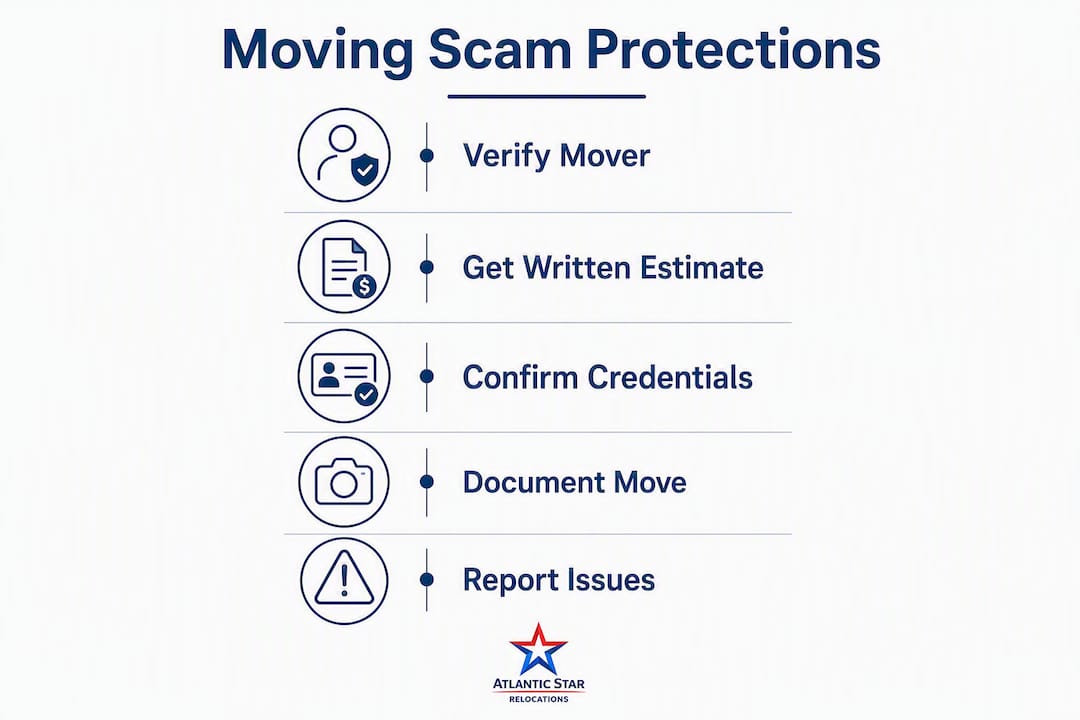
Here are five things you can do right now:
- Look up the USDOT number on the FMCSA's Protect Your Move tool. For moves that start and finish within New York State, call NYSDOT at 518-457-6512 or email nymoving@dot.ny.gov to confirm the mover is licensed.
- Check complaint history in the FMCSA National Consumer Complaint Database (NCCDB) before booking.
- Require an in-person estimate in writing. Refuse any mover who quotes only by phone or online form.
- Photograph all valuables before loading. Date-stamp the images.
- Save NYC311's number (dial 311 or visit NYC311 online). If a mover overcharges, holds your goods, or disappears, NYC311 connects you to the NYC Department of Consumer and Worker Protection (DCWP) to file a formal complaint.
Table of Contents
- Common NYC moving scams and the red flags that expose them
- How to verify a mover before you book
- What to do before you hire a mover
- Move-day protocols: what to document and how to push back
- What to do if you suspect or confirm a moving scam
- How Atlantic Star Relocations reduces your scam risk from day one
- How to protect valuable and high-risk items during your move
- Moving insurance options and how claims work after a scam
- Your legal rights as an NYC consumer against moving scams
- Key Takeaways
- Why the paperwork gap is where most NYC moves go wrong
- Atlantic Star Relocations: vetted moves across Westchester and NYC
- Useful sources for verifying movers and filing complaints
- FAQ
Common NYC moving scams and the red flags that expose them
New York City creates conditions that scammers exploit: tight move windows, building elevator reservations, parking permits, and high-rise stair fees. A bad actor knows you cannot afford to reschedule.
Bait-and-switch is the most common pattern. A mover quotes a low price online, then arrives on move day with a revised "binding" contract that is hundreds of dollars higher. The New York Department of State's Division of Consumer Protection specifically flags instant online quotes and last-minute price changes as deceptive practices.
Holding goods hostage happens when the truck arrives at your destination and the crew refuses to unload until you pay a cash amount well above the original estimate. This is not a billing dispute. It is extortion, and it is a documented complaint category in the FMCSA's NCCDB.

Vanishing movers collect a large deposit, confirm your booking, then stop answering calls. You discover the problem the morning of your move. In NYC, where same-day replacement movers are scarce and elevator reservations are non-refundable, the damage compounds fast.
Unlicensed operators advertise on Craigslist, Facebook Marketplace, and neighborhood apps with no USDOT or NYSDOT number. They carry no insurance. If your furniture is damaged or lost, you have no legal recourse beyond small-claims court.
Hidden accessorial fees show up at delivery: long-carry charges, stair fees, fuel surcharges, and elevator wait-time fees that were never mentioned in the original quote. In Manhattan and Brooklyn high-rises, these can add several hundred dollars to a bill.
"Scammers frequently convert scheduling stress into leverage. They use delays or 'surprise' delivery windows to demand extra money. Treat pressure tactics like hostage-holding as clear scam indicators, not move-day inconveniences." — New York Department of State, Division of Consumer Protection
Red flags to watch for:
- Refusal to conduct an in-person estimate
- Requests for large cash deposits before the move
- No written contract or bill of lading offered
- Company name on the truck does not match the name on your paperwork
- No physical office address listed anywhere
Pro Tip: If a mover calls you the night before your move to renegotiate the price, that is not a scheduling issue. It is a pressure tactic. Hang up and call your backup option.
How to verify a mover before you book
The single most important distinction for NYC residents: intrastate vs. interstate. NYSDOT regulates moves that start and finish within New York State; FMCSA handles moves that cross state lines. Pick the right agency to verify accordingly.
Agency verification table
| Agency | Jurisdiction | When to use | How to verify |
|---|---|---|---|
| FMCSA | Interstate (crossing state lines) | Moving to NJ, CT, FL, or any other state | Search USDOT number at protectyourmove.gov |
| NYSDOT | Intrastate (within NY State) | Moving within NYC, to Westchester, or anywhere within NY | Call 518-457-6512 or email nymoving@dot.ny.gov |
| NYC311 / DCWP | NYC consumer complaints | Overcharge, false advertising, goods not delivered | Dial 311 or file at NYC311 portal |
| BBB | General reputation check | Any move | Search company at bbb.org |
Documents and numbers to confirm before loading
| What to check | Where to find it |
|---|---|
| Carrier name matches truck signage | Side of the truck |
| USDOT or NYSDOT number | Truck cab door or paperwork |
| Proof of insurance or valuation coverage | Ask for a certificate before move day |
| Written estimate with itemized fees | Your copy, signed by both parties |
| Bill of lading / Order for Service | Provided at pickup |
The FMCSA's NCCDB aggregates complaints and uses them to decide which companies to investigate. A company with multiple hostage-holding or uninsured-operation complaints is a company to avoid, regardless of how low their quote is.
What to do before you hire a mover
Getting this phase right eliminates most scam scenarios before they start.
Binding vs. non-binding estimates work differently, and the difference matters on delivery day. A binding estimate locks the price regardless of actual weight. A non-binding estimate can change, but under FMCSA rules, a mover cannot lawfully demand more than 110% of a non-binding estimate at delivery. That 110% ceiling is your legal protection. Know it before you sign.
Here is what your written contract must include before you agree to anything:
- Itemized inventory list signed by both you and the mover before loading begins.
- Pick-up and delivery windows stated as specific dates or date ranges, not vague promises.
- All accessorial fees listed explicitly: stair fees, long-carry charges, elevator wait time, fuel surcharges.
- Valuation and insurance options with your chosen coverage level noted in writing.
- Cancellation policy and claims process including the timeline for filing a damage or loss claim.
- Mover's USDOT or NYSDOT number printed on the contract.
On deposits: a legitimate mover may ask for a modest deposit, typically a small percentage of the total. Any mover demanding full payment in cash before the move is a red flag. Get a written receipt for every payment, no exceptions.
Before you sign, ask these questions in writing and require written answers:
- Will you conduct an in-person inspection before providing an estimate?
- What is your USDOT or NYSDOT license number?
- Can you provide proof of cargo insurance and liability coverage?
- What are all the fees that could be added on delivery day?
- What is your claims process if items are damaged or missing?
If a company will not answer these in writing, FMCSA frames that refusal as a valid reason to stop the booking process entirely. Take that seriously. For a deeper list of questions to ask, the questions to ask moving companies resource from Atlantic Star Relocations covers the full pre-hire checklist.
Move-day protocols: what to document and how to push back
Before a single box goes on the truck, do a full walk-through with the crew's representative. Review the written Order for Service together. If anything on that document differs from your original estimate, stop the move and resolve it in writing before loading begins.
Document everything before loading:
- Photograph high-value items from multiple angles with date-stamp enabled.
- Note the truck's license plate and the USDOT or NYSDOT number on the cab door.
- Photograph the condition of furniture and fragile items.
- Keep your copy of the written estimate and Order for Service on your person, not in a box.
If a mover tries to increase the price after loading, stay calm and use direct language:
- "My written estimate states [amount]. I will pay that amount plus any fees listed in writing on my contract. Please show me the written documentation for any additional charge."
- "I am not authorizing any payment above 110% of my non-binding estimate. That is my right under federal law."
- "If you are unwilling to deliver at the agreed price, I will contact NYSDOT / FMCSA and NYC311 right now."
Do not hand over cash under pressure. Pull out your paperwork. Call the appropriate agency. A mover who is operating legally will back down when they see you know your rights.
At delivery, inspect every item before signing the bill of lading. Note any damage or missing items directly on the bill of lading with a brief description. Photograph damaged items immediately. Your written notation on that document is the foundation of any future claim.
What to do if you suspect or confirm a moving scam
Act fast. The evidence you collect in the first 24 hours is the most useful.
- File with NYC311 / DCWP — first if the move was entirely within NYC. Go to the NYC311 portal or dial 311. Providing your address and email converts your tip into a formal complaint; DCWP will send you a form to complete. Complaint categories include overcharge, false advertising, goods not delivered, and damage.
- Contact NYSDOT (518-457-6512 or nymoving@dot.ny.gov) for intrastate moves. NYSDOT can investigate licensing violations, though loss and damage claims are civil matters that NYSDOT cannot adjudicate directly.
- File with FMCSA NCCDB — for interstate moves. Include the date, location, USDOT number, photos, and the bill of lading. The more specific your complaint, the higher the chance of agency action.
- Pursue civil options if the mover ignores your claim. Under NYSDOT guidance, movers must acknowledge a written claim within 30 days and settle within 120 days. If they do not, small-claims court in New York City handles disputes up to $10,000.
Keep all communications in writing from this point forward. No phone calls without a follow-up email summary.
How Atlantic Star Relocations reduces your scam risk from day one
Atlantic Star Relocations operates as a managed moving company serving Westchester County, Manhattan, Brooklyn, Queens, the Bronx, and surrounding areas including Connecticut and New Jersey. The managed-move model addresses the exact vulnerabilities that scammers exploit: paperwork gaps, unvetted carriers, and move-day pressure.
Here is how Atlantic Star's process differs from booking a random mover online:
- Carrier-neutral coordination: Atlantic Star selects from vetted carriers rather than locking you into one operator, which means the carrier's registration and insurance are confirmed before your move date.
- In-person estimates: Every residential move starts with an in-person assessment, not an online form. The written estimate reflects actual conditions, including elevator access, stair counts, and parking logistics.
- Centralized documentation: A designated move manager holds all paperwork, coordinates building access, and maintains an itemized inventory throughout the process.
- Verified registrations: Every carrier used by Atlantic Star carries confirmed USDOT or NYSDOT credentials and active insurance coverage.
- Issue resolution: If something goes wrong on move day, you have a single point of contact with the authority to fix it, not a call center reading from a script.
For readers who want a vetted option rather than navigating the verification process alone, Atlantic Star Relocations covers Westchester and all five NYC boroughs. Contact the team to request a vetted estimate or discuss move-day oversight for your specific situation.
How to protect valuable and high-risk items during your move
High-value items require a different level of attention than standard household goods. Jewelry, art, electronics, and documents should travel with you personally whenever possible. If they must go on the truck, declare their value in writing on the inventory before loading.
For fragile or irreplaceable items, professional packing services reduce both damage risk and dispute risk. A professionally packed item with documented condition notes is far easier to claim against if it arrives damaged. Atlantic Star's packing services in Westchester include condition documentation as part of the packing process.
For items that cannot move on your timeline, short-term storage in NYC and Westchester through a verified provider keeps goods secure if a mover's delivery schedule is uncertain or if you need a gap between move-out and move-in dates.
Pro Tip: Create a separate high-value inventory list with photos and estimated replacement values before move day. Keep a copy in cloud storage. If items go missing, this list is your first line of evidence.
Moving insurance options and how claims work after a scam
Every mover must offer valuation coverage. This is not the same as insurance, and the distinction matters when you file a claim.
Released value protection is the default and covers only $0.60 per pound per article. A 50-pound flat-screen television is worth $30 under this coverage regardless of its actual value. It costs nothing extra, but it pays almost nothing.
Full value protection requires the mover to repair, replace, or pay the current market value for damaged or lost items. It costs more upfront but is the only coverage worth having for anything of real value.
For interstate moves, FMCSA requires movers to provide the "Your Rights and Responsibilities When You Move" booklet and the "Ready to Move" brochure before you sign. These documents explain your valuation options and the claims process. If a mover does not provide them, that is a federal compliance violation.
In a scam scenario where a mover holds goods hostage or delivers damaged items and then goes dark, your written valuation election on the bill of lading is the document that determines your claim amount. Without it, you default to released value. File your claim in writing with the mover first, then escalate to NYSDOT or FMCSA if the mover does not respond within 30 days.
Third-party moving insurance through providers like Baker International or Moveassist is also available and covers scenarios that carrier valuation does not, including total loss from fraud.
Your legal rights as an NYC consumer against moving scams
New York State and federal law give you real protections. The challenge is knowing which law applies to your move.
For interstate moves, federal law under 49 U.S.C. governs. FMCSA enforces carrier registration, insurance requirements, and the 110% non-binding estimate rule. Movers must provide required disclosure documents before you sign.
For intrastate moves within New York, NYSDOT licensing requirements apply. A mover operating without a NYSDOT license is breaking state law. The New York Department of State's Division of Consumer Protection also has authority over deceptive trade practices, including bait-and-switch pricing and false advertising.
NYC consumers have an additional layer of protection through DCWP, which can investigate and mediate complaints against moving companies operating in the city. Filing through NYC311 creates a formal record that DCWP can act on.
If a mover holds your goods and demands payment above your written estimate, you are not obligated to pay the excess to retrieve your property. Document the demand in writing, contact FMCSA or NYSDOT immediately, and consult a consumer protection attorney if the mover refuses to release your goods. New York City's small-claims court handles disputes up to $10,000 without requiring an attorney.
This article provides general consumer information, not legal advice. Confirm current rules and your specific rights with NYSDOT, FMCSA, or a qualified attorney.
Key Takeaways
Verifying a mover's registration, securing a written estimate, and knowing which agency to contact are the three actions that prevent the vast majority of NYC moving scams.
| Point | Details |
|---|---|
| Verify registration first | Check USDOT via FMCSA for interstate moves; call NYSDOT at 518-457-6512 for intrastate moves. |
| Insist on a written estimate | Require an in-person, itemized estimate; non-binding estimates cannot exceed 110% at delivery under federal rules. |
| Document before and during | Photograph valuables, note the truck's ID, and mark any damage on the bill of lading at delivery. |
| Know where to file complaints | NYC311/DCWP for NYC issues, NYSDOT for intrastate violations, FMCSA NCCDB for interstate fraud, FTC for federal reporting. |
| Atlantic Star Relocations | Provides managed moves with verified carriers, in-person estimates, and a designated move manager across Westchester and NYC. |
Why the paperwork gap is where most NYC moves go wrong
Most people who get scammed were not careless. They were rushed. NYC moves have hard deadlines: elevator reservations expire, parking permits run out, and lease start dates do not flex. Scammers know this and time their pressure accordingly.
The checks in this guide are not bureaucratic formalities. They are the specific friction points that stop a bad actor from completing the scam. A mover who cannot produce a USDOT or NYSDOT number on request is not just disorganized. They are unlicensed, and that means no insurance, no regulatory oversight, and no recourse for you if something goes wrong.
The managed-move model exists precisely because move-day chaos is predictable and preventable. When a single coordinator holds all the paperwork, confirms carrier credentials in advance, and has authority to resolve problems on the spot, the leverage a scammer needs simply is not there. That is not a sales pitch. It is how the process works when it is structured correctly.
If you are planning a move in Westchester or anywhere in the five boroughs, do the verification steps in this guide before you book anyone. And if you want someone else to handle that verification for you, that is a legitimate and often smarter choice.
Atlantic Star Relocations: vetted moves across Westchester and NYC
Hiring a mover you cannot verify is the single biggest risk in a New York City relocation. Atlantic Star Relocations removes that risk by managing the entire process: carrier vetting, in-person estimates, itemized documentation, packing, storage coordination, and real-time problem resolution across Westchester County, Manhattan, Brooklyn, Queens, the Bronx, Connecticut, and New Jersey.

Every move Atlantic Star handles starts with a confirmed carrier registration check and a written, in-person estimate. There are no surprise fees on delivery day because the fees are documented before the truck is booked. If a problem arises on move day, a designated move manager handles it directly, not a general customer service line.
For full-service moves, Atlantic Star's logistics coordination services cover everything from building access scheduling to final delivery sign-off. For readers who need storage between move-out and move-in, short-term storage options in NYC and Westchester are available through the same managed process.
Request a vetted estimate at atlanticstargroup.com and get a written quote from a licensed, insured operator before your move date.
Useful sources for verifying movers and filing complaints
Use these resources to verify registrations, check complaint histories, and file reports. Contact NYSDOT first for intrastate moves, FMCSA first for interstate moves, and NYC311/DCWP for any NYC consumer issue.
Before contacting any agency, have ready: your written estimate, Order for Service, bill of lading, payment receipts, the mover's USDOT or NYSDOT number, and any photos or communications.
- Protect Your Move | FMCSA — Central hub for interstate mover verification, consumer rights, and fraud prevention tools.
- Steps to Select a Mover | FMCSA — Five-step guide including the 110% non-binding estimate rule and complaint-history checks.
- FMCSA Consumer Rights | Protect Your Move — Required disclosure documents for interstate moves and claims process overview.
- National Consumer Complaint Database | FMCSA — Search complaint history and file complaints against interstate movers and brokers.
- Moving | NYSDOT — Intrastate mover licensing verification; phone 518-457-6512, email nymoving@dot.ny.gov.
- NYDOS Consumer Alert on Moving Scams — New York State official warning on bait-and-switch and deceptive moving practices.
- Moving Company Complaint | NYC311 — File a formal complaint with DCWP for NYC moving issues including overcharge and goods not delivered.
- Better Business Bureau | bbb.org — Check company ratings and complaint history; file a public complaint record.
FAQ
How can I avoid being scammed by a moving company in NYC?
Verify the mover's USDOT number (interstate) or NYSDOT license (intrastate), require an in-person written estimate, and never pay a large cash deposit before the move. Keep copies of all paperwork and photograph valuables before loading.
What are the biggest red flags when hiring NYC movers?
Refusal to conduct an in-person estimate, no written contract, a company name on the truck that does not match your paperwork, and demands for full cash payment upfront are the clearest warning signs of a fraudulent or unlicensed operator.
What should I do if a mover holds my goods hostage?
Do not pay unverified extra charges under pressure. Pull out your written estimate, state that you will not pay above 110% of a non-binding estimate, and immediately contact FMCSA (interstate) or NYSDOT at 518-457-6512 (intrastate). File a complaint with NYC311/DCWP if the move is within NYC.
How do I file a moving complaint in New York City?
Dial 311 or visit the NYC311 portal and select "Moving Company Complaint." Providing your contact information converts the report into a formal DCWP complaint. For interstate moves, also file with the FMCSA NCCDB at fmcsa.dot.gov.
Does Atlantic Star Relocations verify carrier credentials before a move?
Yes. Atlantic Star Relocations confirms carrier registration and insurance before booking any move, and provides a written, in-person estimate as the starting point for every residential relocation in Westchester and NYC.