

Storage in transit (SIT) is temporary, mover-managed warehouse storage used when your goods can't be delivered immediately after loading. Households use it for closing delays, lease gaps, or staging a home for sale, but the arrangement runs on tariff rules, not a handshake. Watch three things closely: what the storage costs beyond the move itself, how long you can leave goods there before the terms change, and who's liable for your belongings while they sit in a warehouse you can't see.
TL;DR:
- Storage in transit typically costs between $2 and $6 per hundredweight for handling, plus monthly vault or space rental fees ranging from $50 to $150.
- Most tariffs limit SIT to a few weeks, and exceeding the time triggers a conversion to permanent storage with new liability terms and potential extra charges.
- Accurate planning requires written confirmation of SIT start and end dates, tariff sections, inventory condition, and delivery notice to avoid unexpected fees and disputes.
- Access to goods during SIT is limited and appointment-based, with certain items like hazardous materials, perishables, and live plants being strictly prohibited.
- Disputes often occur due to last-minute schedule changes; early, written communication and itemized pricing help control costs and prevent surprises.
Table of Contents
- What Is Storage in Transit, and How Is It Different From Self-Storage?
- How Does Storage in Transit Work, Step by Step?
- What Does Storage in Transit Cost, and How Do Movers Bill for It?
- Who's Liable for Your Belongings While They're in Storage?
- What Can't You Store, and How Does Access Work?
- What Should You Get in Writing Before Moving Day?
- What Do Experienced Movers Say About Avoiding Surprise SIT Fees?
- How Do You Plan Storage in Transit Without Getting Surprised?
- Why Atlantic Star Relocations Recommends Managed SIT Coordination
- How Atlantic Star Relocations Handles Storage in Transit for You
- Where to Read the Official Rules on Storage in Transit
- Sources
- FAQ
What Is Storage in Transit, and How Is It Different From Self-Storage?
Storage in transit is a hold built into your moving contract, not a separate rental. Your mover takes custody of your shipment as part of one continuous move, warehouses it temporarily, then delivers it once you're ready. That's fundamentally different from renting a self-storage unit down the street, where you hold the key, set the schedule, and load the truck yourself.
The distinction matters because SIT keeps your goods inside the same shipment and liability chain as your original moving contract, rather than starting a new, separate rental agreement. You don't get a key. You don't get daily access. What you get is a mover who controls timing, billing, and release conditions according to their tariff, the price list and rules every licensed carrier files for interstate moves.
That trade-off cuts both ways:
- Convenience: no second company to coordinate, no separate lease, and your goods stay under one point of accountability from pickup to final delivery.
- Cost: SIT usually runs more per month than a self-storage unit of comparable size, especially once handling fees stack up.
- Access: self-storage means walk in anytime; SIT means scheduled visits, sometimes with a fee attached.
- Timing pressure: SIT works best for gaps measured in weeks, not months. Beyond a certain point, most tariffs push you toward a conversion to permanent storage.
SIT is the right call when you know your goods are moving again soon; a closing pushed back three weeks, a new apartment not ready until the 15th, a home staged for sale with the move-out date locked but the buyer's timeline still fuzzy. If you're looking at months of storage with no firm delivery date, a dedicated storage solution, rather than a transit hold, usually makes more financial sense.
How Does Storage in Transit Work, Step by Step?
SIT follows a predictable sequence, even though the exact timing varies by carrier and shipment size.
- Pickup and inventory. Your crew loads the shipment and creates a detailed inventory noting the condition of every item. This document becomes the baseline for any later claim, so review it carefully before signing.
- Warehouse-in. The shipment travels to a bonded warehouse, sometimes the mover's own facility, sometimes a network partner's. Goods typically go into wooden vaults or containers rather than sitting loose on a warehouse floor.
- Storage period. Your belongings sit in SIT status while you finalize your new address, closing date, or lease start. This is where the clock starts running against tariff time limits.
- Delivery request. When you're ready, you notify the mover to schedule delivery out of storage. Most carriers ask for a notice window in the range of 7 to 10 business days to pull your shipment, load a truck, and route it to your new address. Shorter notice is sometimes possible but often costs more or gets bumped for scheduled jobs.
- Final delivery or conversion. If you request delivery within your tariff's SIT window, the shipment comes out and the move completes under the original contract. If you don't, and the storage period runs past the carrier's limit, the shipment can convert to permanent storage.
That conversion point is where things get serious. Federal rules require carriers to notify you in writing before SIT converts to permanent storage, and that notice has to state the conversion date, when the carrier's liability under the original contract ends, and the new facility's terms going forward. Once converted, you're often dealing with a new storage agreement, sometimes new pricing, and a different liability structure entirely. Missing that notice, or not reading it, is how people end up surprised by a bill or a coverage gap months later.
What Does Storage in Transit Cost, and How Do Movers Bill for It?
SIT pricing has more moving parts than most people expect, and each part shows up as its own line item.
- Warehouse-in handling: a one-time charge for moving your shipment off the truck and into the warehouse, often priced per 100 pounds and typically ranging from about $2 to $6 per hundredweight.
- Monthly storage cycles: SIT usually bills in 30-day increments rather than daily rates, so even a few days into a new cycle can trigger a full month's charge.
- Vault or space rental: monthly storage charges commonly fall between roughly $50 and $150, depending on shipment volume and local warehouse rates.
- Warehouse-out and redelivery: pulling your goods back out and loading them for final delivery is billed separately from the original delivery charge.
- Access or partial-pull fees: if you need to retrieve specific items mid-storage, expect an appointment fee on top of any handling charge.
- Taxes: some states apply sales tax to storage and handling charges, which most estimates don't spell out clearly upfront.
The estimate type you sign changes how these charges get paid. With a non-binding estimate, if your final bill runs higher than expected, federal rules cap what the mover can demand at delivery: 110% of the original estimate, with the remainder billed later. A binding estimate locks the number upfront but needs to explicitly account for SIT charges, or you'll get a change order once storage enters the picture.
Here's the part few people plan for: carriers hold a legal lien on your goods for unpaid transportation and storage charges. Disputing a bill doesn't remove that lien. If you think a charge is wrong, pay what's required to get possession, then dispute it in writing, rather than withholding payment and risking your shipment staying locked up in a warehouse.
Who's Liable for Your Belongings While They're in Storage?
Your valuation coverage, the insurance-like protection built into your moving contract, still applies while goods sit in SIT, but the terms shift the moment conversion happens.
For interstate moves, you typically choose between full-value protection (higher cost, replacement-value coverage) or a released-value option based on weight (minimal cost, minimal payout) when you sign your order for service. That choice governs your goods throughout the SIT period, right up until conversion to permanent storage takes effect.
Once conversion happens, the original mover's liability under the moving contract generally ends, and a new storage agreement, often with its own valuation terms, takes over. This is exactly why the written conversion notice matters so much: it marks the legal handoff point between one liability structure and another.
A few practical safeguards worth building into your plan:
- Keep every notice, estimate, and inventory sheet from pickup through delivery. If a claim ever comes up, these are your evidence.
- Know your claims window. Movers generally give you nine months from delivery (or from the date of conversion notice) to file a claim for loss or damage.
- Check your homeowners or renters insurance policy. Many policies extend limited coverage to belongings in transit or storage, which can fill gaps that basic released-value coverage leaves open.
- File claims promptly rather than waiting near the deadline. Warehouses turn over inventory, and memories fade.
What Can't You Store, and How Does Access Work?
Access to SIT isn't like walking into a self-storage unit whenever you want. Most carriers require appointments, and you'll typically need photo ID and your order-for-service paperwork to confirm you're authorized to request items. Some warehouses allow scheduled access with fees attached; others restrict any access until final delivery, so ask before you assume you can grab something mid-storage.
Certain items simply won't go into SIT at all:
- Hazardous materials, including propane tanks, paint, and cleaning chemicals.
- Perishable food items, which spoil and can attract pests in a shared warehouse.
- Certain lithium batteries and other items flagged as fire risks.
- Live plants, which most warehouses won't accept due to pest and humidity concerns.
If you know you'll need something mid-storage, medication, tax documents, a specific piece of furniture, tell the mover when you book SIT, not after your goods are already warehoused. A planned pull is a line item; an emergency pull is a hassle and usually a bigger one.
What Should You Get in Writing Before Moving Day?
Verbal promises about storage timing don't hold up when a warehouse manager is looking at a tariff sheet. Get these locked into paper before your goods leave your old address.
- Order for service with SIT dates. Confirm the start date of storage and the estimated delivery window in writing, not just discussed on a phone call.
- Tariff citations. Ask your mover to point to the specific tariff sections covering SIT time limits and conversion rules, so you know exactly what triggers a status change.
- Inventory with condition notes. Review and correct the inventory at pickup. This document is your primary evidence if you ever file a claim.
- Written delivery-pull confirmation. Once you're ready for delivery, get the scheduled pull date confirmed in writing, including the 7 to 10 business day notice requirement most carriers apply.
Skipping any of these is how a three-week storage gap turns into a billing dispute nobody can resolve because nobody wrote anything down.
What Do Experienced Movers Say About Avoiding Surprise SIT Fees?
Most SIT surprises trace back to timing, not the tariff itself. A closing date slips, a lease start moves, and a household calls their mover two days before delivery instead of two weeks. That last-minute call is often what pushes a routine storage hold into emergency reclassification, with rush fees attached.
Communicating schedule changes early and in writing is the single most effective way to control SIT costs, because it gives the warehouse time to schedule your pull normally instead of squeezing you into an already-booked week.
Before you sign anything, request itemized SIT pricing, not a vague "storage included" line, and ask for the tariff section numbers that govern time limits and conversion. If a final bill comes in high under a non-binding estimate, know that federal rules let you pay 110% of the estimate to take possession while disputing the rest, rather than losing access to your belongings over a contested charge.
Pro Tip: If you're not sure whether your timeline will hold, tell your coordinator the range of possible dates upfront rather than picking one and hoping. Movers can plan around a window far more easily than they can absorb a last-minute change.
Atlantic Star Relocations coordinates SIT windows specifically to avoid double handling, meaning your goods get warehoused once and delivered once, not shuffled between facilities because of scheduling gaps between vendors.
— Admin
How Do You Plan Storage in Transit Without Getting Surprised?
- Request SIT pricing as part of your original moving estimate, not as an afterthought once you realize you need storage.
- Get the SIT start date and expected delivery window in writing before your loading day arrives.
- Plan your delivery request around your mover's required notice, typically 7 to 10 business days, so your pull gets scheduled normally.
- Review the inventory at final delivery and note any damage before you sign off, since that signature closes your window for easy dispute.
Why Atlantic Star Relocations Recommends Managed SIT Coordination
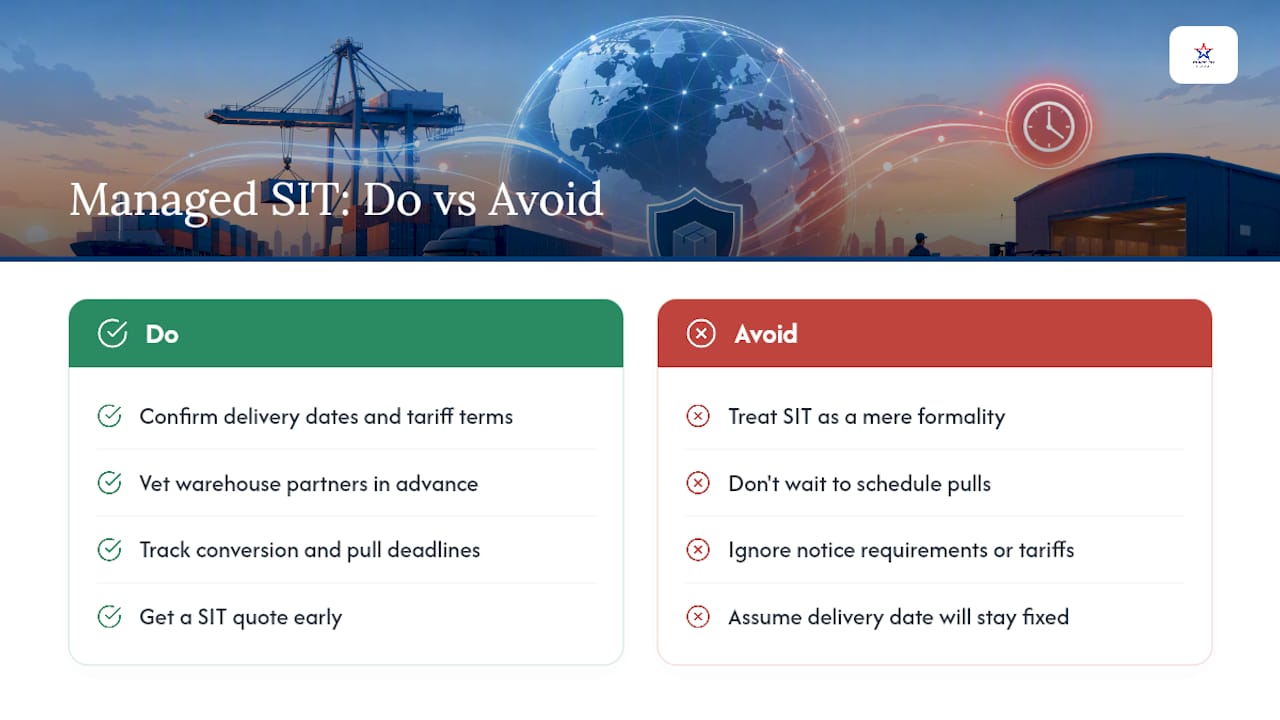
Storage in transit rewards planning and punishes improvisation. Households that treat it as a formality, without confirming dates, tariff terms, or notice requirements, are the ones who end up disputing bills months later.
Atlantic Star Relocations coordinates SIT as one piece of a carrier-neutral move plan: vetting warehouse partners, tracking conversion deadlines, and scheduling pulls to keep storage time as short as the situation allows. A managed coordinator earns its fee on any move where the delivery date isn't locked yet, because that's exactly when SIT terms get complicated fast. If your closing or lease date is still moving, a quote conversation now costs nothing and saves you a scramble later.
How Atlantic Star Relocations Handles Storage in Transit for You
Timing gaps between move-out and move-in are common across Westchester County, Manhattan, Brooklyn, Queens, the Bronx, Connecticut, and New Jersey, especially with co-op board delays, closing contingencies, or new construction that isn't quite ready. Atlantic Star Relocations manages the whole SIT process directly, so you're not left decoding a tariff sheet or negotiating warehouse access on your own.

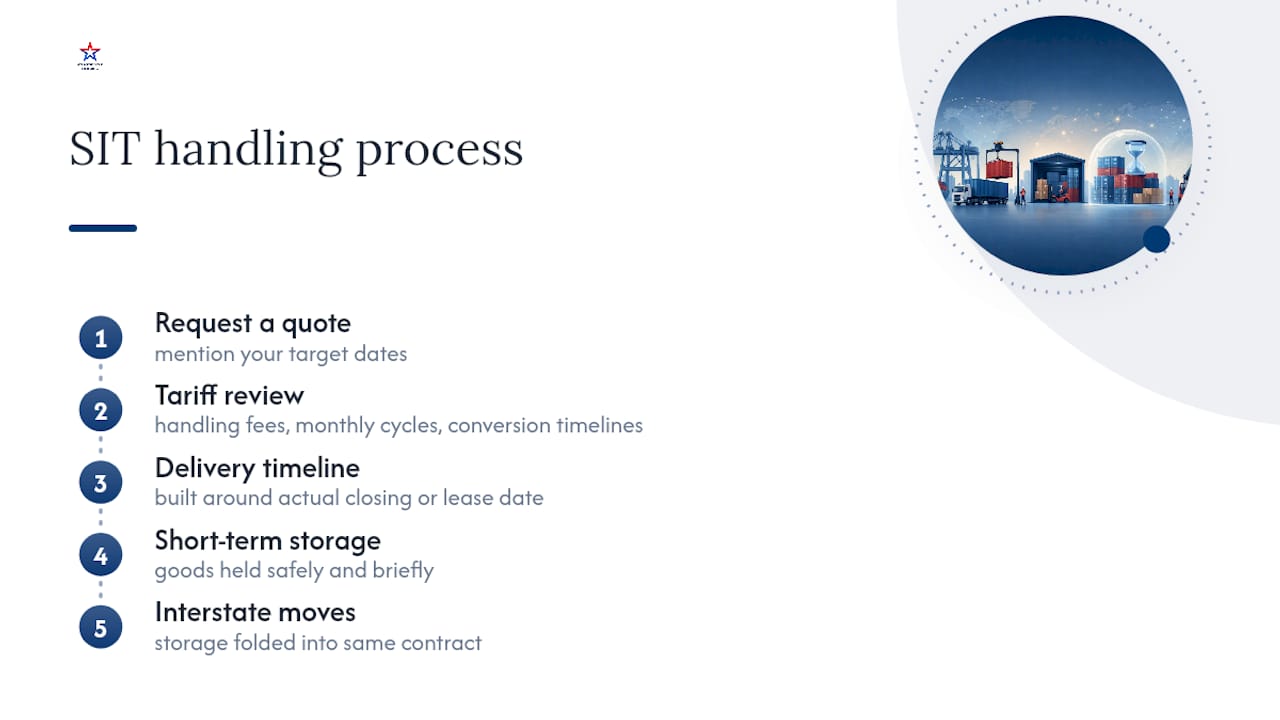
When you request a quote, expect a straightforward tariff review covering handling fees, monthly storage cycles, and conversion timelines, plus a delivery timeline built around your actual closing or lease date rather than a generic estimate. Atlantic Star's short-term storage services cover exactly this scenario: goods held safely and briefly while your new place catches up to your move-out date. For long-distance relocations where SIT often plays the biggest role, our interstate moving services fold storage coordination into the same contract instead of treating it as a bolt-on. If you're weighing binding versus non-binding pricing before you commit to a mover, our breakdown of why moving estimates differ is worth reading first.
Request a quote today, and mention your target dates so we can build a delivery window around your actual timeline instead of a placeholder one.
Where to Read the Official Rules on Storage in Transit
For the exact legal language on notice requirements and conversion rules, read the FMCSA's Rights and Responsibilities booklet and its estimating rules under Subpart D. For plain-language explanations of common fee structures, the CFR excerpts on carrier duties offer useful background context.
Sources
- Your Rights and Responsibilities When You Move (FMCSA)
- Estimating Charges (Subpart D) | FMCSA
- Storage in Transit: How It Works, Costs, and Coverage - LegalClarity
- Storage in Transit Explained for Your Move
FAQ
What Is the Cheapest Way to Move Your Belongings?
For most households, the lowest total cost comes from combining a firm delivery date with careful estimate comparison, since avoiding SIT entirely (by timing your move-out and move-in closely) sidesteps handling and monthly storage charges altogether. When storage is unavoidable, requesting itemized SIT pricing upfront prevents the rollover charges that make storage the most expensive line item on a moving bill.
Does "In Transit" Mean My Shipment Is Coming Soon?
Not necessarily. In a moving context, "storage in transit" means your goods are paused in a mover's warehouse as part of one continuous shipment, not that delivery is imminent; delivery happens once you request it, subject to your mover's notice window, typically 7 to 10 business days.
Will the Military Move Me From a Storage Unit?
Military moves follow different rules and providers than civilian relocations, and government-arranged moves generally don't extend to picking up from privately rented self-storage units; if you're coordinating a military move alongside storage in transit, confirm the specifics directly with your transportation office rather than assuming civilian tariff rules apply.
Can I Access My Belongings While They're in Storage in Transit?
Access depends on your carrier's policy. Some allow scheduled visits with an appointment and a handling fee; others restrict any access until final delivery, so confirm access rules in writing before your goods go into storage, especially if you'll need specific items mid-move.
How Long Can Goods Stay in Storage in Transit Before Conversion?
Time limits vary by carrier tariff, but federal rules require written notice before SIT converts to permanent storage, and that notice must state the conversion date along with the nine-month claims window and new liability terms. Ask your mover to cite the exact tariff section covering your shipment's time limit before you sign.