

Most US office relocations run $5,000 to $15,000 for a small footprint, but the number that actually determines your budget is IT and downtime, not the movers. A single misjudged server migration or an underestimated shutdown window can double your total office relocation cost overnight. Before you sign anything, get itemized quotes from every vendor and set aside a 10 to 15% contingency fund.
TL;DR:
- Office relocation costs are primarily driven by IT and downtime, which can double expenses if underestimated or poorly planned.
- Moving long-distance or maintaining heavy IT infrastructure significantly increases costs, with IT disconnection and reconnection often running $5,000 to $10,000.
- Hidden expenses like lease decommissioning, build-out, signage, and employee communications often surpass initial mover estimates and require proactive budgeting.
- Getting precise, itemized bids from vendors with clear line items and verified credentials helps prevent inflated or surprise costs during the move.
- Early coordination with building management and IT teams reduces the risk of last-minute, costly schedule or access conflicts on move day.
Table of Contents
- What Does Office Relocation Cost by Size and Distance?
- What Are the Major Cost Drivers Behind an Office Move?
- What Hidden Costs Do Office Moves Usually Miss?
- Sample Office Relocation Budgets: Three Real-World Scenarios
- How Do You Get an Accurate, Comparable Moving Quote?
- How Can You Cut Office Relocation Costs Without Cutting Corners?
- What's a Realistic Timeline for Budgeting an Office Move?
- Why a Managed Move Changes What You Actually Pay
- Get a Clear Quote for Your Office Move
- What Operators Actually Learn From Office Moves
- Sources
- FAQ
What Does Office Relocation Cost by Size and Distance?
Office relocation pricing splits into two variables that matter more than any other: how much stuff you're moving and how far it has to go. A basic local move for a 10-person office in Westchester might run a few thousand dollars in labor and trucks alone. A 100-person law firm moving from Midtown Manhattan to a new tower six blocks away faces an entirely different animal, one where elevator scheduling and after-hours labor premiums eat the budget before a single box gets packed.
Angi's data on average office moving costs puts the typical range at $5,000 to $15,000, with outliers stretching from $750 for a tiny startup relocation to $30,000 or more once IT infrastructure, specialty equipment, and long-distance logistics enter the picture.
Here's how that breaks down by office size:
| Office size | Employees | Typical mover cost range |
|---|---|---|
| Small | 1–20 | costs vary in a few thousand dollars range |
| Medium | 20–75 | costs vary with company and move complexity |
| Large | 75–200+ | costs can be several tens of thousands of dollars or more |
Distance changes the equation just as much as headcount:
| Move type | Distance | Typical cost impact |
|---|---|---|
| Local | Local | Base labor and truck rate, no long-haul fuel surcharge |
| Regional | 50–250 miles | Added transit time, possible overnight crew costs |
| Long-distance | 250+ miles (e.g., NYC to Florida) | Freight-style pricing, weight or cubic-foot based |
A Westchester County office moving to a new building in White Plains pays a fraction of what a company relocating from Brooklyn to a new regional hub in New Jersey or Connecticut will spend, mainly because long-distance moves shift pricing from hourly labor to weight and mileage. NYC-based businesses should also budget extra for building-specific friction: certificate of insurance requirements, narrow freight elevator windows, and street parking permits that smaller markets simply don't charge for.
What Are the Major Cost Drivers Behind an Office Move?
Every office relocation quote breaks down into a handful of line items, and knowing what drives each one lets you push back on inflated estimates. Commercial moving costs hinge on office size, distance, labor and equipment needs, IT relocation scope, insurance, and temporary storage.
Labor and crew size move the needle first. A four-person crew billing $150 to $250 an hour for a small office looks nothing like the six-truck, twenty-person operation needed for a 150-person floor. More crew members mean a faster move but a steeper hourly total, so the real cost-per-employee often shrinks as the office grows.
IT relocation is where budgets get blindsided. Disconnecting servers, running new cabling, testing network drops, and reconnecting workstations for a typical 30-person office runs $5,000 to $10,000, and that figure climbs fast if you're maintaining an on-site server room instead of cloud infrastructure. Loop in your IT relocation planning team the same week you sign a lease, not the week before the move.
The remaining line items matter too:
- Packing materials and labor, typically billed separately from moving labor
- Specialty crates for servers, artwork, or lab equipment
- Short-term or climate-controlled storage during transition gaps
- Moving insurance beyond the mover's basic liability coverage
Pro Tip: Ask every bidder to quote IT disconnect and reconnect as a separate line item. Bundled quotes hide whether you're paying moving-crew rates for work that should go to a certified technician.
What Hidden Costs Do Office Moves Usually Miss?
The mover's invoice is rarely where an office relocation budget breaks. It's the costs nobody mentions until they show up.
Downtime is the biggest blind spot. If your team can't work for two days during a weekday move, calculate what that costs in lost billable hours or missed client work, then compare it against the premium for an after-hours or weekend move. Off-hours moves often cost less in the end once downtime is quantified, even with higher labor rates.
Other commonly missed costs include:
- Tenant decommissioning or restore-to-landlord obligations, often $2 to $10 per square foot depending on lease terms
- Build-out and tenant improvement work at the new space
- Signage, letterhead, website updates, and Google Business Profile changes
- Employee communications and change-management time
Pro Tip: Pull your lease's decommissioning clause before you finalize a moving budget. Restoration costs at the old office are the single most-forgotten line item in commercial relocation.
Sample Office Relocation Budgets: Three Real-World Scenarios
Seeing how the numbers stack up for actual office sizes makes budgeting far less abstract.
Scale these numbers against your own square footage and headcount rather than treating them as fixed. A 25,000-square-foot office with a light IT footprint might land closer to the mid-size scenario's total even with more employees, while a data-heavy fintech firm in a small office could rival the large scenario's IT line alone.
How Do You Get an Accurate, Comparable Moving Quote?
Vague estimates are how office relocation costs balloon after the contract is signed. Getting three or four bids that actually compare apples to apples takes a bit of prep work upfront.
- Send identical inventories to every bidder. List furniture, workstations, filing cabinets, server racks, and specialty equipment the same way for each quote request, along with floor plans for both locations.
- Disclose building requirements. Freight elevator hours, loading dock access, certificate of insurance minimums, and parking restrictions all affect labor time and should go to every vendor equally.
- Insist on separated line items. Push for elevator protection, after-hours premiums, crate rentals, and reinstallation labor to appear as their own line items rather than folded into a flat rate.
- Verify the carrier. Confirm USDOT registration through FMCSA's SAFER lookup before signing, especially for long-distance movers.
- Watch for red flags. A quote with no IT line, no insurance detail, or a total that seems 30% below every competitor usually means costs get added later, not eliminated.
How Can You Cut Office Relocation Costs Without Cutting Corners?
Phasing a move, department by department over a few weekends, spreads labor costs but stretches your rent overlap on both spaces, so it only pays off when downtime avoidance outweighs the extra lease weeks.

Negotiating your tenant improvement (TI) allowance with the new landlord before signing can offset build-out costs that would otherwise come straight out of your relocation budget. Many landlords have more flexibility here than businesses assume, especially in a competitive Westchester or Fairfield County commercial market.
Selling or donating furniture you won't need at the new space, rather than paying to move it, often nets enough to cover a chunk of the packing budget. Bundling movers, packers, and storage under one vendor also tends to shave line items that add up fast when handled separately.
Pro Tip: Get your TI negotiation and moving quotes happening in parallel, not sequentially. Landlords move faster when they know you have vendor pricing already in hand.
What's a Realistic Timeline for Budgeting an Office Move?
Locking in numbers early is what keeps an office relocation cost from spiraling once deadlines get tight.
- 6 to 12 months out: Finalize your overall budget, negotiate lease terms and TI allowance, and set a high-level scope for square footage and location.
- 4 to 6 months out: Get construction and build-out bids, start vendor coordination for movers and IT contractors, and finalize your workplace transition plan.
- 2 to 4 months out: Collect itemized moving and IT bids, confirm building access windows, and order signage and marketing updates.
- Move month: Reconcile final invoices against original quotes, tap into your contingency fund for surprises, and confirm employee communications go out with the final schedule.
Working from a structured office relocation planning checklist keeps every deadline tied to a budget decision instead of a guess.
Why a Managed Move Changes What You Actually Pay
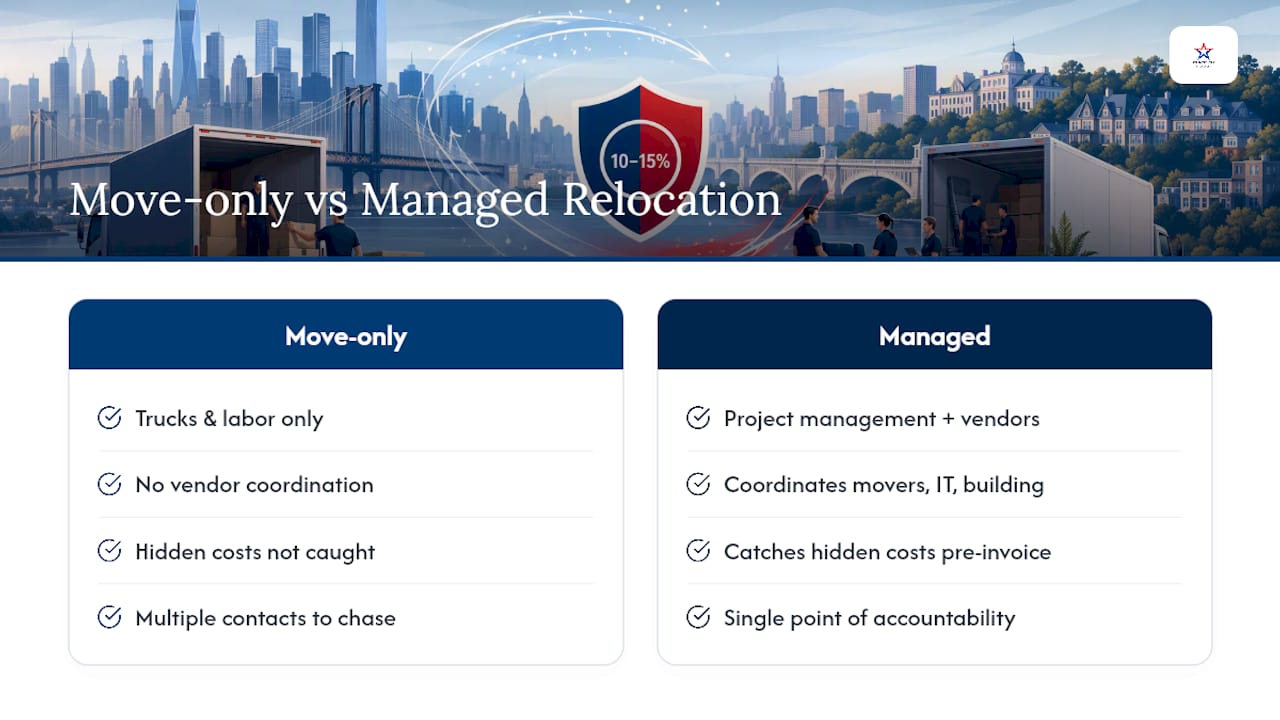
A moving-only bid quotes trucks and labor. A managed relocation coordinates the movers, the IT vendor, the building management, and the timeline so nothing collides on move day, and that coordination is exactly where hidden costs get caught before they hit your invoice. Atlantic Star Relocations runs corporate relocation services built around project management and vendor coordination for businesses across NYC and Westchester County, acting as one point of accountability instead of three separate phone numbers you're chasing during a crisis. To scope an accurate quote, expect Atlantic Star to request your floor plans, equipment inventory, lease decommissioning terms, and preferred move window.
Get a Clear Quote for Your Office Move
Office relocation pricing shouldn't feel like a guessing game, and it doesn't have to. Atlantic Star Relocations builds itemized quotes around what your business actually needs: full-service moving for offices with complex IT and furniture inventories, labor-only support if you've already secured trucks, and short-term storage when your new space isn't ready the same week your lease ends on the old one.

For an accurate estimate, send over your equipment inventory, current and new floor plans, and your target move window. That's usually enough for Atlantic Star's team to put together a line-item quote within a couple of business days, no vague ballpark figures. If you're planning a commercial move anywhere in Westchester, Manhattan, Brooklyn, Queens, the Bronx, Connecticut, New Jersey, or Florida, request a quote for your corporate relocation and get real numbers before you finalize your budget.
What Operators Actually Learn From Office Moves
The surprise cost that trips up most companies isn't the mover's bill. It's discovering three days before the move that the new building's freight elevator only runs until 6 p.m. on weekdays, forcing an after-hours labor premium nobody budgeted for.
The fix is simple and almost nobody does it early enough: bring IT and the building's property management into the conversation the moment you sign the lease, not the week of the move. Loop your facilities contact into the same email thread as your movers before anything else gets scheduled. That one habit prevents most of the five-figure surprises this guide covers.
— Admin
Sources
FAQ
How Much Does It Cost to Relocate an Office?
Most US office relocations cost $5,000 to $15,000 for a small to mid-size office, though moves involving heavy IT infrastructure or long-distance freight can run $30,000 or more.
How Much Does a Corporate Relocation Cost?
A corporate relocation typically scales with headcount and distance. A 45-person regional move often lands near $30,000 total once IT, packing, storage, and a contingency fund are factored in.
How Much Does It Cost to Build Out a 4,000-Square-Foot Office?
Build-out costs vary widely by finish level and local labor rates, but tenant improvement work is one of the largest hidden expenses in an office move and should be negotiated with the landlord before signing a new lease.
Is a $5,000 Relocation Package a Good Amount?
For a very small office of 10 to 15 people making a local move, $5,000 can cover basic moving labor, but it likely won't stretch to cover IT reconnection, packing materials, or a contingency fund, so treat it as a starting point rather than a full budget.
Should I Hire Professional Movers or Handle an Office Move Myself?
DIY moves save on labor costs but shift risk onto your team's time and expose the company to liability if equipment is damaged. A managed mover like Atlantic Star Relocations handles insurance, vendor coordination, and IT scheduling, which usually offsets the higher price through fewer delays and less downtime.