
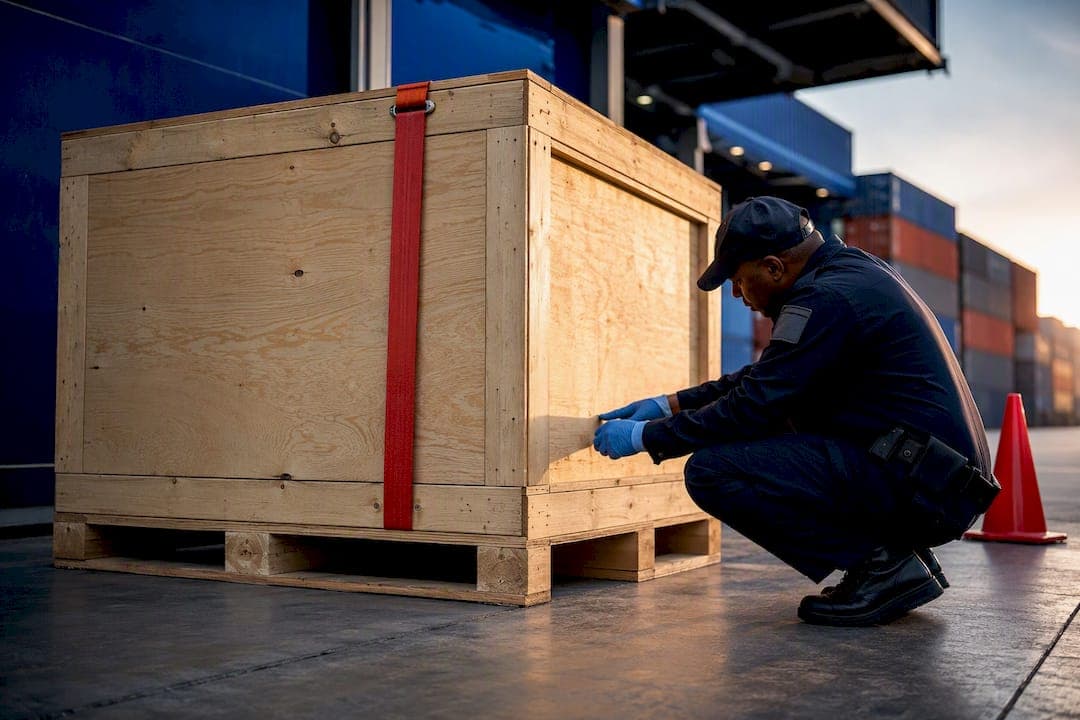
A liftvan is a wooden or plywood crate engineered specifically for international household-goods shipments, built to be moved by forklift and consolidated with other cargo for ocean freight. You need one when your overseas shipment is small to medium in volume, includes bulky or oddly shaped items, or requires less-than-container-load service instead of renting an entire shipping container. Every compliant crate needs ISPM 15 heat-treated timber, and a managed mover like Atlantic Star Relocations handles the crating, paperwork, and carrier coordination so nothing gets stuck at a port.
TL;DR:
- Liftvans are ideal for small to medium shipments involving fragile, bulky, or irregular items requiring custom internal support and ISPM 15-compliant heat-treated wood.
- They typically range from 185 to 230 cubic feet, enough for a one-bedroom apartment, but custom sizes are available for oversized goods like pianos or motorcycles.
- Using a liftvan with less than one-third of a 20-foot container's volume generally costs less than booking a full container, especially for consolidated LCL shipments.
- Proper ISPM 15 certification must be verified before sealing the crate to prevent quarantine delays and re-export costs at customs.
- Atlantic Star Relocations manages the entire process, including crate building, documentation, carrier coordination, and customs compliance, offering a simplified, end-to-end service.
Table of Contents
- What a Liftvan Is and How It's Built
- Standard Sizes and Cubic Capacity
- Liftvans vs. Containers: When One Beats the Other
- When a Liftvan Is the Right Call
- ISPM 15 Compliance and What Happens at Customs
- Cost Drivers and Realistic Transit Timelines
- How Atlantic Star Relocations Handles Liftvan Shipments
- What Operators Always Confirm Before Crating Begins
- Ready to Ship? Here's How Atlantic Star Makes It Simple
- Authoritative Resources on Liftvan Standards
- Sources
- FAQ
What a Liftvan Is and How It's Built
A liftvan is a plywood or wooden crate built specifically for international household-goods shipments, sized to fit inside a standard ocean container. The frame combines plywood panels with timber bracing, and every unit rests on a timber base with skids so forklifts can lift and reposition it without unpacking. Manufacturers offer them assembled or knock-down, with the collapsed version cutting storage and empty-return shipping costs at the expense of on-site assembly time.
Inside, movers add lining paper, foam padding, or internal framing depending on what's being shipped. A crate hauling ceramics gets different bracing than one carrying a motorcycle.
Before you sign off on any crate, confirm it has:
- An ISPM 15 stamp burned or printed directly onto the wood, not just noted on paperwork
- A crate serial number or ID tag for customs tracking
- Visible skid rails rated for forklift handling
- Interior bracing or lining appropriate to the contents
Standard Sizes and Cubic Capacity
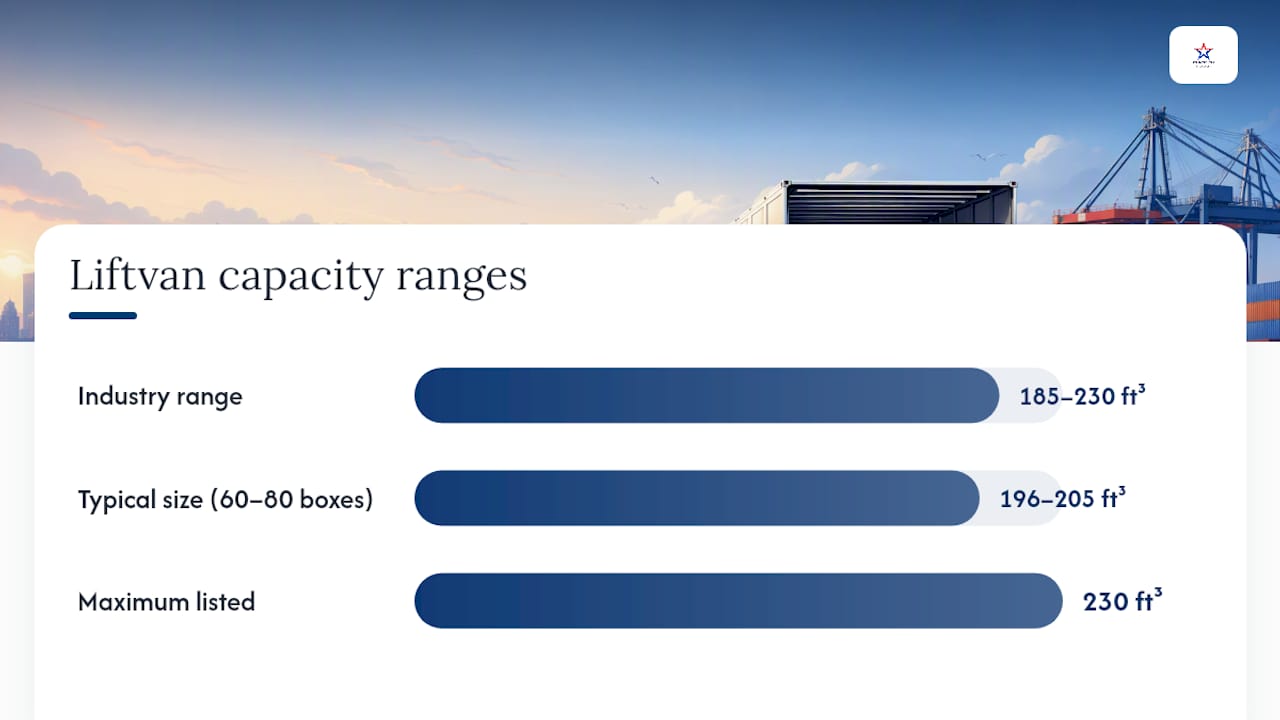
Most suppliers list a standard liftvan at roughly 196 to 205 cubic feet, with the broader industry range running about 185 to 230 cubic feet, or 5.2 to 6.5 cubic meters. That's enough to hold the contents of a small one-bedroom apartment, or roughly 60 to 80 standard moving boxes, plus a sofa or dresser wedged in around them.
Carriers typically bill using the outside dimensions of the crate, since that's what determines how much space it occupies on a vessel. Usable interior volume runs a bit smaller once you account for panel thickness and bracing. When standard sizes don't fit the job, crate makers build custom dimensions for pianos, motorcycles, or industrial machinery, including specialized internal supports for aviation parts, artwork, or electronics.
A few things to keep in mind when requesting a quote:
- Ask whether the quoted volume is outside or usable dimensions
- Get exact measurements for any single oversized item before crating begins
- Confirm whether custom crating carries a separate line-item cost
Liftvans vs. Containers: When One Beats the Other
The decision usually comes down to volume. If your household goods fill less than a third of a 20-foot container, a liftvan consolidated into a shared container almost always costs less than booking a full container for yourself. Our guide to international shipping methods breaks down the ocean freight side of that math in more detail.
Handling differs too. A liftvan gets loaded, sealed, and inspected as a standalone unit, which makes customs review straightforward since officers can access it without unpacking an entire container. Full containers require stuffing and unstuffing at both ends, which adds labor and time when you're shipping less than a full load.
Quick decision points:
- Under roughly a third of a 20-foot container's volume — a liftvan with LCL consolidation is typically more economical
- Multiple fragile or irregular items — a liftvan's custom bracing protects them better than loose container stowage
- Full household worth of furniture and appliances — a dedicated container often makes more sense once you clear that volume threshold
- Tight delivery timeline — containers moving direct can sometimes beat the consolidation wait tied to LCL scheduling
When a Liftvan Is the Right Call
Liftvans work well for a specific set of situations rather than every international move. Small household relocations, like a studio apartment or a single room's worth of belongings, rarely justify a full container. The same goes for one-off items that need protection more than they need volume.
Common scenarios where a liftvan fits:
- Studio or one-bedroom household moves shipping overseas
- A single large item: a motorcycle, sculpture, or antique dresser
- Consolidated LCL shipments combining several smaller loads into one container
- Fragile or high-value pieces that benefit from custom internal bracing and tailored insurance coverage
Insurance matters more here than people expect. A crate built with foam padding and internal framing tailored to the contents materially reduces transit damage and the claims that follow it, so ask your mover what packing level is included before you assume a "standard" crate covers a grand piano the same way it covers a bookshelf.
ISPM 15 Compliance and What Happens at Customs
Every wooden crate crossing an international border has to meet ISPM 15, the international standard requiring wood packaging to be heat-treated or fumigated so it can't carry pests across borders. Skip this and customs can quarantine, reject, or force re-export of your entire shipment, which turns a two-week delay into a two-month one.
Inspectors generally find liftvans easier to process than full containers, since the crate can be pulled aside and opened without disturbing anyone else's cargo. Still, you need paperwork ready: a packing list, the crate's ISPM 15 certificate, and your bill of lading, all matching the serial number stamped on the crate itself.
Before crating starts, confirm:
- Heat-treatment certification is available for every wooden component
- The crate carries a visible IPPC stamp, not just a supplier's word
- Skid height clears forklift equipment at both the origin and destination warehouses
- Stacking limits at the port won't crush anything if the crate sits in a queue
Pro Tip: Ask your mover to show you the ISPM 15 stamp on the actual crate before it's sealed, not just the certificate. Non-compliant wood has triggered quarantine holds and re-export orders on entire shipments, and that's a bill nobody wants after the fact.
Cost Drivers and Realistic Transit Timelines
Liftvan pricing comes down to a handful of variables: total volume and weight, how far your pickup location is from the nearest port, whether you want port-to-port or full door delivery, and consolidation fees if you're sharing container space with other LCL shipments. Customs clearance timing at the destination country adds another variable that's harder to predict from the U.S. side.
For LCL shipments, expect the ocean transit itself to run several weeks depending on the destination, with additional time on either end for consolidation and customs processing. Delays most often happen while a carrier waits to fill a container with enough LCL cargo to sail economically, not during the sailing itself.
Ways to keep costs and timelines under control:
- Get accurate cubic-footage measurements upfront, since most quotes carry a minimum volume charge regardless of what you actually ship
- Stay flexible on pickup dates if your mover is trying to hit a consolidation window
- Ask whether door delivery or port pickup at the destination changes your total cost meaningfully
- Confirm what's included in packing versus billed as an add-on
How Atlantic Star Relocations Handles Liftvan Shipments
Atlantic Star Relocations manages the entire liftvan process as a single point of accountability, starting with a consultation to size the crate against your inventory and confirm ISPM 15 compliance requirements before anything gets built. From there, our team handles packing and crating, coordinates with ocean carriers on a carrier-neutral basis, and tracks the shipment through to final delivery.
If you're shipping a full household internationally, working with a coordinator who already knows the overseas moving process end to end saves you from chasing separate crate builders, freight forwarders, and customs brokers on your own. If you're only shipping one or two special items and already have a crating vendor lined up, you may not need full-service coordination. Everyone else benefits from having one team accountable for the whole move.
What Operators Always Confirm Before Crating Begins
Before any crate gets built, experienced movers check doorway and hallway clearance at pickup, verify weight distribution so nothing shifts in transit, and confirm bracing specs for fragile pieces. A missed stairwell measurement on move day, discovered after a piano's already been crated for a different route, is the kind of snag that proper vetting catches beforehand.

Ready to Ship? Here's How Atlantic Star Makes It Simple
If you've made it this far, you already know liftvan shipping involves more moving pieces than a domestic relocation: crating specs, ISPM 15 paperwork, carrier scheduling, and customs documentation, all of which have to line up correctly the first time. Atlantic Star Relocations handles that entire process for households and businesses across Westchester County, New York City, Manhattan, Brooklyn, Queens, the Bronx, Connecticut, New Jersey, and Florida shipping overseas.

Our team builds ISPM 15-compliant crates, manages logistics coordination with ocean carriers on a carrier-neutral basis, and can hold your shipment in short-term storage if your pickup and container dates don't line up perfectly. We also work with trusted partners like Orange Movers on pickup and delivery coordination when a shipment needs an extra set of hands at either end. Whether you need flat rate movers for a local leg before the overseas shipment or full packing services for the crate itself, one team stays accountable from your first call to final delivery. Request a quote through our contact page and tell us your destination country, we'll walk you through crate sizing and timeline before you commit to anything.
Authoritative Resources on Liftvan Standards
For readers who want to check the standards directly: the Federal Maritime Commission publishes guidance on carrier practices and documentation for U.S. ocean shipments, and the International Association of Movers covers ISPM 15 wood-packaging rules in more technical depth. Crate manufacturers like IWI International Wood Industries and CrateTec publish standard dimensions and construction specs worth comparing against any quote you receive.
Sources
- Lift Van Crates - CrateTec
- Lift vans, type II lift van boxes - IWI International Wood Industries
- IAM (International Association of Movers) - industry guidance
- Federal Maritime Commission (FMC)
FAQ
What Is the Typical Size of a Liftvan?
Most standard liftvans run about 196 to 205 cubic feet, with the broader industry range spanning roughly 185 to 230 cubic feet depending on the manufacturer. Custom sizes are common for oversized single items like pianos or motorcycles.
How Much Weight Can a 40-Foot Container Legally Carry in the USA?
Legal weight limits depend on the trucking route and chassis used to move the container inland, not just the container itself, so the exact figure varies by state and carrier. Check with your carrier or the Federal Maritime Commission for current documentation on your specific route.
What Happens to Empty Shipping Containers After Unloading?
Empty containers get returned to the shipping line's depot, repositioned for another load, or in some cases repurposed for storage or construction use, depending on the carrier's logistics needs at that port.
How Long Does It Take to Unload a 20-Foot Container?
Unloading time depends on cargo type and crew size, but a straightforward household shipment in a 20-foot container typically takes a few hours once the container clears customs and reaches its final destination.
Does Atlantic Star Relocations Handle the Crating Itself?
Yes. Atlantic Star Relocations manages crate specification, ISPM 15 compliance, and packing services in-house as part of its managed international moving process, so you don't need to source a separate crating vendor.