

Staggering office moves across locations is the process of relocating an organization in coordinated phases, moving one site or department at a time to protect business continuity and reduce downtime. This approach, formally called phased relocation, is the standard method for any organization managing a multiple location office move. Done correctly, it keeps revenue-generating teams operational while the physical transition unfolds around them. Atlanticstargroup has coordinated exactly these kinds of moves across Westchester County, New York City, New Jersey, and Connecticut, and the lessons from those projects are what this guide is built on.
What do you need in place before you stagger office moves across locations?
The single most important prerequisite is a centralized governance structure. Hub-and-spoke management prevents the duplicated vendor costs and inconsistent timelines that fragment multi-site projects. One central committee holds the budget and sets the standards. Local transition teams at each site handle on-the-ground logistics within those standards.
Before a single box is packed, every team needs these foundations in place:
- Complete asset inventory. Document every piece of furniture, equipment, and IT hardware at each location. Floor plans for both origin and destination sites are non-negotiable.
- Vendor selection criteria. Choose vendors with documented experience in multi-location office moves. Local building regulations, parking rules, and labor laws vary by city. A vendor unfamiliar with Manhattan freight elevator rules will cost you a full day.
- Digital scheduling platform. A shared project management tool keeps all phases, deadlines, and dependencies visible to every stakeholder.
- Per-location communication plans. Each office has different staff concerns, different department priorities, and different local contacts. A single generic update email serves none of them well.
Pro Tip: Assign a dedicated move coordinator for each location. That person owns local vendor relationships, building access logistics, and employee communications. Without a local point of contact, problems escalate to the central committee and slow everything down.
How do you build a phased schedule and coordinate logistics?

Phased moves sequence relocations by department priority and business function rather than by geography alone. The finance team moves after month-end close. The customer service floor moves after a backup team is confirmed operational at the new site. Sequence decisions should follow business risk, not convenience.
The table below compares two common approaches to scheduling phases across multiple sites.
| Strategy | How it works | Best for | Key risk |
|---|---|---|---|
| Sequential phases | One location completes fully before the next begins | Organizations with limited vendor capacity | Longer total project timeline |
| Overlapping phases | Two or more locations move in parallel with shared oversight | Large organizations with dedicated project teams | Higher coordination complexity |
Off-hours scheduling is the primary tool for minimizing downtime in both models. Moving physical assets on Friday nights and Saturdays means teams arrive Monday morning at a functional workspace. That window also gives IT teams time to test systems before employees return.
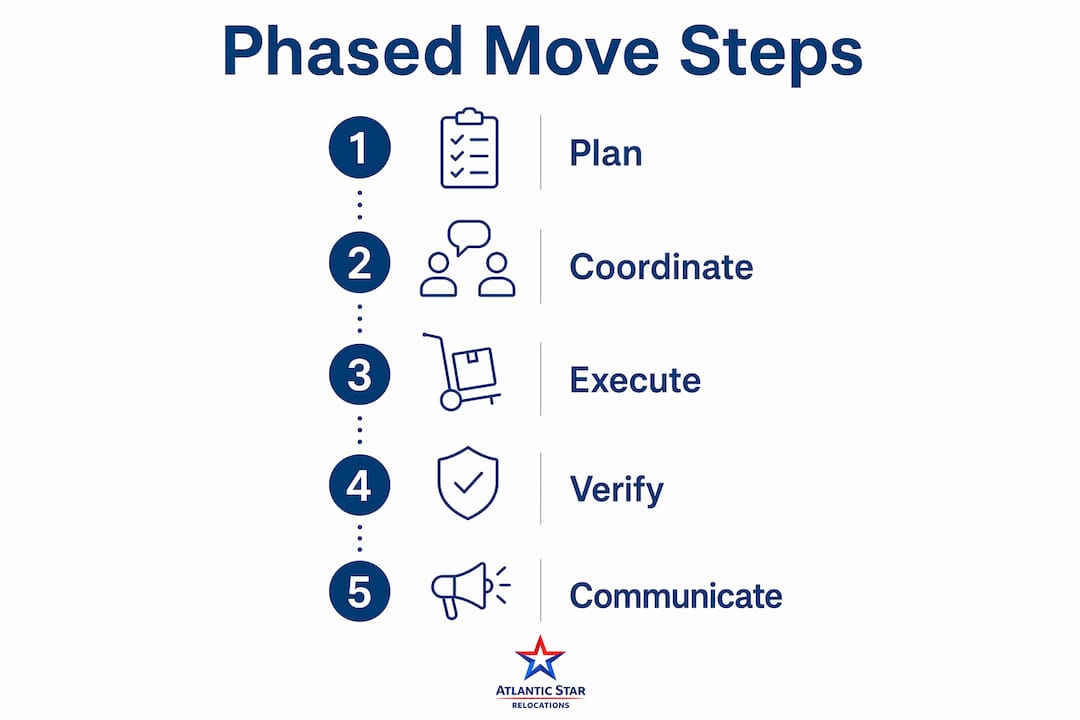
Logistics coordination across sites requires more than a shared calendar. Each office has its own building management contacts, loading dock hours, and parking restrictions. In New York City, a move in Midtown Manhattan operates under entirely different street access rules than one in White Plains or Stamford. Atlanticstargroup manages these local variables as part of its logistics coordination services, so the central committee does not have to chase down building superintendents at every site.
Moving non-essential items to storage early clears staging space and reduces pressure on critical move days. Climate-controlled storage is the right choice for sensitive electronics and archival documents.
Pro Tip: Build a 48-hour buffer between the physical move completion and the first employee workday at each new location. That buffer is your window to fix what the schedule did not anticipate.
How should you handle IT and telecom migration during phased moves?
IT migration is the most common point of failure in a multi-office move. Migrating data to cloud infrastructure months before the physical move decouples data access from the physical location. Teams can work from the old office, the new office, or remotely without losing access to files or applications.
The practical IT checklist for each phase includes:
- Pre-move cloud migration. Move shared drives, applications, and databases to cloud platforms before any physical relocation begins. This is the single step that prevents the most downtime.
- Scheduled disconnect and reconnect windows. Coordinate with your telecom and internet service providers at least six weeks in advance. ISP lead times in dense urban markets like Brooklyn or the Bronx can run longer than expected.
- Full connectivity testing before team arrival. Test network, server, and AV connectivity at each new location before employees arrive. A failed VoIP system on day one costs more in lost productivity than the testing takes.
- Documented rollback plan. If a critical system fails at the new site, the team needs a written plan to restore access at the old location or a backup site within hours.
For a full breakdown of IT relocation best practices, the IT relocation planning guide from Atlanticstargroup covers each phase in detail.
What communication strategies keep employees and stakeholders aligned?
Precise, timely communication reduces employee anxiety without overwhelming teams with unnecessary updates. The goal is not constant communication. The goal is the right information reaching the right people at the right time.
Effective communication during a staggered move follows a clear structure:
- Location-specific updates. Employees at the Brooklyn office do not need details about the White Plains phase. Segment your communications by site and department.
- Dedicated channels. Use a single platform, whether Slack, a project portal, or a dedicated email thread, for all move-related updates at each location. Mixing move updates into general company channels creates noise and missed messages.
- Day 1 welcome materials. Every employee arriving at a new location for the first time should receive a printed or digital guide covering parking, building access, IT login procedures, and who to contact for issues.
- Formal snag lists. Post-move audits on the first business day resolve outstanding issues before they become morale problems. Assign someone at each site to collect and escalate snag items by noon on day one.
Pro Tip: Send a "48 hours out" message to each location's employees before their move date. Cover exactly what to expect, what to bring, and who to call if something goes wrong. That single message cuts the volume of day-of questions by more than half.
Key Takeaways
Successful phased relocation requires centralized governance, sequenced scheduling, and precise communication at every site.
| Point | Details |
|---|---|
| Centralize governance first | A hub-and-spoke committee prevents duplicated costs and inconsistent timelines across sites. |
| Sequence by business risk | Move departments based on operational priority, not geography or convenience. |
| Migrate IT before the physical move | Cloud migration ahead of moving day decouples data access from the physical location. |
| Schedule moves off-hours | Nights and weekends protect productivity and give IT teams time to test systems before employees arrive. |
| Audit on day one | A formal snag list on the first business day resolves issues before they damage morale or output. |
The coordination gap that most organizations underestimate
Multi-location moves fail at the handoff points, not during the moves themselves. I have seen organizations run a flawless phase one in Westchester and then watch phase two in Manhattan fall apart because the central committee assumed the same vendor relationships and building access rules would transfer. They do not.
The uncomfortable truth about how to stagger office moves is that local knowledge is not optional. Every city, every building, and every loading dock has its own rules. The organizations that move well are the ones that treat each location as its own project within a shared framework, not as a copy of the previous phase.
Post-move snag auditing is the step most teams skip because they are exhausted by move day. That is exactly when skipping it costs the most. A formal first-day audit, with a named person responsible for collecting and resolving issues, is what separates a move that employees remember positively from one that generates weeks of complaints. The office relocation planning checklist from Atlanticstargroup includes a ready-to-use snag list template for this reason.
Choose your relocation partner based on their experience with multi-site projects specifically. A company that excels at single-office moves does not automatically have the coordination infrastructure for a five-location phased project. Ask for references from comparable multi-location moves before you sign anything.
— Admin
Atlanticstargroup supports multi-location office moves across the Northeast
Organizations managing phased office relocations across New York City, Westchester County, New Jersey, and Connecticut need a partner who understands both the logistics and the local variables at each site. Atlanticstargroup acts as a single point of accountability across every phase, coordinating vendors, scheduling, building access, and storage so your central team is not managing a dozen separate relationships.

From short-term storage for assets between phases to full logistics coordination across multiple sites, Atlanticstargroup builds the structure that keeps each phase on schedule. Request a consultation to discuss your phased move timeline and get a flat-rate quote for your locations.
FAQ
What does it mean to stagger office moves across locations?
Staggering office moves means relocating one site or department at a time in coordinated phases rather than moving everything simultaneously. This approach, called phased relocation, protects business continuity and reduces operational risk.
How far in advance should you start planning a phased office move?
Most multi-location office moves require a minimum of six months of planning. Complex projects spanning three or more sites in markets like New York City or New Jersey often need nine to twelve months to account for vendor lead times and building access coordination.
What is the biggest risk in a multiple location office move?
IT migration is the most common point of failure. Migrating data to cloud infrastructure before the physical move and testing connectivity at each new site before employees arrive are the two steps that prevent the most downtime.
Should each office location have its own move coordinator?
A dedicated move coordinator at each location is the most effective way to manage local vendor relationships, building access, and employee communications. Without one, problems escalate to the central committee and slow the entire project.
How do you communicate a staggered move to employees without causing confusion?
Send location-specific updates through a dedicated channel, not general company communications. A "48 hours out" message covering logistics, IT access, and day-one contacts reduces questions and anxiety before each phase begins.