

A commercial move employee communication plan succeeds when it delivers a clear timeline, targeted messages that explain what's happening and why, a single source of truth, real two-way feedback, visible leadership alignment, and hands-on support for the first two weeks in the new space. HR and move leadership own it jointly, and the best plans borrow structure from proven frameworks rather than improvising memos as deadlines close in.
If you're staring down an office relocation and wondering where to start, here's the short version of what needs to exist before you send the first announcement:
- Announcement timing confirmed once the lease or decision is locked, but early enough for staff feedback
- Milestone cadence that shifts from monthly to weekly to daily as move day approaches
- Audience mapping so executives, hybrid staff, and facilities teams get different messages
- Channels and assets including an intranet hub, FAQs, floorplans, and short videos
- Change Champions recruited from each department to answer questions in real time
- Move-day checklist for staff covering personal items, access badges, and key contacts
- Day One support with tech help desks, building tours, and welcome messaging
- Measurement through post-move surveys and adoption checkpoints
Carla's 10 tips for office relocation communications remain one of the most cited practical checklists in this space, and the "ABC" messaging framework popularized by SnapComms gives HR teams a repeatable structure for every update. Atlantic Star Relocations has coordinated enough commercial moves across Westchester County and the greater New York City area to know that the moving trucks are rarely the reason a relocation feels chaotic. Confused, late, or inconsistent communication is.
Table of Contents
- Plan at a Glance: A Ready-to-Copy Timeline and Cadence
- Define Your Core Messages Using the ABC Framework
- Map Audiences and Choose the Right Channels
- Prepare the Assets Your Team Will Need
- Drive Engagement Through Leadership and Change Champions
- Move Day and Day One: Checklists That Actually Work
- Measure Success and Iterate After the Move
- How Atlantic Star Relocations Minimizes Disruption During Commercial Moves
- Lessons From Running Multiple Office Relocations
- Ready to Plan Your Commercial Move?
- Key Takeaways: The Essentials to Act on Today
- Sources
- FAQ
Plan at a Glance: A Ready-to-Copy Timeline and Cadence
You don't need to reinvent the wheel here. Most successful office relocations follow a predictable rhythm, and mapping it out early prevents the last-minute scramble that erodes trust.
The pattern in that table is simple: communication frequency increases as uncertainty risk increases. Peldon Rose recommends a phased approach, initial announcement, progress updates, then final details, and that structure holds up in practice because it matches how anxious people actually process change.
Your must-send list by milestone should include:
- Announcement memo with the confirmed date, new address, and reason for the move
- Link to the FAQ hub, published the same day as the announcement
- Packing instructions distributed no later than two weeks before move day
- IT cutover notices sent 72 hours and again 24 hours before systems go dark
A short bullet list of non-negotiables for that first announcement:
- Confirmed move date and new address
- One sentence on why the move is happening
- Where to direct questions
- When the next update will arrive
Define Your Core Messages Using the ABC Framework
Every message you send during a commercial relocation should answer three questions in order: What is happening, why it matters, and what the employee needs to do. SnapComms built its guidance around exactly this structure, calling it the ABC framework, and it works because it forces brevity. Nobody reads a 900-word relocation memo. Everybody reads three short paragraphs that answer their actual questions.
Here's how that plays out in practice, section by section:
- What: "We're relocating to 450 Main Street in White Plains, effective March 16, 2026."
- Why: "The new space gives every team more collaboration room and cuts our commute footprint for hybrid staff."
- What to do: "Pack personal items by March 13. Your new desk assignment is on the floorplan link below."
For a progress update midway through the timeline, the same shape holds: What's changed since last time, why it affects the employee's day-to-day, and what action (if any) is needed now. Final-week instructions get more granular. Day One welcome messages flip the formula slightly, leading with reassurance instead of instruction: "You're in the new space. Here's how to find your desk, log in, and get help if something's not working."
Pro Tip: Don't send every message to every employee. A warehouse crew doesn't need the same cadence as an executive team fielding client questions about the address change. Segment your list early, or you'll train people to skim everything you send.
Map Audiences and Choose the Right Channels
A single company-wide email blast is the fastest way to bury your most important messages under noise nobody reads twice. Different groups need different depth, different timing, and sometimes an entirely different channel.
Think about your relocation from at least five distinct vantage points: executive leadership needs strategic framing and talking points for their own teams. Team managers need enough detail to answer their direct reports' questions without escalating to HR. Hybrid commuters care most about parking, transit access, and desk booking logistics. Frontline or shift staff often miss email entirely and need physical signage or SMS alerts. Facilities and IT staff need the operational calendar, not the emotional narrative.
Cuttlefish Communications recommends involving employees early through surveys and small design committees, which does double duty: it improves your channel selection because you learn how people actually consume information, and it builds early buy-in before the announcement even goes wide.
| Audience Segment | Primary Channel | Message Frequency |
|---|---|---|
| Executive leadership | Direct briefing + talking points | Biweekly, more before major milestones |
| Team managers | Manager toolkit + intranet | Weekly |
| Hybrid commuters | Email + intranet hub | Biweekly, daily in final week |
| Frontline/shift staff | Physical signage + SMS | Weekly, daily in final week |
| Facilities/IT | Direct coordination calls | Ongoing, project-based |
Prepare the Assets Your Team Will Need
Nothing kills momentum faster than building your FAQ page the week before the move because someone finally asked a question you hadn't anticipated. Build your asset library before you send the announcement.
Start with a core template set:
- Announcement memo template with placeholders for date, address, and rationale
- FAQ entries covering parking, commute changes, desk assignments, and IT support
- Packing and labeling checklist formatted for a one-page printout
- Leader talking points so managers give consistent answers in team huddles
- Daily move-day timeline for facilities and vendor coordination
Layer in visual and physical assets too: current and new floorplans, photos of the build-out in progress, a short walkthrough video of the new space, transit and parking maps, and signage content for both the old and new buildings. Atlantic Star's office relocation planning checklist covers many of these operational touchpoints and pairs well with your internal communications calendar.
A few FAQ entries every relocation hub should include from day one:
Where will I sit in the new office? Desk and seating assignments post to the intranet hub two weeks before move day, tied to your team's floorplan zone.
What happens to my parking pass or transit benefit? New building parking and transit details go out in the final-week instructions, along with any updated commuter benefit enrollment steps.
Who do I contact if my computer or phone doesn't work on Day One? A dedicated IT help desk staffs the new location for the first two weeks, with contact info posted at every workstation.
Assign one owner to keep this hub updated. Stale FAQs generate more anxious emails than no FAQ at all.
Drive Engagement Through Leadership and Change Champions
Communication plans fail quietly when leaders say the right things in town halls but contradict them in team meetings. Alignment starts at the top, and it has to be rehearsed, not assumed.
Define these roles explicitly before your announcement goes out:
- Move owner: Accountable for the overall timeline and vendor coordination
- Communications lead: Owns the message calendar and the FAQ hub
- HR sponsor: Handles benefits, accommodations, and sensitive individual concerns
- IT lead: Manages the technology cutover and Day One help desk
- Facilities contact: Coordinates building access, signage, and physical logistics
- Change Champions: Departmental volunteers who answer peer questions and surface concerns fast
Floorspace's guidance on change management points to move champions as one of the highest-leverage tactics available, because peer-to-peer trust moves faster than a memo from HR ever will. Brief your Change Champions before every major milestone, give them a one-page script, and schedule short peer Q&A sessions so questions surface in a room instead of festering in a group chat.
Pro Tip: Give Change Champions a simple shared form to log recurring questions. If five people from the same team ask about parking in one week, that's not five isolated questions. That's a gap in your FAQ hub you need to fix immediately.
Move Day and Day One: Checklists That Actually Work
Move day itself needs almost no creative communication. It needs precision.
A copy-ready move-day checklist for employees:
- Pack personal items into labeled boxes by the deadline in your final-week email
- Return any equipment not moving with you, and confirm handover with your manager
- Save the move-day contact list (facilities, IT help desk, communications lead) to your phone
- Confirm your building access credentials work before leaving the old office
Day One needs its own structure, owned jointly by HR, IT, and facilities:
- Tech help desk staffed and visible from the moment doors open
- Guided tours scheduled in small groups for the first two days
- Signage directing people to restrooms, kitchens, and meeting rooms
- Welcome messaging that acknowledges the disruption and thanks people for patience
Common move-day problems tend to repeat across relocations: badge access that wasn't provisioned in time, phone lines that didn't port correctly, and furniture deliveries running behind the staff arrival. Atlantic Star's project management guidance for office moves stresses rehearsing IT cutovers separately from the physical move, precisely because those two workstreams fail for different reasons and need different contingency plans.
Measure Success and Iterate After the Move
The communication plan doesn't end when the last box gets unpacked. The first two weeks after a move generate the most useful feedback you'll get all year, and most companies never bother to collect it.
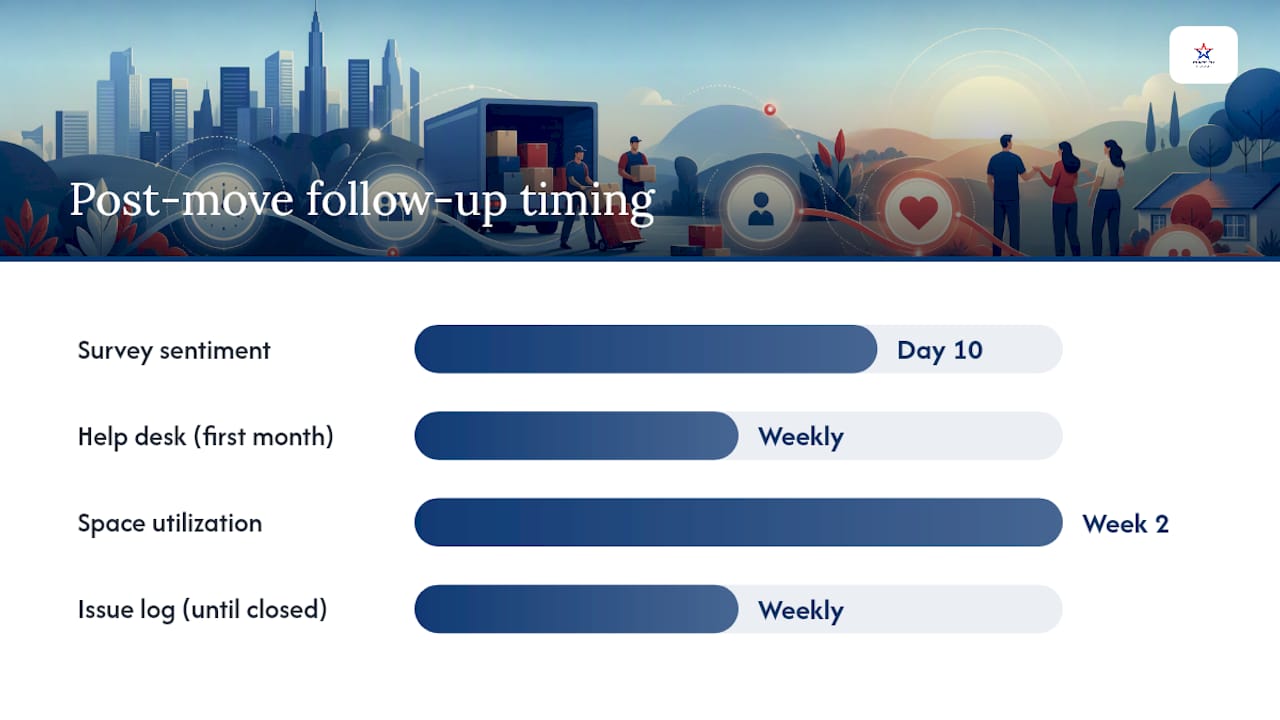
Send a short post-move survey within the first ten days, covering questions like:
- How clear was communication leading up to the move, on a scale of 1 to 5?
- Did you find your workstation and equipment ready on Day One?
- What's one thing that would have made your first week easier?
- Is there anything about the new space still causing friction?
Pair that survey with an issue log that tracks reported problems by category (IT, facilities, access, furniture), assigns an owner, and records a close date. This turns scattered complaints into a visible, accountable list.
| Metric | What to Track | Follow-Up Timing |
|---|---|---|
| Survey sentiment | Overall satisfaction score, open comments | Day 10 post-move |
| Help desk tickets | Volume and category of IT issues | Weekly for first month |
| Space utilization | Desk booking rates, meeting room usage | Week 2 |
| Open issue log | Unresolved facilities or access problems | Reviewed weekly until closed |
Floorspace also recommends continuing to measure satisfaction well after the move itself, not just in the first week, since some friction points (commute patterns, space usage habits) only surface after a full month.
How Atlantic Star Relocations Minimizes Disruption During Commercial Moves
A communication plan is only as good as the move it's describing. If the trucks show up late, the furniture arrives damaged, or nobody can find the vendor's point of contact, no amount of well-crafted messaging saves the day.
Atlantic Star Relocations approaches commercial and office moves across Westchester County, New York City, and the wider region with planning oversight that starts weeks before the trucks arrive. That includes vendor-neutral coordination (no conflict of interest steering you toward a specific carrier), professional packing and logistics management, on-site move supervision, and issue resolution when something inevitably needs adjusting mid-move.

In practice, that means HR and Atlantic Star coordinate closely on the pieces that touch your communication timeline directly: confirming the exact move date for your announcement memo, aligning on building access windows for both the old and new locations, and syncing on Day One logistics so your welcome messaging matches what's actually happening on the ground. Larger relocations involving multi-site logistics coordination benefit especially from this kind of single-point accountability, since misaligned vendors are one of the most common sources of Day One chaos.
Pro Tip: Assign one vendor contact and hold a five-minute daily stand-up during move week. It sounds excessive until you've watched a facilities issue get lost between three different email threads on the day it mattered most.
Lessons From Running Multiple Office Relocations
The recurring failure point across office relocations isn't the physical move. It's timing misalignment between departments that think they're synchronized and aren't. IT assumes facilities has confirmed the cutover window. Facilities assumes HR has told employees about the parking changes. HR assumes IT sent the login instructions. Everyone assumed, nobody confirmed, and the gap surfaces on move day in front of everyone.
The fix isn't more meetings. It's a rehearsal day, roughly one week before the actual move, where every workstream owner walks through their piece of the timeline out loud, in the same room. Overlooked IT cutovers show up almost every time as the single biggest source of Day One complaints, more than furniture, more than parking, more than signage. Give managers a written script for the questions they'll get in team huddles instead of trusting they'll paraphrase the FAQ correctly, because they won't, not consistently, not under pressure.
Atlantic Star's move teams have seen this pattern play out enough times across Westchester and NYC-area relocations to build rehearsal days into their standard project timeline rather than treating them as optional.
Ready to Plan Your Commercial Move?
Atlantic Star Relocations is the alternative to piecing together your own vendor list for an office move across Westchester County, Manhattan, Brooklyn, Queens, the Bronx, Connecticut, or New Jersey: one point of contact managing planning, packing, logistics, and Day One support instead of five separate vendors you have to coordinate yourself.

Our team handles the pieces that make or break your communication timeline: confirmed move dates, professional packing services that keep your team focused on their actual jobs instead of bubble wrap, short-term storage for staged moves, and on-site coordination that keeps facilities, IT, and HR working from the same schedule instead of three different ones. Businesses relocating offices across the New York City area or heading long-distance to Connecticut, New Jersey, or Florida get the same structured oversight from planning through final delivery.
If your relocation timeline is set or still taking shape, request a quote or schedule a planning call with Atlantic Star Relocations, and check our moving FAQ for answers to the questions that usually come up first.
Key Takeaways: The Essentials to Act on Today
A commercial move employee communication plan succeeds when the timeline is clear, every message follows the ABC structure, and Day One support is staffed and visible from the moment doors open.
| Point | Details |
|---|---|
| Announce early, but not too early | Confirm the date and address before announcing, then leave weeks for feedback and questions. |
| Use the ABC framework | Structure every message around what's happening, why it matters, and what to do next. |
| Recruit Change Champions | Peer volunteers surface concerns and answer questions faster than HR emails alone. |
| Build Day One before move day | Staff the tech help desk, schedule tours, and post signage before employees arrive. |
| Atlantic Star handles the logistics side | Vendor-neutral coordination and on-site supervision keep the physical move aligned with your communication timeline. |
Sources
- 10 tips for your office relocation communications plan - All Things IC
- How to communicate an office relocation to your employees | Peldon Rose
- Five communication strategies to support an office move or renovation — Cuttlefish Communications
- Change Management Strategies for Successful Office Moves
FAQ
What should be the first message in a commercial move communication plan?
The first message should confirm the date, new address, and a one-sentence reason for the move, sent once the decision is locked but early enough for employee feedback.
How far in advance should HR announce an office relocation?
Most successful relocations announce their move several weeks in advance, giving employees time to process the change and allowing HR to collect and respond to feedback.
What is the ABC framework for employee move communications?
The ABC framework structures every message around What is happening, Why it matters, and What the employee needs to do, keeping updates short and actionable.
Who should be a Change Champion during an office move?
Change Champions are typically departmental volunteers who answer peer questions in real time and surface recurring concerns back to the communications lead.
Does Atlantic Star Relocations help coordinate employee communications during a move?
Atlantic Star Relocations coordinates the physical logistics, building access, and Day One timing that HR teams rely on to keep their communication plan accurate and on schedule.
How do you measure the success of a move communication plan?
Send a post-move survey within 10 days covering communication clarity, Day One readiness, and lingering friction, then track help desk tickets and space utilization for the following month.