

To hand over a commercial lease without costly disputes, you need six things locked in before move day: a single project lead, a documented move-in baseline, confirmed lease restoration obligations, internet and IT cutover ordered early, vetted movers with binding SLAs and insurance, and a signed surrender agreement after the final inspection.
TL;DR — Required Actions in Order:
- Appoint one project lead with full cross-department authority
- Pull your lease and identify every restoration clause and notice deadline
- Document the current space with timestamped photos and a condition report
- Order internet and telecom at the new location the day the lease is signed
- Run a move-out inspection at least 14 days before handover to allow remediation
- Contract vetted movers with binding estimates, a Certificate of Insurance, and a dedicated project manager
- Execute a written surrender agreement with the landlord at key handover
Atlantic Star Relocations can manage every one of these steps as your single point of accountability.
Table of Contents
- What makes a commercial lease handover different from a standard office move?
- Who needs to be involved and what does each person own?
- Step-by-step moving process: master timeline and move-day checklist
- What are your lease restoration obligations and how do you reduce exposure?
- How do you track inventory and protect sensitive equipment during the move?
- How do you choose a commercial mover for a lease handover?
- How Atlantic Star Relocations manages commercial lease handovers
- Key Takeaways
- Why fragmented responsibility is the real cost driver in lease handovers
- Atlantic Star Relocations handles your commercial lease handover end to end
- Useful sources and templates for your lease handover
- FAQ
What makes a commercial lease handover different from a standard office move?
A standard office move is a logistics problem. A commercial lease handover is a legal, financial, and logistics problem — and the sequence matters.
When you hand back a commercial space, your lease dictates notice periods, restoration standards, landlord inspection rights, and utility transfer obligations. Miss a deadline and you may owe holdover rent. Leave fixtures behind without written landlord approval and you may owe restoration costs. The tenant-first approach recommended by commercial real estate practitioners treats the move as a combined lease advisory and logistics project, not just a truck-and-boxes operation.
Key differences from a routine office move:
- Legal deadlines: Notice periods, restoration timelines, and surrender dates are contractual, not flexible
- Landlord inspections: You must pass a condition check against your original move-in baseline
- Dilapidations exposure: Restoration work can cost multiple dollars per square foot depending on the scope of alterations
- IT and telecom lead times: Connectivity provisioning can take 60–90 days or longer if building infrastructure work is needed
Pro Tip: Photograph every wall, floor, ceiling, and fixture on the day you take possession. That photo set is your primary defense against dilapidations claims years later.
Who needs to be involved and what does each person own?
Single-point accountability is the most reliable control for a successful move. Every task without a named owner is a task that will be missed.
| Role | Primary Responsibility | Key Deliverable |
|---|---|---|
| Relocation Lead (Project Manager) | End-to-end coordination, master timeline | Signed surrender agreement |
| IT Lead | Cutover plan, server decommission, reconnection | IT chain-of-custody log |
| Facilities / Building Liaison | Elevator bookings, access cards, meter reads | Move-out condition report |
| HR / Communications | Staff notifications, change management | Internal move communications |
| Finance | Budget tracking, vendor payments, holdback reserve | Final cost reconciliation |
| Legal | Lease clause review, restoration obligations | Executed surrender agreement |
| Third-Party Mover | Physical move, crating, chain-of-custody | Delivery receipts and COI |
| Property Manager / Landlord Rep | Inspection sign-off, utility transfer | Signed handover certificate |
First-week appointments to make:
- Relocation Lead (must have authority to commit budget and resolve vendor disputes)
- IT Coordinator (separate from the IT Lead if your team is large)
- Vendor Procurement Owner (runs the RFP and holds the contracts)
Step-by-step moving process: master timeline and move-day checklist
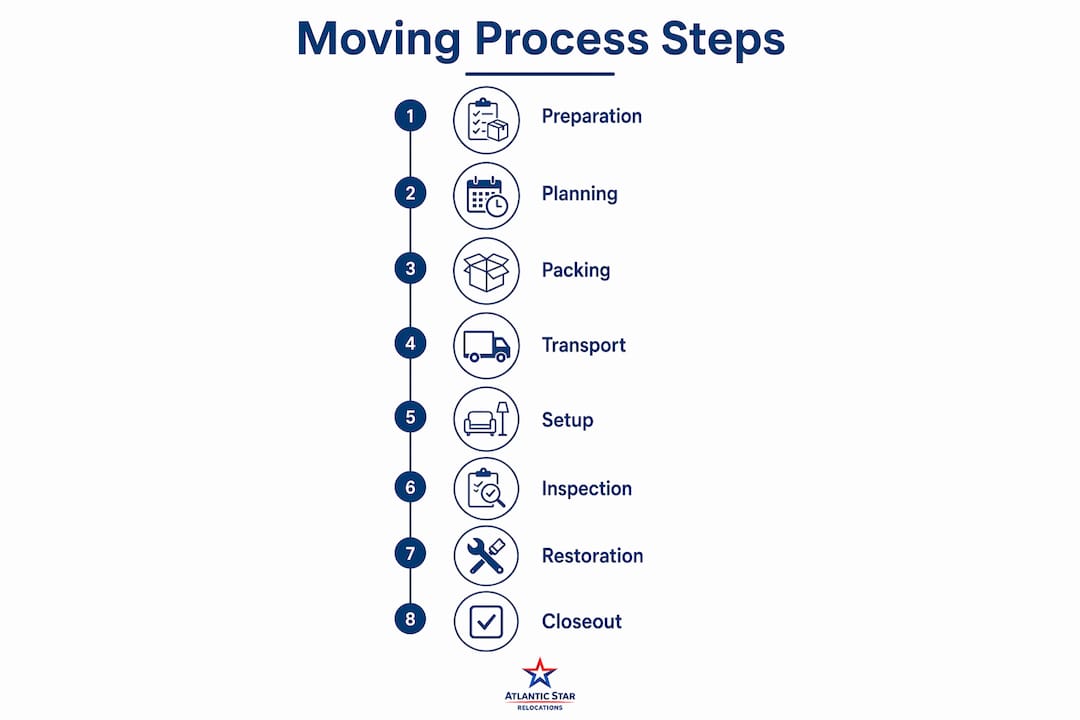
The commercial lease handover moving process runs in eight phases. Compress any phase and you create risk in the next one.

Master timeline
| Phase | Timing | Owner | Key Deliverable |
|---|---|---|---|
| Lease review and notice | 12+ months out | Legal + Relocation Lead | Notice letter served; restoration obligations listed |
| Vendor RFP and budget | 6 months out | Procurement + Finance | Signed mover contract; budget approved |
| IT and telecom order | Day of lease sign (new space) | IT Lead | ISP order confirmed |
| Space planning and fit-out decommission plan | 3 months out | Facilities + Fit-out Contractor | Decommission scope agreed with landlord |
| Pre-move inspection | 14–30 days out | Facilities + Landlord Rep | Punch-list issued; remediation started |
| Final prep | 7 days out | Relocation Lead | Labels applied; elevator reserved; security reset scheduled |
| Move weekend | Day 0 | Mover + IT Lead | All assets delivered; meters read and photographed |
| Post-move close-out | 30–90 days post-move | Relocation Lead + Legal | Surrender agreement signed; deposit returned |
Move-day checklist
- Confirm elevator reservation and building access window with the property manager
- Complete IT cutover in sequence: servers first, workstations second, peripherals last
- Photograph meter readings (gas, electric, water) before keys are handed over
- Verify all labeled assets are loaded against the inventory manifest
- Reset security codes and collect all access cards and fobs
- Conduct a final walk-through with the landlord rep and sign the handover certificate
- Upload all condition photos and chain-of-custody logs to the project folder within 24 hours
Pro Tip: Run a pilot move or dry run 7–14 days before the full move. Move one department, test the IT cutover sequence, and identify building access issues before the main event.
For contingency planning, arrange short-term climate-controlled storage in advance. If the new space is delayed or the fit-out runs over, you need a staging option that protects sensitive equipment.
What are your lease restoration obligations and how do you reduce exposure?
Restoration clauses obligate tenants to return the premises to their pre-alteration condition. The doctrine of accession complicates this: permanent fixtures you installed may legally belong to the landlord, yet your lease may still require you to remove them at your cost.
The legal stakes are real. In one documented New York case, a tenant who vacated without restoring a mezzanine faced holdover damages of $291,402 — representing twice the monthly rent — plus attorney's fees and separate restoration liability.
Negotiation levers to use before and during handover:
- Written determination at consent stage: When you request landlord approval for any alteration, ask simultaneously for a written determination on whether it must be removed at lease end. Landlords often reserve this decision until close to expiry, leaving you with an open-ended liability.
- Cap on restoration costs: Negotiate a dollar cap or a defined scope of work so you know your maximum exposure.
- Designated removal list: Attach a schedule to the consent letter listing exactly which items must be removed and which may remain.
- Surrender agreement: Execute a written mutual release at handover. This document confirms the landlord accepts the space and waives further restoration claims.
"Tenants should secure written determinations at the consent-for-alteration stage or negotiate a cap on restoration liability to avoid open-ended costs at lease end. Landlords commonly reserve the right to decide retention of alterations late in the term." — Legal Clarity, Lease Restoration Clauses
Pro Tip: Your move-in condition report is your primary defense against dilapidations claims. Keep it in a shared folder with timestamped photos, accessible to legal and facilities throughout the tenancy.
How do you track inventory and protect sensitive equipment during the move?
Chain-of-custody documentation with photographic evidence and serial numbers accelerates insurance claims and reduces disputed dilapidations. Require your mover to upload condition photos and custody logs to a central project folder within 24 hours of delivery.
Inventory template fields
| Field | Purpose |
|---|---|
| Asset ID / Serial Number | Unique identifier for tracking and insurance |
| Description and Condition | Baseline condition at move-out |
| Assigned Department | Confirms ownership and destination |
| Disposition Action | Move, donate, sell, recycle, or restore |
| Photo Reference | Links to timestamped condition photo |
| Custody Sign-off | Name and signature of person accepting the asset |
Disposition and labeling guidance:
- Servers and regulated data storage: certified IT specialists handle decommission; chain-of-custody form required at every transfer point
- E-waste: use a certified recycler and retain the destruction certificate for compliance records
- FF&E (furniture, fixtures, and equipment): tag each item with destination room and floor before move day to speed placement
- Meter reads: photograph gas, electric, and water meters on the day of key handover; utility disputes from missed reads can run 6–12 months
You can track complex asset movements using a moving logistics tracker to maintain real-time visibility across departments.
How do you choose a commercial mover for a lease handover?
Not every mover can handle a lease handover. You need a vendor who understands restoration documentation, IT cutover sequencing, and building access rules — not just one who can drive a truck.
Vendor selection checklist:
- General liability insurance (minimum $1M per occurrence is standard for most NYC and Westchester buildings; verify your building's COI requirements)
- Cargo and transit insurance covering high-value IT equipment
- USDOT/FMCSA registration for any interstate move
- Binding written estimate (non-binding estimates are a red flag)
- Named dedicated project manager, not a dispatch rotation
Questions to ask during the RFP:
- Have you managed a commercial lease handover with restoration obligations in the last 12 months?
- How do you handle IT equipment — do you use certified IT relocation specialists?
- What is your damage claims turnaround time, and what does your SLA state?
- Can you provide chain-of-custody documentation at delivery?
- Do you have experience with elevator reservations and building access rules in Manhattan or Westchester?
SLA clauses to require in the contract:
- Arrival window with a penalty clause for late start
- Damage claim resolution within 30 days
- Dedicated project manager available by phone on move day
- Escalation matrix naming a senior contact above the project manager
Pro Tip: Require carrier-neutral coordination and the express right to audit sub-contractors. A mover who sub-contracts without disclosure creates accountability gaps that surface at the worst possible moment.
For a full vendor coordination framework, the commercial relocation vendor guide covers SLA templates and RFP structures in detail.
How Atlantic Star Relocations manages commercial lease handovers
Atlantic Star Relocations operates as a single point of accountability for the entire commercial property transition, from lease-clause review through final landlord sign-off. For businesses in Westchester County, Manhattan, Brooklyn, Queens, the Bronx, and surrounding areas, that means one project manager who owns the master timeline, the vendor relationships, and the on-day problem-solving.
Service deliverables:
- Project-managed scheduling with milestone sign-offs at each phase
- Carrier-neutral vendor oversight: Atlantic Star selects and manages crews without locking you into a single carrier
- IT relocation coordination with certified handling and phased reconnection plans
- Professional packing services and secure custom crating for sensitive equipment
- Short-term climate-controlled storage for staged moves or delayed fit-outs
- Post-move snag list closure and unpacking support
| Deliverable | What It Covers |
|---|---|
| Master timeline | Phase milestones, owners, and sign-off dates |
| Move-in / move-out photographic report | Timestamped condition evidence for landlord disputes |
| Chain-of-custody records | Asset tracking from origin to destination |
| Certificate of Insurance collection | COI from every vendor on the project |
| Signed punch-list | Documented remediation items and closure confirmation |
Atlantic Star's local building access experience in Westchester and across NYC boroughs means elevator reservations, freight lift rules, and property manager relationships are handled before move day, not on it.
Key Takeaways
A successful commercial lease handover requires a single project lead, documented move-in and move-out records, early telecom ordering, binding mover contracts with SLAs, and a signed surrender agreement.
| Point | Details |
|---|---|
| Appoint a lead immediately | One person with budget authority must own the master timeline from day one. |
| Order internet on lease-sign day | Telecom provisioning can take 60–90 days; late orders cause post-move outages. |
| Run inspection 14+ days out | A pre-handover inspection allows remediation time and produces a defensible punch-list. |
| Secure written restoration determinations | Negotiate removal lists and cost caps at the alteration-consent stage, not at lease end. |
| Atlantic Star Relocations | Manages the full handover as a single accountable partner for Westchester and NYC businesses. |
Why fragmented responsibility is the real cost driver in lease handovers
The conventional wisdom is that lease handover costs come from restoration work. They often don't. The bigger cost driver is fragmented responsibility: IT orders the telecom independently of the mover's schedule, facilities runs the inspection without legal present, and no one owns the surrender agreement until the landlord sends a demand letter.
A tenant-first, fiduciary approach to commercial relocation treats the move as a single managed project, not a collection of departmental tasks. When one lead owns the master timeline and every vendor SLA, missed deadlines become visible before they become disputes. The single-point accountability model isn't a luxury for large companies. For any business handing back a commercial space with restoration obligations, it's the difference between a clean surrender and a six-month billing dispute.
Atlantic Star Relocations handles your commercial lease handover end to end
For businesses in Westchester County and across New York City, Atlantic Star Relocations provides corporate relocation services built specifically for commercial lease handovers. One project manager. One timeline. One point of contact when something needs to be resolved on move day.

Atlantic Star coordinates vendors, manages IT cutover sequencing, handles professional packing, and arranges short-term storage when the fit-out schedule shifts. Local building access experience across Manhattan, Brooklyn, Queens, the Bronx, and Westchester means fewer surprises on move day. Request a quote at atlanticstargroup.com or review common questions on the moving FAQ page to understand what to expect before your first call.
Useful sources and templates for your lease handover
| Resource | How to Use It |
|---|---|
| Move-in condition report template | Complete on possession day with timestamped photos; retain for the full tenancy |
| Punch-list template | Issue 14+ days before handover; track remediation to closure |
| Vendor RFP checklist | Use during mover selection to compare insurance, SLAs, and IT capabilities |
| Chain-of-custody form | Attach to every high-value or regulated asset from pack to delivery |
| Surrender agreement template | Execute with the landlord at key handover for a mutual release of claims |
For a ready-to-use planning framework, the office relocation planning checklist from Atlantic Star Relocations covers phase milestones, owner assignments, and vendor coordination tasks you can paste directly into your project tracker. Request Atlantic Star's proprietary commercial handover checklist when you contact the team.
FAQ
How far in advance should you start a commercial lease handover?
Start at least 12 months out for a mid-sized office. Telecom provisioning alone can take 60–90 days, and restoration work requires landlord approval before you can schedule contractors.
What happens if you vacate without completing restoration?
Landlords can pursue holdover rent at contracted rates and separate restoration damages. In documented cases, tenants have faced doubled monthly rent plus attorney's fees for failing to restore alterations as required by the lease.
When should the move-out inspection happen?
Run the inspection at least 14 days before handover to allow time for remediation and to produce a defensible punch-list before the surrender date.
What insurance does a commercial mover need for a lease handover?
At minimum: general liability, cargo and transit coverage for IT equipment, and a Certificate of Insurance meeting your building's requirements. For interstate moves, USDOT/FMCSA registration is also required.
Can Atlantic Star Relocations handle short-notice commercial moves in NYC?
Atlantic Star Relocations serves Westchester County and all NYC boroughs and offers short-term staging and storage options for compressed timelines. Contact the team directly to discuss availability and what information to have ready for a quote.