

If you need storage for under 30 days, a local self-storage unit or a first-month promotion usually costs the least, provided you don't need daily access. If you want on-site flexibility without renting a truck twice, a portable container often wins for gaps of one to eight weeks. If your move involves a tight urban building, a long-distance leg, or you just want one bill and one point of contact, full-service mover storage tends to be the simpler path, even if it costs a bit more upfront.
TL;DR:
- Self-storage units cost between $40 and $150 monthly for a 10x10 size, which is ideal for most families and short-term storage needs.
- Portable containers typically range from $170 to $290 per month, with delivery and pickup fees potentially increasing the total expense beyond fixed storage costs.
- Long-term storage over three months favors contracts or containers, especially if rates are locked in, to avoid rising month-to-month fees.
- Ensuring property access and compliance with HOA or municipal rules is crucial before choosing a portable container, as curbside space and permits are often required.
- Coordinating storage and transport through a single provider reduces failure points, damage risk, and miscommunication compared to managing multiple vendors separately.
Table of Contents
- Temporary Storage Between Moves: Comparing Your Three Real Options
- What Does Temporary Storage Between Moves Actually Cost?
- Matching Storage to Your Move Timeline
- Access, Delivery, and Whether Your Property Can Even Fit a Container
- Packing, Handling, and Insurance for Stored Belongings
- Your Pre-Storage Checklist and the Questions Every Provider Should Answer
- Why a Managed Approach Often Beats Piecing It Together Yourself
- Get a Temporary Storage Quote from Atlantic Star Relocations
- Sources
- FAQ
Temporary Storage Between Moves: Comparing Your Three Real Options
Every household bridging a move-out and move-in date is really choosing between three setups: a portable container, a self-storage unit, or full-service storage through your mover. The right pick depends on your timeline, how often you need to touch your belongings, and your budget tolerance, according to comparison guidance from Smart Storage.
Portable containers get dropped at your curb or driveway, you load them once, and the company either stores them at a local facility or hauls them straight to your new address. They cut down on loading and unloading cycles because you pack once and the container does the traveling, which makes them a favorite for long-distance moves where nobody wants to drive a 26-foot truck across three states. The tradeoff: once the container leaves your property, you generally can't get inside it until delivery, according to Move Buddha's comparison.
Self-storage units are the option most people already know: drive-up bays, indoor climate-controlled rooms, and facilities that let you swing by whenever the gate hours allow. They're strongest when you expect to grab a box of winter coats or a forgotten charger mid-move. The catch in dense areas like Manhattan or Brooklyn is that you're the one hauling everything there and back, usually in a rented van or with paid labor.
Full-service mover storage, sometimes called storage-in-transit, means your moving company picks everything up, holds it in a warehouse, and delivers it once your new place is ready. It bundles transport and storage into one arrangement, which often reduces paperwork and cuts down on how many hands touch your furniture, per research on short-term versus long-term storage.
Quick side-by-side on what matters most:
- Access: Self-storage wins for frequent visits; containers and mover storage both limit you to scheduled retrieval.
- Urban feasibility: Mover storage and self-storage handle apartment buildings and co-ops far better than containers, which need curb or driveway space.
- Labor: Containers and mover storage both minimize how much lifting you personally do; self-storage usually means you're the labor.
- Best for long distance: Containers and full-service storage travel with your move; self-storage does not.
What Does Temporary Storage Between Moves Actually Cost?
Expect to pay somewhere between $40 and $290 a month depending on unit size and provider type, with facility location swinging that range dramatically. A small 5x5 unit typically runs $40 to $70 a month, while a 10x10, the size most families landing between homes actually need, commonly lands between $100 and $150 a month nationally, according to cost data from Moving Calculator. Manhattan and other dense metro facilities routinely charge well above those averages, so treat national numbers as a floor, not a quote.
Portable containers run a different pricing model. Services in that category commonly price between $170 and $290 a month before delivery and pickup fees are added, according to SelfStorageCost's 2026 pricing breakdown. That delivery fee is where budgets get surprised. A container that looks cheaper than a storage unit on paper can end up costing more once you add the drop-off and pickup charges on both ends.
First-month-free promotions change the math for short gaps. If your closing date slips by even two weeks past the promo window, you're paying full retail, and many facilities raise rates 15% to 25% once the introductory period ends, per SelfStorageCost's analysis. A promo that looked like a free month can turn into your most expensive month if your timeline isn't locked down.
Here's what typical unit sizes fit, and what they run for a 30-day stretch:
| Unit Size | Typical Fit | 30-Day Cost Range |
|---|---|---|
| 5x5 | A few boxes, small furniture pieces, seasonal items | $40 to $70 |
| 5x10 | A studio or one-bedroom apartment's worth of furniture | $60 to $100 |
| 10x10 | A two- to three-bedroom home's furnishings | $100 to $150 |
| — | A four-bedroom home or a house with a garage's contents | $170 to $290 |
Pro Tip: A 10x10 unit is the default recommendation for most families between closings, since it's the size where national averages sit at roughly $100 to $150 a month, and it comfortably holds a mid-size home's furniture without paying for square footage you won't use.
Matching Storage to Your Move Timeline
The gap between your old lease ending and your new keys arriving determines almost everything about which option makes sense.
- Days to 30 days: A self-storage unit with a first-month promotion, or short-term mover storage if you're also hiring movers, tends to minimize cost. Containers rarely pay off for gaps this short once delivery fees are factored in.
- One to three months: This is where the math gets interesting. The break-even point between container convenience and pure storage cost commonly sits around 60 days, according to SelfStorageCost's cost modeling. Past that point, confirm your extension policy in writing before you commit, since month-to-month rates can jump without warning.
- Three months or longer: Containers or negotiated long-term storage contracts start to make more financial sense, especially if you can lock in a rate rather than riding month-to-month pricing.
- Renovations and partial-home storage: If you're only clearing out a kitchen or a single floor, a smaller unit or a container parked in the driveway during the work often beats renting space for a full household's worth of furniture.
- Downsizing moves: Storing the "maybe" pile separately from the "definitely keeping" pile in a smaller unit forces useful decisions and keeps costs proportional to what you actually kept.
Access frequency during renovations or chain-closing delays should factor into your choice as much as price, since A2B Moving's storage guidance points out that self-storage suits frequent access while mover storage suits low-effort, hands-off needs.
Access, Delivery, and Whether Your Property Can Even Fit a Container
Before you book a portable container, confirm your property can legally and physically accept one.
- Check HOA and building rules first. Many co-ops, condo associations, and municipalities restrict how long a container can sit on a driveway or street, and some require a permit before delivery day.
- Measure your space. Containers need clearance for the delivery truck to maneuver, plus flat, stable ground. A steep driveway or a narrow city street can rule out delivery entirely.
- Get permission in writing. If you're renting or living in a managed building, a verbal "sure, that's fine" from a super isn't enough. Get an email or a signed note.
- Plan your removal window. Ask the provider exactly how much notice they need to pick the container back up, and build that into your closing timeline.
- Have a backup plan. If your building or municipality won't allow a container, full-service mover storage or a nearby self-storage facility becomes your default, since neither requires curbside placement.
Facility access matters too. Some self-storage locations offer 24-hour gate access; others close at 9 p.m. or require an appointment for retrieval. Mover warehouses almost always require scheduling ahead, since Move Buddha notes that off-site storage inherently limits spontaneous access.
Packing, Handling, and Insurance for Stored Belongings
How you pack for storage should change based on how long items will sit and how many times they'll get moved. Short-term storage, under 30 days, can tolerate lighter wrapping and simpler stacking. Anything past two or three months deserves furniture blankets, plastic sheeting against moisture, and climate control for wood furniture, electronics, or anything with adhesive or fabric that can warp or mildew.

The number of "touches" your belongings go through matters more than most people realize. Every time a box gets picked up, loaded, unloaded, and reloaded, the odds of a drop or a scrape go up. A managed workflow that minimizes handling usually means fewer damage claims by the time your items reach the new address.
Coverage is where a lot of people get burned:
- Renters and homeowners policies sometimes cover belongings in off-premises storage, but always confirm the dollar limit and exclusions before relying on it.
- Movers offer valuation coverage, which is different from full insurance and often caps reimbursement at a set amount per pound.
- Facility-offered insurance policies vary widely in what they'll actually pay out on a claim.
- Photograph and inventory everything before it goes into storage, so you have documentation if a dispute comes up later.
Pro Tip: Ask any provider for their claims process in writing before you sign anything. If they can't give you a clear answer about how a damage claim gets filed and paid, that's a red flag worth walking away from.
Your Pre-Storage Checklist and the Questions Every Provider Should Answer
Before you reserve anything, run through this sequence:
- Inventory what's actually going into storage. This determines unit size and whether a container makes sense at all.
- Nail down a realistic timeline, including a buffer for closing delays, since most cost surprises come from underestimating duration.
- Get at least three quotes covering the same size and duration so you're comparing apples to apples.
- Confirm the extension policy in writing before you commit to any promo pricing.
When you're on the phone with a provider, ask these directly: What's the pricing model past the promo period? What do pickup and delivery cost, separately from monthly storage? Is there a minimum term, and what's the penalty for leaving early? What are the access fees if I need to retrieve something mid-storage? What's the insurance and claims process, in writing? Asking for cost scenarios at 30, 60, and 90 days up front avoids the surprise jump that catches so many people off guard after month one.
| Question | Why It Matters |
|---|---|
| What's the post-promo rate? | Avoids sticker shock if your move slips past the free period |
| Are delivery/pickup fees separate? | Containers often look cheaper until these are added |
| What's the minimum term? | Some contracts penalize early pickup |
| How is a damage claim handled? | Verifies real coverage versus marketing language |
Reject any provider that won't put pricing or policy terms in writing. A verbal quote isn't a contract, and vague answers about fees are the clearest red flag in this entire process.
Why a Managed Approach Often Beats Piecing It Together Yourself
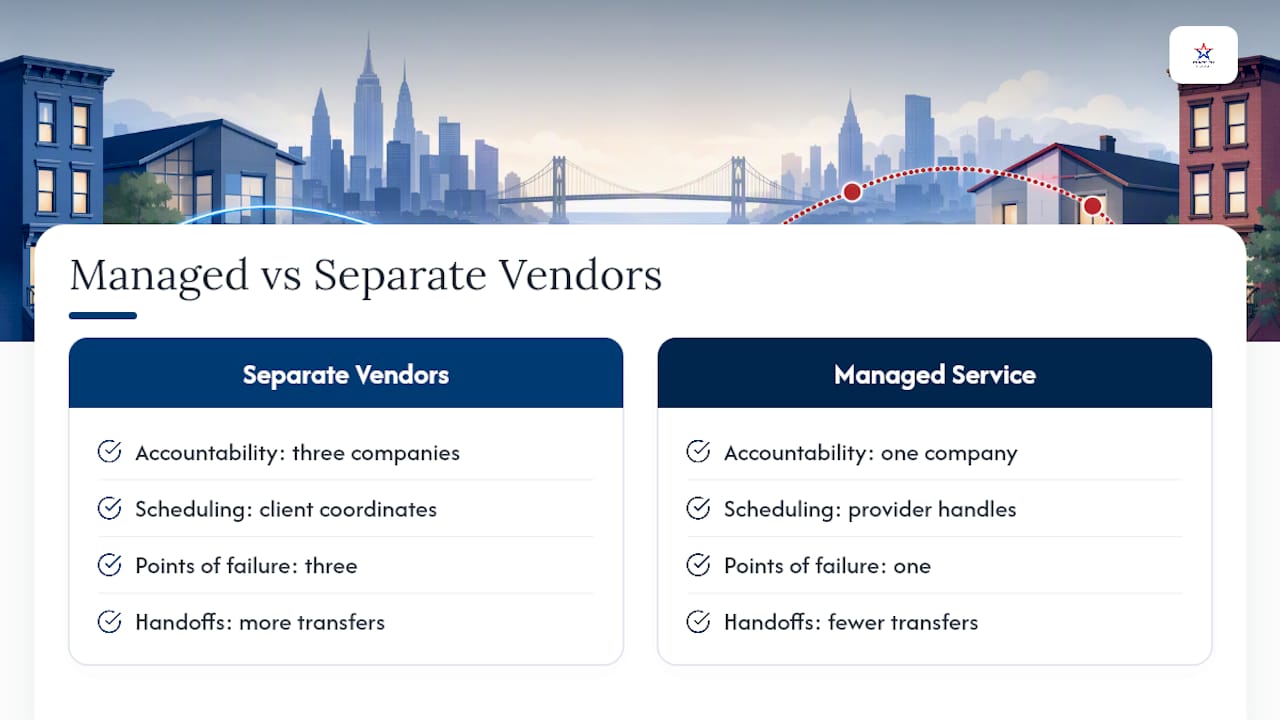
Coordinating a container delivery, a storage facility, and a moving crew as three separate vendors means three separate points of failure. Atlantic Star Relocations approaches temporary storage differently: one point of accountability for the move and the storage piece together, with vendor selection and scheduling handled under a single umbrella rather than juggled across three companies.
That structure matters most when your situation isn't simple, a tight Manhattan co-op move, a multi-leg relocation between Westchester and Florida, or a closing timeline that keeps shifting. Fewer handoffs mean fewer chances for something to get lost between "the container company" and "the movers" and "the storage facility." When items move fewer times between fewer hands, there's less room for the coordination gaps that cause damage or missed delivery windows in the first place.
— Admin
Get a Temporary Storage Quote from Atlantic Star Relocations
Atlantic Star Relocations is the alternative to juggling three separate vendors for movers in Westchester and across the New York City area: one team handles your packing, your transport, and your short-term storage under a single coordinated plan instead of you chasing quotes from a container company, a storage facility, and a moving crew separately.

If you're facing a chain-closing gap, a co-op building with strict delivery rules, or a long-distance move between New York and Connecticut, New Jersey, or Florida, our short-term storage services bundle transport and storage into one plan with one point of contact. We also offer climate-controlled storage for furniture, electronics, or anything sensitive to temperature swings while it waits for your new place. Reach out for a flat rate quote on your specific timeline, whether that's a two-week bridge or a three-month gap, and we'll walk you through exactly what fits your building, your budget, and your move date.
Sources
- Best temporary storage for moving: portable containers vs self storage vs full-service
- Moving storage cost: $80 to $400 per month between homes (2026)
- Storage unit cost calculator
- Self storage vs moving container
FAQ
How Much Does It Cost to Store Furniture Between Moves?
A 10x10 unit, enough for most two- to three-bedroom households, typically runs $100 to $150 a month nationally, while a full container service commonly runs $170 to $290 a month before delivery fees, according to SelfStorageCost. Dense cities like Manhattan often run well above these averages.
What Are Red Flags When Hiring Movers or a Storage Provider?
Refusal to put pricing, extension policy, or claims process in writing is the biggest warning sign. Vague answers about delivery fees, minimum terms, or post-promo rates almost always mean higher costs later.
Where Should I Store Items While Moving?
The right location depends on access needs: self-storage facilities work best for frequent access, portable containers work well for on-site convenience during short gaps, and full-service mover storage, like the option Atlantic Star Relocations provides, works best when you want one company handling transport and storage together.
What Is a Temporary Storage Unit?
A temporary storage unit is short-term rented space, either a self-storage bay, a portable container, or mover-coordinated warehouse storage, used to hold belongings during the gap between moving out of one home and into the next.