

If you're searching for starmovingunited.com alternatives, the short answer is this: national full-service carriers, managed-relocation firms, and container options all give you more verifiable accountability than an unvetted online mover. For clients in Westchester County, New York City, and the surrounding tri-state area, Atlantic Star Relocations stands out as a premium, locally rooted alternative with a single point of contact from estimate through delivery.
Here's a quick shortlist of the alternative categories worth your time:
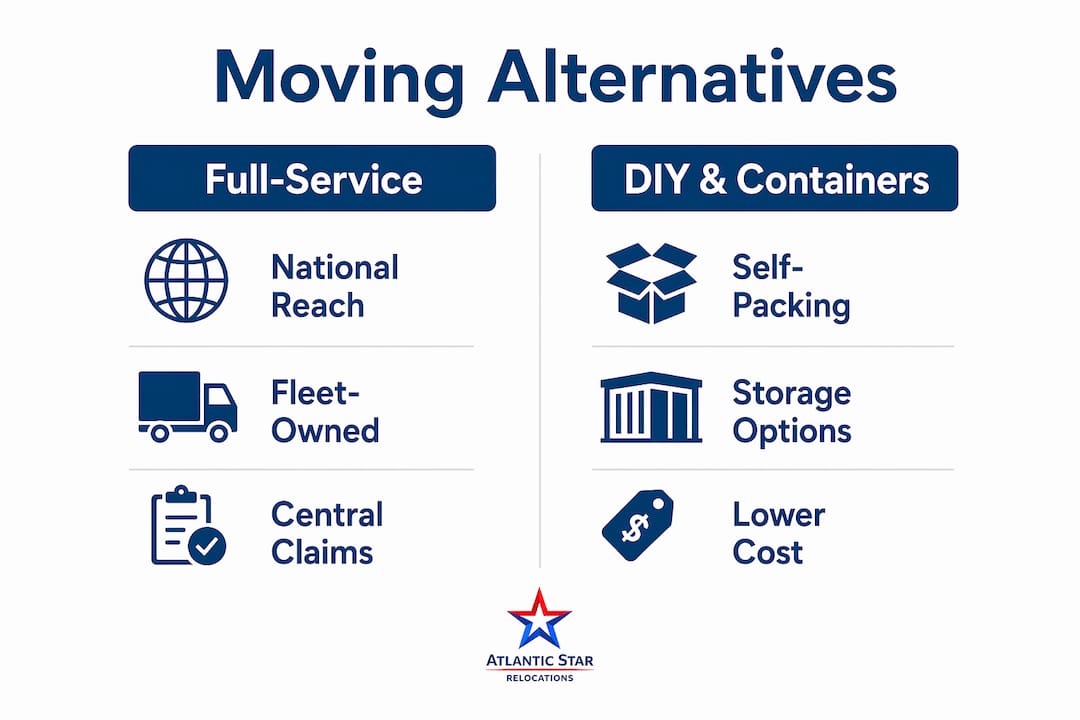
- National full-service carriers (Allied Van Lines, United Van Lines, Atlas Van Lines, North American Van Lines, American Van Lines, Colonial Van Lines, National Van Lines): licensed, insured, and operating their own fleets across all 50 states. Best for long-distance household moves where coverage breadth matters.
- Managed-relocation firms (Atlantic Star Relocations): single-point accountability, vendor-neutral coordination, binding estimates, and real-time problem-solving. Best for corporate moves, executive relocations, and high-value household moves in the NYC/Westchester corridor.
- Container/DIY providers (PODS, U-Pack): you pack, they transport. Lower cost, but you absorb the handling risk. Best for budget-conscious moves where flexibility on delivery timing is acceptable.
- Regional specialty carriers: smaller footprint, often stronger on local knowledge and specialty-item handling within a defined geography.
- Brokered movers: match your move to a third-party carrier. Convenient to book, but accountability is split between the broker and the actual carrier.
TL;DR: Request a binding estimate, verify every mover's USDOT number at FMCSA's SAFER system, and contact Atlantic Star Relocations if you're moving in or out of Westchester, NYC, New Jersey, Connecticut, or Florida.
Table of Contents
- How do the main alternatives to Star Moving United compare?
- How do you pick the right alternative mover?
- Which alternative movers are worth a closer look?
- Key Takeaways
- What operators actually look for when evaluating movers
- Atlantic Star Relocations: get a binding estimate for your move
- Useful sources for verifying movers
- FAQ
How do the main alternatives to Star Moving United compare?
The table below maps each alternative category against the dimensions that actually affect your move outcome. Pricing shapes vary by season, route, and move size, so treat ranges as directional rather than fixed quotes.

| Category | Best for | Service area | Local pricing shape | Long-distance pricing shape | Fleet ownership | Insurance options | Storage | Booking tech |
|---|---|---|---|---|---|---|---|---|
| National full-service carriers | Long-distance household moves | Nationwide | Hourly + minimums | Weight + distance | Carrier-owned | Released value + full-value protection | Yes, often climate-controlled | Online quotes, tracking portals |
| Managed-relocation firms | Corporate, executive, high-value | Nationwide + international | Flat-rate or custom | Custom, binding estimate | Carrier-neutral | Full-value, specialty coverage available | Coordinated | Dedicated coordinator |
| Container/DIY providers | Budget, flexible timing | Nationwide | Monthly container rental | Container transport fee | Third-party drivers | Limited; customer packs | Container doubles as storage | Online self-serve |
| Regional specialty carriers | Local/regional, specialty items | Regional | Hourly or flat | Limited or unavailable | Carrier-owned | Varies | Limited | Varies |
| Brokered movers | Convenience, price shopping | Nationwide | Varies by carrier | Varies by carrier | Third-party carrier | Varies; broker not liable | Varies | Online forms |
Typical pricing shapes at a glance:
| Move type | Common pricing mechanic | Seasonal note |
|---|---|---|
| Local (short distance) | Hourly crew rate + truck fee + minimums | Rates rise May–September |
| Long-distance (interstate) | Weight + mileage estimate, binding or non-binding | Summer peak adds 10–20% to demand |
| Container/DIY | Monthly rental + transport fee | Flexible drop-off dates reduce peak surcharges |
| Managed/corporate | Custom flat-rate or project-based | Negotiated rates often available for volume |
Where each category performs best, in one line:
- Long-distance protection: national full-service carriers with full-value protection plans
- Budget DIY: container providers like PODS or U-Pack, per Forbes Advisor's moving roundup
- Short-term storage: managed-relocation firms and national carriers with climate-controlled warehouse networks
- Managed executive moves: Atlantic Star Relocations, which provides logistics coordination and a single point of accountability for multi-leg corporate relocations
Carriers investing in digital tracking platforms and single-point account management consistently score higher in customer satisfaction reviews, according to industry reporting on service additions by major carriers.

How do you pick the right alternative mover?
The best choice depends on move scope: a local apartment move in the Bronx has different requirements than a corporate relocation from Manhattan to Atlanta. Work through these criteria in order before you sign anything.
Licensing and FMCSA/USDOT verification
Every interstate mover operating in the United States must hold a USDOT number and be registered with the FMCSA. Look up any mover at the FMCSA SAFER system before you request a quote. Confirm the company's operating status is "authorized," check for active insurance on file, and note the complaint history. When reviewing complaint records, consider the ratio of complaints to shipments rather than raw complaint counts. A company moving 50,000 loads per year with 30 complaints looks very different from one moving 500 loads with the same count.
Carrier vs. broker: why it matters
FMCSA guidance is explicit: brokers do not operate trucks or employ crews. They match your move to a third-party carrier and collect a commission. That is not inherently bad, but it splits accountability. If the carrier damages your furniture, the broker's legal exposure is limited. Ask directly: "Are you the carrier, or are you a broker?" Then ask for the operating carrier's USDOT number. For more on this distinction, the moving broker guide walks through exactly what to verify.
In-house crews vs. subcontractors
Carriers that use W-2 employees for packing and loading carry more accountability than those that subcontract labor at origin. Ask whether the crew that shows up at your door is employed by the company or hired day-of through a labor app. For high-value moves, this distinction is worth pressing.
Insurance and protection options
Federal law requires movers to offer two protection levels: released value (minimal coverage, often $0.60 per pound per article) and full-value protection (replacement or repair at current market value). Full-value protection costs more but is the only option that meaningfully covers a flat-screen TV or an antique. Confirm in writing which level applies to your shipment.
Binding on-site or video survey
FMCSA flags refusal to conduct an on-site or video survey as a primary red flag. A mover who quotes you over the phone without seeing your inventory is either guessing or setting up a lowball that inflates at pickup. Insist on a physical walkthrough or a live video survey before you accept any estimate.
Step-by-step verification checklist
- Look up the USDOT number at FMCSA SAFER. Confirm "authorized for hire" status and active insurance.
- Ask whether the company is a carrier or a broker. Get the operating carrier's USDOT number if it's a broker.
- Request an on-site or live-video survey. Decline any mover that refuses.
- Get a written binding estimate. Read the bill of lading before signing.
- Confirm the deposit amount. A large upfront cash deposit (more than 20–25% of the estimate) is a red flag.
- Ask about the claims process: timeline, documentation required, and who handles disputes.
- Verify the company's physical address via a quick satellite view. A residential address or vacant lot for a "moving company" is a warning sign.
Questions to ask on every call or quote visit
- Do you own your trucks, or are you a broker?
- Are your crews W-2 employees or day-labor subcontractors?
- Will you provide a binding estimate after an on-site or video survey?
- What full-value protection options do you offer, and what do they cost?
- What is your claims process, and what is the typical resolution timeline?
- Do you have climate-controlled storage if my move-in date shifts?
- What is your cancellation and rescheduling policy?
- Can you provide references for moves similar in size and distance to mine?
- What is your USDOT number, and can I verify it before booking?
- Who is my single point of contact from booking through delivery?
Pricing and booking windows
Local moves in the NYC metro and Westchester area typically price on an hourly basis: a crew rate plus a truck fee, often with a minimum of two to three hours. Long-distance moves price on weight and mileage, per Move.org's interstate mover guide, with final cost confirmed after a binding survey. Book local moves two to six weeks out; long-distance moves warrant six to twelve weeks of lead time, and earlier during the May–September peak season.
Red flags to watch for
- Sight-unseen estimates with no on-site or video survey
- Unusually low quotes that jump significantly at pickup
- Requests for large upfront cash deposits
- No visible USDOT number on the website or truck
- Pressure to pay the full amount before unloading ("hostage load" situations)
- Generic company name with no physical address listed
Pro Tip: When and why to choose a managed-relocation firm: if your move involves multiple legs, a corporate timeline, or high-value items, a managed-relocation firm gives you a single point of accountability rather than a chain of vendors pointing fingers at each other when something goes wrong.
Which alternative movers are worth a closer look?
These profiles are organized by category. Use them to narrow your shortlist based on move type, distance, and what you need most from a mover.
National full-service carriers
Allied Van Lines, United Van Lines, Atlas Van Lines, North American Van Lines are the largest names in interstate moving. They operate their own fleets, carry FMCSA registration, and offer full-value protection plans. Forbes Advisor's moving company roundup consistently lists these carriers for their licensing transparency and service breadth. Their scale is a genuine advantage for long-distance household moves: they have agents in most major markets, which means local crews at both origin and destination.
The limitation is consistency. A national brand's quality depends heavily on the local agent handling your move. Reviews on ConsumerAffairs show wide variance between markets, so cross-check the specific agent, not just the brand name. Colonial Van Lines and National Van Lines operate on similar agent-network models and appear on many editorial shortlists for their specialty-item handling and training programs. American Van Lines draws attention in Newsweek's readers' choice features for logistical depth and dispute resolution.
Claims handling at national carriers typically runs through a centralized process. Document everything with photos before and after loading. Resolution timelines vary, but most carriers are required by federal regulation to acknowledge claims within 30 days and resolve them within 120 days.
Container and DIY providers
PODS and U-Pack shift the packing and loading responsibility to you in exchange for a lower price. You pack the container, they move it. For a budget-conscious move where you have the time and labor to pack properly, this works well. The trade-off, as Forbes Advisor notes, is that delivery timing is less precise than a full-service carrier, and your liability for improper packing is real. If a poorly secured item breaks in transit, the container provider's coverage is limited.
Storage is a genuine advantage here. PODS containers can sit at your property or at a PODS facility between pickup and delivery, which is useful when move-in dates are uncertain. U-Pack uses a trailer model with a per-linear-foot pricing structure, which can be cost-effective for smaller loads.
Regional specialty carriers
Smaller regional carriers often know a specific geography better than a national brand's local agent. For moves within the New York metro area, Westchester County, or into Connecticut and New Jersey, a regional carrier with established relationships in those markets can be faster and more flexible. The limitation is obvious: they typically don't have the infrastructure for cross-country moves, and specialty-item handling quality varies widely. Verify FMCSA registration the same way you would for any carrier.
Brokered movers
Brokers are convenient entry points for price comparison, but they introduce a layer of separation between you and the crew that actually handles your belongings. The broker's job ends when they hand your move to a carrier. If that carrier has a complaint history or uses day-labor crews, you may not find out until moving day. Use brokers for initial price benchmarking, but always verify the assigned carrier's USDOT number independently before confirming.
Atlantic Star Relocations: featured profile
Atlantic Star Relocations operates as a managed-relocation firm based in Westchester County, serving clients across New York City (Manhattan, Brooklyn, Queens, the Bronx), New Jersey, Connecticut, and Florida. The model is different from a traditional carrier or broker: Atlantic Star acts as a single point of accountability, coordinating vendors, crews, and scheduling under one roof rather than handing your move off to whoever is available.
For residential clients, that means a binding estimate after an on-site or video survey, optional packing services in Westchester, and access to climate-controlled storage when move-in dates shift. For corporate clients, Atlantic Star manages multi-leg relocations, office moves, and corporate relocation projects with consolidated scheduling and a dedicated coordinator. The firm works with trusted carriers and oversees vendor selection, which means you're not relying on a broker's network of unknown subcontractors.
Claims and disputes are handled through a single coordinator rather than a call center. That distinction matters most when something actually goes wrong.
Editorial reviews from Reviewed.com's panel reinforce that training quality and specialty-item handling, not brand familiarity, drive satisfaction on high-value moves. Atlantic Star's vendor-neutral coordination model addresses exactly that gap.
Key Takeaways
The safest move starts with verifying USDOT registration, insisting on a binding on-site or video estimate, and choosing a mover whose accountability structure matches your move's complexity.
| Point | Details |
|---|---|
| Verify USDOT/FMCSA first | Look up every mover at FMCSA SAFER before requesting a quote; confirm authorized status and active insurance. |
| Insist on a binding estimate | Never accept a sight-unseen quote; an on-site or video survey is required before any legitimate binding estimate. |
| Carrier vs. broker matters | Ask directly whether the company owns its trucks; brokers hand your move to a third-party carrier with split accountability. |
| Book early, especially in summer | Local moves need two to six weeks of lead time; long-distance moves need six to twelve weeks, more during peak season. |
| Atlantic Star Relocations | Best fit for Westchester, NYC, NJ, CT, and FL clients who want a single point of accountability, binding estimates, and managed coordination for residential or corporate moves. |
What operators actually look for when evaluating movers
Most people evaluating moving companies focus on price. Operators focus on accountability structure first, because price is meaningless if the mover disappears after a claim.
The most overlooked risk in a brokered move is the gap between who quotes you and who shows up. A broker can present a polished website, a low estimate, and a professional phone call, and then assign your move to a carrier you've never heard of, with crews you can't vet. By the time you find out, your belongings are on a truck. The way to close that gap is to ask for the operating carrier's USDOT number before you sign anything, then look it up independently. If the broker won't give it to you, that's your answer.
One verification step that rarely appears in aggregator guides: confirm the company's physical service address via satellite view. A moving company operating out of a residential address or a vacant commercial lot is a warning sign that no amount of good reviews can override. FMCSA's red-flag guidance supports this check, and it takes about 90 seconds.
Atlantic Star Relocations is ready to evaluate your move and provide a binding estimate for clients in Westchester County, NYC, and beyond. If you're coordinating a nationwide corporate relocation or a multi-leg household move, the managed-relocation model is worth a direct conversation.
Pro Tip: For high-value or specialty-item moves, request a live video survey rather than a phone estimate. A coordinator who walks through your home virtually can flag items that need custom crating, elevator reservations, or permit requirements before moving day, not during it.
Atlantic Star Relocations: get a binding estimate for your move
When the alternatives you've researched still leave you uncertain about who actually shows up on moving day, Atlantic Star Relocations offers a different starting point. You get a single coordinator who manages the entire process, from the initial survey through final delivery, with no handoff to an unknown subcontractor network.

Atlantic Star serves clients in Westchester County, New York City, New Jersey, Connecticut, and Florida. The process starts with a binding on-site or video estimate, so the price you agree to is the price you pay. From there, you can add packing services, short-term storage, or full logistics coordination for corporate or multi-leg moves. Claims, scheduling changes, and questions all go through one point of contact.
To get started, request a quote or call for a tailored evaluation of your move. Atlantic Star's team will confirm scope, timeline, and pricing in writing before anything moves.
Useful sources for verifying movers
Use these authoritative sources to validate any mover's credentials before you book.
| Source | Best used for |
|---|---|
| FMCSA SAFER System | USDOT number lookup, operating status, insurance verification, complaint history |
| FMCSA Protect Your Move | Red-flag checklist, rights and responsibilities, how to file a complaint |
| Move.org interstate mover guide | Long-distance pricing mechanics, service comparisons, carrier profiles |
| Forbes Advisor moving roundup | Editorial rankings by licensing, insurance, and service breadth |
| ConsumerAffairs movers guide | Consumer review aggregation, affordability and service comparisons |
| Newsweek readers' choice | Reader-voted rankings for national carriers |
| Reviewed.com moving panel | Expert panel ratings for training, specialty handling, and dispute resolution |
How to look up a USDOT number: Go to the FMCSA SAFER system, enter the company name or USDOT number, and confirm the operating status reads "authorized for hire." Check that the insurance on file is active and that the company's physical address matches what they've given you.
How to file a complaint: Use the FMCSA's National Consumer Complaint Database at protectyourmove.gov. For Florida-based moves, Palm Beach County Consumer Affairs also accepts complaints and maintains a licensed mover lookup.
Documentation reminder: Photograph your belongings before loading and keep copies of your bill of lading, binding estimate, and any addenda. These documents are your primary evidence if a claim becomes necessary.
FAQ
What is the most reputable type of moving company?
Full-service carriers that own their trucks, employ W-2 crews, and carry FMCSA registration with active insurance are generally the most accountable. Managed-relocation firms like Atlantic Star Relocations add a layer of coordinated oversight that's particularly valuable for corporate or high-value moves.
What are the biggest red flags to watch for in movers?
FMCSA identifies sight-unseen estimates, large upfront cash deposits, no visible USDOT number, and refusal to conduct an on-site or video survey as primary red flags. A mover who pressures you to pay in full before unloading is another serious warning sign.
Is it cheaper to hire a full-service mover or use a container option?
Container providers like PODS or U-Pack typically cost less than full-service carriers because you handle packing and loading yourself. The trade-off is that you absorb the handling risk, and delivery timing is less precise than a full-service move.
Are Mayflower and United Van Lines the same company?
Mayflower Transit and United Van Lines are separate brands but both operate under UniGroup, Inc., which is their shared parent company. They function as distinct agent networks with separate USDOT registrations and branding.
How far in advance should I book a long-distance mover?
Book long-distance moves at least six to twelve weeks before your target date. During peak season (May through September), earlier is better. Local moves in the NYC and Westchester area typically need two to six weeks of lead time.