
If you're weighing an NYC to suburbs move, here's the honest verdict: it pays off for families who need more space and want a yard, a driveway, and quieter nights, but it costs city dwellers who built their lives around subway access and 2 a.m. bodega runs. The decision hinges on three trade-offs. First, more square footage almost always means higher fixed monthly costs once you add property taxes, homeowner's insurance, and a car. Second, you trade a five-minute subway ride for a commute that demands either a Metro-North pass or a car, although hybrid work has made that trade less brutal than it used to be. Third, the upfront transition, closing costs, movers, new furniture, can run higher than people expect.
Before you sign anything, run a real budget against your current rent, schedule a weekday commute test from a candidate town, and shortlist two or three towns for in-person visits.
- Run an honest 12-month budget comparing your current rent to total suburban carrying costs.
- Test the actual commute door-to-door on a Tuesday, not a Google Maps estimate.
- Visit 2 to 3 towns in person before you fall in love with listing photos.
Pro Tip: Price out a full year of suburban costs, not just the mortgage or rent, before you compare it to your current NYC rent. The gap is almost always bigger than the sticker price suggests.
Key Takeaways
A successful NYC to suburbs move depends on budgeting the full four-layer cost stack, testing the real commute in person, and hiring a mover who already knows the parkway and permit rules.
| Point | Details |
|---|---|
| Budget beyond the mortgage | Layer in closing costs, first-year transition spending, and the ongoing property tax and car cost delta. |
| Test the commute before signing | Do a Tuesday visit and time the door-to-door trip during real rush hour, not a map estimate. |
| Rank suburb criteria in order | Prioritize commute pattern, school district, walkability, taxes, and resale value in that sequence. |
| Plan permits and truck routes early | New York parkway restrictions require commercial routing and street parking permits arranged weeks ahead. |
| Use a managed mover for accountability | Atlantic Star Relocations coordinates routing, permits, insurance, and storage as one accountable plan. |
Table of Contents
- What Changes When You Move From NYC to the Suburbs
- What Does a Suburban Move Really Cost?
- How Do You Pick the Right Suburb?
- How Bad Is the Commute From the Suburbs?
- What's the Moving Timeline and What Permits Do You Need?
- How Atlantic Star Relocations Manages an NYC-to-Suburbs Move
- Get a Moving Plan Built Around Your Actual Move
- Sources
- FAQ
What Changes When You Move From NYC to the Suburbs
The biggest shift isn't square footage. It's the rhythm of your day. In the suburbs, evenings get quiet fast. Restaurants close earlier, there's no bodega open at 2 a.m., and the constant hum of city life gets replaced by driveways, porch lights, and the occasional dog barking two houses down.
For families with kids or pets, that trade tends to be a clear win. A yard means the dog doesn't need three walks a day around a crowded block. Kids get a place to ride bikes without dodging traffic. Hobbies that need space, woodworking, gardening, a home gym, suddenly become possible instead of theoretical.

What you lose is harder to quantify but real. NYC's density means options at every hour and every price point: takeout at midnight, a dozen grocery stores within walking distance, live music on a random Tuesday. Suburban towns replace that variety with fewer choices, spaced further apart, usually requiring a car to reach.
Not every suburb feels the same, either:
- Village-style walkable towns (think parts of Westchester like Bronxville or Larchmont) keep a small-town Main Street feel where you can walk to the train, a coffee shop, and a pharmacy.
- Car-dependent towns offer more land and lower density but mean every errand, school drop-off, and coffee run starts with getting in the car.
Neither is wrong. It depends on whether you're chasing space or convenience, and how much you're willing to trade one for the other.
What Does a Suburban Move Really Cost?
The mortgage or rent number is the one everyone fixates on, and it's the one that misleads people the most. A realistic budget needs four layers: the housing cost itself, closing costs if you're buying, first-year transition costs, and the ongoing carrying-cost gap between city and suburban life.
Suburban homes typically deliver significantly more square footage for the money than a comparable NYC apartment, but that space comes with strings attached. Property taxes and home maintenance both climb, and a detailed cost analysis from Brick Underground found that buyers routinely underestimate how much that ongoing carrying-cost delta actually adds up to over a year.
Then there's the transition itself. First-year costs for a typical move from NYC into Westchester, covering closing costs, movers, and furnishing rooms you never had in your apartment, can run into the tens of thousands of dollars once you add it all up, according to a breakdown of true moving costs for NYC to Westchester relocations.
Statistic Callout: Suburban buyers frequently acquire significantly more usable square footage for similar price points compared to city apartments, but that advantage is often balanced by higher property taxes, maintenance costs, and car-related expenses that many buyers underestimate.
The line items people forget most often:
- Furniture for rooms you never had before (a dining room, a finished basement, a guest bedroom).
- Ongoing home maintenance: lawn care, gutter cleaning, HVAC servicing.
- Parking fees or permits at your local train station if you're commuting into the city.
- A second car, plus insurance, gas, and AAA's vehicle operating cost estimates, which show car ownership as one of the largest recurring costs suburban households add to their budget.
Build your budget around all four layers before you commit, not just the number on the listing.
How Do You Pick the Right Suburb?
Start with commute pattern, not curb appeal. If you're only in the office two days a week, a town 45 minutes out opens up options that wouldn't have made sense five years ago. If you're in five days, shave that number down hard before you fall for a house.
Here's the order that actually matters, based on what tends to break relocations when people skip it:
- Commute pattern. How many days a week do you truly need to be in Manhattan, and does the door-to-door time work for that frequency?
- School district and childcare. For families, this often outweighs everything else on the list.
- Walkability and local services. Can you grab coffee, groceries, or a haircut without driving?
- Property taxes and municipal services. These vary sharply even between neighboring towns.
- Resale and liquidity. How easily could you sell if plans change in three years?
Westchester tends to fit families wanting walkable villages and a fast Metro-North line into Grand Central. Long Island splits into two distinct experiences: Nassau offers closer commutes and denser, walkable villages, while Suffolk trades commute time for more space and lower price points per square foot. New Jersey and Connecticut both draw buyers chasing lower property taxes or specific train lines, depending on budget.
Pro Tip: Before you make an offer, spend a Tuesday in the town. Grab coffee, sit in traffic during the school pickup window, and time your actual commute door-to-door. A practical guide to choosing a Westchester town found this kind of real-world test predicts long-term happiness far better than any online ranking.
How Bad Is the Commute From the Suburbs?
This is where hybrid work has quietly rewritten the rules. Five years ago, a 60-minute commute killed a house on the spot. Now, if you're only going in twice a week, that same commute barely registers.
Door-to-door numbers vary a lot by corridor. A Metro-North ride from central Westchester into Grand Central runs roughly 35 to 55 minutes depending on the station, plus a walk or short drive on each end. LIRR commutes from Nassau towns land in a similar range, while Suffolk adds another 15 to 20 minutes. New Jersey Transit and PATH corridors into Manhattan run comparably, depending on the line.
Statistic Callout: A monthly rail pass typically costs far less than driving once you factor in gas, tolls, and Manhattan parking, but if you're only commuting two or three days a week, per-ride tickets or occasional driving can actually beat a full monthly pass.
Before you commit to a town, map your actual in-office schedule against the train timetable, including how school drop-off and after-school pickup fit around your commute window.
What's the Moving Timeline and What Permits Do You Need?
Moving a household out of a Manhattan high-rise into a suburban single-family home involves more moving parts than most people expect, starting with the truck itself. New York State restricts commercial vehicle traffic on a majority of parkways, which means movers have to plan routes over commercial-legal highways instead of the fastest-looking route on a map. Get this wrong and you're looking at fines or a truck that literally can't reach your building.
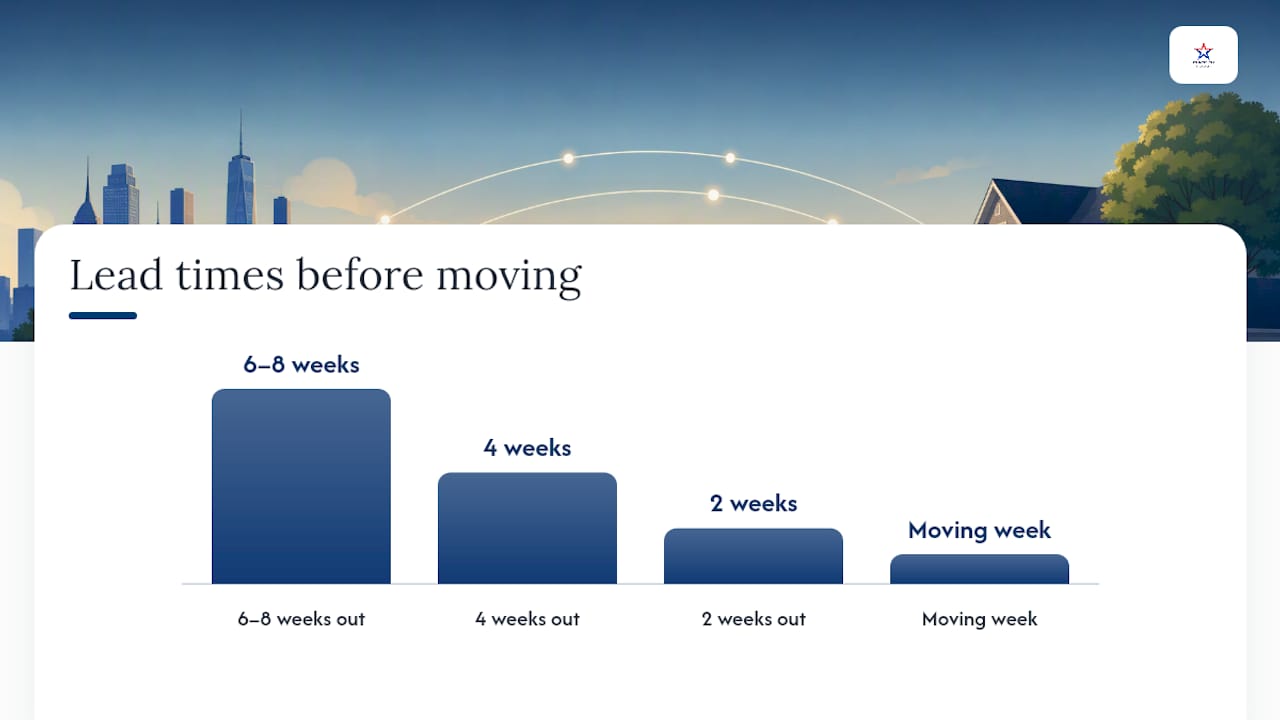
A workable timeline looks like this:
- 6 to 8 weeks out: Book your mover, confirm building move-in requirements with your new town or HOA, and start decluttering.
- 4 weeks out: Arrange your co-op or condo board's move-out paperwork and freight elevator reservation in your current building.
- 2 weeks out: Confirm street parking permits for the truck at both ends, especially if either address is on a narrow suburban street.
- Moving week: Stage anything going into short-term storage separately from what's unloading same-day.
Pro Tip: Call your new town's public works or police department at least two weeks out to ask about temporary parking permits for the moving truck. Many Westchester and Connecticut towns require this, and it's a five-minute phone call that avoids a very expensive surprise.
Building managers and co-op boards each have their own rules on elevator windows, certificate of insurance requirements, and move-out hours. Confirm all of it in writing before moving week, not the morning of.
How Atlantic Star Relocations Manages an NYC-to-Suburbs Move
The details above aren't theoretical; they're the exact issues Atlantic Star Relocations sorts out for clients every week. The company operates as a single point of accountability for the whole move, coordinating trusted carriers, managing the route planning and permits parkway restrictions require, and staging storage when a new home isn't ready for delivery day.
Before hiring any mover for a suburban relocation, ask these questions: How do you route trucks around parkway restrictions? What insurance coverage applies to my move? Can I get an itemized plan showing packing, transport, and delivery timelines separately? What happens if my closing date slips?
Atlantic Star routinely resolves exactly these snags, from multi-leg moves where furniture needs temporary storage between a Manhattan closing and a Westchester move-in, to coordinating building access windows with co-op boards on both ends.
— Admin
Get a Moving Plan Built Around Your Actual Move
A DIY move or a bargain-rate mover can work for a studio apartment. An NYC to suburbs move with a full household, tight building access windows, and parkway restrictions to navigate is a different animal entirely, and that's exactly the gap Atlantic Star Relocations closes. As flat rate movers serving Westchester County, NYC, and the surrounding suburbs, Atlantic Star builds one itemized plan covering the truck route, permits, insurance coverage, and a realistic delivery timeline, so you're not juggling three vendors and hoping they show up on the same day.

A consultation costs nothing and gets you a real cost estimate, a permit and truck-access plan for both addresses, and a proposed timeline built around your actual closing or lease dates. If your new home isn't ready, short-term storage and unpacking services can bridge the gap without leaving boxes stacked in your garage for a month. Request a quote and get your moving plan started today.
Sources
- How much does moving to the suburbs cost vs. staying in NYC?
- Moving from NYC to Westchester: The Full Picture for 2026
FAQ
What Is the Best City to Move to After Leaving NYC?
There's no single best answer since it depends on budget and commute needs, but Westchester towns like Scarsdale and Bronxville, Nassau County villages on Long Island, and commuter-friendly New Jersey towns are the most commonly chosen destinations for former NYC residents.
What States Are New Yorkers Moving To?
Connecticut, New Jersey, and Florida are common destinations for New York City residents moving out of the city, alongside notable movement into Westchester County and Long Island within New York State itself.
Can I Live in NYC on $3,000 a Month?
It's tight but possible in a shared apartment or a smaller studio outside Manhattan's core, though rent alone can consume most of that budget before groceries, transit, and other living costs factor in.
What Are the Best Suburbs to Live Near NYC?
Walkable villages with direct Metro-North or LIRR access, like Bronxville, Larchmont, and towns across Nassau County, tend to rank highest for former city dwellers who still want a short commute and local walkability.
How Do I Actually Test a Suburb Before Committing?
Spend a Tuesday in the town, time your actual commute door-to-door during rush hour, and run errands the way you would on a normal weekday rather than relying on online rankings alone.