

Moving in New York City costs between $550 and $4,000+ for local moves, depending on home size, crew size, and the time of year you book. How much movers cost in NYC varies more than most people expect, and the gap between a budget crew and a fully managed service can be thousands of dollars for the same inventory. This guide breaks down NYC moving company prices by move type, explains every fee category, and gives you a practical framework for budgeting your relocation without surprises.
How much do movers cost in NYC?
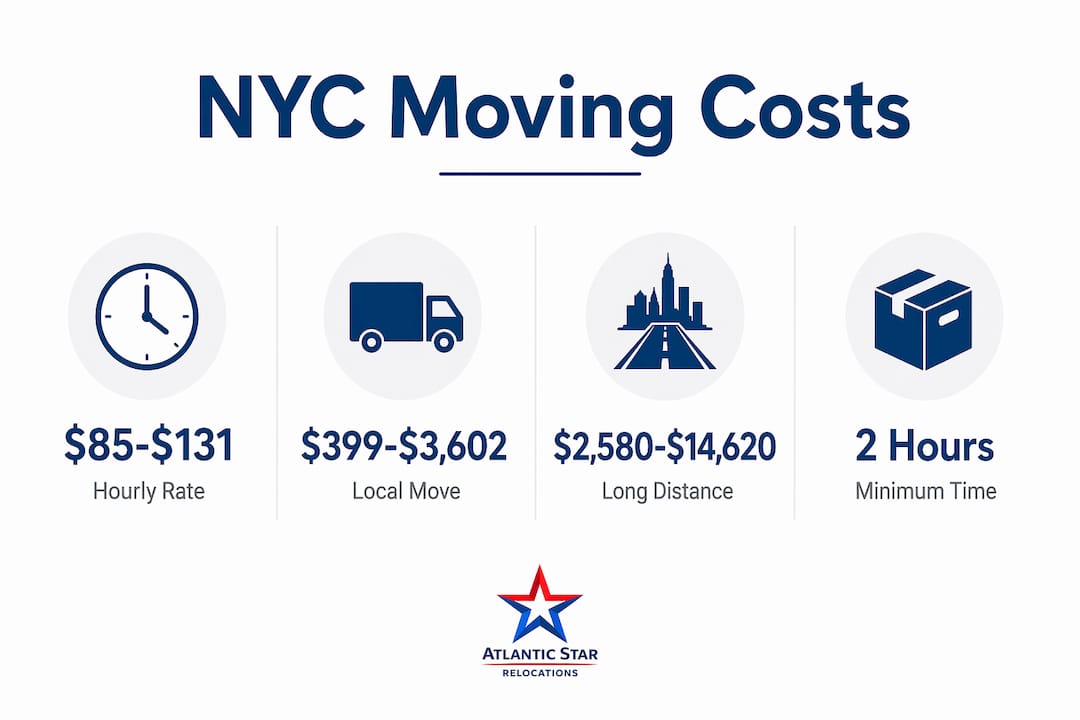
Local NYC movers charge hourly rates between $85 and $131 per mover in 2026, influenced by labor costs, fuel, and borough-specific logistics. That rate means a two-mover crew running at $110 per hour for five hours lands you around $1,100 before any surcharges. The industry term for this model is "time-and-materials pricing," and it is the standard for local moves under 100 miles.
Typical NYC local moves range from $399 for a studio to $3,602 for a five-plus bedroom home, with most jobs requiring two to five movers and three to ten hours of labor. A one-bedroom apartment in Brooklyn or Queens typically falls in the $700 to $1,200 range with a two-person crew. Atlanticstargroup uses structured pre-move assessments to give clients accurate estimates before any crew arrives.

Most companies also apply a two-hour minimum for labor plus travel time. Extra billable time for delays is common in NYC because of building access restrictions, elevator reservations, and loading dock schedules. Budget for at least one extra hour when moving in or out of a Manhattan high-rise or a walk-up in the Bronx.
What factors determine moving costs in NYC?
Several variables push your final bill up or down, and understanding them before you book saves real money.
- Move size: A studio requires two movers for three to four hours. A three-bedroom home in Westchester or Queens may need four movers for six to eight hours. Every additional room adds labor time and truck space.
- Local vs. long-distance pricing: Local moves price by the hour. Long-distance moves over 100 miles shift to weight-based or binding flat-rate estimates, which removes hourly uncertainty but requires accurate inventory.
- Seasonality: Moving costs can fluctuate up to 400% for the same inventory and distance based on timing. June through September is peak season in NYC, and rates reflect that demand directly.
- Building requirements: Manhattan co-ops, Brooklyn condos, and Westchester single-family homes each carry different access rules. Certificate of Insurance requirements, elevator reservations, and loading dock windows all affect scheduling and cost.
- Additional fees: Stair carries, long-carry charges, tolls, and parking costs are billed separately by most companies. These are not hidden fees if you ask about them upfront.
Pro Tip: Book your move for a Tuesday, Wednesday, or Thursday in October or November. You will pay significantly less than the same move on a Saturday in July, often 20 to 30 percent less for identical service.
How to estimate the cost of a local move in NYC
Calculating your local moving cost comes down to four inputs: crew size, estimated hours, hourly rate, and surcharges. Here is a practical step-by-step approach.
- Determine your crew size. Studios and one-bedrooms typically need two movers. Two-bedrooms need two to three. Three-bedrooms and larger need three to four movers minimum.
- Estimate your hours. Add one hour per room as a baseline, then add one hour for travel time and one hour for building access delays in NYC.
- Multiply by the hourly rate. Use $110 per hour as a reliable midpoint for 2026 NYC rates. Premium full-service companies like Atlanticstargroup may price higher but include oversight and accountability that budget crews do not.
- Add known surcharges. Stair fees, long-carry fees, and tolls are predictable if you describe your building accurately when requesting a quote.
Here is a sample cost table based on current NYC market data:
| Home size | Crew size | Est. hours | Estimated cost |
|---|---|---|---|
| Studio | 2 movers | 3–4 hrs | $399–$750 |
| 1 bedroom | 2 movers | 4–5 hrs | $700–$1,100 |
| 2 bedroom | 3 movers | 5–7 hrs | $1,200–$2,000 |
| 3 bedroom | 4 movers | 6–9 hrs | $2,000–$3,200 |
| 4+ bedroom | 4–5 movers | 8–10 hrs | $3,200–$4,500+ |
Pro Tip: Always request a written, itemized quote. Verbal estimates are not binding, and a detailed written quote protects you if the final bill looks different from what you discussed.
For apartment moves in NYC, confirm elevator reservation windows with your building management before scheduling. A missed elevator window can add one to two billable hours to your move.
What do long-distance moves from NYC cost?
Long-distance moves from NYC, defined as relocations over 100 miles, are priced differently from local jobs. The industry shifts from hourly labor to weight-based or binding flat-rate estimates, which means your final cost depends on how much you are shipping and how far it travels.
Long-distance moves from NYC typically cost between $2,580 and $14,620+, depending on distance and shipment volume. That is a wide range, and it reflects real market variation across service tiers and destinations.
| Route | Home size | Estimated cost range |
|---|---|---|
| NYC to Philadelphia | 1–2 bedroom | $1,200–$3,500 |
| NYC to Chicago | 2–3 bedroom | $3,500–$7,000 |
| NYC to Miami | 2–3 bedroom | $4,000–$8,500 |
| NYC to Los Angeles | 3–4 bedroom | $6,500–$14,000+ |
Moves to destinations like Miami, Los Angeles, and Chicago average between $2,800 and $11,500 for typical two to three bedroom shipments. Distance and shipment size are the primary cost drivers, but service level matters too. Full packing, crating for fragile items, and guaranteed delivery windows all add to the base rate. Atlanticstargroup manages interstate moves from New York with carrier-neutral coordination, meaning the company selects the right carrier for each route rather than locking clients into a single fleet.
For large or commercial shipments, LTL freight options can reduce cost on partial loads moving between New York and other major markets.
What are the common hidden fees in NYC moves?
NYC moving bills regularly include charges that were never mentioned in the original quote. Knowing them in advance is the only reliable defense.
- Stair fees: Most movers charge per flight of stairs above the first floor. Walk-ups in the East Village, Astoria, or Harlem can add $50 to $150 per flight to your total.
- Long-carry fees: If the truck cannot park within 75 feet of your building entrance, movers charge for the extra distance. This is common in Midtown Manhattan and parts of Brooklyn.
- Certificate of Insurance fees: Most NYC apartment buildings require a COI for building access. Reputable movers provide this at no charge. Budget movers sometimes add an administrative fee of $50 to $150. Always confirm COI policy before booking.
- Tolls and parking: Bridge and tunnel tolls between boroughs are typically passed through to the client. Parking tickets, while rare, may also appear on some invoices.
- Minimum time charges: Local moves carry a two-hour labor minimum plus travel time. Even a short move across the street will hit this floor.
Pro Tip: Ask every mover to send a written quote that lists every potential surcharge by name. If a company refuses to itemize, that tells you something important about how they handle billing disputes.
How to budget and plan effectively for your NYC move
Effective budgeting for a New York City move requires more than getting one quote and hoping for the best. Follow these steps to protect your budget from the start.
- Get at least three written estimates. Compare quotes from companies including Atlanticstargroup, and make sure each quote covers the same scope of work. Apples-to-apples comparison is only possible with itemized quotes.
- Decide between full-service and labor-only. Full-service moves include packing, loading, transport, and unpacking. Labor-only moving help covers loading and unloading only, which cuts cost significantly if you pack yourself.
- Set aside a contingency fund. Budget an additional 15 to 20 percent above your quoted price for unexpected fees, especially if you are moving during peak season or into a building with strict access rules.
- Consider storage if your timeline is flexible. Short-term storage in NYC can reduce pressure if your new apartment is not ready on move-in day, and it often costs less than rebooking a full moving crew.
- Use online cost calculators. Tools from moveBuddha and moveAdvisor give useful baseline estimates, but always follow up with a real quote from a licensed mover before committing to a budget.
Key takeaways
NYC moving costs are driven by crew size, hourly rate, move distance, and surcharges. Booking off-peak and getting itemized written quotes are the two most effective ways to control your final bill.
| Point | Details |
|---|---|
| Local move cost range | Studios start around $399; large homes can exceed $4,000 in NYC. |
| Hourly rate benchmark | Expect $85 to $131 per mover per hour for local NYC moves in 2026. |
| Long-distance pricing shift | Moves over 100 miles use weight-based or flat-rate pricing, not hourly. |
| Hidden fee awareness | Always confirm COI policy, stair fees, and long-carry charges in writing before booking. |
| Peak season impact | June through September pricing can be up to 400% higher than off-peak rates. |
What I've learned about NYC moving costs after years in this market
The single biggest mistake I see NYC movers make is treating the quoted price as the final price. It almost never is, especially for moves involving Manhattan high-rises, Brooklyn walk-ups, or any building that requires a COI and an elevator reservation window. The administrative friction in this city is real, and it costs time, which costs money.
The second thing I've noticed is that the cheapest quote rarely reflects the cheapest outcome. A company that quotes $800 for a two-bedroom but charges $50 per stair flight, bills for parking, and adds a COI fee will often land higher than a company that quoted $1,100 with everything included. The difference between flat-rate and hourly pricing matters enormously here. Flat-rate quotes protect you from billing creep. Hourly quotes reward efficiency but punish delays.
What I respect about how Atlanticstargroup approaches this is the emphasis on documentation before the move starts. Crew size, access requirements, surcharge policies, and COI handling are all confirmed in writing before anyone shows up at your door. That kind of structured oversight is not standard in this industry, and it is the reason clients rarely face surprise invoices.
— Admin
Plan your NYC move with Atlanticstargroup

Atlanticstargroup provides residential and commercial moving services across New York City, Westchester County, Manhattan, Brooklyn, Queens, the Bronx, New Jersey, Connecticut, and Florida. Whether you need full apartment moving services with packing and COI handling, or straightforward labor-only moving help to load and unload your rental truck, the team delivers transparent pricing and real accountability from start to finish. Every quote is itemized, every surcharge is disclosed upfront, and every move is managed with a single point of contact. Get a custom estimate for your move at atlanticstargroup.com and know exactly what your NYC relocation will cost before moving day.
FAQ
What is the average cost of movers in NYC?
The average cost of movers in NYC ranges from $399 for a studio to over $3,600 for a five-plus bedroom home, with hourly rates around $110 per mover in 2026. Final costs depend on crew size, hours worked, and any applicable surcharges.
How much should I tip NYC movers?
Tipping NYC movers typically runs $10 to $20 per mover per hour, or roughly 15 to 20 percent of the total bill for excellent service. Tipping is expected but not mandatory, and cash is preferred.
Why are NYC moving costs so much higher in summer?
NYC moving costs can fluctuate up to 400% for the same move based on timing alone. June through September is peak demand season, and most moving companies raise rates significantly during those months.
What is a Certificate of Insurance and why does it matter?
A Certificate of Insurance is a document that proves your moving company carries liability coverage, and most NYC buildings require it before granting access. Reputable movers provide it at no charge; budget movers sometimes add an administrative fee, so always confirm the policy before booking.
Is it cheaper to rent a truck than hire movers in NYC?
Renting a U-Haul starts around $20 per day plus mileage and gas, making it cheaper on paper than hiring a crew. However, the labor, time, and risk of damage to a NYC walk-up or elevator building often make professional movers the more cost-effective choice for most households.