

Picture this: moving day is finally here, the truck is unloaded, and you're exhausted. You reach for the light switch and nothing happens. The power isn't on. Your internet isn't connected. The water pressure is nonexistent. This scenario plays out more often than most people expect, and it's almost always preventable. Transferring utilities during a move requires deliberate planning, specific timing, and a solid checklist. This guide walks you through every step so you arrive at your new home with the lights on, the water running, and zero billing surprises waiting in your mailbox.
Table of Contents
- What you need before transferring utilities
- Step-by-step utility transfer process
- Common mistakes and troubleshooting tips
- Making sure nothing falls through the cracks
- What most moving guides miss about utility transfers
- Make your move seamless with professional support
- Frequently asked questions
Key Takeaways
| Point | Details |
|---|---|
| Plan ahead | Start utility transfers 1-2 weeks before moving for best timing. |
| Check responsibilities | Know which utilities are your responsibility to avoid service gaps or double billing. |
| Document everything | Take final meter readings and keep confirmations to protect yourself from billing errors. |
| Handle mail forwarding | Set up USPS forwarding so no final utility bills are missed. |
| Use a checklist | Track providers, account numbers, and transfer dates to ensure every service is covered. |
What you need before transferring utilities
Now that you see what's at stake, let's get organized with the essentials before you start making transfer calls.
Before you contact a single provider, you need to have your information ready. Calling a utility company without your account number, service address, or move dates wastes time and often leads to scheduling errors. Getting organized upfront takes about 30 minutes and saves hours of frustration later.
Here's the core information you'll need to gather:
- Full name and contact information as it appears on each account
- Account numbers for every current utility provider
- Your current service address and your new service address
- Confirmed move-out and move-in dates
- A copy of your lease or closing documents (for proof of residency)
- A government-issued ID (some providers require this for new accounts)
- Payment method for deposits or setup fees
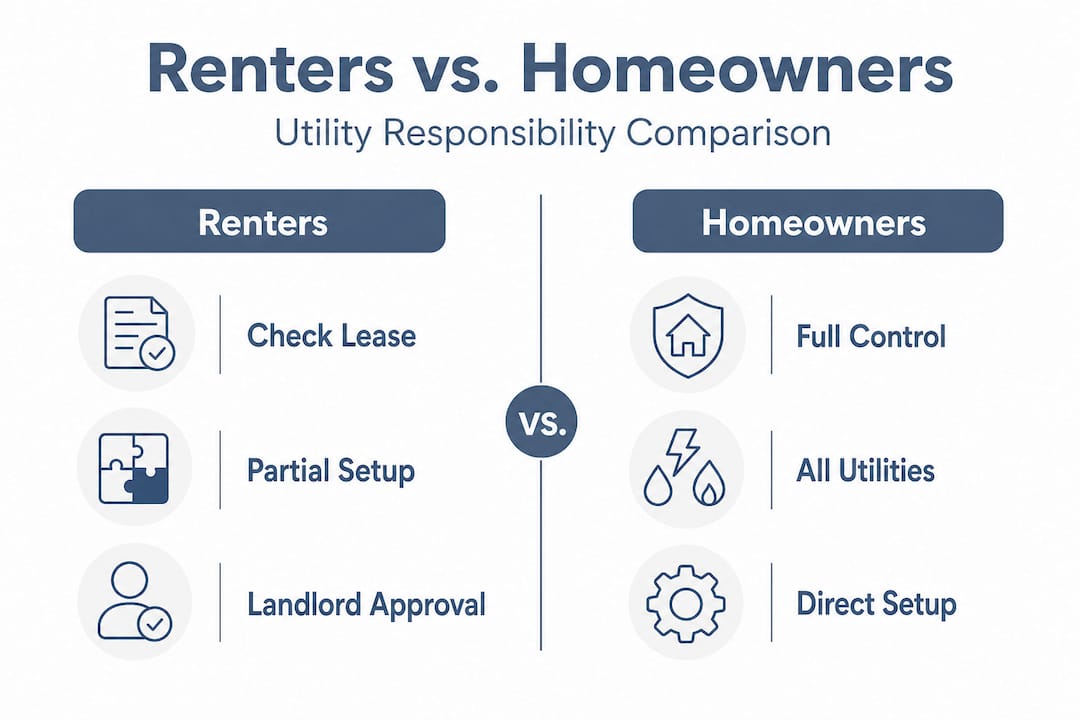
One of the most important things to clarify early is who is actually responsible for each utility. Renters typically need to transfer services in their own name unless the lease or landlord includes specific utilities, so you should confirm which are tenant-responsibility versus included before you start calling. Some apartments advertise "all-bills-paid" arrangements where water, trash, and sometimes even electricity are bundled into rent. If you're moving into one of those units, you may only need to set up internet and renter's insurance on your own.
For homeowners, the situation is more straightforward. You are responsible for every utility at your new address. However, if you're selling a home simultaneously, you also need to coordinate shutoff at the old address without leaving the next owner in the dark, literally.
| Utility type | Typical responsibility | Setup method | Lead time needed |
|---|---|---|---|
| Electricity | Tenant or owner | Call or online | 1 to 2 weeks |
| Gas | Tenant or owner | Call or online | 1 to 2 weeks |
| Water/sewer | Often landlord or municipality | Call municipality | 1 to 2 weeks |
| Internet/cable | Tenant | Call and schedule technician | 2 to 3 weeks |
| Trash/recycling | Varies by city or HOA | Call city or HOA | 1 week |
For electricity, gas, and water during a move, you may need deposits, a valid ID, and in-person verification depending on the provider. Internet and cable services are almost always appointment-based and can involve installation fees and delays if you schedule too late. Booking your internet technician early is one of the most overlooked steps in the entire process.
Pro Tip: Create a simple spreadsheet with one row per utility. Include columns for provider name, account number, phone number, shutoff date, activation date, and confirmation number. This single document will save you from scrambling when a billing dispute shows up six weeks after you move.
Also factor in your relocation logistics timeline when setting service dates. If your move spans multiple days or involves temporary storage, you may need utilities active at both addresses simultaneously for a short window.
Step-by-step utility transfer process
With everything gathered, it's time to put your plan into action. Start with this step-by-step approach.

The key to a smooth utility transfer is treating it as two parallel tasks happening at the same time: closing services at your old address and opening them at your new one. These don't happen automatically, and the timing between them matters more than most people realize.
Follow this sequence for the best results:
- Six to eight weeks before moving: Start researching providers at your new address. Not every company serves every area, so confirm which electricity, gas, and internet providers operate in your new zip code.
- Three to four weeks before moving: Contact your current providers and notify them of your move date. Ask whether they serve your new address. If they do, request a transfer of service. If they don't, initiate a cancellation and start a new account with the local provider.
- Two weeks before moving: Schedule internet and cable installation appointments. These require a technician visit and fill up fast, especially on weekends around popular moving dates.
- One week before moving: Confirm all activation dates for your new address. Verify that your old address shutoff dates are set correctly.
- Moving day: Take photos of all utility meters at both addresses. This creates a timestamped record of your final readings.
- One week after moving: Confirm all services are active and billing correctly. Check that your old address accounts show closed status.
To avoid a service gap, many checklists recommend scheduling your old-service shutoff for one day after move-out and your new-service start for one day before or around move-in. That single-day overlap costs a small amount but completely eliminates the risk of being without power or water during the transition.
There's also an important distinction between transferring a service and canceling and restarting one. If your current provider serves your new address, a transfer is simpler. Your account history often carries over, which can mean no new deposit is required. If you're switching providers, you're opening a brand-new account, which may require a credit check, a deposit ranging from $100 to $300 depending on the company, and a longer setup timeline.
| Situation | Process | Deposit likely? | Timeline |
|---|---|---|---|
| Same provider, new address | Transfer of service | Usually no | 3 to 5 business days |
| New provider, same utility type | New account setup | Possibly yes | 5 to 10 business days |
| Internet with technician visit | New appointment required | Setup fee possible | 1 to 3 weeks |
| Municipal water | Contact city directly | Rarely | 3 to 7 business days |
Scheduling shutoffs on weekends or holidays increases the chance of reconnection delays significantly. If something goes wrong with a weekend shutoff, you may not reach a live representative until Monday. Whenever possible, schedule all utility changes on business days and align them closely with your actual possession date.
Pro Tip: When scheduling utility changes, ask each provider to send a written confirmation to your email. A verbal confirmation over the phone is not enough if a billing dispute comes up later.
Common mistakes and troubleshooting tips
Even with a strong plan, slip-ups happen. Here are the pitfalls to watch out for and how to fix them.
The most common utility transfer mistake is simply forgetting to document everything. People call, get a confirmation number verbally, and then lose track of it. Weeks later, they receive a final bill for a month of service they didn't use, and they have no proof of when the account was closed.
Watch out for these frequent errors:
- Forgetting to take final meter readings at the old address before leaving
- Failing to get written confirmation of shutoff and activation dates
- Scheduling transfers on holidays or weekends when support is limited
- Overlooking secondary utilities like trash pickup, sewer fees, HOA utilities, or municipal services
- Leaving utilities in your name at the old address longer than necessary
- Assuming your landlord will handle something that is actually your responsibility
"Keep proof and confirmations for shutoff and transfer, and take final meter readings when appropriate, to reduce the risk of incorrect final bills after you move." This advice from Redfin's shutoff guidance reflects what experienced movers learn the hard way.
The secondary utilities category is where people get surprised most often. Trash collection, recycling pickup, stormwater fees, and HOA utilities don't always appear on your radar when you're focused on electricity and internet. Some municipalities automatically bill the property owner, while others require a separate account in the resident's name. Call your new city's public works department and your HOA (if applicable) to confirm what's required.
Another common issue is failing to update your billing address with each provider before you move. If your final bill goes to your old address and you haven't set up mail forwarding, you may miss a payment and damage your credit without realizing it.
Pro Tip: Take a short video walkthrough of your old home on your last day there, including close-up footage of each utility meter. This is timestamped evidence that protects you if a provider claims usage after your move-out date.
Making sure nothing falls through the cracks
You're almost done. Here's how to tie up all the loose ends and protect yourself from last-minute surprises.
The final phase of utility management is about verification and follow-through. Most problems that show up after a move, like unexpected charges or service lapses, happen because someone assumed a task was complete without confirming it.
Final closure checklist:
- Confirm in writing that each old-address account is closed
- Verify the exact shutoff date on your final bill matches what you requested
- Check that all new-address accounts are active and billing correctly
- Set up mail forwarding through USPS to catch any stray correspondence
- Update your billing address directly with each provider, not just through mail forwarding
- File away all confirmation numbers and account closure notices for at least 12 months
Setting up USPS mail forwarding ensures you receive final utility bills and other critical documents during the transition period. Mail forwarding typically lasts 12 months for first-class mail, which gives you a full billing cycle buffer to catch anything that slips through.
The most effective approach is to treat utility transfer as two parallel tracks: one track for shutting down and closing everything at the old address, and a second track for starting and activating everything at the new address. Keep a master list with provider names, account numbers, start or end dates, and confirmation numbers for both tracks.
| Utility | Old address status | New address status | Confirmation received |
|---|---|---|---|
| Electricity | Closed on move-out date | Active from move-in date | Yes/No |
| Gas | Closed on move-out date | Active from move-in date | Yes/No |
| Water | Closed or transferred | Active from move-in date | Yes/No |
| Internet | Canceled after last day | Active from installation date | Yes/No |
| Trash/recycling | Removed from account | Added to new account | Yes/No |
| HOA utilities | Notified of move-out | Enrolled at new address | Yes/No |
Keeping this table updated throughout your move gives you a clear, at-a-glance status of every service. It takes five minutes to maintain and can prevent hours of phone calls after the fact.
What most moving guides miss about utility transfers
Most moving checklists treat utility transfers as a simple to-do item: call your providers, set your dates, done. In our experience coordinating hundreds of residential relocations, the reality is messier than that. The real problems almost never come from the big utilities. They come from the ones nobody thinks about.
HOA utility accounts, stormwater fees, and municipal trash services are the ones that generate surprise bills three months after a move. These services often don't send reminders. They bill quarterly, sometimes annually, and they don't always update their records automatically when a property changes hands or a tenant moves out.
The second thing most guides miss is the emotional side of utility management. Moving is exhausting. By the time you're dealing with confirmation calls and meter readings, your attention is stretched thin. That's precisely when administrative errors happen. The solution isn't to be more disciplined. It's to build a system that requires less mental energy to maintain. A simple spreadsheet or even a notes app with provider names and confirmation numbers does more good than any amount of good intentions.
We've also seen clients lose money because they didn't confirm that a transfer actually processed. A provider says "we've got it handled" on the phone, but the account never closes. Six weeks later, the client is being billed at two addresses. Getting written confirmation for every action, every time, is the one habit that prevents almost every post-move billing problem.
Managing relocation logistics well means treating utility transfers with the same structured attention you give to scheduling movers and packing fragile items. It's not glamorous, but it's the difference between a smooth arrival and a frustrating first week in your new home.
Make your move seamless with professional support
Coordinating a move while juggling utility transfers, lease deadlines, and packing timelines is a lot to manage on your own. That's exactly where a professional relocation partner makes a measurable difference.

At Atlantic Star Relocations, we specialize in managing every detail of your move so nothing gets missed. From aligning your utility activation dates with your move-in schedule to coordinating logistics across multiple locations, our team acts as your single point of accountability throughout the process. Whether you're moving across town or across the country, our expert relocation management approach ensures you arrive at your new home with everything in order. Reach out to Atlantic Star Relocations today and find out how a managed move changes the entire experience.
Frequently asked questions
How far in advance should I begin transferring my utilities?
Start contacting providers at least two weeks before your move to secure preferred dates and avoid delays. Late scheduling can cause service interruptions or added connection fees, especially for internet and cable services that require technician appointments.
Do all utilities transfer automatically when I move?
No, most require you to call each provider directly. If your provider doesn't serve the new address, you'll need to set up a new account with a local provider and may face deposits or fees.
Why is it important to document final meter readings?
Documenting readings prevents billing disputes and helps verify the correct shutoff date. Taking final meter readings is one of the simplest ways to protect yourself from being charged for usage after you've moved out.
Is mail forwarding necessary for utility transfers?
Yes, mail forwarding ensures you receive final bills and important correspondence after you move. USPS change-of-address supports receiving final utility bills and documents during the transition, acting as a safety net for anything that slips through.
What should renters check in their lease before transferring utilities?
Review your lease to confirm which utilities are tenant-responsibility versus included in rent. Responsibility can vary significantly by lease agreement, and missing a required transfer or paying for an included utility are both common and avoidable mistakes.